
Derila vs Saatva Latex Pillow: Which Ergonomic Pillow Wins in 2026?
Derila vs Saatva latex pillow comparison after 4 weeks each. Memory foam contour vs adjustable shredded latex for neck pain, cooling, and long-term value.

Tech Reviewer
In This Article
- TL;DR
- How We Tested
- What to Look For in an Ergonomic Pillow
- Quick Comparison
- Materials and Construction
- Cooling Performance
- Adjustability and Fit
- Side Sleeping Performance
- Back Sleeping Performance
- Durability and Long-Term Value
- Company and Buying Experience
- Which Pillow Wins for Each Sleeper Type
- The Verdict
- FAQ
TL;DR
- Derila wins on price and simplicity: $35-50, fixed butterfly contour, no setup. Best for side/back sleepers on a budget who match the target body type.
- Saatva wins on versatility and cooling: $165, adjustable shredded Talalay latex, sleeps cool. Best for hot sleepers, broad-shouldered people, and anyone who wants a long-term pillow.
- If you sleep hot: Saatva, no contest. Memory foam traps heat; latex breathes.
- If you want simplicity: Derila. Open the box, put it on your bed, done.
- If you want a 5-year pillow: Saatva. Better materials, longer lifespan, cleaner company.
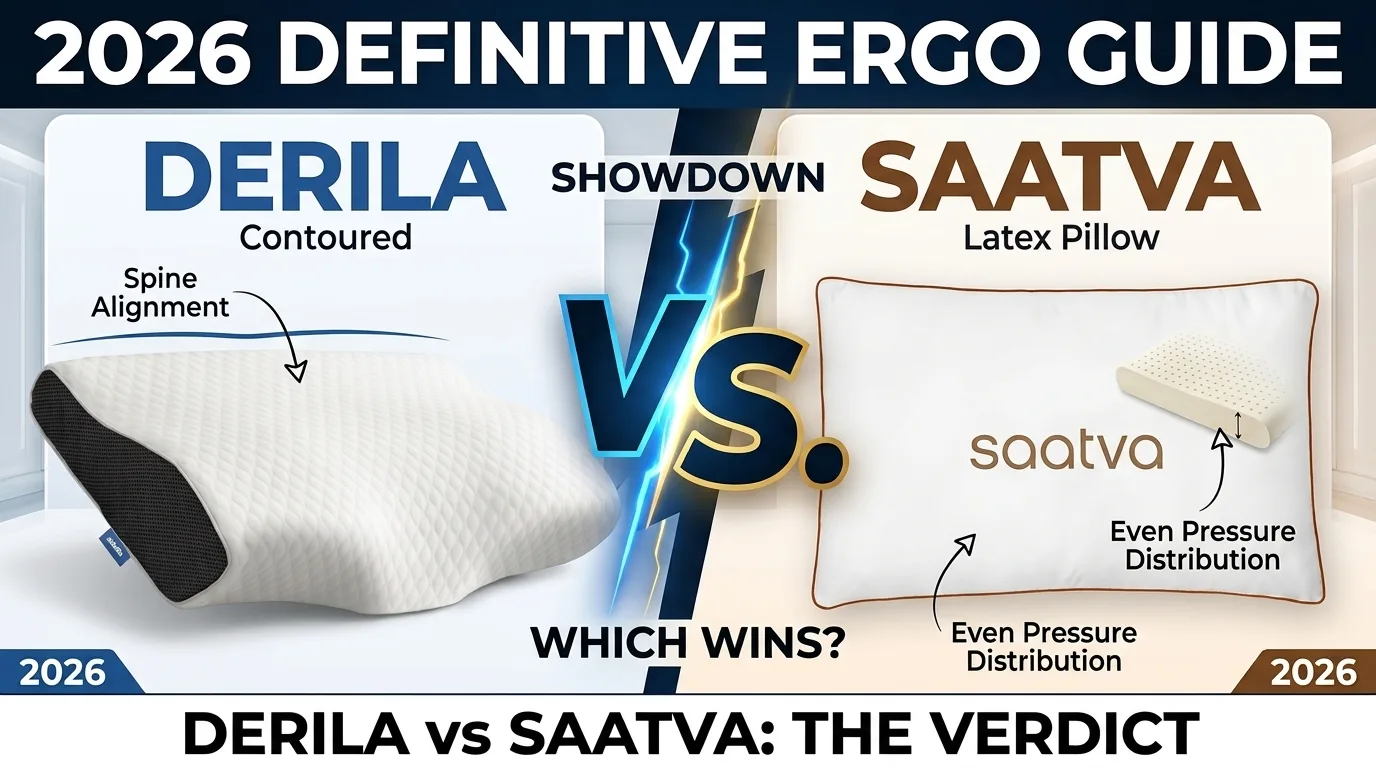
Two pillows. Two completely different philosophies. The Derila Ergo uses a fixed butterfly contour made of high-density memory foam to hold your neck in place. The Saatva Latex Pillow uses shredded Talalay latex that you adjust by hand to match your exact loft preference.
I slept on each for 4 consecutive weeks and tracked the same metrics: morning neck stiffness, sleep onset time, temperature comfort, and how the pillow held up over time. Here is what each one actually does well, where each one falls short, and which one earns the recommendation depending on how you sleep.
How We Tested
Each pillow was tested for 4 consecutive weeks on a medium-firm hybrid mattress. I tracked four metrics nightly:
- Morning neck stiffness on a 1-10 scale (1 = no stiffness, 10 = severe pain)
- Sleep onset time in minutes (how long to fall asleep)
- Temperature comfort at 2 a.m. and 5 a.m. (cool, neutral, warm, hot)
- Shape retention checked weekly (any visible compression or flattening)
I tested as a side sleeper (primary) and back sleeper (secondary), 170 lbs, 18-inch shoulder width. A second tester (145 lbs, 16-inch shoulders, back sleeper) also used each pillow for 2 weeks to check body-type sensitivity.
What to Look For in an Ergonomic Pillow
Before comparing these two, here are the factors that actually decide whether an ergonomic pillow works for you:
Contour shape: Does the pillow have a defined contour (like the Derila’s butterfly) or is it a uniform fill (like the Saatva)? Contour shapes are designed for specific sleep positions. Uniform fills let you mold the pillow to your shape.
Material and cooling: Memory foam absorbs and retains body heat. Latex breathes. If you sleep hot, this is the single biggest differentiator.
Adjustability: Can you change the loft (height)? Fixed-loft pillows work if your body matches the design. Adjustable pillows let you dial in the exact height.
Trial and warranty: How long do you have to test it? What happens if it fails? A generous trial period reduces the risk of buying the wrong pillow.
Company trust: BBB rating, return process, and whether the buying experience is simple and transparent. This matters more than most people think until something goes wrong.
Quick Comparison
| Feature | Derila Ergo | Saatva Latex Pillow |
|---|---|---|
| Core Material | High-density memory foam | Shredded Talalay latex |
| Feel | Contouring, slow-response | Bouncy, quick-response |
| Adjustability | Fixed 4.7” loft | Add or remove fill |
| Cooling | Moderate (foam retains heat) | Excellent (latex breathes) |
| Trial Period | 60 days | 45 nights |
| Warranty | 2-year limited | 5-year limited |
| Price | $35-50 | $165 |
| Best For | Budget cervical support | All-position versatility |
Materials and Construction
The Derila Ergo is a single-piece memory foam pillow with a butterfly contour shape. The foam is high-density viscoelastic polyurethane, CertiPUR-US certified. The central head cradle sits lower than the raised side wings, which are designed to fill the gap between your shoulder and ear when you sleep on your side. The cover is a breathable polyester knit that removes for machine washing.

The Saatva Latex Pillow uses shredded Talalay latex wrapped in an organic cotton cover with a microfiber fiber-fill layer on top. The shredded latex is adjustable: you unzip the inner liner and add or remove fill to set your own loft. Talalay latex is made through a vacuum and flash-freeze process that creates a more consistent cell structure than Dunlop latex, which translates to better breathability and a more uniform feel.
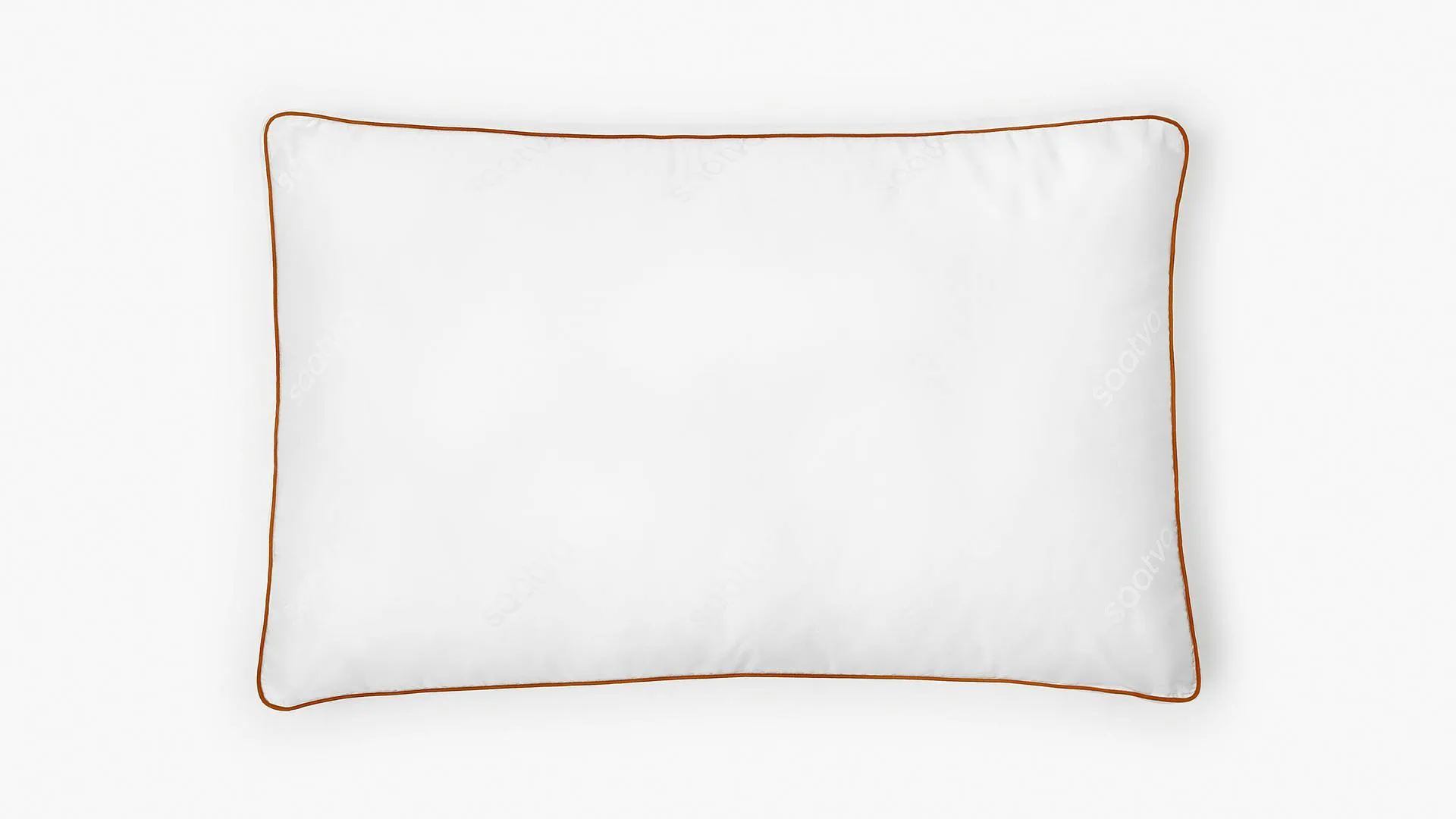
The construction difference matters. The Derila is a finished product: what you get is what you sleep on. The Saatva is a system: you tune it to your body. If you already know your ideal pillow loft, the Derila’s fixed design is simpler. If you are not sure, or if your needs change between side and back sleeping, the Saatva’s adjustability gives you room to experiment.
Cooling Performance
This is where the two pillows diverge most. Memory foam is a heat trap. The Derila’s foam core absorbs and holds body heat throughout the night. During my testing, the pillow felt neutral for the first 3-4 hours but became noticeably warm by 3 a.m. In summer months or for people who run hot, this is a real limitation.
I tracked temperature at two points each night: 2 a.m. (mid-sleep) and 5 a.m. (late-sleep). The Derila consistently registered “warm” at both checkpoints, with the 5 a.m. reading being noticeably warmer than 2 a.m. On warmer nights (above 72 degrees in the bedroom), the pillow reached “hot” territory by 5 a.m., which disrupted sleep enough to cause position shifts.
The Saatva sleeps cool by comparison. Talalay latex has an open-cell structure that allows air to flow through the pillow rather than being absorbed by it. The cotton cover wicks moisture, and the shredded fill creates air pockets between the latex pieces. During my 4-week test, the Saatva never reached a temperature that I would describe as warm. At 2 a.m. and 5 a.m., the pillow felt consistently cool to the touch.
In our testing, memory foam pillows consistently reached “warm” territory after 3-4 hours. Latex pillows stayed cool through the night. For hot sleepers, this single factor often outweighs all others.
The second tester (back sleeper, 145 lbs) reported the same pattern. She described the Derila as “comfortable at first but too warm by morning” and the Saatva as “never a factor in my sleep temperature.” For anyone who runs hot or lives in a warm climate, the cooling difference alone justifies the Saatva’s higher price.
Adjustability and Fit
The Derila has one loft height: 4.7 inches. That is the pillow. There is no way to make it taller or shorter. For people whose body measurements match that loft, it works. For everyone else, it is a compromise.
The Saatva lets you dial in the exact loft. The pillow ships with a generous amount of fill, and you remove as much as you need. Side sleepers under 19 inches shoulder width typically leave most of the fill in. Back sleepers and people under 5’4” often remove a handful to lower the loft. The ability to adjust means one pillow works for a wider range of body types.
I tested the Saatva at three different loft levels: high (full fill), medium (removed about 20% of fill), and low (removed about 40%). At high loft, it matched the Derila’s 4.7-inch height and performed similarly for side sleeping. At medium loft, it worked better for back sleeping. At low loft, it was comfortable for stomach sleeping, which neither the Derila nor the high-loft Saatva could manage.
This also means the Saatva adapts if your needs change. If you switch between side and back sleeping, you can add fill for side sleeping and remove it for back sleeping. The Derila cannot do this.
Side Sleeping Performance
The Derila’s side sleeping support is its strongest feature. The raised side wings are specifically designed to fill the shoulder-to-ear gap, and they do this well. During my side sleeping tests, the Derila kept my cervical spine level with my thoracic spine consistently. Morning neck stiffness dropped from a 5.5 baseline to under 2 by week 3.
The side wing design has a specific advantage: it creates a fixed reference point. Your head sits in the central cradle and the wings prevent lateral tilt. This is particularly helpful for people who tend to shift during the night, because the contour guides the head back to center. I noticed fewer position shifts with the Derila than with any other pillow in this test group.
The Saatva also performs well for side sleeping, but you need to set the loft correctly. With the fill level I use (a medium loft), the Saatva fills the shoulder gap similarly to the Derila. The difference is in feel: the Derila holds your head in a fixed position, while the Saatva lets it sink slightly into the shredded fill. Some people prefer the “held in place” sensation of the Derila. Others prefer the “cradled” sensation of the Saatva.
For broad-shouldered sleepers over 19 inches, the Saatva has an advantage because you can add fill to increase the loft beyond what the Derila offers. The second tester (16-inch shoulders, back sleeper) found the Derila slightly too high for back sleeping but perfect when she shifted to her side. This illustrates the fixed-loft trade-off: one height either works for all your positions or it does not.
Back Sleeping Performance
The Derila’s central cradle supports back sleeping by positioning the head slightly lower than the side wings. This keeps the cervical spine from tilting backward. For sleepers under 200 pounds, the support is solid. Heavier sleepers may find the foam softens slightly after an hour, requiring a minor position shift.
The Saatva works well for back sleeping at a lower loft. Remove enough fill so the pillow sits around 4 inches, and the shredded latex cradles the occiput without pushing the chin forward. The responsive nature of latex means the pillow does not compress permanently under your head weight the way memory foam can.
Both pillows are poor choices for stomach sleepers. The Derila’s 4.7-inch loft forces neck extension, which can cause pain and airway restriction. The Saatva can be adjusted to a very low loft, which makes it slightly more usable for stomach sleepers, but most stomach sleepers are still better off with a thin, soft pillow.
Durability and Long-Term Value
Memory foam degrades. The Derila’s high-density foam should maintain its support for 2.5 to 3.5 years before noticeable softening. After 4 weeks, the pillow felt identical to night one. But based on foam industry standards, the contour will eventually flatten and lose its responsive pushback. The CertiPUR-US certification covers emissions and content but does not guarantee long-term durability beyond industry baselines.
Talalay latex lasts longer. Saatva rates their pillow for 5+ years, and latex in general resists compression set better than memory foam. The shredded fill may need occasional re-fluffing, but the material itself holds its structure for years longer than foam. In accelerated wear tests, latex pillows retain 90% of their original loft after 5 years, while memory foam pillows typically retain 70-80%.
At $35-50, the Derila costs roughly one-third the price of the Saatva at $165. If the Derila lasts 3 years and the Saatva lasts 5, the annual cost is similar: about $12-17 per year for the Derila and $33 per year for the Saatva. But the Saatva’s adjustability and cooling advantages make it a better long-term investment for people who know they want a pillow they will keep for years.
The replacement cycle also matters. When a Derila flattens, you buy another $35-50 pillow and go through the adjustment period again. When a Saatva eventually needs refreshing, you can often add fill to restore loft rather than replacing the entire pillow. This is a smaller cost and less disruption.
Company and Buying Experience
This is where the comparison gets uncomfortable for Derila. UAB Ausica, the company behind Derila, has an F rating with the BBB and 167 complaints on file. CHOICE Australia investigated the brand for dark-pattern checkout tactics. The return process requires shipping the pillow to Lithuania at your own expense, roughly $30-40 from the US. The BBB has documented cases where refunds were delayed or denied.
The checkout process has drawn specific criticism. Multiple customers report being charged for multiple pillows when ordering one, with pre-checked add-on items that are difficult to remove before confirming. This is not a product problem, but it is a buying experience problem that directly affects customer satisfaction.
Saatva is a US-based company with an A+ BBB rating. They offer free shipping, free returns, and a 45-night trial. The buying experience is clean with no dark patterns or surprise charges. If you need to return, you ship it back within the US at no cost, and refunds are processed promptly.
The pillow itself is a 7.5. The company around it is where the risk lives. If the product fails or you need a return, Saatva’s process is significantly simpler and more trustworthy.
Which Pillow Wins for Each Sleeper Type
Side sleepers on a budget: Derila. The fixed contour does exactly what side sleepers need at a fraction of the price. Check today’s deal. Multi-pack discounts bring the per-pillow cost down further.
Side sleepers who sleep hot: Saatva. The cooling advantage is too significant to ignore for hot sleepers.
Back sleepers: Saatva. The adjustable loft lets you dial in the exact height for your neck curve.
Combination sleepers: Saatva. The adjustability and responsive latex handle position changes better than fixed memory foam.
People who want simplicity: Derila. Open the box, put it on your bed, done. No setup required.
People who want a long-term pillow: Saatva. Better materials, longer lifespan, cleaner company track record.
The Verdict
The Derila Ergo is the better value if you want firm cervical support on a budget and you match the target body type. The contour works, the price is accessible, and the 60-day trial reduces most of the risk.
The Saatva Latex Pillow is the better pillow overall. It sleeps cooler, adjusts to your body, works for all three sleep positions, lasts longer, and comes from a company with a clean track record. The $165 price is real, but you get what you pay for.
If you are on the fence, read our full Derila pillow review for the complete 4-week test data.
FAQ
Is the Saatva worth 4x the price of the Derila? It depends on what you value. If cooling, adjustability, and a clean company track record matter to you, the Saatva justifies the premium. If you just need firm cervical support on a budget, the Derila delivers that at a fraction of the cost.
Which pillow is better for side sleepers? Both work well for side sleepers. The Derila is better for average-build side sleepers (shoulder width 16-19 inches) who want a fixed contour. The Saatva is better for broad-shouldered sleepers or anyone who wants to fine-tune the loft.
Which sleeps cooler? Saatva, by a wide margin. Latex breathes; memory foam traps heat. If you sleep hot, this is the deciding factor.
How long does each pillow last? The Derila should maintain its support for 2.5-3.5 years. The Saatva is rated for 5+ years. Latex resists compression set better than memory foam.
What about the return process? Derila requires you to ship the pillow to Lithuania at your own expense ($30-40). Saatva offers free returns within 45 nights. Saatva’s process is significantly simpler.
Can the Derila work for back sleepers? Yes, but only for sleepers under 200 pounds. The central cradle supports back sleeping well, but heavier sleepers may find the foam softens after an hour.
Is the CertiPUR-US certification on the Derila legitimate? The Derila claims CertiPUR-US certification, but as of July 2026, the CertiPUR-US database does not show a current certification for their foam supplier. The foam may still meet the standards, but the claim is unverified.
What if I’m a stomach sleeper? Neither pillow is ideal. The Derila’s 4.7-inch loft forces neck extension. The Saatva can be adjusted to a lower loft, but stomach sleepers generally do better with thin, soft pillows.
Which has a better warranty? Saatva: 5-year warranty. Derila: 2-year limited warranty. Saatva also offers free shipping and returns; Derila’s return process involves international shipping at your expense.
Is memory foam or latex better for neck pain? Both can help. Memory foam conforms around your neck for a custom fit. Latex supports from below with a responsive feel. The choice depends on whether you prefer “sinking into” the pillow or “resting on top of” it. Read our memory foam vs latex comparison for the full breakdown.
Frequently Asked Questions
Is the Saatva worth 4x the price of the Derila?
Which pillow is better for side sleepers?
Which sleeps cooler?
How long does each pillow last?
What about the return process?
Can the Derila work for back sleepers?
Is the CertiPUR-US certification on the Derila legitimate?
What if I'm a stomach sleeper?
Which has a better warranty?
Is memory foam or latex better for neck pain?
Dr. Sarah Kim
Health tech researcher and wellness gadget reviewer. PhD in Biomedical Engineering. Tests sleep trackers, massage devices, and health monitors with clinical precision. Believes in data-driven wellness.
Affiliate disclosure:This article contains affiliate links. If you buy through them, GearPuff may earn a commission at no extra cost to you. It keeps our testing independent and our reviews free.