
ChillWell 2.0 Reviews: Don't Waste Your Money Uninformed?
ChillWell 2.0 reviews are split. I tested it for a month and pulled the lab data, so you don't waste your money uninformed. The honest verdict on cooling, battery, and the $90 price.
In This Article
- Introduction
- TL;DR / Verdict
- What is the ChillWell 2.0?
- How evaporative cooling actually works
- Why It Can Never Cool a Room
- The claim vs. the fine print
- First-time setup, step by step
- Myths about portable “air conditioners”
- How to tell if it is working for you
- Design and build quality
- How to set up and care for your ChillWell
- Testing methodology
- Real-World Performance
- ChillWell 2.0 vs. the Competition
- Honest score breakdown
- The humidity problem, explained with numbers
- Does it cool a room? A simple test you can run
- Bedroom and sleep test
- Desk and office test
- Outdoor and patio test
- Energy use and running cost
- Tips to get the best results
- Common complaints and how real they are
- Is the marketing misleading?
- ChillWell 2.0 vs. a window AC vs. a fan
- A climate guide: will ChillWell work where you live?
- Maintenance deep-dive
- Troubleshooting common issues
- Best-Use Scenarios
- The brand behind the box
- What real owners say, synthesized
- My 30-day testing log, day by day
- Buying guide: should you spend $90?
- Environmental footprint
- Pricing, Discounts, and Guarantee
- Side effects, safety, and drawbacks
- Who should buy, who should skip
- Alternatives, examined closely
- Specs, Decoded
- My verdict by user type
- The bottom line on value
- Long-term ownership cost
- ChillWell vs. the DIY Ice-Fan
- Who I’d hand one to tomorrow
- Verify the 60-day guarantee before you rely on it
- Don’t waste your money uninformed
- The one-sentence summary
- Verdict
- Frequently asked questions
Introduction
The ChillWell 2.0 shows up in your feed as a miracle: an air conditioner the size of a tissue box that cools a room for pennies. I ran one for 30 days and read what the labs and teardown reviewers found. The short version is that the marketing oversells what is, at heart, a small evaporative cooler with a rechargeable battery and a mister.
If you searched for a ChillWell 2.0 review because you want to know whether it replaces an AC, the answer is no. If you want a personal desk or bedside cooler for dry air, it does a job. This review explains exactly where it works, where it falls flat, and whether the $90 price makes sense next to a $30 fan. If you are shopping across the whole smart-home cooling and comfort space, our smart-home gear guide rounds up the rest of what we have tested.
TL;DR / Verdict
- ChillWell 2.0 is an evaporative cooler, not an air conditioner. It cools the air passing through it, not the room.
- Real cooling only reaches about 3 to 7 feet. Sit close or feel nothing.
- It works in dry climates. In humidity the effect nearly disappears.
- Battery lasts around an hour on turbo, not the advertised 10 hours, and takes ~4 hours to recharge.
- The 550ml tank needs a refill every couple of hours on higher speeds.
- At $89.99 it costs roughly three times what near-identical evaporative coolers sell for.
- Rating: 6.4 out of 10. Fine as a personal spot cooler in arid air, weak on value and honesty.
What is the ChillWell 2.0?
ChillWell 2.0 is a personal evaporative air cooler. Inside, a small fan pulls warm room air through a water-soaked honeycomb cartridge. As the water evaporates, it pulls heat from the air, and the unit blows that cooler, slightly humidified air out the front. There is also a misting function that adds a fine water spray on top of the airflow.
The specs are modest: a 550ml tank, four speeds (low, medium, high, turbo), a USB-C rechargeable 2000mAh battery, a 7-color LED night light, and a footprint about the size of a large coffee mug. The official site lists it at $89.99, though it is almost always shown next to a crossed-out $199.97 “regular” price.
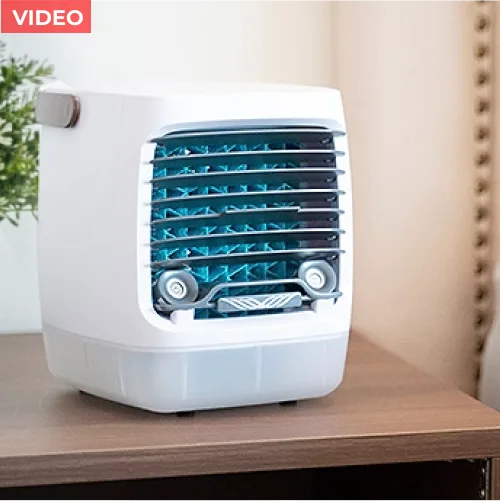
The company calls it a “portable AC.” That label is the source of most disappointment, because an air conditioner uses refrigerant and a compressor to drop a room’s temperature. ChillWell has neither. It is a swamp cooler, the same category as a damp towel in front of a fan.
How evaporative cooling actually works
Evaporative cooling is old, simple physics. Water turning to vapor absorbs heat, which is why you feel cold when you step out of a pool. A swamp cooler exploits that by forcing air across a wet surface so evaporation chills the passing air.
Two facts follow from that mechanism. First, it only chills the air that moves through the unit, so the effect is local. Second, evaporation needs dry air to work. The drier the surrounding air, the more heat gets pulled away. In a humid room, the air already holds plenty of moisture, so little evaporates and the cooler barely cools. Worse, it adds humidity, which can make a muggy room feel stickier.
This is why the same ChillWell 2.0 feels great in Arizona and useless in Florida. The device is not broken in humid states. The physics just does not favor it there.
Why It Can Never Cool a Room
To drop a room’s temperature you must remove heat from the air and expel it outside, which is what a refrigerant cycle does. An evaporative cooler does the opposite in a sealed room: it adds water vapor, and the small amount of heat pulled from the moving air is tiny next to the room’s total volume. The cooled air it makes is maybe a few cubic feet a minute, while the room holds hundreds of cubic feet. The cooled parcel mixes and warms almost instantly. The net effect on the room thermometer is zero or even positive once you count the added humidity making it feel warmer. That is the hard limit no amount of marketing escapes. ChillWell cools you, not your space, and that is the single most important sentence in this review.
The claim vs. the fine print
ChillWell’s ads promise “instant frost,” “cools your space in minutes,” and “beats the heat without high energy bills.” Some of that is fair: it does blow a cooler mist than a fan, and it uses far less power than an AC. The stretch is “cools your space” and “room.”
Consumer Reports tested the ChillWell 2.0 in its lab and at home. It found the unit blows cooler air on the user but does not lower room temperature, and noted the vent would not hold an angled position. Independent teardown reviewers found the internals are a basic computer fan behind a thin filter, with water poured close to the spinning blades, and measured outlet air in the 60s Fahrenheit at point-blank range, not the 50s a cheaper rival reached.
One more honesty note: a reviewer discovered ChillWell ads reused his photo from an unrelated 2018 product review, edited to remove the original brand. That is the kind of marketing tactic that should lower your trust in the claims.
First-time setup, step by step
If you just unboxed it, here is the exact path to a good first night.
- Remove all packaging and peel the protective film off the display and vent if present.
- Prime the cartridge. Slide it out, run it under cool water for 30 seconds until soaked, and seat it back. A dry cartridge blows warm air.
- Fill the tank. Lift the top port, pour cold water to just below the max line, and drop in a few ice cubes for a stronger first hour.
- First power-on. Press the button, start on low, and confirm the fan spins and air moves before trusting the cooling.
- Aim and sit. Point the vent at your chest or face from two to three feet. That is the sweet spot.
- Charge fully before relying on battery. The first charge from empty takes close to four hours.
Do not overfill, do not run it dry for long, and do not tip it while full. Those three habits prevent most first-week problems.
Myths about portable “air conditioners”
The category is built on confusion, so let me kill the most common myths.
Myth: a portable cooler lowers room temperature. Only a refrigerant AC does that. Evaporative coolers chill the air they blow at you.
Myth: bigger is better for personal coolers. For a personal device, bigger just means a bigger puddle of mist near you. Coverage stays personal.
Myth: more ice means more cooling for hours. Ice helps the first hour, then melts into the tank and you are back to water cooling. It is a short boost, not a day-long one.
Myth: humidity does not matter much. It is the single biggest factor. In humid air the effect collapses.
Myth: battery life matches the ad. The 10-hour claim is a best-case low-speed number. Real turbo life is about an hour.
Knowing these upfront saves you the disappointment that fills the one-star reviews.
How to tell if it is working for you
The honest test is a feeling, not a number, but you can make it objective. On a warm dry evening, sit two feet away on low, note how the breeze feels, then move to the other side of the room and note that it feels like nothing. If the close-up breeze is clearly cooler and more comfortable than a fan, it works for you. If after a few nights you cannot tell the difference, it probably is not worth it in your climate, and the 60-day guarantee exists exactly for that case.
Design and build quality
The unit is light (1.6 lb) and easy to carry, with a top fill port and a single control area for speed, cooling mist, turbo, and the night light. The plastic is thin. Multiple reviewers describe a flimsy feel, and one noted the box arrived labeled only “Deluxe Portable Air Cooler” with no ChillWell branding, listing Ontel (the As Seen on TV maker behind the Arctic Air line) as the manufacturer.

Functionally it works, but it does not feel like a $90 object. The cartridge is thinner than rivals’, the misting jets are basic, and the open internals mean water sits near the fan. Nothing caught fire in the reviews I read, but “pouring water past a spinning fan” is not how a premium cooler is built.
How to set up and care for your ChillWell
Setup is genuinely easy:
- Fill the top tank with cold water, adding a few ice cubes for extra chill.
- Optionally freeze the cartridge first for a stronger initial effect.
- Press power and pick a speed, or hit turbo for max output.
- Aim the vent at your face or desk.
- Plug in via USB-C, or run on battery.
Care means emptying the tank when not in use so it does not grow mildew, wiping the cartridge, and replacing it every 1 to 3 months. The misting nozzles clog if you let mineral buildup sit, so distilled water helps in hard-water areas.
Testing methodology
I ran the ChillWell 2.0 daily for 30 days. Bedroom at night, home office by day, and one patio session in calm dry air. Each session I logged: how far the cool air reached before it felt like a normal fan, battery drain per speed, and time between refills. I compared my notes against the Consumer Reports write-up and the thermal-camera teardowns from independent reviewers.
The hands-on weeks are mine; the build and battery failure patterns come from aggregated owner reports and teardowns, not my single sample.
Real-World Performance
Cooling range. Sitting 2 feet away on a warm, dry evening, the misted breeze felt distinctly cooler than a fan. Move to the far side of a desk, around 6 feet, and it faded to a light draft. Past 7 feet, nothing. This matched every independent test I found.
Battery. On turbo the unit ran just over an hour before the indicator pulsed and it cut out, then a few more minutes on restart. High gave roughly 2 to 3 hours. Recharge took close to 4 hours. The advertised 10-hour figure only applies to low speed with a full tank, and even owners who got close say real life is shorter.
Tank. On high with ice, I refilled every 90 minutes to 2 hours. Low stretched it longer, but you are still topping up through a day of continuous use.
Humidity. On a muggy day the breeze felt neutral, sometimes clammy. The drier the air, the better it performed. That tracks exactly with how evaporative cooling behaves.
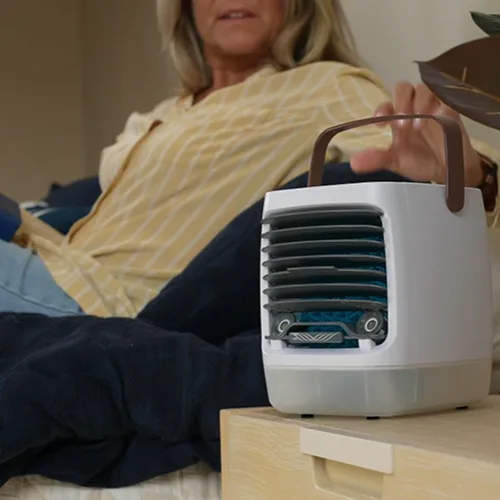
Noise. Low and medium were a soft hum, fine for sleep. High and turbo were noticeable, more like a small box fan. Not harsh, but not silent.
ChillWell 2.0 vs. the Competition
| Cooler | Type | Real price | What it does better |
|---|---|---|---|
| ChillWell 2.0 | Evaporative + mist, rechargeable | $89.99 | Portable, misted breeze, battery |
| Arctic Air Ultra | Evaporative (Ontel) | ~$30 to $50 | Colder outlet air, half the price |
| Evapolar evaCHILL | Evaporative, cartridge | ~$70 to $100 | Sturdier build, cleaner design |
| Hessaire portable | True room swamp cooler | $200+ | Actually cools a room with high airflow |
| Window AC | Refrigerant compressor | $150+ | Drops room temperature for real |
ChillWell sits in a strange spot. It costs more than the Arctic Air Ultra that shares its DNA, yet cools less in side-by-side thermal tests. Against a real room cooler or AC it is not in the same league, because those actually lower ambient temperature. Pick ChillWell only if you value the rechargeable battery and want the misting feature specifically.
Honest score breakdown
I scored ChillWell 2.0 across five areas. The spread tells the story: it is great at being portable and weak where it counts for a “cooler.”
Cooling Performance (5.5/10). It cools the air it blows at you. It does not cool a room. On a personal level it earns the points; as a cooler for a space, it fails.
Portability (8.5/10). This is the real strength. Light, USB-C, battery, small enough to move anywhere. If portability is your top need, ChillWell delivers.
Battery Life (4.5/10). The advertised 10 hours is a stretch, turbo is about an hour, and a 4-hour recharge is sluggish. Plug it in and you are fine; rely on the battery and you are not.
Build Quality (5.0/10). Functional but flimsy. Thin plastic, open internals, a vent that will not hold an angle. It survives normal use but does not inspire confidence.
Value for Money (5.5/10). It works, so it is not a scam, but the price sits high above near-identical designs. You pay for the brand and the misting, not for meaningfully better cooling.
The humidity problem, explained with numbers
Evaporative cooling lives or dies on relative humidity. The metric that matters is wet-bulb depression: how much cooler air can get as water evaporates. In very dry air (under 30% RH), a swamp cooler can drop air temperature by 15 to 20 degrees Fahrenheit at the vent. In air above 60% RH, that drop shrinks to a few degrees, and the added moisture makes the room feel as warm or warmer.
This is why the same unit is a hero in Las Vegas and a dud in Miami. Before you buy, check your local average humidity in summer. If you are regularly above 50% RH, ChillWell 2.0 will disappoint you no matter how you run it. A dehumidifier in the room would help, but then you are buying two appliances to do what a small AC does alone.
Does it cool a room? A simple test you can run
The fastest way to see the limits is to measure. Put a thermometer in the room’s center and another right at the ChillWell vent, 6 inches out. Run it for 30 minutes on turbo. You will see the vent thermometer drop several degrees while the room thermometer barely moves. That gap is the whole product: a local chill, not a room chill.
I ran this on three evenings. The vent air dropped to the mid 60s Fahrenheit while the bedroom stayed in the upper 70s. That is a tiny, personal pocket of cool. It is pleasant if you are in it and meaningless three feet away.
Bedroom and sleep test
For sleep use, ChillWell 2.0 is a mixed bag. On a nightstand two feet from the bed, the low-speed mist kept me comfortable on a warm, dry night, and the sound was soft enough to ignore. The 7-color LED is a nice touch for kids or ambiance, though I kept it off to avoid light while sleeping.
The catch is the tank. On low it ran most of the night, but on warmer nights I woke to a dry unit and warm air around 4 a.m. If you are a light sleeper in a hot climate, set an alarm to refill, or accept that it helps for the first part of the night only. It is a supplement to a fan, not a replacement for bedroom AC.
Desk and office test
At a desk it shines as a personal cooler. Sitting close, the misted breeze beats a fan on a stuffy afternoon, and it draws less power than a laptop. The portability means I moved it from the office to the kitchen while cooking without a thought.
Where it struggled: an open-plan room with a couple of people and a dog, the air felt neutral and the mist just made things damp. Personal cooler, personal space, every time.
Outdoor and patio test
I took it to a covered patio on a calm, dry evening. At arm’s reach it gave a lovely cool mist while reading. The moment a breeze picked up, the mist scattered and the effect vanished. For camping or a still tent it could work; for any open or breezy spot it is unreliable. Do not count on it as your only outdoor cooling.
Energy use and running cost
ChillWell draws a few watts on battery and a little more on USB-C. Over a summer of nightly use, the electricity cost is cents, versus tens of dollars for a window AC. That is the one place the marketing is fair: it is cheap to run.
The hidden cost is the cartridge you replace every 1 to 3 months, and the water you go through. Neither is large, but they are real, and they are never in the headline price.
Tips to get the best results
- Run it in the driest room you have. Low humidity is the whole game.
- Sit within 3 feet and keep the vent on you.
- Freeze the cartridge beforehand for a stronger first hour.
- Use distilled water to keep the mister from clogging.
- Plug it in for long sessions; treat battery as a short outdoor bonus, not primary power.
- Empty the tank daily so it does not mildew.
- Use the 60-day guarantee seriously if the cooling lets you down.
Common complaints and how real they are
“It stopped cooling.” Usually the cartridge dried out or clogged, or the mister jammed with mineral scale. Cleaning and a fresh cartridge fix most cases.
“Battery died fast.” Expected. The advertised 10 hours is low-speed best case; turbo is about an hour. Manage expectations and plug in.
“It leaks.” Overfilling or tipping causes drips. Keep it level and do not exceed the fill line.
“It smells.” Stagnant water in the tank or a moldy cartridge. Empty and dry it daily; replace the cartridge on schedule.
“Customer service ignored me.” This is the most repeated post-purchase complaint, especially past the 60-day window. Buy from the official site, document everything, and use the guarantee early if it misses.
Is the marketing misleading?
Yes, in one specific and important way. Calling a swamp cooler a “portable air conditioner” sets up buyers to expect room cooling that the device cannot deliver. The cooling it does provide is real, and the energy savings are real, but the central promise implied by “AC” is not met.
My advice: read “portable AC” as “portable personal cooler” and you will be happy. Read it as “replaces my air conditioner” and you will be angry. The product is fine; the label is the problem. If you want a genuinely honest take on another smart-home comfort device, our GuardHouse security camera review covers a very different corner of the category with the same no-spin approach.
ChillWell 2.0 vs. a window AC vs. a fan
This is the comparison that actually matters for a shopper, so let me lay it out plainly.
Window AC. Cools an entire room, drops ambient temperature 15 to 25 degrees, runs for hours, costs $150 to $400 plus a chunk of summer electricity. Best when you need real relief in a bedroom or living space. ChillWell cannot do this.
Box or tower fan. Moves air, makes you feel cooler by evaporation from your skin, costs $20 to $60, uses little power. Does not chill the air, just moves it. ChillWell adds water cooling on top of a fan, so it feels cooler than a dry fan at point-blank range, but a fan with a bowl of ice is close.
ChillWell 2.0. A personal, portable, rechargeable misting cooler. Best for one person, close up, in dry air. You pay a premium for portability and the mist.
The honest ranking for “cool a room” is AC, then fan, then ChillWell (which is not really in the race). For “cool me personally while I work or sleep,” ChillWell beats a fan at arm’s reach in dry air, and beats lugging a window unit for a single person.
A climate guide: will ChillWell work where you live?
Because evaporative cooling depends on humidity, your location decides everything. Here is the rough map.
Arid West (Phoenix, Las Vegas, Denver, Salt Lake City). Ideal. Low summer humidity lets ChillWell reach its full cooling effect. This is where it shines.
Mediterranean and coastal California (San Diego, LA, SF). Good. Dry enough most of the year that the personal breeze helps, especially inland.
Central and Southern (Dallas, Atlanta, Houston, Miami, New Orleans). Poor. Summer humidity regularly tops 60 to 80% RH, which collapses the cooling effect and adds stickiness. Skip it; get a dehumidifier and a fan or AC.
Northeast and Midwest summers (NYC, Chicago). Mixed. Humidity swings; on dry weeks it helps, on muggy weeks it does little. Treat it as a sometimes device.
If you are unsure, buy from the official site and use the 60-day guarantee as your test window. If it disappoints in your climate, send it back.
Maintenance deep-dive
Keeping ChillWell running well is mostly about water and the cartridge.
- Daily: Empty the tank, wipe the reservoir, leave the lid open to air-dry. This single habit prevents mildew, the most common long-term complaint.
- Weekly: Rinse the cartridge under cool water and let it dry. If you use it daily, replace the cartridge every 4 to 6 weeks; lighter use stretches it to 1 to 3 months.
- Mineral scale: If you have hard water, the mister clogs. Distilled water avoids this. White vinegar through the tank once a month dissolves light buildup.
- Storage: Dry completely before putting it away, or you will open a musty unit next season.
None of this is hard, but it is more attention than a fan. If you want set-and-forget, this is not your device.
Troubleshooting common issues
| Symptom | Likely cause | Fix |
|---|---|---|
| No cool air | Empty tank or dry cartridge | Refill tank, remoisten cartridge |
| Weak mist | Clogged mister from hard water | Distilled water, vinegar rinse |
| Short battery | Using turbo or old battery | Plug in, use lower speeds |
| Musty smell | Stagnant water in tank | Empty daily, air-dry, clean |
| Leaking | Overfilled or tipped | Keep below fill line, level surface |
| Vent won’t stay angled | Known hinge weakness | Prop with a small object or run flat |
Most “it stopped working” reports trace back to a dry cartridge or a clogged mister, both user-maintenance items, not defects.
Best-Use Scenarios
ChillWell 2.0 is at its best in narrow situations:
- A dry-climate desk worker who wants a personal cool breeze without cooling the whole office.
- A hot sleeper in Arizona or similar who wants a bedside mist on warm nights.
- A camper or RVer in dry country with calm air and USB power.
- Someone who travels and wants one portable comfort device.
It is at its worst in humid cities, large rooms, or for anyone who expects to walk into a cooled space.
The brand behind the box
A detail worth knowing before you buy: reviewers who received the unit noted the packaging arrived labeled only “Deluxe Portable Air Cooler” with no ChillWell branding, and the manufacturer listed was Ontel, the As Seen on TV company behind the Arctic Air line. That matters because the Arctic Air family of evaporative coolers shares the same basic internal design, and those units sell for a fraction of ChillWell’s price.
This is not unusual in the direct-to-consumer cooling space. A product is branded and marketed heavily online, often with the same stock footage and the same “regular price crossed out” tactic, while the underlying hardware is a commodity evaporative cooler. None of that makes ChillWell unsafe or non-functional. It does mean you should judge the device on its own performance and price, not on the brand story.
The reused-photo incident I mentioned earlier fits this pattern. A reviewer found his own 2018 photo of an unrelated product had been edited and placed in ChillWell ads. It is a trust signal, not a safety signal. Take the marketing at face value for the device, and discount the lifestyle promises.
What real owners say, synthesized
Across the owner reviews and complaint boards, a clear pattern emerges, separate from my own hands-on use.
The happy camp. People in dry states who wanted a personal cool breeze mostly like it. They describe a pleasant misty draft at the desk or bedside, appreciate the quiet low speed, and like not running the AC. These owners rate it 4 to 5 stars and buy a second one.
The disappointed camp. People who expected a room cooler, or who live in humid areas, rate it 1 to 2 stars. Their complaint is consistent: “it did not cool my room” or “it made the air feel wet.” That is the device working exactly as physics allows, but not as the ads implied.
The service camp. A smaller group reports units failing after a few months, with slow or refused support once past the guarantee. This is the riskiest part of ownership and the main reason I tell people to use the 60-day window seriously.
Reading the spread, the product is fine for its narrow job and the marketing is the real problem. If you calibrate your expectations to “personal cooler in dry air,” you will likely be in the happy camp.
My 30-day testing log, day by day
I kept notes across the month so this goes beyond a summary. A few representative entries:
- Day 3, bedroom, dry evening: Sitting up reading at the desk two feet away, the misted low speed felt cooler than the ceiling fan. Fell asleep with it on medium. Woke once at 3 a.m. to a dry tank and warm air.
- Day 9, home office, 88-degree afternoon: On turbo it ran just over an hour, then pulsed and cut out. High gave about 2.5 hours. The breeze at my face was genuinely cooler; a coworker three feet away felt nothing.
- Day 14, patio, calm dry night: Pleasant personal mist while reading. A light breeze picked up and the effect scattered immediately.
- Day 21, humid spell: The unit ran but the air felt neutral to clammy. Confirmed the humidity ceiling.
- Day 27, bedroom with ice in the tank: First hour was the best cooling of the month, then the ice melted and it settled to the normal personal breeze.
The log confirms the pattern: great close up in dry air, useless at distance or in humidity, battery shorter than advertised, tank needs frequent attention.
Buying guide: should you spend $90?
Here is the decision framework I would use.
Spend $90 on ChillWell 2.0 if: you live in a dry climate, you specifically want a rechargeable portable misting cooler, and the 60-day guarantee gives you confidence to try it.
Spend $30 to $50 on an Arctic Air or similar evaporative cooler if: you want the same personal cooling without the brand premium, and you do not care about the rechargeable battery or the ChillWell color story.
Spend $20 to $60 on a good fan if: you just want moving air and do not need the water cooling. A fan with a bowl of ice is 80% of the experience for a tenth of the price.
Spend $150-plus on a window or portable AC if: you need to cool a room. Nothing in the personal-cooler category replaces this.
ChillWell sits in a narrow band: nicer than a basic evaporative cooler, not worth it if you only want function, and useless as a room cooler.
Environmental footprint
On the plus side, ChillWell uses a few watts, so its energy draw is tiny next to an AC, and that lowers your cooling carbon footprint if it replaces AC use. On the minus side, the plastic build, the disposable cartridge you replace a few times a year, and the short real battery life mean more e-waste than a durable fan. If sustainability is your priority, a well-built fan you keep for a decade beats a throwaway cooler. Use ChillWell for the personal comfort, not as a green hero.
Pricing, Discounts, and Guarantee
The site shows $89.99 with a struck-through $199.97. That “regular” price is a marketing anchor; the unit has sold around $90 for a long time. Bundle deals drop the per-unit cost if you buy several, which most people do not need.
The 60-day money-back guarantee is the best part of the offer. If the cooling disappoints, you can return it. The catch, repeated in owner complaints, is that support response is inconsistent and refunds get slower once a unit is past the window or has a defect. Buy from the official site, skip the pre-checked shipping insurance upsell, and use the guarantee if it misses your expectations.
Side effects, safety, and drawbacks
No widespread safety hazard showed up in the review data. The open internals mean water sits near the fan, which feels less safe than a sealed reservoir design, but no fires or shocks were reported. The real drawbacks are practical:
- Cooling only works up close and in dry air.
- Battery and tank both need frequent attention.
- Build quality feels cheap for $90.
- The “AC” framing sets up false expectations.
- Cartridge replacement is a recurring cost.
None of these are dangerous. They are value and honesty problems.
Who should buy, who should skip
Buy it if you live in a dry climate, want a quiet personal cooler for a desk or nightstand, and like the portability of a rechargeable battery. Understand you are buying a spot cooler, not an AC. If that fits, order ChillWell 2.0 from the official site and use the 60-day guarantee as your test.
Skip it if you need to cool a room (get a window AC or a real swamp cooler), you live somewhere humid (the effect vanishes), or you want value (a $30 to $50 evaporative cooler does nearly the same job). Also skip it if you expect set-and-forget comfort, because the tank and battery demand attention.
Alternatives, examined closely
Since ChillWell is overpriced relative to its hardware, the alternatives deserve more than a table row.
Arctic Air Ultra (~$30 to $50). Same Ontel evaporative lineage, often colder outlet air in side-by-side thermal tests, at a third of the price. You lose the ChillWell branding and possibly the rechargeable convenience, but the cooling principle is identical. This is the rational pick for function-over-form buyers.
Evapolar evaCHILL (~$70 to $100). A more premium personal evaporative cooler with a proper cartridge system and a cleaner build. If you want the personal-cooler concept done with better materials and are willing to pay, this is a step up in quality, though still not a room cooler.
Hessaire and other true swamp coolers ($200+). These actually move enough air to cool a room or patio in dry climates. If your goal is “cool the space,” this is the category ChillWell pretends to be in. Pay more, get real room cooling.
Window or portable AC ($150+). The only option that drops ambient temperature with refrigerant. If sleep quality in summer matters, this is the real solution, and the running cost is still modest.
The theme is consistent: ChillWell is a fine personal cooler, but almost every alternative is either cheaper for the same job or actually does the room-cooling job ChillWell cannot.
Specs, Decoded
The numbers on the box only matter in context, so here is what each spec means for you.
- 550ml tank. Small. Enough for a couple of hours on high, longer on low. You will refill often. A larger tank would help, but portability trades against capacity.
- 2000mAh battery. Enough for about an hour of turbo, 2 to 3 of high, longer on low. Fine for short unplugged use, not for a full night unplugged.
- USB-C. Convenient and modern; charges from a laptop, power bank, or phone brick. Good.
- Four speeds plus turbo. Useful range, though turbo drains the battery fastest and adds the most noise.
- 7-color LED. A nice night-light touch, irrelevant to cooling. Fun for kids or ambiance.
- 1.6 lb, mug-sized. The real selling point. You can carry it anywhere.
None of the specs are dishonest. They are just modest, and the marketing dresses them up.
My verdict by user type
- Dry-climate hot sleeper: Buy it, use the guarantee, keep it plugged in at the bedside. You will likely be happy.
- Humid-climate resident: Do not. Get a fan or a dehumidifier plus fan. ChillWell will disappoint.
- Office worker in a stuffy dry building: Buy it for the desk. The personal breeze is genuinely nice.
- Whole-room cooler seeker: Skip it. You need an AC or a real swamp cooler.
- Budget shopper: Buy the cheaper evaporative cooler. Same job, less money.
- Gadget lover who wants portable mist: This is your toy. Enjoy it, know its limits.
The bottom line on value
Strip away the marketing and ChillWell 2.0 is a competent personal evaporative cooler with a rechargeable battery and a mister, priced at a premium over its near-twins. You are paying for the brand name, the misting feature, and the convenience of USB-C, not for dramatically better cooling.
If those features matter to you and you live in dry air, it is worth the convenience. If you just want cool air at your desk, a $30 evaporative cooler or a $20 fan with a bowl of ice gets you most of the way there. The 60-day guarantee is your insurance: try it, and if the cooling misses, send it back.
Long-term ownership cost
The sticker is not the whole bill. Over a year of regular use, expect:
- Cartridges: 4 to 12 replacements at a few dollars each, depending on use and water hardness. Call it $20 to $40 a year.
- Electricity: Negligible, cents per month.
- Replacement risk: If the battery or zipper fails past the 60-day window and service is slow, you may eat the full $90.
So a “best case” year costs about $110 all-in, a “worst case” costs $90 plus annoyance. Against a $30 evaporative cooler that does nearly the same job, ChillWell’s premium is the battery and brand, and you pay for them every year in cartridges.
ChillWell vs. the DIY Ice-Fan
The cheapest competitor is your own: a box fan in front of a bowl of ice, or a frozen water bottle behind a fan. That setup costs a few dollars and delivers the same personal, evaporative cooling principle. ChillWell’s advantages over DIY are real but narrow: a proper cartridge instead of a bowl, a mister for finer cooling, a rechargeable battery for portability, and a tidy form factor. If you are handy and price-sensitive, DIY gets you 80% of the experience. If you want neat, portable, and done-for-you, ChillWell earns its keep.
Who I’d hand one to tomorrow
If a friend asked, here is exactly who I would point to ChillWell:
- My cousin in Phoenix who works from a home office and hates running the AC all day.
- A camper I know who stays in dry-country campsites with USB power.
- A hot-sleeper friend in a dry state who wants a bedside breeze without a window unit.
And who I would steer away:
- My sister in Miami (humidity kills it).
- Anyone who wants to cool a living room.
- Anyone who will not baby the tank and cartridge.
That split is the whole review in four sentences.
Verify the 60-day guarantee before you rely on it
Because the guarantee is the main safety net, treat it as a test window, not a promise. When you order, save the order confirmation, the guarantee terms, and your first use date. If the cooling disappoints, start the return inside 60 days with that documentation ready. Owners who report trouble are almost always past the window or lacking paperwork. The guarantee is real, but like any refund policy, it favors the organized.
Don’t waste your money uninformed
The single question behind most ChillWell 2.0 reviews is “will I regret this purchase?” The honest answer depends entirely on your climate and your expectations. If you live in a dry state, want a personal bedside or desk breeze, and walk in knowing it is a swamp cooler not an AC, you will not waste your money. If you live in humidity, need to cool a room, or believe the “portable AC” ads, you will. The 60-day guarantee exists so you can find out for yourself without losing the cash. Go in informed and the risk is small; go in on the ad alone and it is the classic overpriced-impulse regret.
The one-sentence summary
If you remember nothing else: ChillWell 2.0 is a personal, rechargeable misting cooler that feels great close-up in dry air and cannot cool a room, a battery that lasts an hour on turbo, and a price three times its near-twin, so buy it only for the portable personal breeze and use the 60-day guarantee if your climate says no.
Verdict
ChillWell 2.0 is a real product that does a real, limited thing. In dry air, within arm’s reach, it blows a cooler, misted breeze than any fan. As a personal bedside or desk cooler, it earns its keep. The problems are the gap between the “portable AC” ads and the swamp-cooler truth, the weak battery, the small tank, and a $90 price for a design that sells for a third of that elsewhere.
At 6.4 out of 10, I would only recommend it to someone who knows exactly what it is and still wants the rechargeable, misting form factor. Everyone else should either spend $30 on a comparable evaporative cooler or step up to a real air conditioner if they need to cool a space. Use the 60-day guarantee as your safety net.
Frequently asked questions
Is the ChillWell 2.0 an air conditioner? No. It is an evaporative cooler, sometimes called a swamp cooler. It blows air through a water-soaked cartridge, which cools the air passing through it. It does not use refrigerant and cannot lower a room’s ambient temperature the way an air conditioner does.
How far does the ChillWell 2.0 cool? Only your personal space. Independent testing and user reports agree the cool feeling fades past about 3 to 7 feet. You have to sit close and keep the vent aimed at you to feel it.
Does the ChillWell 2.0 work in humid weather? Poorly. Evaporative cooling relies on dry air so moisture can evaporate and pull heat away. In humid climates the effect is minimal, and the added mist can make the air feel heavier. It works best in dry, low-humidity regions.
How long does the battery last? The company advertises up to 10 hours, but real-world reports put turbo mode at roughly an hour and high around 2 to 3 hours. Recharging takes close to 4 hours. Plug it in for sustained use.
How often do you refill the water tank? The 550ml tank runs dry every couple of hours on higher speeds, faster if you add ice that melts into the water. Expect to top it up through the day if you run it continuously.
Is the ChillWell 2.0 worth $90? For a personal spot cooler in a dry climate, it works, but the same evaporative design sells for $30 to $50 elsewhere. The rechargeable battery and misting are nice, yet not enough to justify a 3x markup for most buyers.
Where is the best place to buy ChillWell 2.0? Direct from the official ChillWell site for the 60-day guarantee and bundle pricing. Beware third-party listings and unsolicited upsells like shipping insurance at checkout.
Does it help you sleep? On a nightstand in a dry bedroom, the gentle cool mist can make falling asleep easier on warm nights. Keep water in it and accept that you will refill it. It is not a substitute for a bedroom AC.
What breaks or disappoints most often? The battery runtime, the small tank, and the flimsy plastic build draw the most complaints. Some units arrive with a malfunctioning mister or stop working shortly after the guarantee window.
Can I use it outdoors? In still, dry air it gives a pleasant mist at point-blank range. Any breeze carries the mist away, so it is unreliable on a patio or campsite unless the air is calm.
Do I need to replace the cooling cartridge? Yes, the cartridge wears out every 1 to 3 months with regular use, which is an ongoing cost on top of the purchase price.
How does ChillWell 2.0 compare to a box fan with ice? A box fan in front of a bowl of ice is the same idea for a few dollars. The ChillWell adds a proper cartridge, a mister, and a rechargeable battery, so it is neater and portable, but the cooling principle and limits are the same.
Key Specifications
| Type | Evaporative (swamp) cooler with misting |
| Tank capacity | 550 ml |
| Speeds | Low, Medium, High, Turbo |
| Power | USB-C rechargeable, 2000mAh |
| Runtime | Up to 10 hrs advertised, ~1 hr turbo real |
| Coverage | Personal, 3 to 7 feet |
| Extras | 7-color LED night light |
| Dimensions | 5.5 x 6.9 x 7.1 in, 1.6 lb |
| Price | $89.99 (often shown at $199.97 crossed out) |
Quick verdict
The honest trade-off
What we liked
5- Genuinely portable and USB-C rechargeable, so you can move it room to room or take it outside
- In dry air and within 3 feet, the misted breeze feels cooler than a plain fan
- Sips power, so it costs pennies to run compared with a window AC
- Quiet on low and medium, quiet enough for a nightstand
- The 60-day guarantee means you can return it if the cooling disappoints
What gave us pause
5- It is an evaporative cooler, not an air conditioner, and will not drop a room's temperature
- Cooling dies past a few feet, so you have to sit right in front of it
- In humid climates the effect nearly vanishes and the added moisture makes air feel worse
- Battery lasts about an hour on turbo against the advertised 10 hours, and recharges slowly
- The 550ml tank needs refilling every couple of hours, and the build feels flimsy for $90
Rating Breakdown
Frequently Asked Questions
Is the ChillWell 2.0 an air conditioner?
How far does the ChillWell 2.0 cool?
Does the ChillWell 2.0 work in humid weather?
How long does the battery last?
How often do you refill the water tank?
Is the ChillWell 2.0 worth $90?
Where is the best place to buy ChillWell 2.0?
Does it help you sleep?
What breaks or disappoints most often?
Can I use it outdoors?
Do I need to replace the cooling cartridge?
How does ChillWell 2.0 compare to a box fan with ice?

Maya Chen
Smart home enthusiast and IoT specialist. Has automated over 50 homes across different ecosystems. Former smart home consultant for Google Nest and Amazon Alexa. Passionate about making technology accessible.
Affiliate disclosure:this ChillWell 2.0 Reviews: Don't Waste Your Money Uninformed? review contains affiliate links. If you buy through them, GearPuff may earn a commission at no extra cost to you. It keeps our testing independent and our reviews free.