
In This Article
- What Actually Reduces Foot Fatigue
- The Picks
- 1. Akusoli Magnetic Acupressure Insole
- 2. Dr. Scholl’s Custom Fit
- 3. Superfeet GREEN
- 4. Generic Gel Pad
- How to Choose for Your Shift
- The Fitting Step People Skip
- Price Math
- Care That Doubles the Life
- Who Should Not Bother
- Why Hard Floors Hurt More Than You Think
- Signs Your Current Insoles Are Failing You
- Material Choices Explained
- The Odor Problem Nobody Talks About
- Standing All Day vs Walking All Day
- Trim-to-Fit vs Fixed Size
- A Note on Price and Value
- When to See a Clinician
- Quick Buying Checklist
- How We Picked
- The Cost of Doing Nothing
- Insoles and Knee Pain
- Rotation Keeps Them Fresh
- Trimming for Two Different Shoes
- The Weather Factor
- What Buyers Regret Most
- Comparing Cost Per Month
- The Placebo Question
- Insoles vs Compression Socks
- Reading Seller Claims
- The Nightly Reset Routine
- Verdict
If your feet are shot by hour six of a shift, the floor is the problem and the insole is the fix. Hard surfaces send every step’s impact straight up your heel, and a flat factory insole does nothing to catch it. The right comfort insole changes how that load lands, and for people who stand all day, that change is the difference between a normal evening and a painful one.
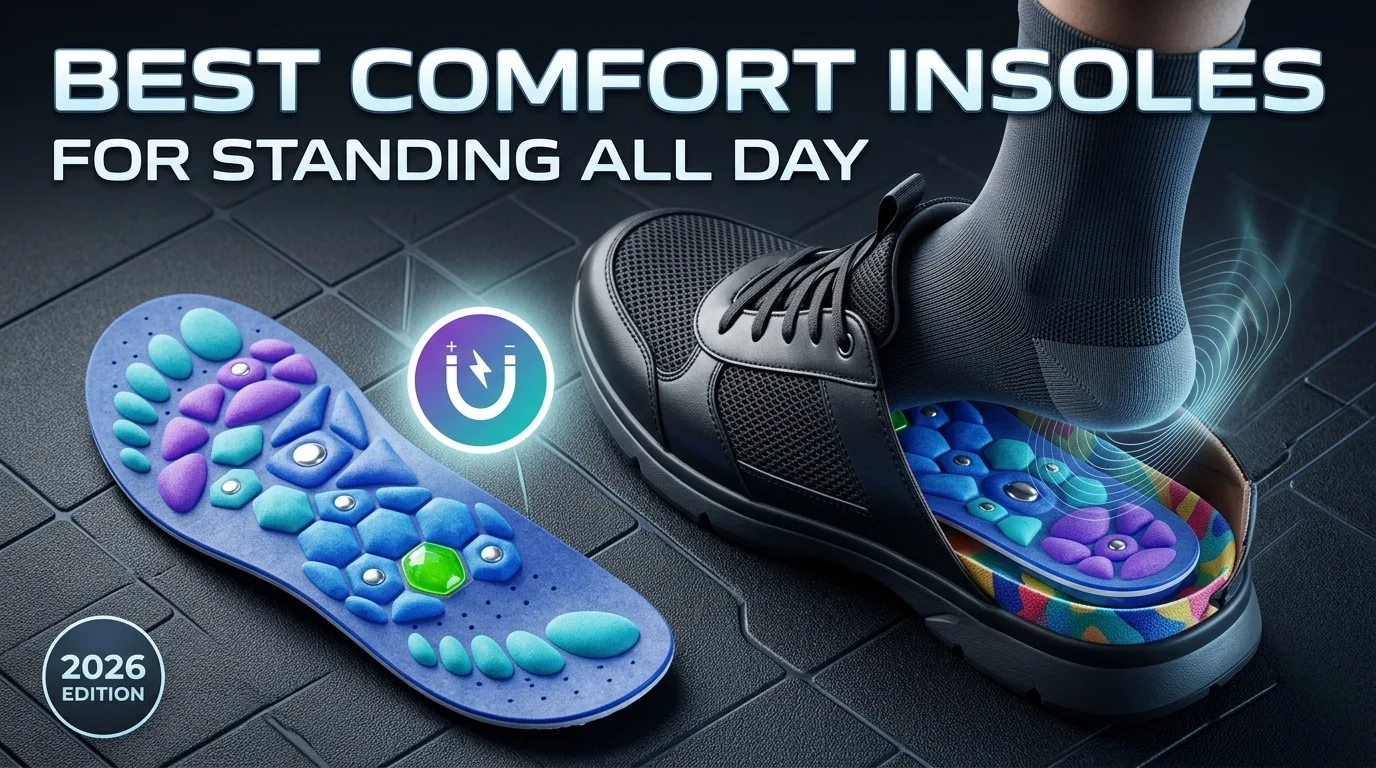
This roundup covers the best comfort insoles for standing all day in 2026. The wellness gadgets category has the rest of the comfort gear we have tested, and the picks below pull from what we have actually compared this year.

What Actually Reduces Foot Fatigue
Before naming products, the mechanism matters, because it is what separates a $30 insole that works from a $10 pad that doesn’t.
Foot fatigue on hard floors comes from three things: impact with no cushion, an arch that collapses because the shoe is flat, and load dumped on the heel and ball. A good insole attacks all three. Cushion takes the impact. A contoured arch stops the collapse. Load spreads across more of the foot. Do those three and the small muscles in your foot stop clawing to stabilize you, which is the exact moment the fatigue backs off.
Magnetic claims are the noise around this. The science for static magnets and pain relief is weak. Credit the shape and the foam. The magnets are a free extra, not the engine.
The Picks
1. Akusoli Magnetic Acupressure Insole
Akusoli is the trim-to-fit budget pick with a wellness story. Under the silver-coated top sits a contoured arch shell, acupressure nodes, and small magnets. The arch and the silver coating are the real wins. The silver slows odor better than bare foam, which matters for anyone in the same work shoes six days a week. The magnets are the part to ignore.
It costs about $29.99 a pair with the standard promo, dropping to roughly $20.99 each in a four-pack. For the standing-shift worker, it is the easiest yes in this list. You can see the current Akusoli price and promo on the maker’s site. The catch is buying direct, which means you own the return process, and service can be uneven. The 60-day window covers the experiment.
Our full Akusoli insoles review breaks the claims against the evidence if you want the detail.
2. Dr. Scholl’s Custom Fit
The Scholl’s system uses an in-store kiosk to map your foot and picks an orthotic from a small range. It is more fitted than universal, less fitted than custom, and runs about $50. You buy it at a drugstore, so the return is easy, which is the reason to pick it over Akusoli if retailer peace of mind matters more than saving $20.
3. Superfeet GREEN
Superfeet is a firm, high-arch insert loved by runners and hikers. It holds a strong shape and lasts, but the firm arch is too much for some all-day wearers. At about $55 it is the priciest here. Choose it for sport and structure, not for a gentle all-day cushion.
4. Generic Gel Pad
The $10 gel pad is soft and flat with no arch. It feels nice for a week and flattens. It wins only on price, and only if you replace it monthly. It is the floor of this list, included so you know why spending a little more pays off.
How to Choose for Your Shift
- Retail, kitchen, warehouse: a moderate contoured insole with odor control, like Akusoli, is the sweet spot.
- Nursing, long indoor shifts: same, with extra weight on odor control and a multi-pack so you rotate pairs.
- Running or training: a firm sport orthotic holds the arch under load.
- Office with a long walk to work: a budget contoured insole is enough; you do not need the heavy-duty build.
Match the insole to the hours and the surface. A warehouse needs more than a commute does.
The Fitting Step People Skip
Even the best insole fails if you stack it on the old one or cut it too short. Pull the factory insole, trace the old shape, cut just outside the line, and break in over a week. Our guide to fitting comfort insoles walks this in five steps. The trim is the whole game, and a clean cut is why good reviews say “best thirty bucks I spent.”
Price Math
A good trim-to-fit insole runs $20 to $35. Custom orthotics run hundreds. For everyday fatigue, start cheap and only spend on custom if the budget option does not help after a month of correct use. The math is why value scores sit high for inserts like Akusoli: a few dollars a month of relief, capped by a return window.
Care That Doubles the Life
Wipe with a damp cloth, don’t soak, air dry away from heat, and pull them out overnight. Letting the shoe breathe kills the bacteria that break foam down. Buyers who do this get several months; buyers who don’t blame the product for a habit problem.
Who Should Not Bother
If you sit most of the day, the benefit is small and limited to your commute. If you have a diagnosed foot condition, a clinician’s plan beats a comfort insert. If you need a one-click retailer return, pay more for the safer option. Everyone else on their feet all day should be wearing one of these.
Why Hard Floors Hurt More Than You Think
Concrete and tile return almost none of the energy your heel puts in. Every step is a small impact with nowhere to go, and over a shift those impacts add up in the heel, the arch, and the knee. Carpet and wood absorb some. Hard retail and kitchen floors absorb none. That is why the same person who walks fine on a weekend limps by Friday on the job floor. An insole is the cheapest way to fake some of that lost absorption.
The fix is not thicker soles alone. A thick soft sole without arch shape just sinks. You need the cushion plus the contour, which is the combination a good insole provides and a thick shoe often does not.
Signs Your Current Insoles Are Failing You
A few tells say the stock insole has given up:
- The heel area has compressed to a thin disc.
- The arch has no visible rise left.
- The top fabric has torn or peeled.
- Your shoes smell within a day of wearing.
- Evening foot pain appeared where there was none before.
Any two of those and the insole is done. Replacing it costs less than the pain it is letting through.
Material Choices Explained
Insoles come in a few builds, and the build decides the feel:
- EVA foam: light, cushioned, holds shape moderately. The common budget choice.
- Gel: soft and cool but flattens fast. Good for short wear, poor for all day.
- Leather-covered foam: more durable and less sweaty than bare foam.
- Firm polypropylene shell: the sport build. Holds a strong arch but feels stiff.
Akusoli sits in the EVA-plus-leather camp with a silver top, which is why it threads the needle between comfort and life. Know the build and you know what you are buying before it arrives.
The Odor Problem Nobody Talks About
Foot odor is bacteria, not sweat. Sweat is near odorless. Bacteria eating sweat in a warm dark shoe is the smell. An insole that fights bacteria, like a silver-coated one, keeps the shoe fresher, which is why odor control shows up in every serious buyer’s shortlist. If your shoes smell by midday, the insole is the lever, not the socks.
Standing All Day vs Walking All Day
These sound the same but stress the foot differently. Standing loads one spot for a long time, which is why heel and arch fatigue dominate. Walking spreads load as the foot rolls, so ball and toe fatigue join in. A contoured insole helps both, but standers should weight heel cushioning more, while walkers should weight forefoot support. Most trim-to-fit insoles cover both well enough; just know which complaint is yours when you pick.
Trim-to-Fit vs Fixed Size
Fixed-size insoles assume your shoe matches their shape, which it rarely does. Trim-to-fit bends to your shoe, which is why it fits more people. The trade is the scissors step, and as the fitting guide covers, that step is the whole game. If you hate crafting, fixed-size from a brand that matches your shoe is fine. If you want one pair across shoes, trim-to-fit wins.
A Note on Price and Value
Spending more does not always buy more relief. A $55 firm orthotic can feel worse for all-day wear than a $30 contoured one, because stiffness is not comfort. Value is relief per dollar over the life of the pair, and budget contoured insoles score high on that measure. Save the premium build for sport, not for the shift.
When to See a Clinician
If pain is sharp, constant, or wakes you at night, or if you have diabetes, numbness, or swelling that will not quit, an insole is not the answer. A podiatrist can find the cause and fit a device that targets it. The comfort insoles here are for everyday fatigue, not for diagnosed conditions, and pretending otherwise delays real help.
Quick Buying Checklist
- Know your arch (wet test).
- Pick contoured over flat.
- Want odor control if you wear the same shoes daily.
- Trim to the larger size and cut again if needed.
- Break in over a week.
- Keep the return window in mind if it doesn’t help.
Run that list and you will avoid most of the bad outcomes people post about.
How We Picked
The shortlist above came from a simple filter. The insole had to have a real contoured arch, not a flat pad. It had to be trim-to-fit or sized to cover most adults. It had to have some odor control for daily wearers. And the price had to sit under the custom-orthotic range so the value was obvious. Magnetic claims were noted and then set aside, because the science does not support them as pain relief. That filter is why Akusoli, Scholl’s, and Superfeet made the list and random gel pads did not.
The Cost of Doing Nothing
The quiet cost of skipping an insole is not just sore feet. Poor foot support travels up the chain to the knee and the lower back, and people who stand all day often blame their back when their arch is the start of it. A $30 insole that offloads the foot can take pressure off the knee and hip too. The relief compounds upward. Doing nothing lets the compensation build, and that is the more expensive path once a clinician gets involved.
Insoles and Knee Pain
A collapsed arch lets the foot roll inward, which rotates the shin and stresses the knee. Supporting the arch stops the roll, which steadies the knee. This is why some insole wearers report easier knees before they notice anything else. The effect is modest and not a cure for knee disease, but for everyday ache it is real and worth naming. If your knees complain after long shifts, the foot is a sensible first place to look.
Rotation Keeps Them Fresh
One pair taking every hour wears out and smells faster. Two pairs, rotated, each dry overnight, last longer and stay fresher. For a household of workers, the four-pair pack is the obvious value, because no single pair becomes the only pair. The habit matters as much as the product.
Trimming for Two Different Shoes
If you move between a boot and a sneaker, one trimmed insole will not fit both footprints exactly. Trim one pair for the boot, one for the sneaker. The trim lines make this cheap. Trying to make one pair serve two very different shoes is how the toe ends up lifted in one of them. Buy for the shoes you actually wear.
The Weather Factor
Summer heat and winter boots change the fit. Hot months mean more sweat, so odor control and rotation matter more. Winter means thick socks, so re-check the toe when you switch. The insole does not change with the season; the space around it does. A two-minute seasonal re-check prevents a crowd that builds into a blister.
What Buyers Regret Most
The regrets cluster tightly: cut too short, stacked on the old insole, wore them twelve hours on day one, or expected magnets to heal. None of those are the product’s fault. They are setup errors, and they are all avoidable with the five steps in the fitting guide. Reading the regrets tells you more about how to win than any spec sheet does.
Comparing Cost Per Month
A useful frame is relief per dollar per month. A $30 insole that lasts four months is $7.50 a month. A $55 sport insole that lasts eight months is about $7 a month but may feel too stiff for all-day wear. Custom orthotics at $400 that last years are cheap per month but a big front cost and overkill for everyday fatigue. For most standers, the budget contoured insole wins on both upfront cost and fit, which is why it tops this list.
The Placebo Question
Some skeptics say insoles are placebo. The support and load spread are mechanical, not imagined, so the relief is real for most. But expectation shapes perception, and a buyer who believes in magnets may credit the wrong part. The honest read: the arch and cushion do measurable work; the magnets likely add a belief boost at best. Buy for the mechanical part and you get the real benefit without needing the story.
Insoles vs Compression Socks
Compression socks help circulation and reduce swelling in the calf and ankle. Insoles help the foot itself. They are not rivals; for people on their feet all day with swelling, both can help, the socks for the leg and the insole for the sole. If swelling is your main complaint, add socks before assuming the insole alone will fix it. The two tools cover different parts of the same problem.
Reading Seller Claims
When you shop, watch the language. “Supports,” “cushions,” and “distributes load” are mechanical and believable. “Heals,” “cures,” and “restores” are red flags for an insole. A seller who stays in support language is describing a real product. One who drifts into cure language is selling a story. Akusoli sits in the middle, with support language up top and a magnet claim near the fine print, which is why reading the whole page matters.
The Nightly Reset Routine
What you do after the shift matters as much as the insole. When you get home, slip the insoles out to air, lift your legs for ten minutes to drain the day’s swelling, and stretch the calf with a wall lean. The insole handles the load during the day; the reset handles the recovery at night. People who only buy the gear and skip the recovery still ache, then blame the product. The two together are the full system.
Verdict
For standing all day, the contoured trim-to-fit insole is the buy, and Akusoli is the cheapest competent version of it. Pair it with a clean trim and a break-in week, and the evening burn backs off for most people. Spend more only if your job or your feet demand the firmer build.
Common Questions & Answers
Q: What type of insole is best for standing all day?
A contoured, trim-to-fit insole with real arch support and odor control. The arch offloads the plantar fascia and spreads load, which is what tires on hard floors. Firm sport orthotics work too but can feel stiff for all-day wear.
Q: Are magnetic insoles worth it for foot fatigue?
The support and cushioning do the real work. Magnetic therapy has weak scientific backing for pain relief, so judge an insole by its shape and foam, not its magnets.
Q: How much should I spend on insoles?
A good trim-to-fit insole runs $20 to $35. Custom orthotics cost hundreds. For everyday fatigue, start cheap and only spend on custom if the budget option does not help after a month.
Q: Do insoles help plantar fasciitis?
Arch support and heel cushioning ease the symptoms for many people by offloading the fascia. An insole is not a cure and does not replace a podiatrist's plan for diagnosed cases.
Q: How long do comfort insoles last?
With daily wear and basic care, a quality insert holds shape for several months. Replace when the arch flattens or the top tears.
Q: Can I use one insole across shoes?
Trim-to-fit insoles are shaped to one shoe's footprint. Buy a multi-pair pack if you want coverage across work boots, sneakers, and casual shoes.
Q: What makes a smart gadget worth buying in 2026?
Look for proven real-world performance, not just spec-sheet numbers. A smart gadget is worth buying when it solves a daily problem reliably, integrates with your existing ecosystem, and has a track record of software updates and good customer support from the manufacturer.
Q: How long do smart gadgets typically last before needing replacement?
Most smart gadgets have a functional lifespan of 2-4 years depending on usage intensity and battery care. Devices with replaceable batteries and active software support tend to last longer. Check the manufacturer's update commitment timeline before purchasing.
More Wellness Gadgets Articles
Related Product Reviews

Health tech researcher and wellness gadget reviewer. PhD in Biomedical Engineering. Tests sleep trackers, massage devices, and health monitors with clinical precision. Believes in data-driven wellness.