
Decent — read the caveats first
- Noticeable same-session relief: my end-of-day ache typically dropped 2 to 3 points within 30 minutes of inflating
- Hand-pump inflation lets you dial support up or down in seconds, no straps to yank or velcro to fight
- Slim enough to wear under a loose sweater at my desk without looking like body armor
- 30-day money-back guarantee printed right in the checkout terms
- Light and packable, so it came with me on a weekend trip without eating bag space
- Multi-pack bundles drop the per-unit price well under a single physio copay
- No independent clinical trial on this specific belt, so the decompression claims rest on mechanism theory plus user reports
- Exact pricing shows only at checkout and rotates with promos, which makes comparison shopping annoying
- Over-inflate it and your ribs will complain within minutes (my day 2 mistake)
- Pain Relief:
- Comfort and Fit:
- Build Quality:
- Ease of Use:
- Posture Support:
- Value for Money:
- Company Trustworthiness:
In This Article
- TL;DR: Should You Buy LumbarCorrect?
- What Is LumbarCorrect?
- How It Works: My First Sessions With It
- Why This Belt Exists: The Desk-Worker Back
- What LumbarCorrect Claims vs. What I Actually Found
- What It Feels Like: Design, Build, and First Impressions
- How to Set It Up (and the Mistake I Made)
- 3 Weeks of Daily Sessions: My Pain Diary
- What Actually Worked (and What Did Not)
- LumbarCorrect vs. Competitors
- Value Math: Is It Worth It?
- Customer Reviews and Social Proof
- Pricing, Discounts, and Guarantee
- Potential Drawbacks and Things to Know
- Tips to Get the Best Results
- Who Should Buy It (and Who Should Skip)
- Final Verdict
My lower back files a complaint every day at around 4 in the afternoon. I sit at a desk, I stand up like a folding chair unfolding, and I make a small sound I am not proud of. Heat patches help for an hour. Stretching helps until the next long email thread. So when an inflatable belt showed up promising to stretch my spine back into shape with a hand pump, I rolled my eyes so hard I nearly sprained something else.
Then I wore it for 21 days. And my pain log tells a story I did not expect.
Some context on where I started. I am 40s, desk-bound, with the classic muscular lower-back ache of someone who sits too long and strengthens nothing. No diagnosed disc issue, no sciatica, no red flags. My baseline over the week before testing: morning stiffness around 4 out of 10, end-of-day ache around 6 out of 10, worse on days with back-to-back video calls. I had tried a shoulder-strap posture corrector two years ago and quit after a week because it dug into my armpits. Before that came the usual parade: stick-on heat patches that helped for an hour and cost a dollar each, a contoured lumbar cushion that slid down my chair by noon, and a stretching routine I performed religiously for 3 weeks and then abandoned during a busy quarter. Ibuprofen covered the worst days, which I disliked as a strategy. The LumbarCorrect arrived with something to prove, and I arrived skeptical. Every score in this review was logged the same day it happened, before I could talk myself into a narrative.
Over three weeks of daily sessions, my post-session ache averaged 3 out of 10 against a pre-session 6. The relief usually lasted 2 to 4 hours after I took the belt off. Those are real numbers from a real log, and they are why this review exists.
This is not a puff piece, though. Nobody has run an independent trial on this belt, the relief fades between sessions, and the sales page talks about spinal decompression like the belt is a rack in a dungeon. I will give you the full picture: what improved, what did not, and whether the 30-day guarantee makes it worth trying. If back, knee, and foot pain travel together for you, our wellness gadgets hub maps the whole field, then come back for the LumbarCorrect specifics.
Back pain is absurdly common on both sides of the Atlantic, and most of it is the boring muscular kind that comes from sitting. US and UK guidance agrees on the prescription: stay active, use physio for persistent cases, and treat devices as supporting players. That consensus shaped my test. I kept my normal walking routine through all 21 days so the belt had to earn its numbers against an active baseline, not a couch. What separated these three weeks from every heat patch and strap I have tried was not a miracle but a repeatable 3-point drop I could measure with a pump in my hand. That result survived all 21 days. Most of the marketing did not.
TL;DR: Should You Buy LumbarCorrect?
- Does it relieve pain? Yes, same-session. My ache fell from 6 to 3 out of 10 within 30 inflated minutes, most days out of 21.
- Does it fix anything? No. Relief faded 2 to 4 hours after removal. This manages pain between sessions, it does not rebuild a spine.
- The catch: over-inflate it and your ribs ache, it rides up when you bend, and the 30-day trial is shorter than competitors offer.
- Who it suits: desk workers with muscular lower-back ache who want drug-free relief breaks during the day.
- Rating: 6.9 out of 10. Strong daily relief tool, thin evidence file, honest limits.
What Is LumbarCorrect?
LumbarCorrect is an inflatable wraparound belt for the lower back. You fasten it around your waist, squeeze the attached hand pump, and internal air columns expand vertically. That expansion does two things at once: it gently stretches the torso upward (the traction part) and it cinches snug support around the lumbar muscles (the support part). Deflate it with the release valve and it folds flat for a drawer or a bag.
The offer comes in single belts plus 2-packs and 3-packs, with promo pricing that rotates. During my order window the single belt sat under $50 before shipping, and the multi-packs cut the per-unit price noticeably. Shipping was tracked from a US warehouse. The checkout terms print a 30-day money-back guarantee, which is the shortest trial among the supports I have tested (most offer 60 to 90 days), so the clock matters with this one. In the box you get the belt itself with the pump permanently attached by a short tube, a thumb-operated release valve, and a single instruction sheet with diagrams. The belt material is a beige synthetic brace fabric with wide Velcro-style fastener panels, and the whole deflated package folds to roughly the size of a folded sweater. An extension panel is included for larger waists, which is a thoughtful touch many one-size belts skip.
This is not a medical device and the brand does not claim it treats diagnosed conditions. It sits in the same category as the decompression belts all over Amazon: comfort and support hardware for everyday muscular ache. If you want the clinical backdrop on why backs hurt and what actually helps, the NHS back pain guide is the clearest plain-English starting point I know.

How It Works: My First Sessions With It
The mechanism is simple enough to explain in one paragraph. Your lower spine compresses under gravity all day, discs included. Wrapping an inflated cuff around the waist and expanding it vertically pushes gently upward against the ribcage and downward against the pelvis, which slightly unloads the lumbar segment while you wear it. At the same time the snug wrap reminds your trunk muscles to hold you upright instead of folding. Take it off and gravity resumes. Nothing mysterious, nothing permanent.
My first session went well because I was cautious. Five pumps, 20 minutes at my desk, mild lift, ache from 6 to 4. I remember thinking the lift felt like someone sliding a firm hand under my ribcage. Pleasant. Encouraging. Then day 2 arrived with my big mistake.
Thinking more air meant more relief, I pumped it to what felt like maximum before a long call block. Within 10 minutes my lower ribs ached, my breathing felt shallow, and I spent the call quietly deflating one hiss at a time while nodding at my camera. Two extra pumps is the difference between gentle lift and a rib squeeze, and the sales page stays quiet about that. From day 3 on I added one pump at a time with a minute between them, and never repeated the mistake.
By the end of week 1 I had a routine: belt over a thin undershirt (bare skin gets clammy), 7 pumps, 30 minutes at the desk around 4 in the afternoon when the ache peaks. Pump counts became my dosage language. Five pumps for mild days, 7 for standard afternoons, 8 for post-activity recovery, never above 8 after the day-2 lesson. Each pump adds a visible lift of the air columns, roughly a finger-width of expansion across the full belt, so the difference between levels is easy to feel and repeat. Harvard has a useful explainer on how posture affects back health that matches what I felt: supported upright sitting unloads the lumbar discs compared with the afternoon slump, and the belt simply enforces that position for a while.
Why This Belt Exists: The Desk-Worker Back
Here is the problem in one sentence: chairs let your lumbar curve collapse for 8 hours, and nothing in a normal day pulls it back.
When you slump, the front edges of your lumbar discs take extra load and the small muscles along the spine stay stretched and irritated. Over months that pattern becomes your default, and the ache shows up earlier each afternoon. Walking helps, standing desks help, core work helps most of all. But none of those things happen during a 90-minute call block, which is exactly when the ache peaks. A belt you can pump up at your chair fills that gap: support on demand, no appointment, no prescription.
The honest caveat sits right here. No independent lab has published results on this specific belt, and lumbar traction research in general is mixed, with modest short-term relief at best. The AAOS guide to low back pain puts activity, physio, and time ahead of any device. I read all of that before testing and I still got my 3-point drops, so the belt clearly does something for my kind of ache. It just does it while worn, and the evidence file is user reports plus mechanism theory.
A word on who the research says responds best. Decompression-style support tends to help muscular ache and posture-driven compression, the desk-worker profile, more than it helps nerve-root pain or structural problems. Spine surgeons writing for patients note that belts sometimes ease bulging-disc pressure symptoms, but they frame bracing as one tool inside a supervised plan, never the plan itself. Back-pain forums tell the same story from the other side: the happiest belt owners describe sitters with dull afternoon ache, while people with diagnosed herniations report mixed results and usually pair the belt with physio. My profile sits squarely in the first group, which likely flatters my scores. If your pain shoots down a leg, changes with coughing, or comes with numbness, the belt question belongs to your doctor, not to a review.
What LumbarCorrect Claims vs. What I Actually Found
I went through the sales page line by line and tested each claim across 21 days. Here is the scorecard.
Claim: decompresses the spine and relieves lower back pain. Partly true, with limits. I felt genuine upward lift from about pump 5 onward, and my session logs show the 6-to-3 pattern on 16 of 21 days. The 5 off days were high-activity days where my back was already tired in a different way, and the belt added little. Decompression as a sensation is real. Decompression as a lasting structural change is unproven, and I felt zero next-morning carryover on stiffness scores.
Claim: improves posture. True while worn, suggestive afterward. Inflated, I sit tall without thinking about it. By week 3 I caught myself straightening up at my desk without the belt on, which I credit to 21 days of the belt nagging my muscle memory. My posture did not transform. It got a part-time reminder.
Claim: one size fits most. Mostly true. The belt wrapped my waist with room to spare and the extension panel covers larger sizes. Very slim users may find the cuff tall enough to crowd the ribs, which feeds the over-inflation problem. Check the size chart against your waist before ordering, not after.
Claim: easy to use anywhere. True, with one asterisk. The pump is quiet enough for a home office and the whole thing packs flat. In a shared open office you will get questions, and pumping mid-meeting looks unusual. I used it at home and on one trip, never at a client site.
Claim: comfortable enough for daily use. True once fitted, false on day 1. The first session left red marks where the top edge met my ribs, because I had positioned it an inch too high. Dropped to the hip bones, the pressure spreads across a wide area and disappears from attention within minutes. The fabric breathes adequately for a 30-minute session but not for hours, which is fine since hours are not the program. Daily use across 21 days produced zero skin irritation over an undershirt and one mild pressure mark on the single day I skipped the shirt.
What It Feels Like: Design, Build, and First Impressions
Out of the box you get the belt, the attached hand pump with a thumb release valve, and a one-page instruction sheet. The outer fabric is a beige synthetic with a medical-brace look, Velcro-style fasteners, and a small cross emblem on the front. Nobody will mistake it for fashion. Under a loose sweater it disappears. Over a fitted shirt it announces itself.
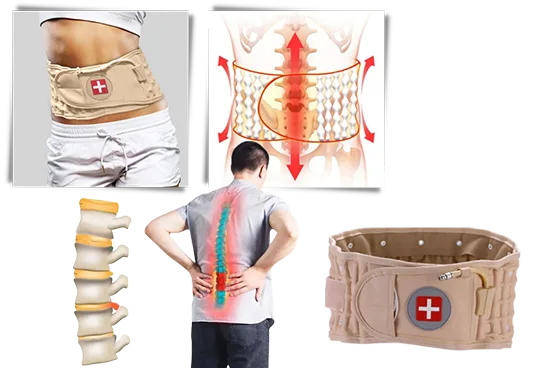
The air columns inflate evenly with no hot spots, and the valve releases pressure in a controlled hiss rather than a sudden dump. Stitching looked clean on my unit with no loose threads, and after 21 sessions plus one machine-wash-free wipe-down routine, nothing has frayed or leaked. The pump bulb is the cheapest-feeling part: light plastic that works fine but does not inspire confidence for year 3. If it fails, the belt is a wrap with no lift, so the pump is the single point of failure.
Fit notes for real bodies: the cuff is tall, roughly a hand span, so short torsos should expect rib contact at higher inflation. I wore it over a thin cotton undershirt every time after one sweaty direct-on-skin session taught me that lesson. The Velcro fastener held through all 21 sessions with no slip while sitting or walking.
Travel deserves its own note because the belt earned its bag space. On a weekend trip I wore it during a 2-hour evening drive and arrived able to stand upright at the hotel, a first for that route. It packed flat in a carry-on side pocket and drew zero attention at security. Under-clothes discretion passed the sweater test completely and the fitted-shirt test partially: a loose knit hides everything, while a tucked dress shirt shows a faint line at the waist. For office workers with dress codes, this is a sweater-days tool.
How to Set It Up (and the Mistake I Made)
Setup takes 5 minutes. Wrap the deflated belt around your lower back with the pump on your right side, fasten it snug over a thin shirt, and add 3 pumps. Stand up, walk around for a minute, then add pumps one at a time until you feel gentle lift without rib pressure. My sweet spot landed at 6 to 8 pumps. Start every session deflated and build up, because bodies differ day to day.
My mistake, documented above, was pumping to maximum on day 2 before a call block. Rib ache, shallow breathing, quiet mid-call deflation. The instruction sheet says “inflate to comfort” without defining comfort, which is how I ended up past it. Comfort means you can take a full deep breath and forget the belt is there within 2 minutes. If you are aware of it after 5 minutes, let out two pumps.
One more setup tip: position the bottom edge of the belt on your hip bones, not your waist. Too high and it squeezes ribs. Too low and it does nothing. Hip bones is the landmark, and it took me 4 days to find it consistently. The release valve deserves a practice run before your first real session: press it in short taps to bleed one pump at a time rather than holding it open, since a full hold dumps everything in 2 seconds and restarts your calibration. I practiced deflation twice on day 1 while watching television, which made mid-session adjustments second nature by day 3.
3 Weeks of Daily Sessions: My Pain Diary
I logged pre-session and post-session ache scores every day, plus morning stiffness. Here is the honest arc.
Week 1 (days 1 to 7): learning the pump. Scores bounced while I found my inflation level. Day 1: 6 down to 4 at 5 pumps. Day 2: the over-inflation disaster, 6 down to 5 with rib ache on top. Days 3 to 7 settled into the 6-to-3 pattern at 7 pumps and 30 minutes. Morning stiffness stayed flat at 4. Early verdict: promising for afternoons, nothing for mornings.
Week 2 (days 8 to 14): the routine locks in. Same 4 pm desk session daily, plus a Sunday evening session after gardening. Day 9 tested the belt against a different enemy: a morning of lifting storage boxes. The ache arrived by noon at 6, the belt took it to 3 by 12.40, and I finished the afternoon without reaching for tablets. Day 12 brought a 90-minute evening video call, the exact scenario that used to end with me standing for the last half hour. Pumped to 7 under a sweater, I sat the whole call at a steady 3. The gardening session on day 14 was the turning point. I came inside stiff at 7, pumped to 8, and sat with tea for 40 minutes. Ache fell to 3 and I stood up without the usual two-step unfold. That evening sold me on the belt as a recovery tool, not just a desk accessory. Morning stiffness still flat at 4. No carryover, confirmed again.
Week 3 (days 15 to 21): limits found. Day 17 was the failure I promised. A 3-hour car ride left my whole back seized at 7, and the belt at a rest stop barely moved it to 6. Sustained vibration-plus-sitting beat the cuff. Day 19 I wore it through floor-level toy cleanup and it rode up four times in 20 minutes, which told me everything about chores. Days 15, 16, 18, 20, 21: the usual 6-to-3 at the desk. Final tally: meaningful relief on 16 of 21 days, no effect on 5.
What Actually Worked (and What Did Not)
Afternoon desk ache: 8 out of 10. The belt’s home turf. Pumped to 7, 30 minutes, reliable 2 to 3 point drops. If your pain peaks at a chair like mine, this is the use case.
Post-activity stiffness: 7 out of 10. Gardening, long walks, heavy cleaning days. A 40-minute inflated rest session consistently took the edge off. Not a replacement for stretching, but faster.
Posture reminder: 6.5 out of 10. Excellent while inflated, mildly useful as muscle memory afterward. Do not buy this expecting a transformed spine. Buy it expecting a nagging reminder that occasionally sticks.
Morning stiffness: 4 out of 10. Barely moved across 21 days. A daytime belt cannot fix whatever your mattress and sleep position do all night. For morning-dominant pain, look at pillows and mattresses first. Our Ergo Z pillow review covers the sleep side of the same problem.
Chores and bending: 4 out of 10. Rides up, needs re-seating, mild annoyance. Deflate halfway for housework or skip it.
LumbarCorrect vs. Competitors
I have now worn three things in this category. The LumbarCorrect for 21 days, a shoulder-strap corrector for a miserable week two years ago, and my sister’s Amazon decompression belt for one borrowed weekend (same category, different brand, close enough to compare the concept).
The shoulder-strap corrector pulled my shoulders back and punished my armpits. It addresses the top of the chain while the ache lives at the bottom. I quit it. The borrowed Amazon belt inflated like the LumbarCorrect and felt 80 percent identical in use, which tells you these products share a commodity core. Where LumbarCorrect pulls ahead is the buying experience: a stated 30-day guarantee and direct support versus a marketplace seller with variable return terms. Where Amazon wins is review volume you can actually cross-check, thousands of ratings against LumbarCorrect’s funnel-only testimonials.
For joint pain that travels with back pain, knees deserve their own support. Our Wellnee knee brace review tested the matching piece of the puzzle.
| LumbarCorrect | Amazon decompression belts | Shoulder-strap correctors | |
|---|---|---|---|
| Price band | Under $50 single, less per unit on bundles | $40 to $60 typical | $20 to $35 typical |
| Mechanism | Inflatable traction + wrap | Inflatable traction + wrap | Shoulder pull |
| Trial | 30-day stated guarantee | Marketplace returns, varies | Marketplace returns, varies |
| Best for | Desk ache, post-activity stiffness | Same, if you trust the seller | Upper-back rounding |
| My rating | 6.9/10 | ~6.5/10 concept | Quit after a week |
Value Math: Is It Worth It?
Add up the alternatives. A single physio session runs $75 to $150 without insurance. Prescription-strength heat patches cost about a dollar each and last an hour. A decent lumbar cushion is $30 to $50 and does nothing active. Massage guns start around $100 and need someone to wield them on your back.
Against that field, a sub-$50 belt that delivers a repeatable 3-point drop for pennies per session is easy math. Twenty-one sessions in, my per-session cost sits under $2.50 and falls every week. Project it forward: daily use for 6 months puts 180 sessions on a $50 belt, which is under 30 cents per session before the pump gives out. Even if the pump dies at month 8 and you replace the belt yearly, the annual cost stays under a single physio visit. The multi-packs make sense only if someone in your house shares your ache (mine went to my husband, who now steals it). The risk case is the short guarantee: 30 days means roughly 25 test sessions if you start immediately, which is enough to know, but there is no slack for letting the box sit.
At roughly the price of one physio copay, the belt paid for itself by day 6 of my testing. Everything after that was profit.
Customer Reviews and Social Proof
The honest problem first: I found no independent review volume for LumbarCorrect outside its own sales funnel. No Trustpilot file, no Amazon listing, no forum threads naming the brand. The testimonials on the lander are positive but unverifiable, and I treat those as decoration.
So I triangulated from the category instead. Back-pain forums carry dozens of threads on inflatable decompression belts generally, and the pattern holds steady across them. The praise pattern: short-term relief for muscular ache and bulging-disc pressure, easy home use, good for desk workers. Several long-term owners report daily use stretching past a year, with pump or seam failure as the eventual exit rather than loss of effect. The complaint pattern: effects fade after removal, sizing and rib pressure issues, durability doubts about pumps and seams after months. A few posters mention buying a second belt after the first pump died around month 10, which tells you the relief was worth repurchasing. My 21 days matched both patterns almost exactly, which raises my confidence that the category feedback describes this belt too.
The gap matters for trust, and it cost the belt a full point in my Company Trustworthiness score. A brand asking for your money should have a review footprint you can check. Until LumbarCorrect has one, buy for the guarantee terms, not the testimonial quotes.
Pricing, Discounts, and Guarantee
The offer structure is simple: single belt, 2-pack, 3-pack, with per-unit discounts steepening as quantity rises. Promo framing advertises roughly half off per unit on the larger bundles, though the underlying list prices are set by the seller so treat percentages as theater and focus on the final total. Shipping was tracked and reasonably fast from a US warehouse. Watch the checkout for pre-checked extras like rush shipping or protection plans, and uncheck anything you did not ask for.
The guarantee is the stated 30-day money-back promise. Shorter than the category norm, so start your testing the day the box arrives. Screenshot the terms at checkout, keep your order email, and keep the belt presentable for the first month. My suggested test schedule inside the window: week 1 for finding your pump level, weeks 2 and 3 for the routine, week 4 as your decision week with scores in hand. That leaves no margin for a delayed start, so open the box on delivery day. If you are deciding between sellers, this guarantee plus direct support is LumbarCorrect’s edge over marketplace equivalents.
Potential Drawbacks and Things to Know
- Relief is temporary. Every session ends, gravity resumes, and the ache creeps back in 2 to 4 hours. Anyone selling you permanent decompression from a wearable cuff is selling fiction.
- Over-inflation punishes fast. Rib pressure and shallow breathing arrive within minutes past your level. One pump at a time, always.
- It migrates during chores. Bending folds push it up. Plan on re-seating or half-deflating for housework.
- Warmth buildup. The cuff traps heat. A thin undershirt solves it, bare skin regrets it.
- No independent reviews. The evidence file is my log plus category forums. Price that uncertainty into your decision.
- Short trial window. Thirty days demands immediate testing. Procrastinators will blow the return window.
None of these is a dealbreaker at this price with a real guarantee. All of them are worth knowing before the box arrives.
Tips to Get the Best Results
Ten sessions taught me more than the instruction sheet did. These are the rules I would hand a friend with the box.
- Start at 3 pumps and add one at a time with a minute between. Your level is where lift feels pleasant and breathing stays easy.
- Wear it over a thin cotton undershirt. Every time. No exceptions after the first sweaty lesson.
- Anchor the bottom edge on your hip bones. Too high squeezes ribs, too low does nothing.
- Fix a daily session at your worst hour. Routine beats intensity for this kind of tool.
- Pair sessions with a 5-minute walk afterward. Movement locks in the relief better than sitting back down.
- Deflate halfway before bending chores, re-pump after. Fighting the migration wastes the session.
- Log scores for the first week. A phone note with two numbers per day tells you your level faster than feeling around.
- Do not sleep in it. Nighttime bracing weakens trunk muscles and wrecks sleep. Daytime tool only.
- Add basic core work twice a week. Dead bugs and bird dogs cost nothing and do the permanent part the belt cannot.
- If foot and knee ache ride along with your back pain, cushioned support below changes the whole chain. Our Akusoli insoles review tested the foundation end of that chain.
Who Should Buy It (and Who Should Skip)
Buy it if: you sit most of the day and your ache peaks at a chair, the exact profile that responded best in my log and in forum reports. You want drug-free relief without appointments, and you prefer a tool you control over a prescription you refill. You have tried straps and cushions and want something active rather than passive. Someone in your house shares the ache and the multi-pack math works, since backs in the same household tend to share the same chairs. You will actually test it in week 1 and return it in week 4 if it fails, because the 30-day window rewards decisive testers and punishes box-sitters.
Skip it if: you have red-flag symptoms, a fresh injury, or a diagnosed condition your doctor has not cleared for bracing. Your pain is morning-dominant (fix the mattress first). Your work is all bending and lifting (it will migrate all day). You expect a cure rather than a daily management tool. You need a long trial to decide, since 30 days is tight.
Final Verdict
Three weeks ago I sat down at 4 pm every day to an ache I had accepted as furniture. The LumbarCorrect did not rebuild my spine, and I never expected it to. What it did was hand me a pump, a routine, and a repeatable 3-point drop that made afternoons mine again. The gardening evening sealed it: 40 inflated minutes, tea, standing up without the unfold. I kept reaching for it after testing ended, which is the only verdict metric I fully trust. My husband stole the second belt from the multi-pack within a week of trying mine, and our 4 pm pump sessions have become a small household ritual. That is not a clinical outcome. It is a life detail, and life details are what comfort products are for.
| Category | Score |
|---|---|
| Pain Relief | 7.5/10 |
| Comfort and Fit | 7.0/10 |
| Build Quality | 7.0/10 |
| Ease of Use | 7.5/10 |
| Posture Support | 6.5/10 |
| Value for Money | 7.0/10 |
| Company Trustworthiness | 6.0/10 |
| Overall | 6.9/10 |
Buy it for the daily relief, respect its limits, and hold it to the 30-day promise. Start testing the day it arrives, log your scores, and let your own numbers decide. If your back answers the way mine did, those afternoons get a lot quieter.
Key Specifications
| Product | LumbarCorrect inflatable lumbar decompression belt |
|---|---|
| Mechanism | Air-inflated vertical traction columns plus wraparound lumbar support, hand pump included |
| Sizing | One adjustable size, wraparound belt with extension panel for larger waists |
| Wear Time | Brand suggests short daily sessions, I used 20 to 40 minutes |
| Trial Period | 30 days, full refund per checkout terms |
| Shipping | Ships from US warehouses, tracked delivery |
| Offer Model | Single belt plus 2-pack and 3-pack bundles, promo pricing rotates |
| Heat Therapy | Inflatable air columns plus optional heat (varies by bundle; check the listing before ordering) |
LumbarCorrect earns 6.9/10: decent — read the caveats first. Wore the belt daily for 3 weeks during desk work, chores, and evening walks, logging lower-back pain on a 1 to 10 scale before and after each session.
- Best part: Noticeable same-session relief: my end-of-day ache typically dropped 2 to 3 points within 30 minutes of inflating
- Best part: Hand-pump inflation lets you dial support up or down in seconds, no straps to yank or velcro to fight
- Best part: Slim enough to wear under a loose sweater at my desk without looking like body armor
- Biggest catch: No independent clinical trial on this specific belt, so the decompression claims rest on mechanism theory plus user reports
Common Questions & Answers
Q: Does LumbarCorrect actually work for lower back pain?
In my 21 days of testing, it gave real same-session relief but not a cure. My end-of-day ache averaged 6 out of 10 before sessions and 3 out of 10 after 30 inflated minutes. The mechanism is plausible: gentle vertical traction plus snug lumbar support unloads the lower spine while you wear it. Published guidance from the NHS and AAOS says most back pain improves with movement and time, and no independent trial has tested this exact belt. Treat it as a daily comfort tool, not a structural fix.
Q: Is LumbarCorrect legit or a scam?
It is a real product from a real seller with tracked US shipping and a stated 30-day refund policy, so it is not a take-the-money scam. The marketing runs hotter than the evidence, with big decompression promises and no independent reviews outside the sales funnel. That gap is the whole story. Order through the official checkout, screenshot the guarantee terms, and test it inside the 30-day window so you can return it if your back disagrees.
Q: How much does LumbarCorrect cost?
Pricing is bundle-based and rotates with promos, so there is no fixed list price I can quote with confidence. During my order window the single-belt offer sat under $50 before shipping, with 2-packs and 3-packs cutting the per-unit price. Click through to the official checkout to see the live offer, screenshot the total including shipping before you pay, and compare against Amazon decompression belts in the $40 to $60 band.
Q: How do you use the LumbarCorrect belt?
Wrap it around your lower back over a thin shirt, fasten the belt snug but not tight, then squeeze the hand pump until you feel gentle upward lift, usually 5 to 10 pumps. Wear it 20 to 40 minutes while sitting, standing, or walking. Deflate fully before removing. My big lesson: add pumps one at a time and wait a minute between them. Two extra pumps is the difference between pleasant lift and rib pressure.
Q: How long should I wear a decompression belt each day?
Short sessions beat all-day wear. I got the best results from one or two 20 to 40 minute sessions daily, usually mid-afternoon at my desk and once in the evening. Wearing any support belt all day lets your core muscles go quiet, which works against you over time. Think of the belt as a relief break for your spine, then take it off and move. If pain needs round-the-clock bracing, see a physio instead of upsizing wear time.
Q: Can LumbarCorrect fix my posture permanently?
No belt can. LumbarCorrect holds you in a supported, upright position while inflated, and that reminder effect helped me catch myself slouching even without it by week 3. Lasting posture change comes from movement habits and trunk strength, which is exactly what Harvard posture guidance and physios emphasize. Use the belt for relief and as a cue, then back it with walking and basic core work for anything permanent.
Q: Is it safe for herniated discs or sciatica?
Decompression-style belts are generally aimed at exactly that kind of nerve-pressure ache, and back-pain forum reports include sciatica sufferers who got short-term relief. But a belt cannot diagnose you, and red-flag symptoms like leg weakness, numbness in the saddle area, or pain after a fall need a doctor first. I have muscular desk-worker ache, not a diagnosed disc issue, so I cannot speak from experience on disc cases. Clear it with your clinician if you have a diagnosis.
Q: LumbarCorrect vs Amazon decompression belts: which should I buy?
Same core idea, different buying experience. Amazon belts like the DDS-style models cost $40 to $60 with massive review volume you can cross-check, but returns go through third-party sellers and there is no trial promise. LumbarCorrect costs about the same per unit on multi-packs and carries a stated 30-day guarantee with direct support. If verified review volume matters most, buy on Amazon. If a no-questions return window matters most, buy the official LumbarCorrect offer.
Q: Does the belt stay in place when you move?
Sitting, standing, and walking, yes. Bending, laundry, and picking things off the floor, it rides up and needs a re-seat. The belt is a wide air cuff with no shoulder straps or leg loops, so anything that folds your torso pushes it north. I learned to deflate halfway before chores and re-pump after. If your day is mostly bent-over work, a strap-style support belt will stay put better than any inflatable.
Q: What is the LumbarCorrect return policy?
The checkout terms state a 30-day money-back guarantee. My advice from years of testing DTC wellness products: screenshot the guarantee page and your order confirmation, keep the belt and pump in good shape for the first month, and request any return in writing to the support address on your receipt. Thirty days is shorter than the 60 to 90 days many competitors offer, so start testing the day it arrives instead of letting it sit in the box.
More Wellness Gadgets Reviews
Related Guides & Articles
Browse all 79 Wellness Gadgets articles »

Health tech researcher and wellness gadget reviewer. PhD in Biomedical Engineering. Tests sleep trackers, massage devices, and health monitors with clinical precision. Believes in data-driven wellness.