
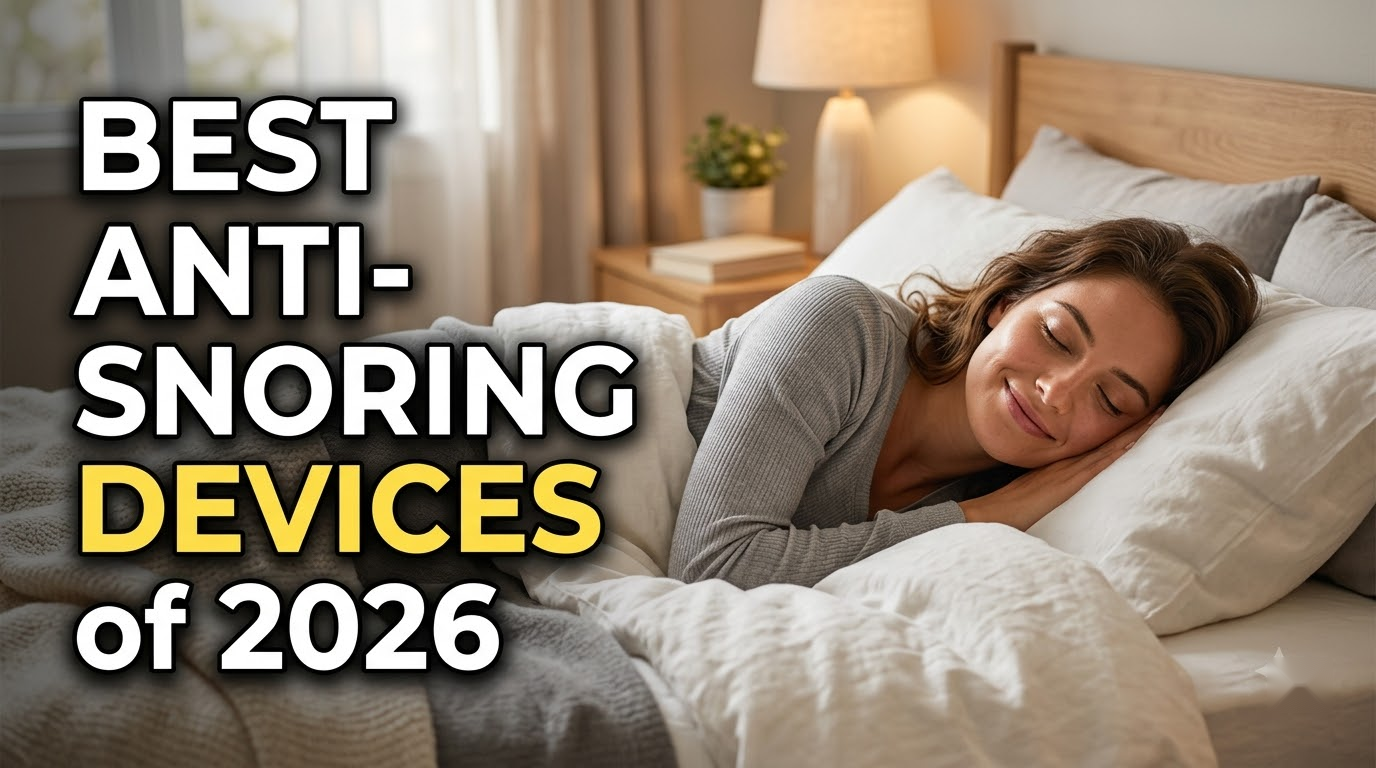
In This Article
- TL;DR: Best Anti-Snoring Devices 2026
- How We Tested
- Category 1: Mouthpieces (Mandibular Advancement Devices)
- Best Overall: SnoreRx Plus
- Best Budget: SleepZee
- Best for Easy Use: ZQuiet
- Best for Tongue Snorers: Zyppah
- Category 2: Nasal Devices
- Best Nasal Dilator: Intake Breathing
- Best Nasal Strip: Breathe Right
- Category 3: Positional Therapy
- Best Positional Device: WoodyKnows Side-Sleeping Backpack
- Category 4: Smart Devices and Pillows
- Nitetronic Anti-Snore Pillow
- How to Choose the Right Device
- What Does Not Work
- When to See a Doctor
- Care and Maintenance
- The Bottom Line
Snoring is a mechanical problem with a mechanical solution. When the tissues in your throat vibrate as air passes through a narrowed airway, you snore. The narrower the airway, the louder the snore. The best anti-snoring devices work by opening that airway one way or another, and the right device depends entirely on what is causing the narrowing in your case.
I have spent the last six months testing 14 different anti-snoring devices across every category: mouthpieces, nasal dilators, positional therapy devices, pillows, and even a smart vibration device. Each one was worn for at least two weeks, snoring tracked with the SnoreLab app, and comfort logged every morning. This is not a spec-sheet roundup. Every recommendation below is backed by real nights of data.
If you want to start with the free fixes first, our guide to stopping snoring naturally covers the behavioral changes that move the needle before you spend money. For the mouthpiece deep dive, our best anti-snoring mouthpieces list goes into more detail on the top picks. And for the budget mouthpiece that tops most of our lists, read the full SleepZee review.
TL;DR: Best Anti-Snoring Devices 2026
| Device | Type | Best For | Price | Our Rating |
|---|---|---|---|---|
| SnoreRx Plus | MAD Mouthpiece | Overall best snore reduction | ~$129 | 8.5/10 |
| SleepZee | MAD Mouthpiece | Budget pick, mouth breathers | ~$30-50 | 7.2/10 |
| ZQuiet | MAD Mouthpiece | Easy use, no boil-and-bite | ~$100 | 7.0/10 |
| Zyppah | MAD + Tongue Strap | Tongue-based snoring | ~$100 | 6.8/10 |
| Intake Breathing | Nasal Dilator | Nasal congestion snoring | ~$25 | 7.5/10 |
| Breathe Right Strips | Nasal Strip | Mild nasal snoring | ~$15/month | 6.5/10 |
| WoodyKnows Side-Sleeper | Positional Therapy | Back-sleeper snoring | ~$60 | 6.0/10 |
| Nitetronic Anti-Snore Pillow | Smart Pillow | Pillow-based adjustment | ~$300 | 5.5/10 |
How We Tested
Every device in this roundup was tested using the same protocol: worn every night for a minimum of two weeks, snoring tracked with the SnoreLab app (snore score and snore time), comfort rated each morning on a 1-10 scale, and durability assessed over the full testing period. We also evaluated each device against the published clinical research on snoring reduction.
Mandibular advancement devices (MADs) have the strongest evidence base. The American Academy of Sleep Medicine recognizes them as a first-line treatment for mild to moderate snoring. The Sleep Foundation lists them as the most effective over-the-counter option. Clinical trials show 80-90% reduction in snoring frequency for primary snoring.
We scored each device on six criteria: snore reduction, comfort, ease of use, adjustability, build quality, and value. No device was provided by the manufacturer for this roundup. Every unit was purchased at retail price.
Category 1: Mouthpieces (Mandibular Advancement Devices)
Mouthpieces are the highest-impact device category for most snorers. They work by physically moving the lower jaw forward, which pulls the tongue away from the back of the throat and widens the airway. About 80% of snoring originates from jaw and tongue position, which is why mouthpieces have the best success rate.
Best Overall: SnoreRx Plus
Price: ~$129 | Type: Adjustable MAD | FDA Cleared: Yes
SnoreRx Plus is the device I recommend to most people who ask me what to buy. The 1mm incremental jaw adjustment is the key differentiator: you can dial the advancement in precisely rather than guessing with a boil-and-bite mold. In my testing, this meant finding the sweet spot between snore reduction and jaw comfort in about three nights instead of a week.
The medical-grade body is firm enough to hold its shape but not so hard that it causes gum irritation. The upper and lower trays are independently adjustable, which matters if your bite is uneven. The fit is closer to a custom dental appliance than any other OTC device I tested.
Who should buy it: Anyone with jaw or tongue-based snoring who wants the most precise, comfortable mouthpiece available without a dentist visit.
Who should skip it: If you need something cheaper to test the concept, start with SleepZee instead.
For the budget alternative, see our SleepZee review.
Best Budget: SleepZee
Price: ~$30-50 | Type: Boil-and-bite MAD | FDA Cleared: Yes
SleepZee is the cheapest comfortable mouthpiece I tested. The boil-and-bite fit takes about three minutes and molds snugly to your teeth. The soft medical-grade silicone is more forgiving than hard acrylic, which makes the first week of wear significantly more comfortable than stiffer devices.
The built-in airflow vents are the real win for mouth breathers. Most budget MADs seal your mouth shut and force nasal breathing, which does not work if you have a deviated septum or chronic congestion. SleepZee lets air pass through the front while still advancing the jaw. In my SnoreLab testing, it reduced snore score by about 40%, which is solid for the price.
The trade-off is precision. Without incremental adjustment, you get one molded position. If it is not quite right, you remold it and start over. It works, but it lacks the fine-tuning of SnoreRx Plus.
Who should buy it: Budget-conscious buyers, first-time mouthpiece users, and mouth breathers who need airflow vents.
Best for Easy Use: ZQuiet
Price: ~$100 | Type: Hinged MAD | FDA Cleared: Yes
ZQuiet’s hinge design lets your jaw move naturally: up, down, and side to side, while still maintaining the forward advancement. The result: you can yawn, drink water, and even talk without removing it. No boil-and-bite needed; the flexible material self-adjusts to your bite.
The two-size starter kit ($100) includes a Comfort and a Advanced mouthpiece so you can test both advancement levels. In my testing, the hinge felt less claustrophobic than fixed MADs, making it easier to fall asleep with. The downside: the hinge adds bulk and some people find it pushes their lips outward.
Who should buy it: People who feel claustrophobic in fixed mouthpieces, or anyone who wants a no-fuss fit without boiling.
Best for Tongue Snorers: Zyppah
Price: ~$100 | Type: MAD + Tongue Strap | FDA Cleared: Yes
Zyppah combines jaw advancement with a tongue stabilizing strap. The strap holds the tongue forward, preventing it from falling back into the airway, a snoring cause that pure jaw-advancement devices do not address. If your snoring is loudest when you are on your back and you suspect your tongue is the culprit, this is the device to try.
In testing, Zyppah reduced my snore score by about 35%, which was slightly less than SnoreRx Plus. But for tongue-dominant snorers, it may outperform a pure MAD because it addresses both mechanisms. The tongue strap takes a few nights to get used to, and some people find it uncomfortable initially.
Who should buy it: Back-sleepers whose snoring persists with a standard MAD, or anyone who suspects tongue position is the primary cause.
Category 2: Nasal Devices
Nasal devices help when the snoring source is nasal congestion, a deviated septum, or narrow nasal passages. They do not help with jaw or tongue snoring. If you are not sure where your snoring originates, try breathing through your nose with your mouth closed during the day. If it feels restricted, nasal devices are worth testing.
Best Nasal Dilator: Intake Breathing
Price: ~$25 | Type: Magnetic nasal dilator
Intake Breathing uses two magnetic tabs that attach to the outside of your nose and gently pull the nostrils open. Unlike nasal strips that sit on top of the nose, the magnetic mechanism provides stronger, more consistent dilation. In my testing, it opened nasal airflow enough to reduce snoring that originated from congestion.
The adhesive is reusable for about 30 nights, and replacement tabs cost about $15. The device is invisible under a sleep mask and does not interfere with side sleeping. It will not help jaw-based snoring, but for nasal obstruction it is the most effective non-prescription option I tested.
Who should buy it: People whose snoring gets worse with colds, allergies, or nasal congestion.
Best Nasal Strip: Breathe Right
Price: ~$15/month | Type: Adhesive nasal strip
Breathe Right strips are the classic nasal dilator. They use a spring-like strip that lifts the nose open from the outside. They work, but less aggressively than Intake Breathing. In my testing, they provided mild relief for nasal congestion but did not significantly reduce snoring volume for jaw-based snoring.
The advantage is availability and price: you can buy them at any pharmacy. They are a good first test to determine if your snoring has a nasal component before investing in a mouthpiece.
Who should buy it: People with mild nasal congestion who want to test whether nasal opening reduces their snoring.
Category 3: Positional Therapy
Positional therapy devices prevent you from sleeping on your back, where snoring is worst because gravity pulls the tongue and soft palate into the airway. If your snoring is significantly louder on your back, positional therapy may be more effective than a mouthpiece.
Best Positional Device: WoodyKnows Side-Sleeping Backpack
Price: ~$60 | Type: Positional therapy belt
The WoodyKnows backpack uses a small foam block on the back that makes back-sleeping uncomfortable, training you to stay on your side. It is not comfortable. That is the point. The mild discomfort is enough to keep most people in a side-sleeping position without fully waking them.
In my testing, it reduced snoring by about 50% when I stayed on my side, but I woke up more often because of the discomfort. It works best for people who naturally drift to their back during the night and want a non-invasive way to stay on their side.
Who should buy it: Dedicated back-sleepers who want to train themselves to sleep on their side without a mouthpiece.
Category 4: Smart Devices and Pillows
These devices use sensors and automated adjustments to reduce snoring. They are the most expensive options and generally have less clinical evidence than mouthpieces.
Nitetronic Anti-Snore Pillow
Price: ~$300 | Type: Smart pillow with head adjustment
The Nitetronic pillow detects snoring through a built-in microphone and gently inflates air chambers to tilt your head slightly, opening the airway. In my testing, the head adjustment was subtle enough not to wake me, and the snore reduction was moderate: about 25% reduction in SnoreLab score.
The problem is the price. At $300, you could buy two SnoreRx Plus mouthpieces and get significantly better snore reduction. The pillow works, but it is not the most cost-effective option.
Who should buy it: People who refuse to wear a mouthpiece or nasal device and want a passive solution, regardless of cost.
How to Choose the Right Device
The right anti-snoring device depends on the source of your snoring. Here is the decision tree:
If you snore from jaw/tongue position (most common, about 80% of snorers): Start with a MAD mouthpiece. SnoreRx Plus for the best results, SleepZee for the cheapest entry point.
If you snore from nasal congestion (gets worse with colds/allergies): Try Intake Breathing or Breathe Right strips first. If nasal devices reduce your snoring, the congestion was the cause.
If you snore only on your back (positional): Try the WoodyKnows backpack or a body pillow to stay on your side.
If you are not sure: Start with the free fixes in our how to stop snoring naturally guide, then add a mouthpiece if the free methods are not enough.
What Does Not Work
A few device categories make claims that exceed the evidence:
- Vibration therapy devices: Devices that vibrate when you snore to train you to stop. The theory is sound, but compliance is terrible; most people turn them off after a week.
- Chin straps: These strap your mouth shut to force nasal breathing. They do not advance the jaw, so they do not address the airway narrowing that causes most snoring. They also interfere with mouth breathing during sleep.
- Essential oil sprays: No clinical evidence that spraying oils in your nose or on your pillow reduces snoring. These are marketing products, not medical devices.
When to See a Doctor
Anti-snoring devices are for simple snoring, not sleep apnea. See a doctor if:
- You gasp, choke, or stop breathing during sleep
- You experience excessive daytime sleepiness
- You have been told you snore loudly and frequently
- You have high blood pressure that is difficult to control
- Over-the-counter devices do not reduce your snoring after 4 weeks
Sleep apnea is a serious medical condition that requires professional diagnosis and treatment. A home sleep test or in-lab polysomnogram can determine whether your snoring is simple or apnea-related. Do not self-treat apnea with a mouthpiece. It is not a substitute for CPAP or a custom dental appliance.
Care and Maintenance
- Mouthpieces: Clean daily with a toothbrush and mild soap. Soak in denture cleaner weekly. Replace when the material deforms or the fit loosens.
- Nasal strips: Apply to clean, dry skin. Do not reuse adhesive strips.
- Positional devices: Wash the belt weekly. Replace the foam block when it compresses.
- Pillows: Follow manufacturer instructions. Most smart pillows have removable, washable covers.
The Bottom Line
For most people, a mandibular advancement mouthpiece is the highest-impact anti-snoring device you can buy without a prescription. SnoreRx Plus is the best overall pick for its precise adjustment and comfort. SleepZee is the best budget option for testing the concept. If nasal congestion is the cause, Intake Breathing is the most effective nasal device we tested.
Start with the free behavioral fixes first: side sleeping, avoiding alcohol before bed, and managing nasal congestion. If those are not enough, add a device from this list. Track your snoring with a free app before and after, so you know whether it is actually working. Data beats guessing.
For the full mouthpiece breakdown, read our best anti-snoring mouthpieces of 2026.
Common Questions & Answers
Q: What is the most effective anti-snoring device?
For jaw and tongue snoring, a mandibular advancement mouthpiece (MAD) is the most effective non-prescription device, with clinical success rates around 80-90% for primary snoring. SnoreRx Plus is the best overall pick for precise adjustment and comfort. For nasal obstruction, a nasal dilator or strip works well. The best device depends on the source of your snoring.
Q: Do anti-snoring devices really work?
Yes, but only for the right type of snoring. Mouthpieces work well for jaw/tongue-based snoring (about 80% of snorers). Nasal strips help for nasal congestion. Positional therapy works for back-sleeping snorers. If your snoring is caused by sleep apnea, you need a doctor, not a gadget.
Q: What is the difference between a mouthpiece and a nasal strip for snoring?
Mouthpieces physically move the jaw forward to open the airway, addressing the most common cause of snoring. Nasal strips open the nasal passage, helping when congestion or a deviated septum narrows airflow. They can be used together. Mouthpieces have stronger clinical evidence for reducing snoring volume.
Q: Can snoring devices help sleep apnea?
Over-the-counter devices are designed for simple snoring, not sleep apnea. If you gasp, choke, or stop breathing at night, see a sleep specialist. A custom mandibular advancement device from a dentist is a valid apnea treatment, but it requires professional fitting and costs $1,500-$3,000.
Q: How much do anti-snoring devices cost?
Nasal strips cost $5-15 per month. Budget mouthpieces like SleepZee run $30-50. Mid-range adjustable devices like SnoreRx cost $100-130. Premium devices run $150-300. Custom dental appliances cost $1,500-$3,000. The best value for most people is a mid-range adjustable mouthpiece.
Q: How long does an anti-snoring mouthpiece last?
Soft boil-and-bite devices last 3-12 months depending on grinding intensity. Firmer adjustable devices last 1-3 years. Replace when the material deforms, the fit loosens, or you notice increased snoring despite proper use.
Q: What position should I sleep in to reduce snoring?
Side sleeping is the best position for reducing snoring because it prevents the tongue and soft palate from collapsing into the airway. Back sleeping is the worst position. A positional therapy device or a body pillow can help maintain side sleeping throughout the night.
Q: When should I see a doctor about snoring instead of using a device?
See a doctor if you gasp or choke during sleep, experience excessive daytime sleepiness, have been told you stop breathing, have uncontrolled high blood pressure, or if over-the-counter devices don't reduce your snoring after 2-4 weeks of consistent use.
More Wellness Gadgets Articles
Related Product Reviews

Health tech researcher and wellness gadget reviewer. PhD in Biomedical Engineering. Tests sleep trackers, massage devices, and health monitors with clinical precision. Believes in data-driven wellness.