
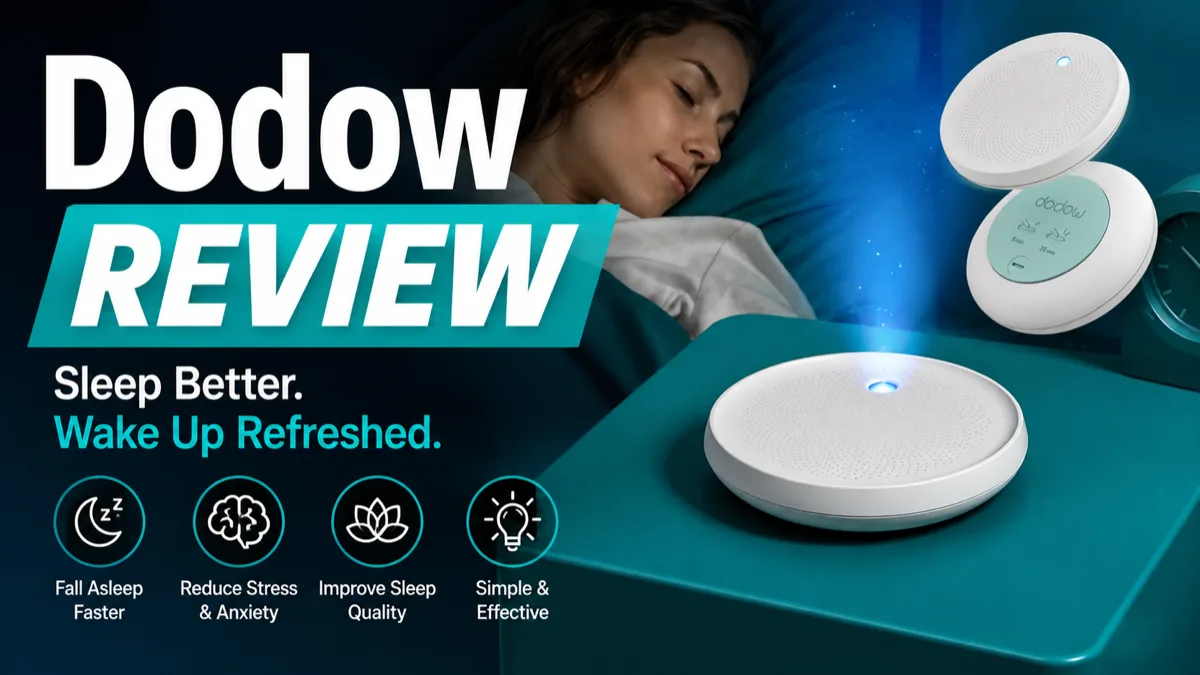
Two of the most-recommended drug-free sleep aids, and they could not be more different under the hood. Dodow is a little light you set on the nightstand that projects a slowly pulsing glow on your ceiling, and you breathe out in time with it to slow your racing mind. The Sleep Ease Calming Mask is a mask you strap on and sleep in, using total blackout, gentle heat, a subtle vibration pulse, and weighted pressure to do the same job through touch instead of breath. I have run 21 nights with each, tracking my lights-out to sleep time with a stopwatch every morning, so this comparison comes from two actual sleep logs.
The short version is that both helped me fall asleep faster, but they fail in different places. Dodow is the pick if you cannot stand anything on your face and you sleep on your back. Sleep Ease is the pick if you want darkness, warmth, and pressure, and if lying awake at 3 a.m. is part of your problem. The middle of that sentence is where most people actually live, so let me lay out the whole thing.
TL;DR: Sleep Ease vs Dodow at a Glance
| Sleep Ease Calming Mask | Dodow | |
|---|---|---|
| What it is | All-night blackout sleep mask | Nightstand breathing light |
| Touches you? | Yes, worn all night | No, sits on the nightstand |
| Mechanism | Blackout plus heat, pressure, vibration | Paced-breathing blue light on ceiling |
| Sleep position | Any, including side | Mostly back sleepers |
| Helps fall asleep | Yes | Yes |
| Helps middle wake-ups | Yes | No |
| Drug-free | Yes | Yes |
| Guarantee | 30 nights | 100 nights |
| Rough price | Rotating 50% off bundles | Around $59 |
| Best for | Racing thoughts, light sleepers, 3 a.m. wake-ups | People who hate wearables, back sleepers |
Cannot stand anything on your face, and you sleep on your back? Dodow. Want blackout plus heat and pressure, and something still working at 3 a.m.? Sleep Ease.

The Two Mechanisms: Breath Versus Touch
Dodow’s whole idea is paced breathing. You lie on your back, look up at a soft blue light that expands and contracts on a metronome rhythm, and you exhale slowly each time it dims. Matching your breath to a slow external pace shifts your nervous system toward the parasympathetic side, the rest-and-digest state, which is a real and well-understood route to sleep. It is elegant, and it never touches you. The catch is attention: the technique only works while your mind is willing to follow the light, and a genuinely racing brain sometimes refuses to look up for 8 minutes straight.
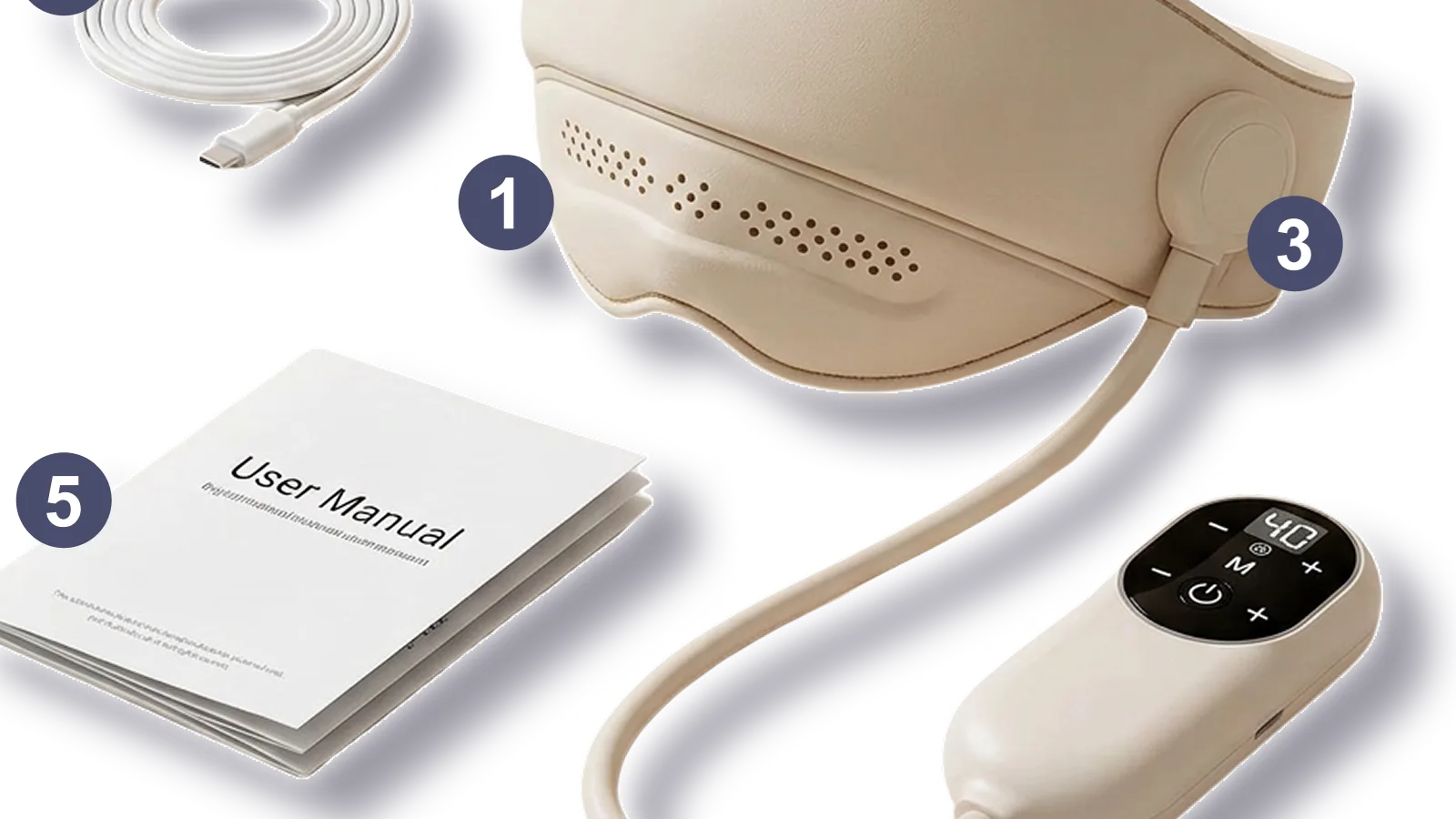
Sleep Ease works through sensation. The mask seals total darkness around your eyes, then gentle heat builds over a couple of minutes and a soft vibration pulses while weighted pressure settles across your forehead and cheekbones. Instead of asking your mind to focus on a light, it gives your body something physical to relax into. In my 21-night log, that combination dropped my sleep onset from about 45 minutes in week 1 to around 25 minutes by week 3. My own read is that the passive, physical approach holds up better on the nights when your brain is least willing to cooperate, because it does not depend on your attention at all.
Both are drug-free and non-habit forming, with none of the morning grogginess that pushed me off melatonin in the first place.
Common Questions & Answers
Q: What is the main difference between Sleep Ease and Dodow?
The mechanism and the form factor. Dodow is a small device you put on the nightstand that projects a slowly pulsing blue light on the ceiling, and you match your exhales to the pulse to pace your breathing and quiet your mind. It never touches you. Sleep Ease is a mask you wear all night that combines total blackout, gentle heat, subtle vibration, and weighted pressure to calm you through touch and darkness instead of breath.
Q: Which works better for falling asleep faster, Sleep Ease or Dodow?
Both shortened my sleep onset, but by different amounts and through different levers. Sleep Ease cut my lights-out to sleep time from roughly 45 minutes to about 25 minutes over 21 nights. Dodow helped most when I actively followed the breathing pace and less on nights I could not keep my attention on the light. If you can commit to watching a breathing light, Dodow helps; if you would rather have your attention captured by warmth and pressure, Sleep Ease is more passive and more reliable.
Q: Does Dodow help with waking up in the middle of the night?
No, and this is its biggest limitation. Dodow only trains the transition from awake to asleep at the start of the night. In my testing it did nothing for middle-of-the-night wake-ups. The Sleep Ease mask reduced my wake-ups from roughly 3 per night to about 1, because the blackout, pressure, and warmth are still on your face at 3 a.m. If you wake and lie awake, only the Sleep Ease is still working.
Q: I hate anything on my face. Which should I get?
Dodow, and it is not a close call. Dodow sits on your nightstand and touches nothing. If you cannot stand a mask, no feature on the Sleep Ease overcomes that, and it will end up in a drawer. Dodow is the whole category of sleep device for people who reject wearables, and its 100-night money-back guarantee makes trying it genuinely low risk.
Q: Which is better for side sleepers?
Sleep Ease. Dodow is a light on your ceiling that you watch while lying on your back, so it effectively requires a back-sleeping position with a line of sight upward. The Sleep Ease mask works in any sleep position, and after a week of strap tuning it held its seal for me whether I was on my back or my side.
Q: Do either of them work for people with high ceilings?
Dodow struggles there. The projected light gets fainter as the distance to the ceiling grows, and my review found high ceilings make the pulse hard to follow, which undercuts the whole breathing-pacing trick. Sleep Ease has no ceiling at all, so it works the same in a bunk, a basement, or a hotel with a low soffit.
Q: Are both Sleep Ease and Dodow drug-free?
Yes. Neither uses a pill, supplement, or habit-forming ingredient, and both are non-habit forming with no next-day grogginess. That shared trait is why they land in the same conversation. They differ in how they calm you: Dodow uses paced breathing, Sleep Ease uses blackout, gentle heat, and weighted pressure. The Sleep Foundation notes that breathing and relaxation techniques are a legitimate drug-free route to sleep, which is the principle Dodow is built on.
Q: Why does Dodow cost around $59 for what is basically a light?
You are paying for the breathing-pacing design, the research behind the technique, and a 100-night guarantee, not for complex hardware. My honest read is that $59 is expensive for a light and a timer, and it is the main reason Dodow scored lower on value in my review. Sleep Ease costs more but bundles heat, massage, weight, and blackout into the single purchase, so the per-feature math is friendlier.
Q: Can I use Sleep Ease and Dodow together?
You can, but they overlap more than they complement. Both target the same problem, the awake-to-asleep transition, so stacking them is usually redundant. The one useful combination: use Dodow for a few weeks to build a consistent wind-down habit, then switch to the Sleep Ease if you find you also want blackout against light and something still helping at 3 a.m.
Q: Which has the better guarantee?
Dodow, clearly. It carries a 100-night money-back guarantee, which is more than three times the Sleep Ease window. The Sleep Ease offers 30 nights, which is enough to judge the wind-down effect since results build over about two weeks, but it is short for a sleep product. If a long trial matters to your decision, Dodow removes more of the risk.
More Wellness Gadgets Articles
Related Product Reviews

Health tech researcher and wellness gadget reviewer. PhD in Biomedical Engineering. Tests sleep trackers, massage devices, and health monitors with clinical precision. Believes in data-driven wellness.