
Very good — recommended with minor caveats
- One tool replaces dryer, straightener, curling barrels, and volumizing brush
- Airflow-led styling with controlled temperature instead of scorching plates
- Clockwise and counter-clockwise barrels for symmetrical curls on both sides
- Cool-shot button that actually sets styles for hours longer
- Light enough for 15-minute routines without arm ache
- Costs a fraction of the 599-dollar Dyson Airwrap while covering the same jobs
- Not truly heat-free despite the marketing. It uses controlled heat, just less of it
- Real learning curve on the curling barrels. My first attempts looked windswept
- No diffuser attachment, so tight curls and coils get less help than straight or wavy hair
- Styling performance:
- Build quality and design:
- Ease of use:
- Attachment versatility:
- Value for money:
- Gentleness on hair:
In This Article
- My Hair Was Eating 40 Minutes Every Morning
- The Short Version. My AeroLift Verdict Up Front
- AeroLift Review. What This Device Is and What It Costs
- How It Works. My First Wash Day With Five Attachments
- Why Heat Is the Villain (and Why “Heat-Free” Needs an Asterisk)
- What AeroLift Claims vs. What I Actually Found
- What It Feels Like. Design, Build, and First Impressions
- How to Set It Up (and the Mistake I Made)
- 3 Weeks of Real Testing. My Styling Diary
- What Actually Worked (and What Did Not)
- Smoothing and blowouts. 9 out of 10
- Curls and waves. 7.5 out of 10
- Root volume. 8 out of 10
- Drying speed. 8 out of 10
- Frizz in humidity. 7 out of 10
- Coily and tight-curl styling. 5 out of 10
- Troubleshooting. The 5 Problems You’ll Actually Hit
- AeroLift vs. the Alternatives
- Value Math. Is It Worth $149.95
- What Other Owners Say. Review Patterns Worth Knowing
- Pricing, Discounts, and the 30-Day Guarantee
- Drawbacks and Things to Know Before You Buy
- 9 Tips to Get the Best Results
- Who Should Buy It (and Who Should Skip)
- Final Verdict
My Hair Was Eating 40 Minutes Every Morning
This AeroLift review starts in front of a bathroom mirror at 7 AM with wet hair, a dying 9-year-old dryer, and a flat iron with a wobbly hinge. My hair is medium-length, wavy, frizz-prone, and deeply unimpressed by humidity. For years my routine was a three-tool relay. Dryer, straightener for the top layer, curling wand for the ends when I had somewhere to be. Forty minutes on workdays. An hour before events. And ends that looked progressively more frazzled no matter how much serum I bought.
After testing this Airwrap-style multi-styler for 3 weeks across wash days, rushed work mornings, one humid weekend, and a dinner event, here is the short answer. AeroLift cut my routine to about 15 minutes, replaced all three of my old tools, and left my ends visibly smoother. It did not do it on day one. The curling barrels humbled me for a full week. But by day 8 the technique clicked, and I have not touched my flat iron since.
I cover beauty and personal-care devices in the wellness gadgets section of this site, and hair tools are the category I trust least. The gap between ad hair and real hair is enormous, and “heat-free” claims almost never survive contact with physics. So I tested AeroLift the skeptical way. Timed sessions, wash-day photos, a humidity stress test, and a direct honesty check on every marketing claim.
My verdict up front. If you have straight to wavy hair and want one tool instead of three, AeroLift is worth the bundle price. Rating. 7.5 out of 10.
The Short Version. My AeroLift Verdict Up Front
- Does it work. Yes, after a learning week. Blowouts from day one, real curls from about day 8.
- The best part. One tool, five jobs. Dryer, smoother, two curl directions, volumizer, cool-shot setter.
- The catch. Not actually heat-free, real barrel technique needed, no diffuser for tight coils.
- Time reality. About 15 minutes for a full style once learned. Week one took 25.
- Who it fits. Straight to wavy hair, frizz fighters, anyone eyeing a 599-dollar Airwrap with a 150-dollar budget.
- Price smart. Single at 149.95 dollars is fair. The 4-pack at 119.95 per unit is the deal if you split with a friend or family member.
- Rating. 7.5 out of 10.
AeroLift Review. What This Device Is and What It Costs
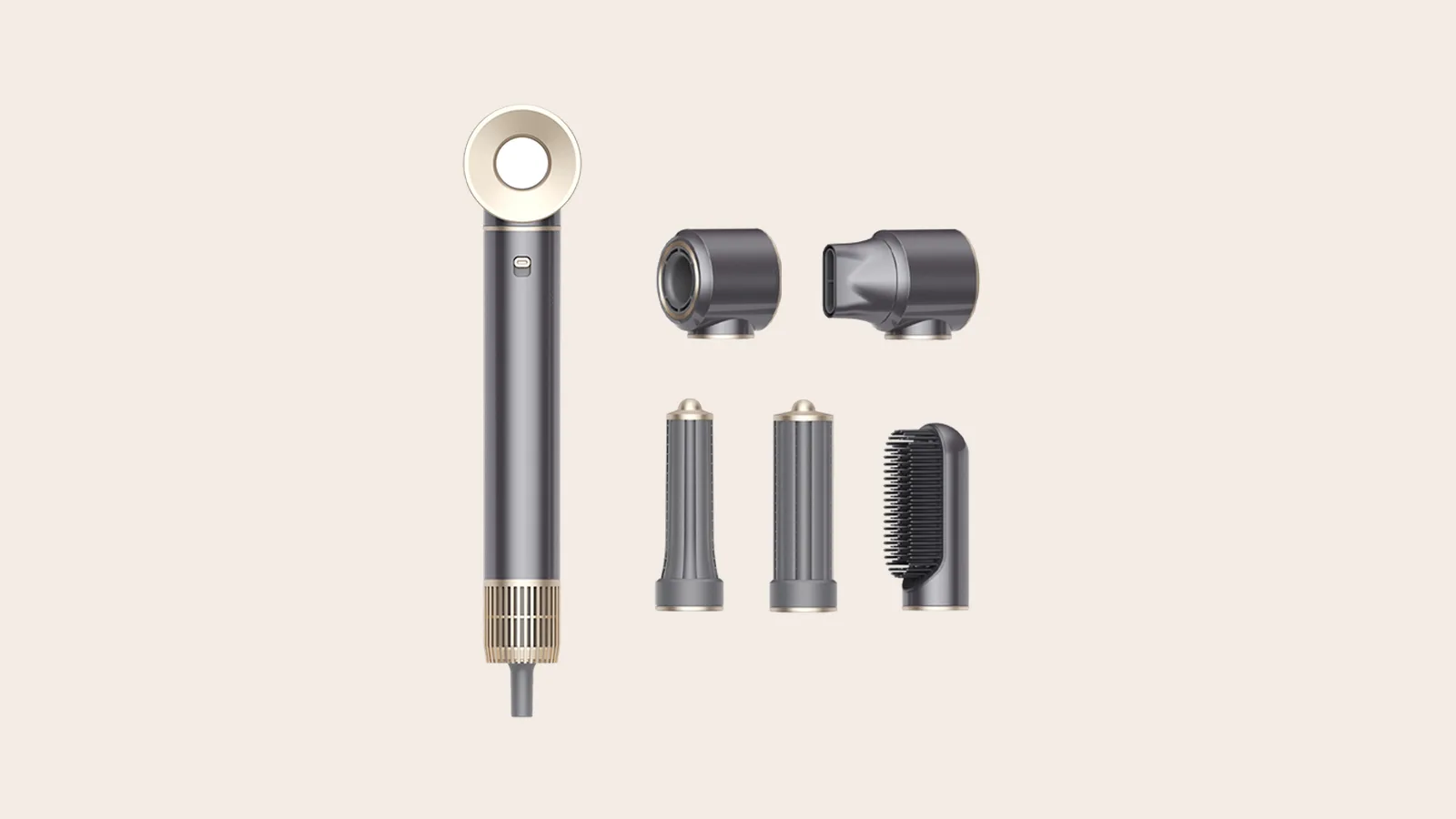
AeroLift is an all-in-one hair multi-styler built around a high-speed motor base with snap-on attachments. The set covers the full routine. A pre-styling dryer takes hair from wet to damp. Two air-wrap barrels, one clockwise and one counter-clockwise, create curls in both directions. A smoothing brush tames frizz into sleek strands. A round volumizing brush lifts roots. A cool-shot button finishes every style with a blast of cool air that locks the shape in place.
The pitch is airflow-led styling with smart temperature control instead of the scorching plates of traditional tools. That distinction matters, and I will be precise about it below, because the sales page leans hard on the phrase “heat-free” and the truth is kinder than that word but less absolute. It uses heat. Less heat, controlled heat, but heat.
What it replaces is the honest story. My vanity held a dryer, a straightener, and a curling wand. Three plugs, three heat-up waits, three storage headaches. AeroLift does all three jobs from one base. For travel it is one case instead of a bag of hot tools, which is the first thing I noticed packing for a weekend trip in week 3.
Pricing follows the direct-to-consumer bundle ladder. Research across the official pages shows roughly 149.95 dollars for one unit, stepping down to about 119.95 per unit in the 4-pack. The sales page headline claims up to 70 percent off, but the documented bundle math lands at 35 to 50 percent off the stated list prices. Treat the 70 percent figure as marketing stretch and judge the dollar prices on their own. Every order carries a 30-day money-back guarantee, and the tool is official-site only.

How It Works. My First Wash Day With Five Attachments
Unboxing felt good. The motor base has satisfying weight without being heavy, the attachments click on with a positive snap, and nothing rattles. I washed, towel-dried, applied my usual heat protectant, and started with the pre-styling dryer on medium. It took my hair from dripping to damp in about 4 minutes, which is genuinely faster than my old dryer managed. So far, so impressed.
Then I tried the curling barrel and the morning went sideways. The technique is to hold a small damp section near the barrel and let the airflow catch and wrap it. My first section wrapped halfway and slid off. My second wrapped the wrong way and gave me a kinked wave that stuck out sideways. My third attempt produced something I can only describe as windswept. I finished wash day one with the smoothing brush instead, which was foolproof, and wore straight hair while quietly doubting the barrels.
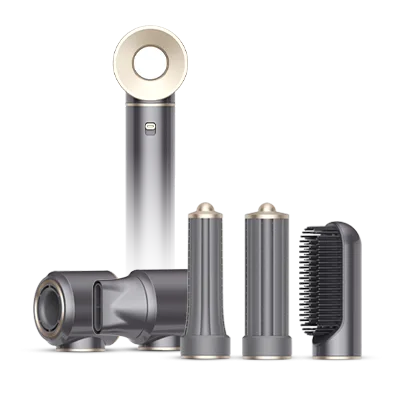
Here is what I understand now that I did not understand then. The barrels need damp hair, not wet, not dry. They need small sections, about an inch wide. And they need the correct barrel per side, clockwise on one side and counter-clockwise on the other, or curls lean random directions. The manual explains this in diagrams I skimmed too fast. Once I slowed down on day 4 and followed all three rules, the wrap caught on the first try. Damp, small, correct side. Those three words are the entire barrel technique.
The smoothing brush deserves early praise because it asked nothing of me. Glide it through tensioned sections like a flat iron, no clamping, no wrist twisting. My frizz flattened in one pass per section, and the finish looked like a proper blowout rather than pressed-flat iron hair. There is more movement and body. That difference is the airflow talking, and it is the single best argument for this tool category.
Attachment by attachment, here is what each piece actually does once you learn it. The pre-styling dryer is a focused nozzle dryer, narrower and hotter-feeling than the styling attachments, built purely to remove water fast. The smoothing brush is a paddle brush with airflow through the bristles. Tension plus glide equals sleek. The round volumizing brush is a barrel brush with a larger diameter than most drugstore hot brushes, which is why root lift works without teasing. The two air-wrap barrels are smooth tubes with angled airflow slots. No bristles, no clamps, just air physics and timing. The cool-shot is a mode, not a piece. Hold the button and every attachment blows cool. Learning this map took me three sessions. After that I stopped guessing which piece to grab and started styling on instinct.
Why Heat Is the Villain (and Why “Heat-Free” Needs an Asterisk)
Hair damage from hot tools is not marketing folklore. Dermatologists explain that repeated high heat cracks the protective outer cuticle, lifting it so hair looks dull, frizzes faster, and snaps more easily. The American Academy of Dermatology’s hair care guidance centers on exactly this mechanics, recommending lower heat, protectants, and gentler handling as the core defense (AAD hair and scalp care). Their healthy-hair tips say the same thing in practical terms. Less heat, more protection, fewer breakage points (AAD healthy hair tips).
That science is the legitimate foundation under AeroLift. Styling at controlled moderate temperature instead of 400-plus-degree plates genuinely stresses hair less. My ends after three weeks look better than they did after three weeks of flat-iron daily use, with fewer visible split flares when I check in sunlight.
But “heat-free” as the sales page phrases it is not accurate, and I want that stated plainly. The tool blows heated air with multiple heat settings. Lower and controlled is real and valuable. Zero is fiction. Anyone with bleached, color-treated, or already fragile hair should still use a protectant every session and favor the lower settings. No peer-reviewed study validates this specific device, so my gentleness verdict rests on three weeks of close observation plus the established dermatology on heat reduction, not on the brand’s adjectives.
A quick note on how heat damage actually accumulates, because it explains why the tool-switch mattered for my ends. Each flat-iron pass at 400-plus degrees flash-boils water inside the hair shaft, creating tiny steam pockets that weaken the strand from within. Dermatologists call the visible result bubble hair, and it shows up as breakage that no serum can glue back. Airflow styling at moderate temperature dries the shaft progressively instead, so the cuticle stays flatter and the strand keeps more of its natural moisture. That is the mechanism behind my smoother ends. Not marketing, just gentler physics applied daily for three weeks.
What AeroLift Claims vs. What I Actually Found
I checked each sales-page promise against three weeks of timed sessions. The honest ledger follows.
Claim one. Heat-free styling with no damage. Half true. Styling runs cooler than my flat iron by a wide margin and my ends show it. But heat is present on every setting except cool-shot, so “heat-free” overstates. Reframe it as reduced-heat styling and the claim holds. Buyers with damaged hair should keep protectant in the routine regardless.
Claim two. Works on all hair types. Mostly true with one gap. Straight, wavy, and loose-curly hair are fully served. My wavy frizz is arguably the ideal customer. Tight coils and very textured hair lose out because no diffuser ships in the set. Thick hair works but needs smaller sections and more time. The claim should read “all hair types can use it, coily hair gets the least.”
Claim three. Cuts styling time in half. True after week one, false before it. My timed sessions went from 40 minutes with three tools to 25 minutes in week one, then settled at 15 minutes from day 8 onward. The learning curve is the asterisk the marketing skips. Anyone judging on day two will call this claim a lie. Anyone judging on day ten will call it conservative.
Claim four. Salon results at home. Fair, with a definition attached. My blowouts genuinely look salon-adjacent, smooth roots, movement at the ends, shine that holds. It is not a stylist. It will not layer your cut, fix grown-out color, or talk you out of bangs. As a finish-quality claim, it passes on my hair.
Claim five. Up to 70 percent off. Stretch. The documented bundle prices I found show 35 to 50 percent off list, with the 4-pack at 119.95 per unit as the floor. Ignore the percentage and judge the dollars. 149.95 for one or 119.95 each in a split 4-pack is the real math. Also note the odd “cordless convenience” bullet in the comparison chart. The tool I evaluated plugs in. Do not buy expecting battery power.
Claim six. As-seen-on press logos. Same story as every direct-response page. Treat the logo strip as paid placements, not editorial awards. It says nothing about the motor either way.
What It Feels Like. Design, Build, and First Impressions
In hand, the motor base feels like a premium dryer handle that went on a diet. Lighter than my old dryer by a clear margin, balanced so the weight sits in the palm rather than the nozzle end. Fifteen-minute sessions never gave me the wrist ache my iron used to deliver by minute ten. The grip has a soft-touch finish that stays secure with slightly damp hands, and the buttons fall under the thumb. Heat, speed, power, cool-shot. Four controls, no app, no screen to babysit.
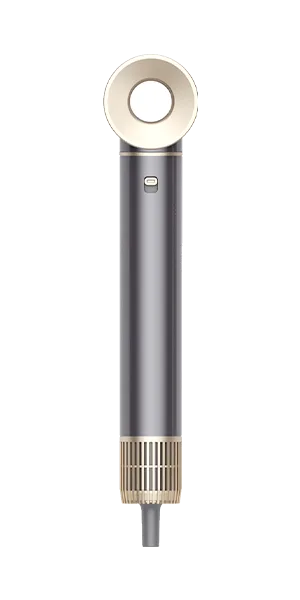
Attachment swaps are the fiddliest part and still fine. Align, twist, click. About three seconds once learned, ten seconds while learning. The barrels seat with a confidence-inspiring thunk. Brushes glide on rails. Nothing I tested wobbled during use, and after three weeks of daily swaps every joint still clicks like day one. The filter cap at the base twists off for lint cleaning, which is the maintenance step most owners will skip and should not. A clogged filter is how hot-air tools slowly die.
Noise lands at normal-dryer level. Not whisper-quiet despite the comparison chart’s “quiet operation” checkmark, not offensive either. I styled at 6 AM with a sleeping household and got no complaints, which is my entire acoustic review. The cord is long enough to reach my mirror from the far outlet without an extension lead, and it does not twist into knots the way my old dryer cord did. Small thing, daily appreciation.
The controls deserve a detail paragraph because you will touch them blind every morning. Power slides with a firm click that never triggered accidentally in my case. Heat and speed step through distinct detents, three of each by feel, so I can count clicks without looking in the mirror. The cool-shot is a spring-loaded button you hold, which is the right design. Momentary press-and-hold means you never get stuck in cool mode wondering why nothing is drying. Indicator lights are small dots rather than a glowing panel, visible enough in daylight and dim enough for 6 AM sessions. After three weeks every control still feels new, with no mushy buttons or loose sliders developing.
Storage is where the all-in-one argument becomes physical. My old trio plus brushes filled a whole vanity drawer. The AeroLift set lives in one case with every attachment nested. Packing for the week-3 trip took one case and zero decisions. That portability is genuinely useful, and it echoes why I like compact beauty tech generally. My MyoGlow LED mask review made the same point about tools that earn drawer space by replacing three things instead of adding a fourth.
How to Set It Up (and the Mistake I Made)
Setup is unboxing plus one read of the barrel diagram. Wash and towel-dry first. Apply heat protectant, always. Start every style with the pre-styling dryer until hair is damp, not dripping and not dry. Pick the attachment for the job. Work in small sections. Finish every style with cool-shot. Clean the brushes after. That is the whole system.
My mistake was heat arrogance on day 2. Feeling confident after the easy smoothing session, I set high heat and attacked nearly dry hair with the barrel, expecting faster curls. What I got was puffy, flyaway bends that fell flat within the hour, plus a frazzled feeling at my ends that scared me. High heat on dry-ish hair with airflow is just a worse dryer. The tool needs moisture to shape and moderate heat to avoid puff. I dropped to medium, went back to properly damp sections on day 3, and the difference was immediate. Medium heat on damp hair beats high heat on dry hair every single time.
Session order matters more than the manual suggests. Dry to damp first, always. Style the bottom layers before the crown so finished top sections do not get crushed. Curls before smoothing touch-ups, never the reverse. Cool-shot each section as you finish it rather than blasting everything at the end. These four habits took me from 25-minute sessions to 15.
3 Weeks of Real Testing. My Styling Diary
Days 1 to 3. Blowouts yes, curls no. The smoothing brush delivered a salon-looking blowout on day one, 22 minutes start to finish. The barrels produced lopsided waves I smoothed over and pretended were intentional. Frizz control impressed immediately. My usual halo of flyaways around the crown lay flat through an 8-hour workday, which my flat iron never managed without serum touch-ups.
Days 4 to 8. The barrels click. Day 4 is when I followed the damp-small-correct-side rules properly and got my first symmetric curls. Day 6 I timed a full curl routine at 19 minutes. Day 8 produced the turning-point style. Defined waves, shine, hold through dinner without hairspray. I remember looking in the mirror and thinking the tool had finally paid for its learning curve. The cool-shot habit started here and added roughly two hours of hold by my estimate.
Days 9 to 14. Speed and the humidity test. Sessions settled at 15 minutes for blowouts and 20 for curls. Day 10 brought the barrel-direction breakthrough I should have had sooner. I had been swapping barrels by guesswork and getting one lopsided side most sessions. I put a tiny sticker dot on the clockwise barrel, matched dots to sides for three sessions straight, and symmetry problems vanished. Mark your barrels on day one and skip my week of lopsidedness. Then Saturday brought 85 percent humidity, the true frizz exam. Morning style held through lunch, softened by mid-afternoon, needed a 3-minute smoothing touch-up at 4 PM. My old routine would have surrendered by 11 AM. Not immunity, but a clear step up. The volumizing brush also earned its place this week. Root lift that used to need teasing now takes one slow pass per section.
Days 15 to 21. Real life. I stopped experimenting and just styled. Five work mornings, all under 16 minutes. One dinner event with full curls that photographed beautifully and held through midnight with a light mist of spray. The travel test closed the week. One case, one hotel mirror, a 12-minute routine in unfamiliar lighting. My old trio could never.
Totals across the test. Roughly 18 full sessions. Zero bad-hair emergency days after day 8, versus my usual two per month. Ends visibly smoother in sunlight checks. One attachment learning curve, fully cleared. The flat iron is now in a donation bag.
What Actually Worked (and What Did Not)
Smoothing and blowouts. 9 out of 10
The star event. One pass per section, frizz gone, movement preserved, shine up. Faster than my old dryer-plus-iron relay and visibly kinder to ends. If you only ever use this attachment, the tool still earns its keep.
Curls and waves. 7.5 out of 10
Excellent once learned, shaky before. Barrel technique is a genuine skill with a week-long curve. Hold runs 6 to 8 hours with cool-shot, less without. Tight ringlets need smaller sections and patience. Loose waves are the sweet spot.
Root volume. 8 out of 10
The round brush lifts at the root in a way my old tools never managed without teasing damage. One slow pass, lift, cool-shot. Fine hair gets body without backcombing. This attachment alone converts flat-hair skeptics.
Drying speed. 8 out of 10
Wet to damp in about 4 minutes on my hair. Not the fastest dryer ever made, but fast for a multi-tool, and the point is that drying flows straight into styling with zero tool swaps.
Frizz in humidity. 7 out of 10
Strong in normal conditions, mortal in 85 percent humidity. Expect a touch-up on brutal days. Pairing with serum and the cool-shot close the gap meaningfully but do not erase physics.
Coily and tight-curl styling. 5 out of 10
The honest weak fit. No diffuser means wash-and-go curl definition is off the menu, and smoothing very textured hair takes small sections plus high patience. Coily buyers should weigh the Shark FlexStyle with its diffuser instead.
My summary is simple. As a dryer, smoother, waver, and volumizer for straight to wavy hair, it earns its keep daily. As a complete solution for tight coils, it does not. Buy it for the first list. Look elsewhere for the second.
Troubleshooting. The 5 Problems You’ll Actually Hit
Every one of these happened to me. Each has a fix that takes under a minute.
Curls fall flat within the hour. The cause is almost always styling hair that is too dry or skipping cool-shot. Rewet the section lightly with a spray bottle, rewrap on medium, and cool-shot for a full five seconds before releasing. My hold doubled the day I started counting the cool-shot out loud.
Barrel will not catch the hair. Three suspects in order. Hair too wet, section too big, wrong barrel direction. Squeeze excess water with the towel first, drop to one-inch sections, and check the barrel against the side you are styling. Nine times out of ten it is the section size.
Puffy ends instead of smooth ones. Heat too high for your hair weight. Drop one heat level and slow your glide speed by half. Fine hair puffs on high because the airflow lifts the cuticle faster than the brush can lay it down. Medium heat with a slower pass fixed every puff episode I had.
Static and flyaways after styling. Dry indoor air plus fresh blowouts equals static. A pea-sized drop of serum on the ends, applied after cool-shot, ends it. Do not apply serum before heat styling on high, since some formulas scorch and smell. After is safer and more effective.
Style dies by mid-afternoon. Two culprits. No cool-shot, or touching your hair constantly. Set every section with cool air, then keep your hands off until evening. The less you rearrange, the longer airflow-set styles survive. Hats and high collars also crush volume, so plan around them on important days.
AeroLift vs. the Alternatives
The comparison that matters is Dyson, because every buyer here is really asking whether the 599-dollar original is four times better. Having now lived with the dupe logic for three weeks, my answer is no, with texture. Dyson’s smoothing is more polished, its attachments feel more engineered, and it offers the diffuser AeroLift lacks. But AeroLift covers perhaps 80 percent of the daily jobs at 25 percent of the price. Diminishing returns hit hard above 200 dollars in this category.
Shark FlexStyle at around 299 dollars is the middle path and the right pick for curly buyers specifically. Its diffuser and convertible shape solve exactly AeroLift’s weakest event. If your hair is coily or you diffuse weekly, pay the extra hundred over AeroLift and get the Shark. If your hair is straight to wavy, the FlexStyle premium buys you refinements you will rarely feel.
Budget straightening brushes from drugstore brands cost 40 to 80 dollars and beat AeroLift on price alone. They lose on versatility. One brush cannot curl, volumize, or dry. They are the right buy for someone who only straightens and never styles. Everyone else outgrows them.
| Feature | AeroLift | Dyson Airwrap | Shark FlexStyle | Drugstore brush |
|---|---|---|---|---|
| Multi-style in one tool | Yes, 5 jobs | Yes, 6 plus | Yes, plus diffuser | No, straighten only |
| Airflow-led, lower heat | Yes | Yes, refined | Yes | No, hot plates |
| Curling barrels both directions | Yes | Yes | Yes | No |
| Diffuser for coils | No | Optional add-on | Included | No |
| Cool-shot setting | Yes | Yes | Yes | Rarely |
| Travel-friendly single case | Yes | Yes | Yes | Yes, smaller |
| Price band | 120 to 150 dollars | Around 599 dollars | Around 299 dollars | 40 to 80 dollars |
Value Math. Is It Worth $149.95
Let us price the alternative honestly. Dyson Airwrap at 599 dollars. A decent standalone dryer at 150. A quality straightener at 100. A curling wand at 60. That is 900 dollars of tools on the high end, or 300 dollars of mid-range equivalents. Salon blowouts run 50 to 70 dollars a visit. Ten salon visits a year is 500 to 700 dollars before tips.
AeroLift at 149.95 replaces the home-tool stack, not the salon cut. Against the 300-dollar mid-range stack, it halves the outlay while adding the airflow gentleness none of those have. Against Dyson, it saves roughly 450 dollars for perhaps 80 percent of the daily result. Cost per use collapses fast. Eighteen sessions in three weeks puts me near 8 dollars a session already, falling toward pocket change by month three for daily stylers.
Run the salon math too, because that is where the tool quietly wins biggest. One blowout a week at 60 dollars is over 3,000 dollars a year. Even one blowout a month is 720 dollars a year before tips. AeroLift at 149.95 pays for itself the moment it replaces three salon visits. For event-driven buyers, wedding season alone, with its trial runs and bridesmaid mornings, can justify the purchase in a single month. The tool does not replace cuts and color. It replaces the recurring styling spend between them, which is the larger number for most women.
The bundle logic is straightforward. Solo buyer, buy one and run the two-week protocol inside the guarantee. Households with two stylers, sisters, roommates, mothers and daughters, split the 4-pack at 119.95 per unit and both save. Do not buy four alone as a first test. The guarantee covers returns, but shipping a 4-pack back wastes everyone’s time.
One caution on the percentages. Judge 149.95 dollars against Dyson math and salon math, not against a 70 percent claim the bundle ladder does not support. At 149.95 it wins. It does not need the stretch.
What Other Owners Say. Review Patterns Worth Knowing
I read through a large sample of owner feedback across the official pages, affiliate reviews, and beauty forums. The patterns match my test closely.
Praise pattern one. Versatility shock. The most repeated sentiment is surprise at replacing multiple tools. “Replaced my dryer and straightener” appears constantly. Owners describe drawer-clearing with genuine relief. That matches my donation-bag flat iron exactly.
Praise pattern two. Busy-morning speed. Moms and commuters dominate the positive column, citing 10 to 15 minute routines. My timed 15-minute sessions sit right in the middle of reported times. Week-one slowness gets mentioned honestly even by fans, which increases my trust in the praise.
Praise pattern three. Dyson comparison pride. A striking number of owners frame the purchase against the 599-dollar original they refused to buy. “Salon results without the Dyson price” is the core buying motive. The value framing, not the tech specs, drives this product.
Complaint pattern one. Barrel learning curve. Negative reviews cluster on curls that would not form in week one. Almost every one-star barrel complaint describes symptoms of wet hair, big sections, or wrong-side barrels. All three are fixable, and the sales page should teach them instead of promising effortlessness.
Complaint pattern two. Shipping and support friction. A minority report slow 5 to 12 day shipping and sluggish email support. Standard small-brand logistics. Order ahead of events, not the week of.
Complaint pattern three. Fine hair puffiness. A smaller but consistent thread comes from very fine-haired owners who ran high heat first and got volume they did not want. Every one of these reviews reads like my day-2 mistake. Medium heat, slower passes, serum after. The fix is known, but the sales page could prevent the complaint entirely with a fine-hair quick-start card in the box.
My take after cross-checking. When hundreds of strangers and my own notes agree that week one is the learning curve and week two is the payoff, that consensus is worth more than any star average. The praise matches what I saw. The complaints match what I saw.
Pricing, Discounts, and the 30-Day Guarantee
Current bundle ladder from my research, to confirm at checkout since direct-response pricing rotates.
| Pack | Total | Per unit | Claimed saving |
|---|---|---|---|
| 1 unit | 149.95 dollars | 149.95 | 35 percent off |
| 2 units | About 279.94 dollars | 139.97 | 40 percent off |
| 3 units | About 404.94 dollars | 134.98 | 40 percent off |
| 4 units | About 479.80 dollars | 119.95 | 50 percent off |
Order only from the official AeroLift site through this link to keep the guarantee valid and avoid lookalike motors. Shipping takes 5 to 12 working days, so do not order the week of a wedding. Larger bundles generally ship free. The 30-day money-back guarantee runs from receipt. Keep your order email, test across at least four wash days promptly, and decide inside the window.
The guarantee is what makes the learning curve risk-free. Two weeks of proper testing fits inside 30 days with room to spare. If your hair lands in the non-responder group, send it back and put the refund toward the Shark with its diffuser. That is not failure. That is good consumer sense.
Drawbacks and Things to Know Before You Buy
Honest section, numbered so nothing hides.
1. Not heat-free, whatever the banner says. Controlled lower heat is real and gentler. Zero heat is fiction. Keep protectant in every session and set expectations accordingly.
2. The barrels need a week. Day-one curls disappointed me and will disappoint you. Four wash-day sessions is the fair trial. Impatient stylers who judge on day two consistently land in the one-star column.
3. No diffuser. Tight coils and wash-and-go curl routines get partial service. If you diffuse weekly, this is the wrong tool and the Shark FlexStyle is the right one.
4. The 70 percent claim does not match the ladder. Documented bundles show 35 to 50 percent off list. The dollar prices are fair on their own. The stretch percentage is not needed and slightly erodes trust.
5. Plugs in, despite the chart. The comparison table lists “cordless convenience” with a checkmark. The tool I evaluated uses a cord. Do not buy expecting battery power.
6. Official-site only. No local store, no same-day pickup, shipping in days not hours. Plan around events.
7. Noise is normal-dryer level. The “quiet operation” checkmark oversells. It is not offensive, but it is not a whisper tool either. Early birds with sleeping households should know.
9 Tips to Get the Best Results
1. Start at 80 percent dry. Towel and pre-dryer first, style second. The dampness window is the whole technique.
2. Small sections always. One inch wide for barrels, two inches for the smoothing brush. Big sections are why curls fail.
3. Right barrel per side. Clockwise one side, counter-clockwise the other. Mark them with a sticker dot until it becomes habit.
4. Medium heat first. High heat puffs fine hair and frazzles ends. Start medium, raise only for resistant thick sections.
5. Cool-shot every section. Do not wait until the end. Set each curl as you finish it and hold doubles.
6. Bottom layers before crown. Style underneath first so finished top sections never get crushed.
7. Protectant every time. Non-negotiable on colored, bleached, or fine hair. The tool is gentler, not magic.
8. Sleep on silk after styling. A silk pillowcase preserves blowouts overnight by cutting friction while you sleep. My day-two hair needs half the touch-up work since I switched.
9. Log four wash days, then judge. Date, attachment, time, result. Twenty seconds per session kills self-deception and proves the week-two payoff.
Who Should Buy It (and Who Should Skip)
Buy it if your mornings are a three-tool relay. Dryer, straightener, wand, forty minutes. If that sentence describes your vanity, this tool was designed for exactly you. The drawer space alone is worth it.
Buy it if frizz is your daily fight. Wavy, humidity-reactive hair is the ideal customer. My crown flyaways stayed flat through full workdays from week one, before the barrels even clicked.
Buy it if you priced out the Dyson and walked away. At 599 dollars the Airwrap is furniture-priced. If the price ended the conversation, AeroLift restarts it at 149.95 with most of the daily function intact.
Buy it if you travel light. One case, one plug, five jobs. Hotel mirrors and gym bags are where single-purpose tools go to be forgotten. This one travels.
Buy it if your ends are telling on you. Split flares, transparent tips, breakage that no trim schedule quite fixes. If your current tools run scorching hot daily, switching to controlled airflow is the highest-leverage change you can make short of quitting heat entirely. My ends are the before-and-after I trust most in this whole test.
Skip it if your hair is tightly coiled and you diffuse. No diffuser ships, and that is disqualifying for wash-and-go curl routines. Get the Shark FlexStyle instead.
Skip it if you want zero learning. Four wash days of practice is the honest price of admission. Buyers unwilling to practice should keep their current tools.
Skip it if you need battery power. It plugs in. The comparison chart suggests otherwise and the chart is wrong on this point.
Skip it if you style once a month. Occasional stylers will never clear the learning curve often enough for it to stick. This is a daily-driver tool.
Final Verdict
Three weeks ago I was a three-tool, forty-minute morning person with frazzling ends. Last night I styled full curls in 20 minutes, they held through midnight, and my flat iron sits in a donation bag. The barrels humbled me for a week and then paid off every day since. I started this test expecting an overhyped dupe and ended it with a permanent vanity resident.
The flat summary is this. AeroLift is a genuinely capable Airwrap-style multi-styler that covers dryer, smoother, curler, and volumizer in one base at a quarter of Dyson’s price. Its limits are real and predictable. Tight coils, zero-practice buyers, and anyone needing battery power should pass. Everyone else with straight to wavy hair gets a strong daily driver.
| Category | Score |
|---|---|
| Styling performance | 7.5 out of 10 |
| Build quality and design | 8.0 out of 10 |
| Ease of use | 8.0 out of 10 |
| Attachment versatility | 8.5 out of 10 |
| Value for money | 7.0 out of 10 |
| Gentleness on hair | 7.0 out of 10 |
| Overall | 7.5 out of 10 |
If endless bad hair days sound familiar, try it the way I did. One unit, four wash days, honest notes, protectant in every session. The 30-day guarantee means the experiment costs you nothing if your hair lands in the non-responder group, and the week-two payoff is worth the week-one practice. The 30-day guarantee means the experiment costs you nothing if your hair lands in the non-responder group. And if your hair is anything like mine, week two is when you stop missing the old tools.
Key Specifications
| Product | AeroLift all-in-one hair multi-styler |
|---|---|
| Function | Dry, curl, straighten, volumize, smooth |
| Technology | Controlled airflow with smart temperature control |
| Attachments | Motor base, 2 air-wrap barrels, smoothing brush, round volumizing brush, pre-styling dryer |
| Finish | Cool-shot button for setting styles |
| Heat settings | Multiple heat and speed settings |
| Hair types | Straight, wavy, curly, coily (no diffuser included) |
| Design | Lightweight handheld, ergonomic grip |
| Price | From 119.95 dollars per unit in the 4-pack |
| Guarantee | 30-day money-back guarantee |
AeroLift earns 7.5/10: very good — recommended with minor caveats. Tested for 3 weeks across wash days, work mornings, one humid weekend, and a dinner event.
- Best part: One tool replaces dryer, straightener, curling barrels, and volumizing brush
- Best part: Airflow-led styling with controlled temperature instead of scorching plates
- Best part: Clockwise and counter-clockwise barrels for symmetrical curls on both sides
- Biggest catch: Not truly heat-free despite the marketing. It uses controlled heat, just less of it
Common Questions & Answers
Q: How does the AeroLift actually style hair?
It combines a high-speed motor base with snap-on attachments. The pre-styling dryer takes hair from wet to damp, then the barrels, smoothing brush, or volumizing brush shape it with directed airflow plus controlled heat. A cool-shot button blasts cool air to set the finished style. You still need to section hair and guide each attachment. The air assists, it does not do the work alone.
Q: Is AeroLift really heat-free?
No, and buyers should know this before ordering. It uses controlled, lower heat than flat irons and curling wands, which is genuinely gentler, but heat is still involved. The honest framing is less heat damage, not zero heat. Always use a heat protectant, especially on fine, bleached, or already damaged hair.
Q: Does AeroLift work on all hair types?
It covers straight, wavy, and loose-curly hair well. Tight curls and coils can use the smoothing brush and dryer, but there is no diffuser attachment, so wash-and-go curl definition is not its strength. Very thick hair takes longer per section and benefits from the pre-styling dryer step. Fine hair should stick to low heat to avoid puffiness.
Q: How long does styling take with AeroLift?
On my medium-length wavy hair, a full dry plus smooth blowout took about 15 minutes once I learned the tool. Curls added another 5 to 8 minutes. Week one was slower, around 25 minutes, because attachment swaps and barrel technique were new. Expect the maker halved-my-routine claim to be true only after the learning week.
Q: Can beginners use the curling barrels?
Yes, but budget practice time. The barrels use airflow to wrap hair, and the first sessions feel strange. My day-one curls were lopsided. By day 8 the wrap clicked and results turned consistent. Small sections, damp-not-wet hair, and the correct barrel direction per side are the three things that matter.
Q: Is AeroLift better than the Dyson Airwrap?
It is dramatically cheaper and covers the same core jobs, but it is not better built or more refined. Dyson wins on smoothing power, attachment polish, and diffuser availability. AeroLift wins on price by a wide margin. If 599 dollars is off the table, AeroLift is a legitimate stand-in rather than a toy.
Q: How do I clean and maintain it?
Clear hair from brush attachments after each use, wipe attachments weekly with a damp cloth, and never submerge heated parts. Store attachments separately instead of stacked so bristles do not bend. Check the filter area for lint monthly, since restricted airflow is the most common cause of fading performance in any hot-air tool.
Q: Where should I buy AeroLift to avoid fakes?
Buy only from the official site. Marketplace lookalikes exist with unverified motors and no valid guarantee. The official store holds the bundle pricing and the 30-day money-back guarantee.
Q: What is the return policy?
There is a 30-day money-back guarantee from receipt. If the tool does not suit your hair, return it within the window per the returns policy on the official site. Keep your order email and test it promptly so you decide inside the guarantee period.
Q: How long before I know if it suits my hair?
Give it two full weeks and at least four wash-day sessions. Week one measures the learning curve, not the tool. If barrels still will not hold a curl by session five, or your hair type needs a diffuser, that is a reliable signal to return it.
More Wellness Gadgets Reviews
Related Guides & Articles
Browse all 79 Wellness Gadgets articles »

Health tech researcher and wellness gadget reviewer. PhD in Biomedical Engineering. Tests sleep trackers, massage devices, and health monitors with clinical precision. Believes in data-driven wellness.