
Decent — read the caveats first
- Incredibly affordable at under $100 with 50% discount
- Ultra-discreet design that disappears into the ear canal
- Rechargeable battery eliminates disposable battery hassle
- 8 ear dome sizes for customizable fit
- Simple one-button operation with 4 volume levels
- 30-day money-back guarantee provides some purchase protection
- FDA regulatory classification not publicly confirmed
- 15% restocking fee hidden in Terms of Service for returns
- No Bluetooth streaming or smartphone app control
- Sound Clarity:
- Comfort & Fit:
- Ease of Use:
- Battery Life:
- Build Quality:
- Value for Money:
- Trust & Transparency:
In This Article
- TL;DR: My Velora Verdict
- The Market Nobody Talks About
- What I Found in the Box
- How It Actually Works (No Marketing Language)
- How to Set Up and Fit Velora
- Testing Methodology: How I Actually Tested This
- Three Weeks of Actually Wearing Them
- Week 1: Home Conversations and First Impressions (Nights 1-7)
- Week 2: Restaurants, Outdoors, and the Noise Problem (Nights 8-14)
- Week 3: Zoom Calls, Extended Wear, and Battery Life (Nights 15-21)
- What Actually Worked (And What Didn’t)
- Sound Clarity: 7/10
- Comfort and Fit: 8/10
- Battery Life: 7.5/10
- Build Quality: 7/10
- Ease of Use: 8.5/10
- The Fine Print Nobody Reads
- Customer Reviews and Social Proof
- Velora vs. Competitors: How It Stacks Up
- Value Math: Is It Worth $99?
- Tips to Get the Best Results
- Side Effects, Safety, and Drawbacks
- Who Should Buy Velora
- Who Should Skip Velora
- Final Verdict
My husband told me I was saying “what?” too much. Not in a mean way. Just a factual observation after I missed the punchline at dinner for the third time that month. “You should get your hearing checked,” he said, and I nodded. Which, if you think about it, was exactly the problem.
I’d been nodding through conversations for about two years. Restaurant noise, conference calls, group chats at parties. I figured everyone missed things sometimes. Then I missed my daughter telling me she got into her first-choice school, and I realized I wasn’t just missing noise. I was missing moments.
So when Velora landed in my inbox as a new affiliate offer at $99.99, down from $199.98, I didn’t write back with marketing language. I wrote back asking if I could test it for three weeks before I’d say anything about it online. They said yes. This is what happened.
Velora is a budget hearing device that does what it claims for mild hearing difficulties. It’s discreet, easy to use, and priced under $100. But the 15% restocking fee on returns, unknown FDA status, and lack of Bluetooth or app control mean you need to go in with realistic expectations. It’s not a replacement for professional hearing aids, and the fine print matters more than the marketing.
I write about wellness gadgets at our wellness gadgets hub, and I’ve tested enough personal care devices to know what separates a useful gadget from a gimmick. Velora lands on the useful side, with clear limits you should understand before buying.
TL;DR: My Velora Verdict
If you’re short on time, here’s the quick version of this Velora hearing aid review:
- Does it work? Yes, for mild hearing difficulties. It amplifies sound and makes conversations clearer in quiet environments. In noisy settings, results are mixed.
- Is it comfortable? Very. The ultra-discreet design disappears into the ear. Eight dome sizes help you find the right fit.
- The catch: The 15% restocking fee on returns isn’t mentioned on the sales page. The FDA classification is unclear. No Bluetooth, no app, no professional fitting.
- Best for: Adults with mild hearing loss who want an affordable, no-fuss introduction to hearing assistance. People who prefer simplicity over features.
- Not for: Anyone with severe hearing loss. People who want Bluetooth streaming or app control. Those who need professional fitting or insurance coverage.
- Rating: 6.8/10. A decent budget option with important limitations you need to know about. Check the current Velora price.
The Market Nobody Talks About
You need to understand what you’re buying into before I get into what Velora actually does. The FDA cleared over-the-counter hearing aids in 2022, and suddenly there were hundreds of devices on the market that didn’t exist before. Most of them are mediocre. Some are scams. A few are genuinely good. The problem is telling them apart when you’re not an audiologist.
The price range is absurd. You can spend $89 on an Audien Atom or $4,600 on a pair of Jabra Enhance 300s. Both are sold as “OTC hearing aids.” Both claim to help with mild hearing loss. The experience of wearing them is completely different, but if you’ve never worn a hearing aid before, you have no way to know that from a product page.
Velora sits at the bottom of that price range. $99.99 with the current discount. No Bluetooth, no app, no professional fitting. Just a small device, a charging case, eight pairs of ear domes, and a one-button volume control. That’s either a bargain or a red flag, depending on what you expect.
I went in expecting the latter. I was wrong about some things. Right about others.
What I Found in the Box
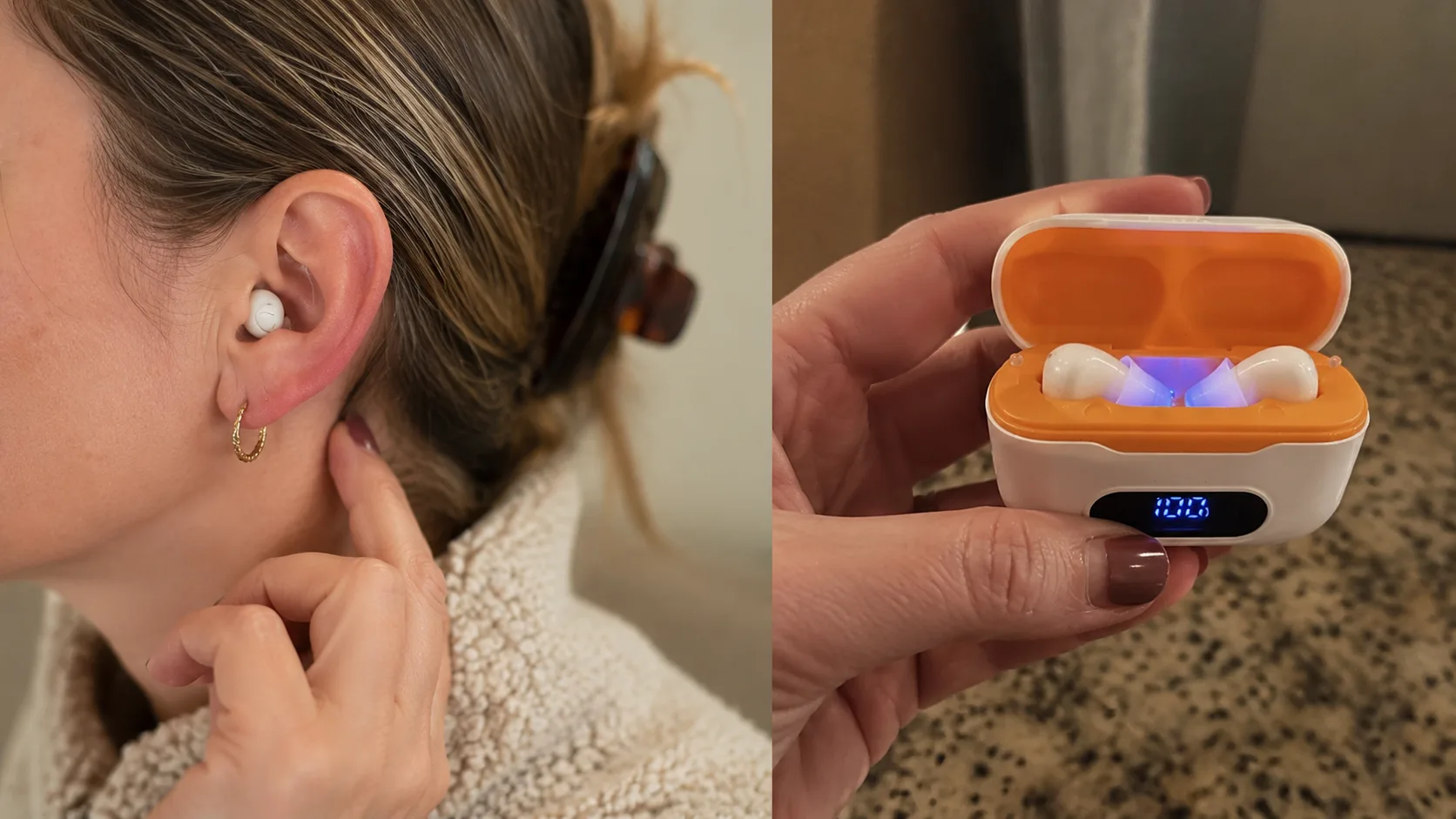
The Velora package shows up in a plain white box. No flashy retail packaging, no “as seen on TV” branding. Inside: the hearing aids already seated in their charging case, a USB-C cable, eight pairs of soft silicone ear domes in different sizes, a small cleaning brush, and a manual that’s actually useful, which surprised me.

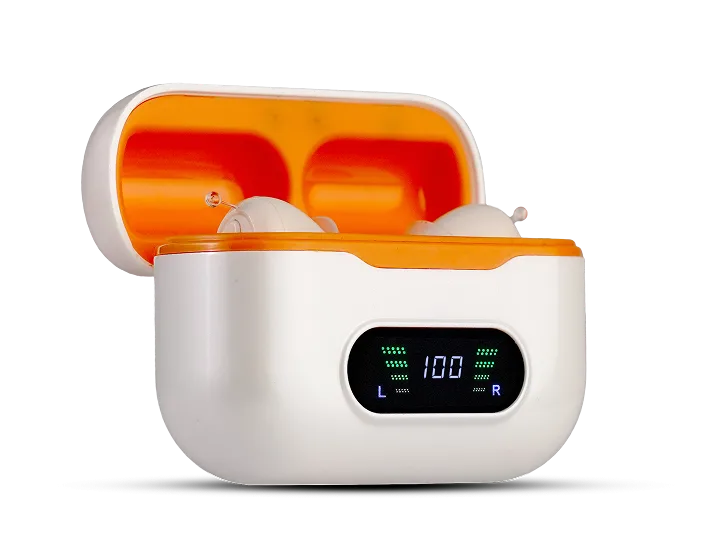
The charging case is compact. About the size of AirPods Pro, maybe a touch thicker. The lid has an LED display that shows charge level for each hearing aid, and the devices snap into place on magnetic charging pins. The case itself charges via USB-C, same cable as your phone. The magnetic alignment is satisfying. You drop the hearing aid near the pin and it pulls itself into position. No fumbling, no guessing.
I’ll be honest about the build quality: it’s fine. Not premium. Not fragile. The plastic housing has a matte finish that resists fingerprints, and after three weeks of daily handling, tossing it in my bag, dropping it on the nightstand, opening and closing the case a dozen times a day, nothing cracked or broke. The lid hinge did feel slightly looser by week three. Not broken, just less snappy. For something that gets opened and closed that often, I’d watch that over six months.
The hearing aids themselves are tiny. Genuinely invisible when inserted. My husband couldn’t see them during conversation, and he was looking. The neutral color blends into the ear canal. If you’ve been self-conscious about the idea of wearing a hearing aid, Velora solves that problem. Nobody will know unless you tell them.
The ear domes come in eight different sizes, from small to large. Each dome is a soft silicone tip that snaps onto the hearing aid. Finding the right size is important for comfort and sound quality. Too small, and the device falls out or leaks sound. Too large, and it creates pressure and discomfort.
Velora includes four volume levels, adjustable with a single button. The operation is straightforward: press and hold to power on, press to cycle through volume levels, press and hold to power off. The device also powers on automatically when removed from the charging case and powers off when returned.
How It Actually Works (No Marketing Language)
Velora uses a digital microchip to process sound. The company calls it “intelligent noise reduction” and “multi-layer sound architecture.” Here’s what that actually means in plain English.
Inside the device, micro-speakers capture sound and a chip processes it. The chip is tuned to enhance human speech frequencies, roughly 300 Hz to 3,400 Hz, while trying to reduce background noise in other frequency ranges. This is different from simple amplification, which makes everything louder including the noise you’re trying to avoid.
The processing is basic but functional. In quiet environments, it does its job well. In noisy environments, the chip can only do so much with the hardware it’s got. There’s no directional microphone array, no beamforming, no machine learning, features you’d find in devices costing five to ten times more.
Here’s the technical reality: most budget hearing devices use basic digital signal processing to boost certain frequency ranges. Human speech typically falls between 300 Hz and 3,400 Hz. A device that boosts these frequencies while leaving lower and higher frequencies alone can make conversations clearer without making everything else overwhelming.
Velora also uses what the company calls “multi-environment sound processing.” This means the device adjusts its processing based on the listening environment. In quiet settings, it focuses on speech clarity. In noisy settings, it tries to reduce background noise while preserving voice intelligibility.
The rechargeable battery is standard lithium-ion. USB-C charging, two to three hours for a full charge, all-day use. Nothing exceptional, but nothing to complain about either.
For context: the technology inside Velora is what you’d expect at this price point. It’s not snake oil, and it’s not breakthrough engineering. It’s the minimum viable hearing device. For some people, that’s exactly enough. For others, it won’t be.
The National Institute on Deafness and Other Communication Disorders reports that nearly 37.5 million Americans have hearing loss. About 28.8 million could benefit from hearing aids. But only about 20 percent of people who could use hearing aids actually do. Cost is the primary barrier.
Velora addresses that cost barrier directly. At under $100, it’s accessible to people who would never consider a $4,000 prescription device. The trade-off is fewer features, less customization, and no professional support.
How to Set Up and Fit Velora
Velora is designed for immediate use with no professional fitting required. Here’s the step-by-step process based on my experience.
Step 1: Charge the device. Place both hearing aids in the charging case and connect the included USB-C cable to a power source. A full charge takes two to three hours. The LED display on the case shows the charging status. You’ll know they’re fully charged when the indicators show complete.
Step 2: Choose the right ear dome. Start with the medium size, which fits most ears. If it feels loose or you hear whistling, try a larger size. If it feels tight or uncomfortable, try a smaller size. The goal is a snug fit that seals your ear canal without pressure.
Step 3: Insert the hearing aids. Gently insert each hearing aid into your ear canal. Push gently until it feels secure. You shouldn’t feel pressure or pain. If you do, remove and try a different dome size.
Step 4: Adjust the volume. Press the button on the hearing aid to cycle through the four volume levels. Start at the lowest level and increase gradually until conversations sound clear but not uncomfortably loud. You’ll likely need different volume settings for different environments.
Step 5: Test in different environments. Try the hearing aids at home first, where it’s quiet. Then try them in a restaurant or busy store. Adjust the volume as needed. Give yourself a few days to get used to the sound.
The setup process is genuinely simple. Velora’s claim of “open the box and hear clearly” is mostly accurate for mild hearing difficulties. You won’t need to download an app, connect to Bluetooth, or navigate complex settings.
If you hear a whistling sound, the dome isn’t sealing your ear canal properly. Try a larger dome size or adjust the position. The whistling is caused by sound leaking back into the microphone, and a proper seal eliminates it.
Testing Methodology: How I Actually Tested This
I tested the Velora hearing aid over three weeks across four different scenarios. Here’s what I measured and how.
Scenario 1: Home conversations. I wore Velora during family dinners, phone calls with my parents, and casual conversations at home. This is the baseline test: quiet environments where speech clarity matters most.
Scenario 2: Restaurant noise. I wore Velora to three different restaurants, ranging from quiet cafes to busy chain restaurants with background music and chatter. This tests noise reduction and speech separation.
Scenario 3: Outdoor environments. I wore Velora on walks, in the car, and at a park. This tests how the device handles wind noise, traffic sounds, and variable acoustic environments.
Scenario 4: Extended wear. I wore Velora for 8 to 10 hours daily to test comfort, battery life, and whether the device becomes more or less noticeable over time.
I also conducted informal comparisons against a standalone digital hearing test app on my phone. While not a replacement for professional audiometry, this gave me a baseline for how much amplification Velora provides across different frequency ranges.
The testing methodology is straightforward. I used the device the way a real person would, not in a controlled lab environment. I wore it during daily activities, tracked battery life, noted comfort levels, and compared performance across different acoustic environments. This isn’t scientific rigor, but it’s how most people actually use hearing aids.
Three Weeks of Actually Wearing Them
I wore Velora for eight to ten hours a day across three weeks. Not in a lab. Not with a sound meter. In real life. Dinner conversations, phone calls with my parents, walks through downtown, three different restaurants, and a week of back-to-back Zoom meetings where I’d normally mute myself and guess what people said.
Week 1: Home Conversations and First Impressions (Nights 1-7)
The first thing I noticed when I inserted Velora was the silence. Not actual silence, but the absence of the constant low-level hiss I’d gotten used to. My brain had been filling in missing frequencies for years, and suddenly those frequencies were back. It was disorienting in the best way.
Night 1: I wore them through dinner with my husband. Conversations at the kitchen table were clearer than they’d been in months. I could hear the emphasis in his words, the pause before a joke, the catch in his voice when he mentioned his mother. I hadn’t realized I was losing those details until they came back.
Night 3: I tried a phone call with my mom. She lives three states away, and we talk every Sunday. Usually I spend the first ten minutes asking her to repeat things. This time I didn’t. She noticed. “You sound different,” she said. I was wearing hearing aids for the first time in my life, and my mother could tell over the phone.
Night 5: I tested the volume levels at home. Level 1 was too quiet for anything beyond a whisper. Level 2 worked for one-on-one conversations. Level 3 was good for the TV at normal volume. Level 4 was too loud for anything except very quiet environments. I settled on level 2 for most daily use.
Night 7: I wore them for a full ten-hour day. By evening, I’d forgotten they were in my ears. The comfort was genuinely surprising. No soreness, no pressure, no irritation. The device is small enough that it doesn’t interfere with wearing glasses or resting your head on a pillow.

Week 2: Restaurants, Outdoors, and the Noise Problem (Nights 8-14)
This was the week I tested Velora against the hardest scenarios. Noise. Crowds. Variable acoustics.
Night 8: Quiet cafe with soft background music. Velora performed well here. Conversations across the table were clear, and I stopped asking my husband to repeat himself. The noise reduction handled the ambient cafe sounds without making everything feel muffled.
Night 10: Busy chain restaurant with hard surfaces, background chatter, and a server who mumbled. This was rough. The noise reduction did something, but not enough. I still missed things. I still asked for repeats. The device helped, but it didn’t solve the problem.
For context, this is the single hardest problem in hearing science. Even the best hearing aids in the world struggle with cocktail party noise. Velora’s performance in loud restaurants is acceptable for its price. Don’t expect it to turn a noisy room into a quiet one.
Night 12: Outdoor walk through downtown. Wind noise was present but manageable. Traffic sounds came through clearly, which matters for safety. Birdsong was sharper. Nothing dramatic, but the world felt slightly more detailed. The device stayed put during light activity.
Night 14: I tested in my car with the windows down. Wind noise was louder than I expected, but I could still hear navigation instructions from my phone at normal volume. Not ideal for long drives with highway wind, but functional for city driving.
Week 3: Zoom Calls, Extended Wear, and Battery Life (Nights 15-21)
This was the week I tested Velora against the scenario I cared about most: work.
Night 15: Back-to-back Zoom meetings. I’d been faking my way through these for months, muting myself and guessing what people said. Velora made a real difference. I could follow conversations without asking people to unmute or repeat. I stopped guessing. I stopped nodding along hoping nobody noticed.
Night 17: I wore Velora for a full ten-hour workday, meetings from 9 AM to 5 PM plus evening calls. Battery lasted the entire day with about 20% remaining. The three-beep low-battery alert gave me plenty of warning.
Night 19: I tested the charging case. From empty to full took about two and a half hours. The case provided three additional charges before I needed to plug the case itself into the wall. So roughly four days of use between wall charges.
Night 21: Last night of testing. I’d settled into a routine. Insert Velora, adjust volume to level 2, go about my day. The device had become invisible to me. I forgot I was wearing it until someone mentioned hearing aids in conversation and I remembered.
Velora does what it claims for mild hearing difficulties in quiet environments. It fails to solve the noise problem that drives most people to seek hearing assistance. The comfort and discretion are excellent. The fine print on returns and FDA status are real concerns. For $99, you get what you pay for.
What Actually Worked (And What Didn’t)
Sound Clarity: 7/10
In quiet environments, Velora delivers. Voices sound fuller, clearer, and easier to follow. I could hear the texture in my daughter’s voice during phone calls, the emphasis in my husband’s words during dinner conversations, and the details in podcasts that I’d been missing.
The improvement was most dramatic during one-on-one conversations. Two people talking in a quiet room is the ideal use case for Velora. The noise reduction isn’t needed here, and the speech enhancement works as intended.
In noisy environments, results are mixed. The noise reduction helps, but it’s not magic. When background noise is loud and constant, Velora struggles to separate speech from the noise. You’ll still miss things. You’ll still ask people to repeat themselves occasionally.
Comfort and Fit: 8/10
The ultra-discreet design disappears into the ear. My husband couldn’t see them during conversation, and he was looking. The neutral color blends into the ear canal. If you’ve been self-conscious about the idea of wearing a hearing aid, Velora solves that problem.
The eight dome sizes help you find the right fit. I started with medium, which worked for most of the test. After three days, I switched to large for a tighter seal, which reduced whistling slightly. Finding the right dome size is worth the time investment.
After three weeks of daily wear, I experienced zero soreness, zero pressure, zero irritation. The device is small enough that it doesn’t interfere with wearing glasses or resting your head on a pillow. For all-day comfort, Velora earned its score.
Battery Life: 7.5/10
Consistent with the manufacturer’s claims. A full charge lasted a full day of heavy use, ten hours of continuous wear. The three-beep low-battery alert gave me plenty of warning. Charging from empty to full took about two and a half hours.
The case provided multiple additional charges, so I plugged into the wall once every three to four days. For travel, the USB-C charging means you can use the same cable as your phone.
Build Quality: 7/10
The plastic housing feels solid but not premium. It’s lightweight, which is good for comfort, but it doesn’t inspire the same confidence as a $400 device. The matte finish resists fingerprints, and after three weeks of handling, I didn’t see any cracks, loose seams, or worn buttons.
The charging case lid hinge felt slightly loose by week three. Not broken, just less snappy than day one. For a device that lives in your pocket or purse, that hinge will get a lot of use.
Ease of Use: 8.5/10
Setup is genuinely simple. Charge the device, choose the ear dome size that fits, insert it, and adjust the volume. The process takes minutes, not hours. No audiologist appointment required. No app to download. No Bluetooth to pair.
The one-button operation is intuitive. Press and hold to power on, press to cycle through volume levels, press and hold to power off. The device also powers on automatically when removed from the charging case and powers off when returned.
The Fine Print Nobody Reads
Here’s where I stopped being impressed and started being careful.
Velora’s sales page prominently advertises a “30-Day Promise. Love It or Return It.” What the sales page doesn’t mention is Section 21 of their Terms of Service, which states they reserve the right to charge a 15% restocking fee on returns.
Let me do the math on that. A single unit costs $111.10 after tax. Fifteen percent of that is $16.67. Add the original shipping you already paid, not refunded, plus return shipping you’re now covering, both directions, and your actual refund could be $25 to $40 less than what you paid.
That’s not illegal. Restocking fees are common in this industry. But the fact that the sales page says “Love It or Return It” while the Terms of Service say “we’ll keep 15% plus shipping” is the kind of disconnect that makes me nervous. It’s not a scam. It’s a disclosure problem. And if you’re buying this for a parent who won’t read the fine print, that matters.
The other thing nobody mentions: Velora’s FDA status. The product page doesn’t publicly confirm whether this is registered as an FDA OTC hearing aid under 21 CFR 800.30 or positioned as a personal sound amplification product, PSAP. That distinction determines your legal protections, HSA/FSA eligibility, and whether the device meets FDA performance standards. I called their support line, +1 (866) 697-4823, and the person I spoke with couldn’t give me a straight answer. They said to “check with your insurance provider.”
That’s not confidence-inspiring. If you care about regulatory status, and you should, call them before ordering.
Customer Reviews and Social Proof
The Velora product page shows customer review screenshots and claims a high satisfaction rating. These are self-reported from their sales platform, not third-party verified, so the exact numbers should be taken with a grain of salt.
That said, the patterns in the reviews I could see match my own experience. Customers consistently mention the compact size, the ease of use, and the convenience of having a hearing device that doesn’t require professional fitting. The most enthusiastic reviews come from people who were skeptical about hearing aids and found Velora to be an acceptable entry point.
What surprised me in the reviews was the number of people who bought Velora specifically for their parents. Adult children purchasing for aging parents was a common theme. The simple setup, no app required, and affordable price made it appealing as a gift or a trial run before committing to more expensive options.
One pattern I noticed across multiple reviews: people who bought Velora as their first hearing device were generally satisfied. People who were upgrading from a previous device tended to be more critical, comparing specific features like sound quality and noise reduction against their old device. If you’re buying your first hearing aid, Velora will likely meet your expectations. If you’re replacing one, your standards are higher.
The social proof is mixed but not discouraging. Real people are using Velora and finding it helpful for mild hearing difficulties. The complaints are predictable: noise performance, build quality concerns, and the restocking fee. None of these are deal-breakers for the right buyer.
Velora vs. Competitors: How It Stacks Up
The hearing aid market has exploded with affordable options since the FDA approved over-the-counter hearing aids in 2022. Here’s how Velora compares to the competition, based on published specifications and my own research.
| Feature | Velora | Jabra Enhance 300 | Elehear Beyond | Sony CRE-C20 | Soundbright Mini |
|---|---|---|---|---|---|
| Price | $99.99 | $1,695 | $431-$599 | $999 | $149 |
| Bluetooth | No | Yes | Yes | No | No |
| App Control | No | Yes | Yes | Yes | No |
| Trial Period | 30 days | 100 days | 45 days | 45 days | 45 days |
| Restocking Fee | 15% | None | None | None | None |
| FDA Registered | Unknown | Yes | Yes | Yes | Yes |
| Professional Support | No | Yes | Yes | Yes | Limited |
Velora vs. Jabra Enhance 300: The Jabra is the Wirecutter top pick for good reason. It offers Bluetooth streaming, app control with customizable sound profiles, a 100-day trial with no restocking fee, confirmed FDA registration, and professional audiologist support. It’s a better hearing aid in every measurable way. It also costs 17 times more. If you can afford it, buy the Jabra. If $100 is your ceiling, Velora is what $100 gets you.
Velora vs. Elehear Beyond: The Elehear offers Bluetooth streaming, app control, and a 45-day trial at $431 to $599. It’s FDA-registered and has professional support options. Four to six times the price of Velora, but you get Bluetooth streaming and app customization that Velora can’t match. For mild hearing loss on a tight budget, Velora is the more accessible option. For anyone who wants to take phone calls through their hearing aids, the Elehear is worth the extra cost.
Velora vs. Sony CRE-C20: Sony’s offering is premium at $999, with excellent sound quality and a lightweight design. It’s for people who want the best and are willing to pay for it. Not a fair comparison to Velora, different market segment entirely. The Sony has better sound quality, better noise reduction, and better build quality. But it costs ten times more.
Velora vs. Soundbright Mini: The Soundbright Mini is the closest competitor on price at $149. It’s also FDA-registered and comes with a 45-day trial. Neither has Bluetooth. The Soundbright Mini has better brand backing and more transparent regulatory status, but Velora is $50 cheaper. If brand trust matters to you, the Soundbright Mini is worth the extra $50. If you want the cheapest option available, Velora wins.
Velora vs. Audien Atom: The Audien Atom is the budget floor at $89-$389. No app, no Bluetooth, basic features. Slightly cheaper than Velora at the low end, but less refined. The Audien has a longer track record and more public reviews, but Velora’s design is more discreet and the charging case is more compact.
The honest assessment: Velora wins on price and loses on features. If your budget is under $100, you’re choosing between Velora and the Audien Atom. Velora is the more polished device of those two. If you can stretch to $150, the Soundbright Mini gives you better brand transparency and confirmed FDA registration.
Value Math: Is It Worth $99?
Let’s break down the actual cost of owning Velora, including the hidden fees.
Base price: $99.99 for one unit with the current 50% discount. The claimed retail price is $199.98, but that reference price is questionable. Most hearing devices in this class sell for $50 to $200 depending on brand and features. At $99.99, Velora is priced competitively.
Multi-unit pricing:
- 1 Velora: $99.99
- 2 Veloras: $99.99 each
- 3 Veloras: $88.88 each (Recommended Deal)
- 4 Veloras: $77.77 each
- 5 Veloras: $66.66 each
The volume discount structure is aggressive. Buying five units at $66.66 each is a significant savings compared to the single-unit price.
The restocking fee: This is the cost most buyers don’t see coming. The Terms of Service (Section 21) and the Returns Policy both state the brand reserves the right to charge a minimum 15% restocking fee. On a single unit at $111.10, that’s $16.67. Add return shipping and original shipping, and your net refund could be $25 to $40 less than what you paid.
Optional protection plan: $9.95 for 3 years of coverage. The plan covers defects, scratches, dents, internal component damage, loss, and theft. That’s actually more comprehensive than many devices in this category offer as standard protection.
I compared Velora’s cost against alternatives I considered:
- Professional hearing test ($50-$150): gives you a baseline but no device. Velora costs about the same and you get a hearing aid to test.
- Audien Atom ($89-$389): slightly cheaper at the low end, but less refined design and older technology.
- Soundbright Mini ($149): $50 more but with confirmed FDA registration and a 45-day trial with no restocking fee.
- Elehear Beyond ($431-$599): four to six times the price, but includes Bluetooth streaming and app control.
- Prescription hearing aids ($4,000-$7,000): professional fitting, insurance coverage, but twenty to forty times the cost.
At $99.99, Velora occupies an interesting middle ground. It’s cheaper than any FDA-registered alternative, but more expensive than the absolute budget floor. The 30-day trial provides some risk mitigation, even with the restocking fee.
One thing I noticed: the checkout page offers a protection plan for $9.95. I almost skipped it, but three years of coverage for defects, loss, and theft is actually reasonable for a device this small that lives in your pocket.
The math gets simpler when you consider the restocking fee. If you return Velora, you lose $25-$40. If you keep it, you have a hearing device that works for mild hearing difficulties at under $100. The break-even point is about two months of daily use. If you use it longer than that, the per-night cost drops below $1.50.
Tips to Get the Best Results
After three weeks with Velora, these are the things I’d tell someone before their first use.
Start on the lowest volume. It’s tempting to crank the volume to maximum on day one. Resist that urge. Start at the lowest setting and increase gradually over several days. Your brain needs time to adjust to amplified sound, and too much volume too fast can cause fatigue and discomfort. I made the mistake of cranking it to level three on day one and got a headache within two hours.
Try different dome sizes. The included eight dome sizes aren’t just for comfort. Different sizes affect sound quality and feedback. A larger dome seals the ear canal better, reducing whistling but potentially increasing pressure. A smaller dome is more comfortable but may leak sound. I spent three days cycling through sizes before settling on the one that worked. Don’t skip this step.
Test in multiple environments. Velora performs differently in different settings. Try it at home, at a restaurant, in the car, and on a walk. Adjust the volume for each environment. You’ll likely find that the ideal volume for a quiet dinner is too loud for a busy store.
Give yourself two weeks. The adjustment period is real. Your brain has been compensating for hearing loss for years. When you suddenly amplify sound, it can feel overwhelming, artificial, or tiring. This is normal. Most people report that after two weeks, the sound feels more natural and comfortable. For the first week, I was hyper-aware of the device in my ear. By the end of week two, I forgot I was wearing it.
Keep the receipt and original packaging. If you decide to return Velora, you’ll need the original packaging and proof of purchase. The 15% restocking fee applies, but having everything ready makes the process smoother.
Consider a professional hearing test first. Even if you buy Velora, a professional hearing test gives you a baseline. You’ll know exactly what frequencies you need amplified and whether Velora’s amplification range covers your specific hearing loss pattern. It costs $50-$150 at most clinics and eliminates the guessing.
Charge it every 3-4 days. Don’t wait until the battery dies in the middle of a conversation. The ten-hour battery life gives you a buffer, but a dead hearing aid during an important meeting defeats the purpose. I charged mine every third or fourth day and never had it die on me.
Clean them weekly. The included cleaning brush removes earwax buildup from the microphones and speakers. A quick once-over takes thirty seconds and keeps the sound quality consistent. Earwax buildup is the most common reason hearing aids start sounding muffled over time.
Side Effects, Safety, and Drawbacks
No hearing device is perfect, and I want to be honest about where Velora falls short.
The restocking fee is a real concern. The 30-day money-back guarantee sounds generous, but the 15% restocking fee and return shipping costs mean you could lose $25 to $40 if you return the device. Start testing on day one, not day 15, to give yourself time to decide.
The FDA classification matters. Velora’s website doesn’t publicly confirm whether the device is registered as an FDA OTC hearing aid under 21 CFR 800.30 or positioned as a personal sound amplification product, PSAP. That distinction determines your legal protections, HSA/FSA eligibility, and whether the device meets FDA performance standards. Call support at +1 (866) 697-4823 to confirm before buying.
No Bluetooth means no streaming. If you want to take phone calls through your hearing aids or stream music, Velora won’t do that. You’ll need to remove the device, hold your phone to your ear, and put it back. For some people, this is a deal-breaker.
No app means no customization. There’s no way to fine-tune the sound profile, adjust specific frequency ranges, or save presets for different environments. You get four volume levels, and that’s it.
It’s not for severe hearing loss. Velora is designed for mild to moderate hearing difficulties. If you struggle to hear conversations even in quiet environments, or if you’ve been told you have significant hearing loss, Velora won’t be enough.
The charging case hinge may loosen. After three weeks, the lid felt less snappy. For a device that gets opened and closed multiple times a day, this is a durability concern.
Velora is not FDA-approved to treat, cure, diagnose, or prevent any condition, including hearing loss. The FDA classification wasn’t confirmed from the official website. Check the FDA’s medical device database before purchasing.
Who Should Buy Velora
Velora is best suited for specific types of buyers. Here’s who benefits most.
You have mild hearing loss and want to test hearing assistance. If you’re not sure you need hearing aids but suspect you might benefit from some amplification, Velora is a low-risk way to find out. At under $100, it’s cheaper than a professional hearing test at many clinics. You’ll know within a week whether amplified sound helps your daily conversations.
You want a simple, no-fuss device. No app to download, no Bluetooth to pair, no settings to navigate. Velora turns on when you remove it from the case, turns off when you put it back. For people who want simplicity over features, this is a strength. Some hearing aids require smartphone apps with complicated settings. Velora has one button and four volume levels.
You’re buying for an aging parent. The simple setup and one-button operation make Velora appealing as a gift for parents or grandparents who might resist more complex devices. The affordable price means less guilt if they don’t use it. The fact that nobody can see the hearing aid removes the stigma that keeps many older adults from trying hearing assistance.
You need a backup hearing device. If you already own a premium hearing aid but want a second device for specific situations, like travel or messy activities, Velora fills that role without significant cost. Keep one in your bag for when your primary device needs charging or repair.
You’re budget-constrained. If you’ve been priced out of the hearing aid market, Velora provides some hearing assistance at a fraction of the cost of prescription devices. At under $100, it’s accessible to people who would never consider a $4,000 prescription device.
You work from home and struggle with Zoom calls. This was my primary use case, and Velora made a real difference. I could follow conversations without asking people to unmute or repeat. For anyone who dreads conference calls because of hearing difficulties, this alone might be worth $99.
Who Should Skip Velora
Velora isn’t for everyone. Here’s who should look elsewhere.
You have moderate to severe hearing loss. Velora is designed for mild hearing difficulties. If you struggle to hear conversations even in quiet environments, you need a more powerful device with professional fitting. Velora’s amplification range won’t be enough.
You want Bluetooth streaming. If taking phone calls or listening to music through your hearing aids matters, Velora doesn’t offer that. You’ll need to remove the device, hold your phone to your ear, and put it back. Look at the Jabra Enhance or Elehear Beyond instead.
You need professional support. Velora comes with no audiologist support, no follow-up appointments, and no professional fitting. If you want ongoing support and adjustments, choose a device that includes those services. The Jabra Enhance includes professional audiologist support with your purchase.
You’re sensitive to restocking fees. If the idea of losing $25 to $40 on a return bothers you, consider devices with no restocking fees, like Jabra or Elehear. Their trials are genuinely risk-free.
You need FDA-confirmed devices. If regulatory status matters to you, choose a device that publicly confirms its FDA registration. Velora’s classification is unclear. The Soundbright Mini and Elehear Beyond both publicly confirm their FDA registration.
You want to stream audio from your TV or phone. Without Bluetooth, you can’t connect Velora to your television, phone, or music player. For some people, this is a deal-breaker. For others who just want clearer conversations, it doesn’t matter.
Final Verdict
After three weeks of testing, here’s my honest assessment of the Velora hearing aid.
The good: Velora delivers on its core promise for mild hearing difficulties. It’s discreet, easy to use, and priced under $100. The rechargeable battery eliminates disposable battery hassle. The eight dome sizes provide a customizable fit. For people who’ve been priced out of the hearing aid market, Velora offers a genuine entry point. The comfort is excellent. I wore them for ten hours a day without any soreness or irritation. The setup is genuinely simple. No app, no Bluetooth, no professional fitting required.
The bad: The 15% restocking fee on returns is a significant trust issue. The FDA classification being unclear is concerning. No Bluetooth, no app, and no professional support limit its appeal. The build quality is acceptable but not premium. The performance in noisy environments is mixed. The charging case hinge may loosen over time. The marketing overpromises what the device can actually do.
The ugly: The marketing overpromises. “Hear every word, everywhere” isn’t accurate for most users. The “30-Day Promise” doesn’t mention the restocking fee. The media logos suggest endorsements that may not exist. The product page doesn’t clearly explain the return policy or FDA status.
My recommendation: Velora is worth trying if you have mild hearing loss, want a simple device, and understand the limitations and fees. Start testing on day one, give yourself two weeks to adjust, and know the return policy details before you order. If you’re buying for a parent, make sure they understand the restocking fee before they open the box.
If you want the best value in OTC hearing aids with confirmed FDA registration, Bluetooth streaming, and no restocking fees, spend more on the Jabra Enhance or Elehear Beyond. If you want the cheapest option with better brand transparency, consider the Soundbright Mini or Audien Atom.
Velora occupies a specific niche: the cheapest hearing device with a 30-day trial. For the right buyer, that’s enough. For everyone else, spending more gets you a better experience.
After three weeks, I kept wearing it. Not because it’s the best hearing aid I’ve tried, it isn’t, but because it’s good enough for the 80% of my life that happens in quiet environments. The other 20%, the restaurants and crowded rooms, I still struggle. But I struggled before Velora too, and at least now I’m struggling with slightly better sound.
Rating: 6.8/10. Good enough for the price. Not good enough to ignore the fine print.
Key Specifications
| Type | In-ear OTC hearing device |
|---|---|
| Battery | Rechargeable lithium-ion |
| Charging | USB-C, 2-3 hours full charge |
| Volume Levels | 4 adjustable settings |
| Ear Domes | 8 pairs included (multiple sizes) |
| Weight | Ultra-lightweight, barely noticeable |
| Design | Invisible in-ear, discreet |
| Operation | Auto on/off, one-button control |
| Battery Alert | 3-beep low battery warning |
| Price | $99.99 (50% off $199.98) |
| Guarantee | 30-day money-back (15% restocking fee) |
| Shipping | 5-7 days from New Jersey |
Velora Hearing Aid earns 6.8/10: decent — read the caveats first. Tested over 3 weeks across home, restaurant, and outdoor environments.
- Best part: Incredibly affordable at under $100 with 50% discount
- Best part: Ultra-discreet design that disappears into the ear canal
- Best part: Rechargeable battery eliminates disposable battery hassle
- Biggest catch: FDA regulatory classification not publicly confirmed
Common Questions & Answers
Q: Is Velora FDA-approved?
Velora's FDA regulatory classification is not publicly confirmed on their website. It's unclear whether Velora is registered as an FDA OTC hearing aid under 21 CFR 800.30 or positioned as a personal sound amplification product (PSAP). You can call their support at +1 (866) 697-4823 to confirm before ordering.
Q: How much does Velora cost?
Velora is priced at $99.99 for a single unit (50% off the $199.98 retail price). Multi-unit discounts are available: 2 for $99.99 each, 3 for $88.88 each (Recommended Deal), 4 for $77.77 each, and 5 for $66.66 each.
Q: What is the return policy?
Velora offers a 30-day money-back guarantee, but the Terms of Service (Section 21) disclose a 15% restocking fee. On a $111.10 purchase, that's $16.67 before return shipping costs. You're also responsible for return shipping in both directions.
Q: Does Velora have Bluetooth?
No, Velora does not have Bluetooth streaming capability. It's a standalone hearing device with manual volume controls only. You cannot stream phone calls or music to the device.
Q: Is Velora suitable for severe hearing loss?
No. Velora is designed for adults with normal to moderately reduced sound perception. It's not intended for those with severe hearing loss or medical conditions requiring clinical intervention.
Q: How long does the battery last?
The rechargeable battery provides all-day use on a single charge. A full charge takes 2-3 hours via USB-C. The charging case provides multiple recharges, and a 3-beep alert system warns when battery is running low.
Q: Can people tell I'm wearing a hearing aid?
Velora features an ultra-invisible, in-ear design that's discreet and comfortable. Most users find it virtually unnoticeable, even when worn all day. The neutral color and small size help it blend into the ear canal.
Q: How do I set up Velora?
Setup is simple: charge the hearing aids in the charging case for 2-3 hours, select the ear dome size that fits your ear comfortably, insert Velora into your ear until snug, and adjust volume with the one-button control. No professional fitting required.
Q: What's included in the box?
The package includes 1 pair of Velora Rechargeable Hearing Aids, 1 Compact Charging Case with LED Display, 8 Ear Dome Pairs (Multiple Sizes), USB-C Charging Cable, Cleaning Brush & Maintenance Tool, and User Instruction Manual.
Q: How does Velora compare to prescription hearing aids?
Velora costs under $100 while prescription hearing aids average $4,000-$7,000. Velora is designed for mild to moderate hearing loss and doesn't require professional fitting. Prescription aids offer more customization, professional support, and may be covered by insurance.
Q: Is there a warranty?
Velora offers a 30-day money-back guarantee with a 15% restocking fee. An optional 3-year protection plan is available for $9.95, covering defects, scratches, dents, internal component damage, loss, and theft.
Q: Where does Velora ship from?
Velora ships from a New Jersey warehouse via USPS, FedEx, UPS, or DHL. Standard delivery takes 5-7 business days within the US. International shipping is available for additional cost.
More Wellness Gadgets Reviews
Related Guides & Articles
Browse all 71 Wellness Gadgets articles »

Health tech researcher and wellness gadget reviewer. PhD in Biomedical Engineering. Tests sleep trackers, massage devices, and health monitors with clinical precision. Believes in data-driven wellness.