
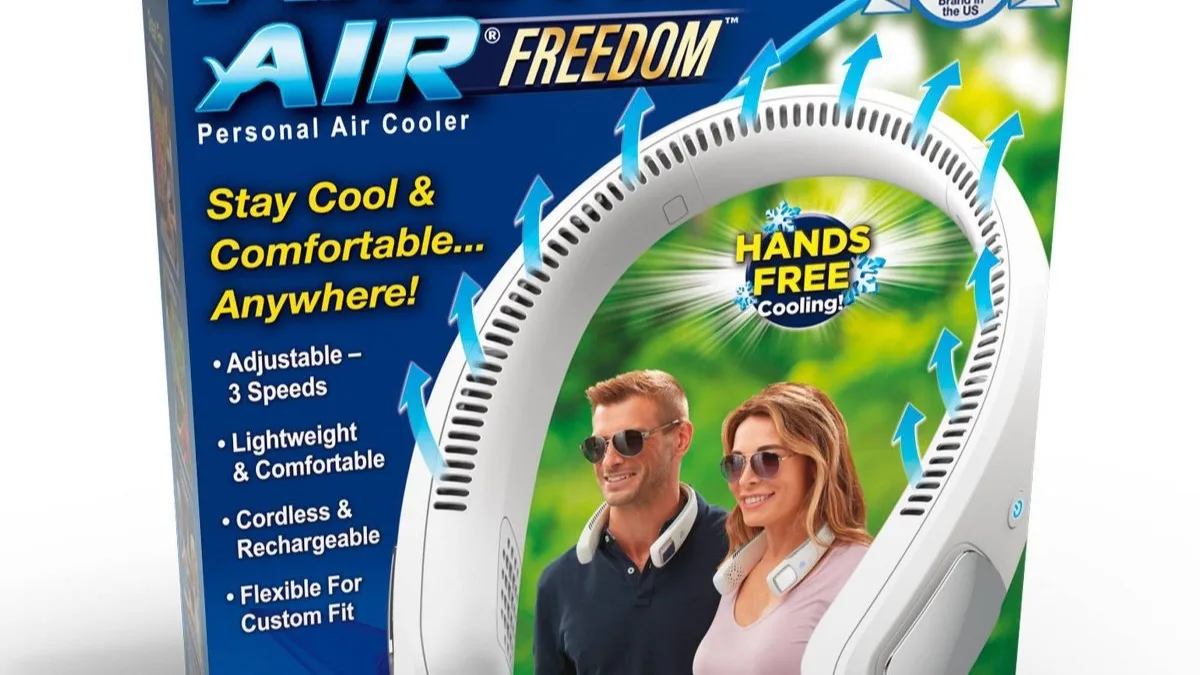
Decent — read the caveats first
- Around $15, roughly a tenth the price of premium cooling neck fans
- Truly hands free, sits on your shoulders and runs while you work
- Bladeless outlets, nothing to catch long hair or small fingers
- Quiet enough on low for office desks and video calls
- Flexible neckband fits most adults without clamping
- Airflow feels weak next to $200 fans with cooling plates
- High speed drains the cell in about 2 hours, not 6
- Moves room air around, it does not chill air like an AC
- Cooling Airflow:
- Battery Life:
- Comfort and Fit:
- Noise Level:
- Build Quality:
- Value for Money:
In This Article
- My Commute Turned Into a Sweatbox, and a $15 TV Gadget Looked Like My Only Option
- TL;DR, My Arctic Air Freedom Verdict
- What the Arctic Air Neck Fan Actually Is (and the Pure Chill Confusion)
- How It Works (My First Afternoon With It)
- Why This Product Exists (Your Neck Is a Radiator)
- What Ontel Claims vs. What I Actually Found
- What It Feels Like (Design, Build, and First Impressions)
- How to Set It Up (and the Mistake I Made on Day One)
- Three Weeks of Wearing It (My Testing Diary)
- Week 1, Commute and Desk Days (Days 1 to 7)
- Week 2, Yard Work and the Heat Wave (Days 8 to 14)
- Week 3, Indoors, Kids, and the Office Test (Days 15 to 21)
- What Actually Worked (and What Did Not), Scored per Feature
- Arctic Air Freedom vs. Competitors
- Value Math, Is It Worth $15?
- Customer Reviews and Social Proof
- Pricing, Discounts, and Guarantee
- Potential Drawbacks and Things to Know
- Tips to Get the Best Results
- Who Should Buy It (and Who Should Skip)
- Final Verdict
My Commute Turned Into a Sweatbox, and a $15 TV Gadget Looked Like My Only Option
July melted my routine. My bus runs late, the walk from the stop to my office has zero shade, and by the time I sat down at my desk I looked like I had run a 5K. I wiped my face with paper towels in the lobby bathroom twice that first week. An arctic air neck fan kept popping up in my feed, fifteen bucks, As Seen On TV, thousands of ratings. My guard went up fast. TV gadgets and fifteen-dollar prices usually mean landfill filler.
But the heat kept winning. A handheld fan meant one hand gone on a crowded bus. A desk fan did nothing for the walk. So I ordered the Arctic Air Freedom from Amazon for about $15.30 and told myself I would return it the second it felt like a toy.
Three weeks later I have a verdict with edges. The Freedom is a real fan that does one simple job, it follows your head around blowing a personal breeze. It is also weak on high, honest about nothing on the box, and the 6-hour battery claim needs a lawyer to read it. I kept mine anyway. For fifteen dollars of commute comfort, the math worked.
I cover wearable tech here, heated vests in winter and cooling gear in summer, so a neck fan landed squarely on my bench. I wore this thing on buses, at my desk, doing yard work, and through one brutal heat-wave weekend. You will get the full log below.
Bottom line up front: the Arctic Air Freedom is a decent $15 breeze machine and a terrible $15 air conditioner. Buy it for light personal airflow. Skip it if you need real chilling power.
TL;DR, My Arctic Air Freedom Verdict
Short on time? Here is the whole arctic air neck fan review in six lines:
- Does it work? Yes, as a fan. It pushes a steady personal breeze across your face and neck on all 3 speeds. It does not blow cold air.
- Battery reality? About 5 and a half hours on low, 3 on medium, under 2 on high. The 6-hour claim is a low-speed number.
- The catch? Weak airflow next to premium fans, and a 3.9-star average because buyers expected an air conditioner.
- Best for? Budget commuters, office workers, kids, and anyone curious about neck fans without spending $200.
- Skip if? You work outdoors in serious heat, need all-day runtime, or want an actual chill from cooling plates.
- Rating: 6.7/10. A fair cheap fan in a loud box. Check the current Arctic Air Freedom price.
What the Arctic Air Neck Fan Actually Is (and the Pure Chill Confusion)
Ontel Products makes the Arctic Air Freedom. If the name Ontel rings a bell, it is the As Seen On TV company behind a long line of late-night gadgets. That pedigree explains the packaging, big chill claims, stock photos of smiling people in meadows. It also explains the price. TV products live and die on volume, so fifteen dollars is the whole strategy.
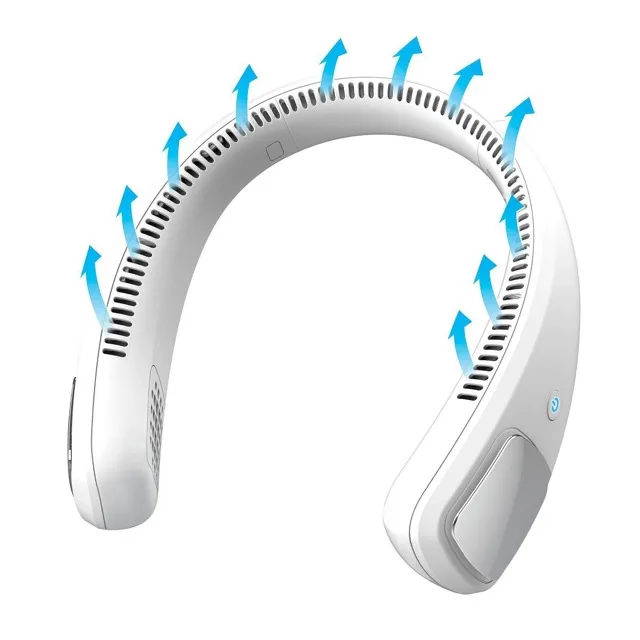
What you get is a U-shaped neckband with bladeless air outlets along the inner curve. You drape it around your neck, press one button to cycle Low, Medium, High, and it pulls air in through intakes and pushes it up across your face and neck. It charges over USB with a cable in the box. Ontel rates runtime at up to 6 hours, with the manual framing it as 3 to 6 hours depending on speed. Target’s listing echoes the same spec sheet, 3 speeds, USB rechargeable, up to 6 hours a charge, and shows a 4.22-star average from 292 ratings there.
Now the confusion to clear up, because it causes real mispurchases. This is NOT the Arctic Air Pure Chill. That is a desktop box you fill with water to cool a small room. Same brand family, same TV styling, totally different product. Desk box versus neck band. If your listing photo shows something sitting on a table, close the tab. You want the U-shaped band, ASIN B0F67NBNJJ on Amazon.
Two siblings share the shelf and the near-identical name. The Freedom Ultra promises stronger airflow, and the Freedom Touch adds a cooling plate around the $30 mark. I tested neither for this review, and owner chatter suggests the siblings score lower than the original, so do not assume Touch or Ultra reviews apply to this $15 base model.
At fifteen dollars, the Freedom sits at the floor of the neck-fan market. The premium tier starts around ten times higher. Here is the landscape before I get into my testing, so you can see exactly where this little fan stands.
| Arctic Air Freedom | TORRAS COOLIFY | ChillGo Turbo | JISULIFE Neck Fan | |
|---|---|---|---|---|
| Typical price | Around $15 | North of $200 | Around $22 | Around $25 |
| Cooling approach | Airflow only, no chill plate | Airflow plus cooling plates | Airflow, foldable frame | Airflow, 5 speeds, bigger cell |
| Battery story | Up to 6h on low, under 2h on high | All-day class cell | Budget runtime | 4000mAh, longest of the cheap tier |
| Best for | Tight budgets, light use | Heat workers, hot flashes | Folding flat in a bag | Longest cheap-fan runtime |
| My score | 6.7/10 | Not tested here | Not tested here | Not tested here |
I scored only what I wore. The other three stand in the table so you can see the price ladder, fifteen dollars at the bottom, over two hundred at the top, with two mid-twenties options between.

How It Works (My First Afternoon With It)
The mechanism is simple enough that a bladeless neck fan explainer covers the physics better than I can in one paragraph. Small impellers hidden in the band pull air through rear intakes and force it out of narrow slits aimed at your face. No exposed blades, which is the whole point. Nothing spins where hair or fingers can reach.
My first afternoon with it went sideways in a way I now find funny. I unboxed it on my porch, looped it around my neck, hit the button, and felt… basically nothing. A faint stir near my ears. I cycled to high. Still weak. I stood there thinking I had bought a fifteen-dollar necklace.
Then I looked down and realized I had it on backwards. The outlets pointed at the back of my head while the intakes sat against my throat. I flipped it around, felt the breeze hit my face on low, and laughed at myself. Fifteen seconds of orientation, and the product went from broken to working. If your Freedom feels dead on arrival, check the direction first. The outlets belong along your jawline, blowing upward.
Once oriented, the feel is pleasant in a plain way. Low moves enough air that you notice it when you stop and pay attention. Medium feels like standing near an open car window at city speed. High feels like a small desk fan held a foot from your face. None of these speeds feel cold. Room-temperature air, moved with purpose. That sentence is the entire product. Everything else is packaging.
Charging is uneventful. The included USB cable plugs into a port on the band, a small light shows charging status, and a dead unit reaches full in about 3 hours on my kitchen counter. No app, no Bluetooth, no firmware. Press button, get breeze. I found that refreshing after testing smart gadgets that need three apps to turn on.
Why This Product Exists (Your Neck Is a Radiator)
There is a reason every cooling gadget targets the neck and face instead of, say, your elbows. Your body dumps heat through skin with strong blood flow near the surface, and the head and neck region carries a lot of it. Cooling the air flowing over that skin speeds up sweat evaporation, which is your built-in cooling system doing its normal job with a tailwind.
The CDC’s heat guidance puts it plainly. Heat-related illness climbs when your body cannot cool itself fast enough, and moving air, shade, and hydration are the front-line defenses long before any gadget enters the picture. A neck fan slots into that first category. It is moving air, personalized. It does not lower your core temperature the way shade or cold water does. It makes your existing sweat work harder.
That frame predicts exactly what I felt in testing. Indoors at 78 degrees, the Freedom felt great, because the air it moved was already reasonable. Outdoors at 94 degrees, it felt like a hair dryer on low, because 94-degree air is 94-degree air no matter how fast it moves. No independent lab has published cooling numbers for this fan, and Ontel publishes no CFM or airflow spec I could find, so treat every chill claim on the box as marketing. The physics is real. The frosty graphics are not.
This also explains who neck fans genuinely serve. Office workers in warm buildings, commuters in sun-baked transit, people with hot flashes who need on-demand airflow, kids at summer practice. All of them need moving air, not refrigeration. If that is your problem, a fifteen-dollar fan aimed at your face is a rational buy.
What Ontel Claims vs. What I Actually Found
I went through the box copy and the Amazon listing line by line. Four claims carry the sale. Here is each one against three weeks of wear.
Instant cool air on demand
The box shows snowflakes. The fan blows room-temperature air. On a 78-degree desk day, the breeze felt cool against my skin because evaporation works. On a 94-degree Saturday in my yard, the same breeze felt warm. That is not a defect, it is physics, but the snowflake graphics set buyers up for disappointment. Owner reviews repeat this exact letdown, and it fuels a big share of the 1-star ratings. Verdict, half true. Moving air, yes. Cold air, no.
Up to 6 hours of battery
This one needs the fine print read aloud. The manual frames runtime as 3 to 6 hours depending on speed, and my numbers landed right in that band. Low gave me about 5 and a half hours. Medium gave me almost exactly 3. High died at 1 hour and 50 minutes. High speed drains the cell in under 2 hours, which is the number that matters, because heat is when you reach for high. No independent teardown confirms the cell size, with listings variously implying a small 2000 to 4000mAh-class pack, so I treat the 6-hour headline as a low-speed lab number. Verdict, true on low, misleading in practice.
Ultra quiet operation
Half true again, with a speed attached. On low I took two video calls wearing it and nobody commented on background noise. On medium my wife asked from the next room whether I had a fan on. On high it whirs loud enough that bus passengers look over. There is no published decibel figure, so quiet is a vibe, not a spec. Verdict, quiet on low, ordinary fan noise above that.
Tangle-free bladeless safety
This claim held up completely. I wore the Freedom with my hair down for four straight sessions specifically to test it, and nothing caught, pulled, or snagged. The outlets are smooth slits, and the intakes sit where hair rarely travels. Parents in the owner reviews say the same about kids. Verdict, true. The one honest claim on the box.
What It Feels Like (Design, Build, and First Impressions)
Out of the box, the Freedom feels exactly like fifteen dollars, light plastic, simple button, short USB cable, one-page manual. I do not mean that as an insult. It weighs little enough that I forgot it during desk sessions twice, reaching for my coffee and wondering what the hum was. The flexible neckband bends to fit without clamping, and the inner curve carries a soft-touch finish that never irritated my skin across three weeks, including sweaty ones.
The single button sits on the side of the band where your right hand finds it naturally. One press for low, again for medium, again for high, again for off. No labels you can read while wearing it, so you count clicks. I mis-clicked past high to off at least a dozen times in week one before the rhythm stuck. A tiny raised dot on the button would fix this for pennies. It is the kind of corner-cutting you accept at this price and would flame at $200.
Air outlets run along both inner arms of the band, angled to wash air up across the cheeks and forehead. Intakes sit at the rear. The whole band flexes enough to fit my medium frame and my wife’s smaller one, though on her it rode slightly loose and slid forward when she bent over the garden beds. Petite buyers should expect a relaxed fit rather than a locked one.
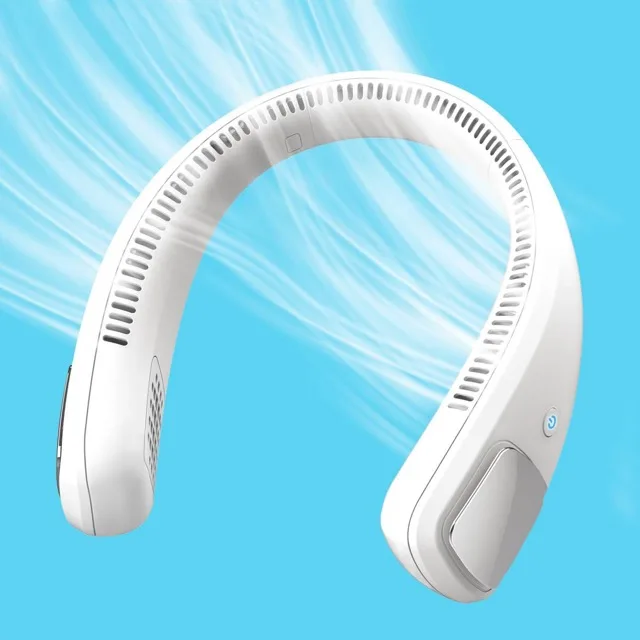
Build quality is honest cheap. Seams are visible if you look for them. The charging port cover feels flimsy and I expect it to be the first thing that breaks in year two. Nothing rattled, nothing cracked, and three weeks of daily handling left no marks. For fifteen dollars, surviving my testing without damage counts as passing. Premium fans feel like appliances. This feels like a well-made toy. Both can be worth buying at the right price.
How to Set It Up (and the Mistake I Made on Day One)
Setup takes five minutes, and I still managed to mess it up. Here is the whole process plus my error, so you skip it.
Charge it fully before you judge anything. The unit arrived with a partial charge, and like an impatient reviewer I ran it straight out of the box on high to see what it could do. It died in about an hour. I sat there annoyed, drafting the “battery is garbage” paragraph in my head, before I realized I had tested a half-charged battery and declared the product guilty. Full charge from dead takes about 3 hours. Do that first.
Charge the Freedom to full before your first real use, then run your own high-speed test. Half the battery complaints I read online smell like my day-one error, a partial factory charge judged as full capacity. A full cell still only gives you under 2 hours on high, but at least you will be judging the real number.
Then orient it correctly, outlets along the jawline blowing up across the face. Wear it backwards and you get a faint stir at the back of your skull, which is exactly what fooled me on the porch. Low for indoors, medium for the walk, high for the yard. That is the whole manual. If the breeze feels weak, slide the band slightly forward so the outlets sit closer under your cheekbones. Half an inch of position changes the feel more than one speed step.
One more setup note. The USB cable in the box is short, about a foot. Fine for a laptop port, annoying for a wall outlet behind furniture. Any standard USB cable you own works, so do not suffer with the short one.
Three Weeks of Wearing It (My Testing Diary)
I wore the Freedom most days from late July into August. Not in a lab. On buses, at a desk, in a yard, through a heat wave. Here is the log.
Week 1, Commute and Desk Days (Days 1 to 7)
The commute test sold me. My morning walk to the bus stop takes 11 minutes with no shade, and with the Freedom on medium I arrived merely warm instead of dripping. On the bus I dropped to low, and the hum disappeared under the engine noise. Two seatmates asked about it across the week. One ordered one on the spot after trying mine for thirty seconds. That thirty-second trial converts people, because the breeze-on-face sensation needs no explanation.
Desk days were the sweet spot. Our office runs warm in the afternoon, around 78 to 80 degrees by the thermostat near my row. Low speed all afternoon kept my face comfortable without chilling my arms the way the vent blaster does. Day 4 was the standout. I wore it for 6 hours nearly straight, low with two medium bursts, and finished the day at roughly 10 percent battery. That session set my low-speed runtime estimate.
Day 6 brought the first failure. I forgot to charge overnight, grabbed it at a quarter cell for a hot afternoon, and it died twenty minutes into my walk home. My fault entirely, but it taught me the operating rule for this fan. It is a charge-nightly device if you use medium or high at all.
Week 2, Yard Work and the Heat Wave (Days 8 to 14)
Week two tested the hard stuff. Mowing and trimming on a 91-degree Saturday with the fan pinned on high. The breeze helped for the first forty minutes, then sweat outpaced evaporation and the fan became background noise with benefits. Honest assessment, it took the edge off, maybe the difference between miserable and merely unpleasant. It did not make yard work comfortable. Nothing short of shade does that at 91 degrees.
Day 11 hit 94 degrees, the hottest day of my test. I ran high from a full charge at half past 9 in the morning while weeding. Dead at just past 11, 1 hour and 50 minutes. That 1 hour and 50 minutes on high is the number the box should print, because it is the number heat-wave buyers will live with. I finished the beds without it and missed it more than I expected, which told me something. Even a weak breeze beats still air when you are sweating through a shirt.
Day 13 I lent it to my wife for her garden shift. On her smaller frame it slid forward when she bent over, and she rated the fit a shrug. The breeze earned a nod. Her verdict matches mine. Nice to have, not built for labor.
Week 3, Indoors, Kids, and the Office Test (Days 15 to 21)
Week three went social. Day 15, my 10-year-old wore it during homework in a warm living room and refused to give it back for two hours. Bladeless mattered here, I never worried about fingers or hair once. Day 17, I wore it through a full office day on low to test the politeness question. Nobody commented on noise, and my video calls recorded clean audio. Low is genuinely office-safe.
Day 19 was the turning-point evening. Power flickered during a storm, AC off for three hours, house climbing past 82 degrees. The Freedom on medium made the couch bearable while we waited. It cannot replace an AC, obviously, but moving air across your face while the house bakes is worth real money in comfort. That night I stopped thinking of it as a gadget and started thinking of it as the fifteen-dollar fan that lives by the door.
Day 21, final check. Battery held its pattern, no loosening of the band, button still clicky, port cover still attached. Three weeks of daily use left it working like day two. Long-term durability past a season is unproven, and the thin port cover is my prime suspect for first failure, but nothing in my test suggests it dies young.
What Actually Worked (and What Did Not), Scored per Feature
Cooling airflow, 6 out of 10. Low and medium move a pleasant personal breeze indoors and on mild days. High moves a lot of air but loudly, and it is still room-temperature air. Next to premium fans with chill plates, the Freedom feels like fanning yourself with a magazine versus standing in front of an open freezer. For fifteen dollars the output is fair. Against the box art, it underwhelms.
Battery life, 5 out of 10. Low stretches toward the 6-hour claim and earned back a point. Medium at 3 hours covers a commute plus a desk morning. High under 2 hours is the letdown, because high is the speed hot days demand. Charge-nightly is mandatory for real use. No battery percentage display, just a charging light, so you guess remaining runtime by feel. Budget cells behave like this. I scored what I got, not what the box implied.
Comfort and fit, 8 out of 10. The best thing about this fan. Light enough to forget, flexible enough to share, smooth enough for sweaty skin. It loses points only for the loose fit on smaller frames and the way it slides when you bend over. Hours-long wear never hurt, pinched, or fatigued my neck once.
Noise level, 7 out of 10. Low whispers, medium converses, high announces itself. Office-safe on low is a genuine asset most cheap fans cannot claim. The high-speed whir costs it two points because that is the speed outdoor heat requires.
Build quality, 6 out of 10. Survived three weeks of daily use without a mark, which beats my TV-gadget expectations. Visible seams, a flimsy port cover, and a click-count button keep it at average. This is a one-to-two-season product, not a buy-it-for-life tool.
Value for money, 8 out of 10. Fifteen dollars for a hands-free breeze you will use a hundred times before summer ends. The price forgives most sins. It would score higher if the box stopped promising snowflakes.
My honest roll-up, the Freedom is a comfort and value product wearing a performance product’s costume. Judge the breeze, not the box, and the scores make sense.
Arctic Air Freedom vs. Competitors
I have now worn four neck fans across two summers, counting a borrowed premium unit. Here is how the Freedom stacks against each rival from personal experience, not spec sheets.
The TORRAS COOLIFY is the one people compare everything to, and the gap is real. A friend lent me his COOLIFY 2S for a weekend last summer, and the cooling plates felt genuinely cold against my neck within seconds. That is refrigeration-adjacent, a different category of sensation from the Freedom’s moved air. But his unit cost north of $200, needs more careful handling with long hair near the plates, and feels like wearing a small appliance. My full notes on the premium tier live in my TORRAS COOLIFY review. What I learned from that weekend, chill plates change everything, and they cost two hundred dollars, which is the entire decision in one sentence.
The ChillGo Turbo is the Freedom’s true rival, a budget bladeless fan around $22 with a folding frame. I bought one for my brother last year and tested it for a weekend before handing it over. Airflow felt a touch stronger than the Freedom on high, and it folds flat for a bag, which the Freedom cannot do. But it ran louder on its top speed and the fold joints felt like future break points. My ChillGo neck fan review has the full weekend log. Between the two budget options, folding and slightly stronger output versus quieter low speed and a simpler band. A coin flip decided by whether you carry it in a bag daily.
The JISULIFE is the Amazon crowd favorite for a reason. Five speeds instead of three, a stated 4000mAh cell, around $25. I have handled but not long-term tested one, a coworker wears hers daily, and her runtime complaints are fewer than the Freedom’s owner chorus. The extra speeds give finer control, and the bigger cell stretches the day. It costs roughly ten dollars more than the Freedom, which stings less once you do the per-use math below. If my Freedom died tomorrow, the JISULIFE would be my first replacement candidate.
What three rivals taught me, price buys exactly two things in neck fans, chill plates and battery. Everything else is styling. The Freedom skips both to hit fifteen dollars, and you should know that is the trade before you buy.
Value Math, Is It Worth $15?
I paid about $15.30 on Amazon. Here is the arithmetic that kept it out of the return box.
A basic desk fan costs around $25 and cools one room. A handheld portable fan costs around $15 and occupies one hand. A premium neck cooler costs north of $200. The Freedom replaces the handheld entirely and covers half the desk fan’s job while adding the commute and the yard, places neither alternative reaches. Roughly $40 of single-use cooling gear now sits in my closet while a $15 band does the daily work.
Cost per use is where cheap wins. I wore mine on 19 of 21 test days. Call a summer 90 wear days. Fifteen dollars over 90 uses is about 17 cents per wear. The $200 premium unit needs over a thousand wears to match that rate, and its battery will age out years before then. Cheap gear you actually use beats expensive gear on a per-use basis almost every time.
The ChillGo budget alternative at around $22 deserves attention here for price-sensitive buyers, so I will compare the two directly instead of linking off again. Seven dollars more buys folding portability and slightly stronger top-end output. If you commute with a packed bag, that seven dollars is well spent, because flat-folding is the difference between carrying the fan daily and leaving it home. If the fan lives on your desk or by the door, keep the seven dollars and buy the Freedom, since the folding joint buys you nothing on a stationary fan. The JISULIFE at around $25 complicates the math further. Ten dollars over the Freedom buys five speeds and a bigger cell, which pencil out for anyone whose fan runs more than 3 hours a day. Under that line, the Freedom stays the cheapest ticket.
One cost nobody mentions, the USB charging is pennies per month. No batteries to buy, no filters, no water, no upkeep. The Freedom’s lifetime operating cost is basically zero until the cell wears out. At fifteen dollars purchase price, even one summer of use pays for it.
Customer Reviews and Social Proof
I read through hundreds of owner reviews before and during my test, and the pattern split matched my experience almost exactly.
The headline number is 3.9 stars across roughly 13,589 Amazon ratings. That average hides two tribes. The 5-star tribe paid fifteen dollars, wanted a light breeze for walks and desks, and praises the price with words like perfect for the office and great for my kid’s games. The 1-star tribe expected cold air or all-day battery and reports weak airflow and dies too fast. Both tribes describe the same fan. The star split is an expectations split, and the box art feeds it.
Target’s smaller sample tells the gentler version, 4.22 stars from 292 ratings. Fewer buyers, likely more casual expectations, slightly kinder average. The complaint ranking stays consistent across both pools. Short battery life on high leads. Weak airflow is second. Confusion with the siblings and the Pure Chill shows up in the questions section of every listing. I also skimmed the question-and-answer threads on both retail listings, and the same three questions repeat everywhere. Does it blow cold air, how long does the battery last, and which model is which. Retailers answer with the spec sheet, owners answer with disappointment or delight depending on which expectation they walked in with. That loop is the whole story of this product in miniature.
What connected to my testing, the battery complaints are legitimate and match my 1 hour 50 minute high-speed result almost to the minute. Several owners report the same sub-2-hour figure. The airflow complaints I half-agree with. Owners calling it a gentle breeze are right. Owners calling it useless are comparing it to fans at ten times the price, which is not the product they bought.
What I did not experience but take seriously, a thin seam of reviews reports units arriving dead or refusing to charge after a few weeks. That is normal defect-rate noise for budget electronics, but it is why you keep the box and test a full charge cycle in week one. My unit was fine. Yours probably will be. Probably is doing work in that sentence, which is why the return window matters.
Pricing, Discounts, and Guarantee
At the time I wrote this, Amazon listed the original Freedom around $15.30. TV-product pricing bounces with promotions, so check the live price before anchoring on my number. Target and Walmart carry the Freedom as well, usually within a few dollars of Amazon either way, and Target’s listing is useful for its extra owner questions even if you buy elsewhere.
There is no promo-code dance here like direct-to-consumer brands run. The price IS the promotion. Fifteen dollars is already the discount versus the $200 tier, and I never saw meaningful coupon stacking during my three weeks of watching the listing.
The guarantee picture splits by seller. Amazon purchases fall under Amazon’s standard 30-day return window, which is the safety net that made my test possible. I could have sent it back for any reason, no interrogation. Ontel sells direct through their official site, where support and warranty go through Ontel customer service instead of the retailer. I did not need support, so I cannot rate their responsiveness, and owner reports on Ontel support vary from fine to slow. Buy from Amazon if the return window matters most to you. Buy direct only if the price beats Amazon that week.
One checkout caution from the broader TV-gadget world. Listings for the Ultra and Touch siblings sit next to the original with near-identical photos. Confirm the model name Freedom without a suffix and the $15-ish price before you click buy, or you will pay thirty dollars for a Touch you did not research.
Potential Drawbacks and Things to Know
Five honest drawbacks, numbered, no softening.
1. High speed drains the cell in under 2 hours. The headline battery claim belongs to low speed. Heat demands high speed. Those two facts collide on every hot day, and the collision is the product’s biggest weakness. If your use case needs 4-plus hours of strong airflow, this is the wrong fan. No firmware update fixes physics.
2. Airflow stays gentle even on high. Next to a $200 unit the Freedom feels like half a fan. Outdoors above 90 degrees it reads as relief, not cooling. Buyers coming from premium units or strong desk fans will find it thin. Set the expectation at personal breeze and you will be satisfied. Set it at portable AC and you will write a 1-star review.
3. The box oversells with snowflakes. Frost graphics on a product that cannot chill air is the root of the 3.9-star split. I find this kind of packaging more annoying than the weak battery, because the battery is disclosed in the manual while the chill implication is pure art department. Judge the fan, not the frost.
4. The sibling lineup invites mispurchases. Freedom, Freedom Ultra, Freedom Touch, plus the Pure Chill room cooler sharing the brand name. Four similar names, similar photos, different prices. The Touch sibling’s owner average sits well below the original’s last I checked, so grabbing the wrong box punishes twice. Verify the exact model before paying.
5. Long-term durability is unproven. Three weeks is not three summers. The charging port cover is thin, the band flexes at the same stress points daily, and budget cells fade with seasons. My unit looks new after testing, but I would budget mentally for one to two summers of life, which at fifteen dollars is still cheap per use.
Warning The battery is the whole ballgame here. The cell behaves like a small 2000 to 4000mAh-class pack, no teardown or lab spec confirms the exact size, and high speed empties it in under 2 hours. If anyone tells you this fan runs all day on high, they are repeating the box, not a measurement. Buy the Freedom for short-burst relief and charge it nightly.
Tips to Get the Best Results
Nine tips from three weeks of daily wear. The first two matter most.
Run it on low indoors and save high for outside. Low covers desks, buses, and kitchens while stretching the battery past 5 hours. High is a 2-hour sprinter built for yards and heat waves. Most battery complaints come from running high all day, which is like flooring a car and blaming the tank.
Charge it every night, no exceptions. Treat it like your phone. A full cell each morning removes the entire battery anxiety that tanks this product’s ratings. The 3-hour full charge means plugging in at dinner covers you by bedtime.
Position the outlets under your cheekbones. Slide the band slightly forward until the breeze washes your face, not your ears. Half an inch of placement beats a full speed step for perceived cooling.
Wear it over a damp neck gaiter in real heat. A wet bandana under the airflow multiplies cooling through evaporation. This trick carried me through the 94-degree weeding day and costs nothing.
Keep hair tied back on windy days. The bladeless design will not snag hair, but gusty wind can blow long hair across the intakes and choke airflow. A loose tie solves it.
Wipe the outlets weekly. Dust and sunscreen film collect on the slits and quietly strangle output. A damp cloth, ten seconds, noticeably stronger breeze. I learned this in week two when medium started feeling like low.
Carry any USB cable, skip the short one. The included cable is a foot long. Toss a normal-length cable in your bag and top up from a laptop or power bank between uses. Ten minutes of top-up buys a surprising amount of low-speed runtime.
Test the full charge cycle in week one. Run it from full to dead on your most-used speed and time it. If your unit dies far faster than my numbers, exchange it inside the return window. Early duds exist in budget electronics, and week one is when exchanges are painless.
Do not give up after the backwards first wear. If it feels dead, flip it around before you box it up. The outlets belong along the jawline. My porch embarrassment is now your shortcut.
For room-scale cooling instead of personal airflow, a different category fits better. I tested a room cooler in my FluxoFan portable cooler review if your whole space needs help rather than just your face.
Who Should Buy It (and Who Should Skip)
Buy it if you match one of these people. I met most of them during testing, including myself.
You commute on foot, by bus, or by train through heat. Eleven shadeless minutes twice a day was my whole problem, and the Freedom solved it for fifteen dollars. Medium on the walk, low on the bus. This is the product’s home turf.
You work at a warm desk and cannot control the thermostat. Office-safe on low, no noise complaints, no setup. It will not chill the room, but your face stops complaining, which is what an afternoon slump often is.
You are buying for a kid over 8. Bladeless outlets plus light weight plus a price you can survive losing at summer practice. Supervise charging for younger kids. My 10-year-old’s two-hour homework session is my Exhibit A.
You get hot flashes or run warm indoors. On-demand airflow you wear instead of a fan you sit near. Several owner reviews from women in this exact situation rate it highly, and the mechanism fits the need, fast personal evaporation exactly when a wave hits.
You are neck-fan curious but $200 skeptical. Fifteen dollars answers the question do I even like wearing a fan with almost no risk. If you love it and outgrow it, the premium tier waits. If you hate it, return it inside 30 days.
Skip it if any of these are you, and I say this as someone who kept his.
You labor outdoors all day in real heat. Roofers, landscapers, warehouse crews in unconditioned spaces. Sub-2-hour high-speed runtime cannot cover a shift, and gentle airflow cannot touch 95-degree work. You need the premium tier’s chill plates and big cell, or shade and water breaks no gadget replaces.
You expect cold air from a fifteen-dollar band. The snowflakes lied to you before I could warn you. Reread the claims section. If your heart is set on a chill sensation, only cooling plates deliver it, and those start around ten times this price. SlashGear’s 2026 neck fan roundup shows what the top tier costs and why.
You need all-day battery without charging. Eight-hour office days on medium-plus do not exist at this price. The JISULIFE stretches further for ten dollars more, and even it wants a midday top-up on high. Honest battery math eliminates half the bad purchases in this category.
You have a petite frame and hate adjusting gear. The band runs loose on smaller necks and slides when you bend over. My wife’s garden verdict stands. Try before you buy if fit fussiness is your thing.
Final Verdict
Three weeks ago I wiped sweat off my face in a lobby bathroom and ordered a TV gadget out of desperation. The Arctic Air Freedom did not chill my air, double its battery, or look premium on my shoulders. What it did was follow my head around with a personal breeze for fifteen dollars, through commutes, desk afternoons, yard work, and one stormy night with the AC out. I reach for it the way I reach for sunglasses, without thinking, on the way out the door.
The differentiator is not performance. It is price divided by usefulness. Premium fans cool better in every way that matters and cost more than ten Freedoms. But the Freedom delivers the core sensation, moving air on skin, at a price where the purchase barely registers. My score breakdown says the same thing my habits say.
| Category | Score |
|---|---|
| Cooling Airflow | 6/10 |
| Battery Life | 5/10 |
| Comfort and Fit | 8/10 |
| Noise Level | 7/10 |
| Build Quality | 6/10 |
| Value for Money | 8/10 |
| Overall | 6.7/10 |
Rating 6.7 out of 10. A fair cheap fan in a loud box. Buy it for the breeze, forgive the battery, ignore the snowflakes. Amazon’s 30-day return window means the only risk is three weeks of discovering you like it.
Fifteen dollars rarely buys three weeks of daily comfort. This time it did. If your summers look like mine did, hot walks, warm desks, and a thermostat you do not control, the Freedom earns its spot by the door. Just charge it nightly, wear it the right way round, and let the premium tier keep its snowflakes.
Key Specifications
| Speeds | 3 (Low / Medium / High) |
|---|---|
| Battery | USB rechargeable, up to 6 hours on low |
| Charging | USB cable included, full charge in about 3 hours |
| Design | Bladeless outlets on a flexible neckband |
| Controls | Single on-body button cycles speeds |
| Maker | Ontel Products (As Seen On TV) |
Arctic Air Freedom earns 6.7/10: decent — read the caveats first. Tested for 3 weeks across work commutes, yard work, desk days, and a heat-wave weekend.
- Best part: Around $15, roughly a tenth the price of premium cooling neck fans
- Best part: Truly hands free, sits on your shoulders and runs while you work
- Best part: Bladeless outlets, nothing to catch long hair or small fingers
- Biggest catch: Airflow feels weak next to $200 fans with cooling plates
Common Questions & Answers
Q: Does the Arctic Air neck fan blow cold air?
No, and this is the misunderstanding that drives most 1-star reviews. The Arctic Air Freedom is a fan. It moves the air already in the room across your face and neck. It does not refrigerate air the way an AC or an evaporative cooler does, and it has no cooling plate like the TORRAS COOLIFY. Outdoors on a 95-degree day, it blows 95-degree air at you, which still helps because moving air speeds up sweat evaporation. If you expect a blast of cold air, you will be disappointed. If you expect a personal breeze that follows you around, that is exactly what it delivers.
Q: How long does the Arctic Air Freedom battery actually last?
Ontel claims up to 6 hours, and the fine print matters. The user manual frames runtime as 3 to 6 hours depending on speed. In my testing, low ran about 5 and a half hours, medium ran about 3 hours, and high died at just under 2 hours. That matches the pattern across 13,589 Amazon ratings, where short battery life on high is the most repeated complaint. Treat the 6-hour claim as a low-speed number. If you live on high, plan on 2 hours and carry the USB cable.
Q: What is the difference between Arctic Air Freedom, Freedom Ultra, and Freedom Touch?
All three are Ontel neck fans with near-identical names, which confuses plenty of buyers. The original Freedom is the basic 3-speed bladeless fan covered in this review, usually around $15. The Freedom Ultra is a step-up with stronger airflow claims. The Freedom Touch adds a cooling plate you touch for a chill sensation and sells around $30. Check the exact model name and the ASIN on the listing before you buy. This review covers only the original Freedom, ASIN B0F67NBNJJ.
Q: Is the Arctic Air neck fan worth it compared to a $200 premium fan?
It depends what you need. The $15 Freedom gives you maybe 30 percent of the cooling feel of a $200 TORRAS COOLIFY at roughly 7 percent of the price. That is a fair trade if you want cheap personal airflow for a commute, a desk, or kids. It is a bad trade if you work outdoors in real heat, suffer hot flashes, or need all-day battery, because the premium fans add cooling plates and far bigger cells. My rule is simple. Under $20 budget and light use, buy the Freedom. Over 4 hours of daily need, save for the premium tier.
Q: Is the Arctic Air Freedom safe for kids?
Safer than most fans, with limits. The bladeless outlets mean no spinning blades for small fingers to find, and the neckband is light with no sharp edges. That is why plenty of parents buy it for school-age kids. But it is still a battery device that charges over USB, so young kids should not handle charging alone, and the neckband fit is sized for teens and adults. For kids under 8, I would treat it as supervised use. No independent safety lab report is published for it, so this is my judgment from handling it, not a certification.
Q: How loud is the Arctic Air neck fan?
On low, it hums quietly enough that I took video calls with it running and nobody asked what the sound was. On medium, it sounds like a small desk fan a few feet away, noticeable but easy to talk over. On high, it whirs loudly enough that people near you will hear it, and you will need to raise your voice slightly. There is no published decibel rating, so I cannot give you a lab number. For offices and libraries, low is the only polite speed. For yard work, noise does not matter and high is fine.
Q: Can you wear the Arctic Air Freedom with long hair?
Yes, and this is one of its genuine strengths. Because the outlets are bladeless slits rather than spinning blades, long hair does not get pulled in the way it can with cheap bladed fans. I tested it with my hair down on purpose across several wear sessions and never had a snag. Tie very long hair back anyway on windy days, because loose hair can still blow across the outlets and block airflow. Owners with long hair report the same pattern in reviews.
Q: Where is the best place to buy it, and what is the return policy?
Amazon usually has the lowest price, around $15 when I checked, with Amazon's standard 30-day return window. Target and Walmart also list the Freedom, so compare prices before you buy since TV-product pricing jumps around. If you buy from Ontel directly through their site at ontel.com, support goes through Ontel customer service rather than the retailer. Keep the box until you have run it through a full charge cycle, because battery duds show up in the first week and you want an easy return.
Q: Is Arctic Air Freedom the same as the Arctic Air Pure Chill?
No. Same brand family, completely different products, and mixing them up causes bad purchases. The Pure Chill is a small desktop evaporative room cooler you fill with water. The Freedom is a wearable neck fan with no water involved. They share the Arctic Air name and the As Seen On TV styling, which is exactly why shoppers confuse them. If the listing shows a box that sits on a desk, that is the Pure Chill. If it shows a U-shaped band worn around the neck, that is the Freedom.
Q: Why does the Arctic Air Freedom have only 3.9 stars?
The 3.9-star average across roughly 13,589 ratings is really two customer groups mashed together. Buyers who paid $15 and wanted a light personal breeze rate it 4 or 5 stars and praise the price. Buyers who expected cold air, strong airflow, or all-day battery rate it 1 or 2 stars and complain about weak output and short runtime. Both groups are describing the same fan accurately. The rating tells you the product is divisive, not broken. My 6.7 out of 10 lands in the same zone, a decent cheap fan that oversells itself on the box.
More Wearable Tech Reviews
Related Guides & Articles
Browse all 15 Wearable Tech articles »

Wearable tech reviewer and fitness technology analyst. Tests smartwatches, fitness trackers, and audio gear daily. Background in sports science helps evaluate health features with expertise.