
Good — worth it for the right buyer
- Motion activation works. My dog woke it herself and chased for 10 to 15 minutes at a stretch without me throwing anything
- Four AA batteries and one button. No app, no charging cable, no pairing, and it sleeps on its own between sessions
- Two balls for $39.99, so a second dog or a rotation ball is already in the box
- LED glow makes evening play easy to supervise, and the shell survived four weeks of batting, dropping and slobber
- Bundles drop the per-ball price to $12.22, and the 30 day guarantee lets you test the idea cheaply
- The sales pages still publish no battery type, run time, weight or diameter, even though the box says four AA cells
- Loud on tile and hardwood. I stopped using it in the kitchen after 9 PM
- Not a chew toy. The nubs can be bitten off and a strong jaw can crack the shell, so heavy chewers are a bad match
- Proof It Works:
- Ease of Use:
- Durability Evidence:
- Disclosure:
- Value:
- Seller Reliability:
In This Article
- TL;DR: The PetsBoro Pet Ball Verdict
- What Is the PetsBoro Pet Ball?
- How PetsBoro Compares
- How a Self-Jumping Ball Works
- What PetsBoro Claims vs What I Actually Found
- Why This Toy Exists
- Design and First Impressions
- Setup and the Mistake I Made
- Four Weeks of Testing
- What Worked and What Didn’t
- What Owners Report
- Value Math: Is It Worth $39.99?
- Pricing, Guarantee and Checkout Gotchas
- Is PetsBoro Safe for Dogs?
- Drawbacks to Know Before You Buy
- Tips to Get the Most Out of It
- Troubleshooting: Five Problems and Fixes
- Who Should Buy PetsBoro and Who Should Skip It
- Is It Legit? A Closer Look at the Trust Signals
- Final Verdict
- Score Breakdown
My border collie mix, Juno, is three years old and has the work ethic of a dog bred to herd sheep from dawn to dark. I work from home. Those two facts have been in conflict since the day she arrived, and for two years the conflict has had a schedule. Long walk at 7. Puzzle feeder at 11. By 3 PM, she is lying on the hallway tiles staring at the baseboard I have repainted twice.
I have tried the usual suspects. A stuffed Kong lasted a month before she defeated it. A puzzle feeder taught her to flip the whole thing over and vacuum the floor. An indestructible ball lasted one afternoon. So when the ads for a ball that jumps by itself followed me around the internet, I did what I always do and bought the thing to see.
The PetsBoro pet ball cost me $39.99 for the two-ball pack, and I ran it through four weeks of supervised play, 31 sessions in total, on carpet, on tile and out on the lawn. If you want the wider picture of gadgets for pets, the Pet Tech category holds the rest of what I have tested.
Here is where I land. For a chase-driven, non-destructive dog, this is a genuinely useful little toy at a fair trial price, and it earns a 7 out of 10. For a dog that shreds toys, it is a waste of $39.99, and no amount of LED lights changes that.
TL;DR: The PetsBoro Pet Ball Verdict
- What is it? A battery-powered, motion-activated dog ball with LED lights and sound that bounces, rolls and hops in unpredictable directions.
- Does it work? Yes, for the right dog. Juno triggered it herself and chased for 10 to 15 minutes at a stretch, and the auto-sleep meant it was not running flat in an empty room.
- What is the catch? The $19.99 headline price is a per-ball figure on a two-ball order, so you pay $39.99 to start, and the site still publishes no battery type, size or run time.
- The surprise: it clacks loudly on tile and hardwood. On a rug it is fine, and that single detail decides where you will use it.
- Best for: small to medium, toy-driven dogs and owners who want a cheap self-play session during the day.
- Skip it if: your dog is a power chewer, or you want a toy to leave with your dog unattended for hours.
- Rating: 7/10. A real toy that does what it says, held back by missing specs and the durability record of this product style. See the current PetsBoro price and guarantee terms.
What Is the PetsBoro Pet Ball?
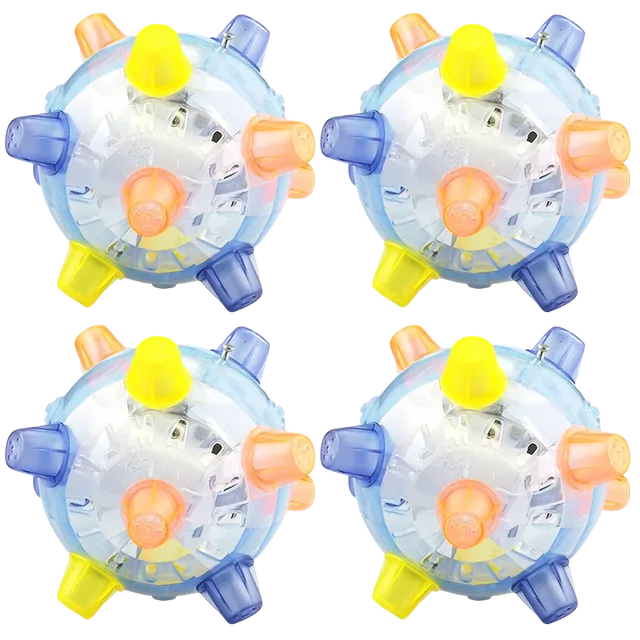
The PetsBoro pet ball, sometimes labeled the Jumping Activation Ball, is a clear plastic sphere covered in soft colored nubs. Inside are a motion sensor, a small motor with an off-balance weight, LED lights and a sound module. Touch it and it takes off, rolling and hopping in directions that do not repeat, flashing and playing a short melody. Leave it alone and it goes quiet.
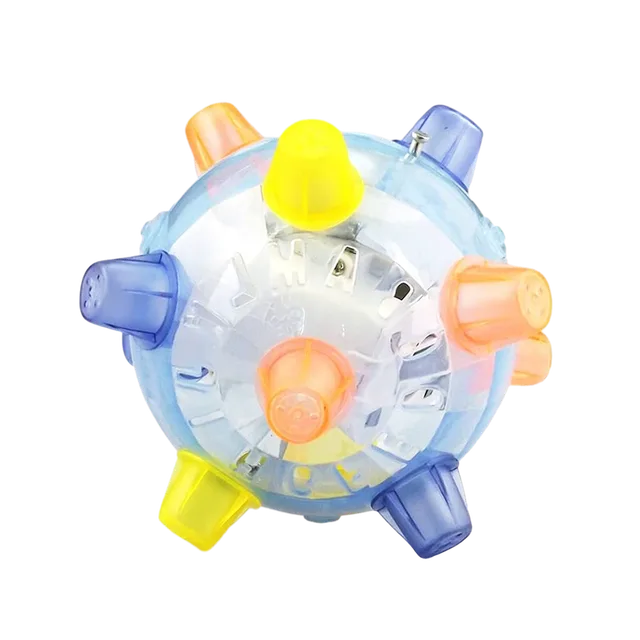
The box tells you more than the website does. Mine took four AA batteries, had one firm power button, and needed zero setup beyond that. The shell is described as PP polypropylene, which the brand calls non-toxic and BPA-free, with a finish that resists saliva. It is indoor toy first, with lawn use allowed as long as it stays away from water.
The sales pages make six promises worth putting in a row.
| Claim on the sales pages | What it means in practice |
|---|---|
| Self-jumping with random movement | Movement is unpredictable, which is what triggers a chase |
| Motion-sensor activation | Your dog’s nudge starts it, so it needs a dog willing to touch it |
| Auto shut-off when not chased | Real in my use, though no timing is published |
| Flashing lights and melody | Fun for many dogs, startling for some |
| Non-toxic, BPA-free PP | A plausible material claim with no test report shown |
| Designed by a veterinary behaviorist | Stated on one funnel page only, with no name given |
One thing to clear up early. This is a category product, not an invention. Balls of this shape and behavior are sold under dozens of names, and PetsBoro is one of them. If you are shopping the category rather than the brand, the roundup of the best self-moving dog balls lines up four options side by side.
How PetsBoro Compares
Before the deep dive, here is the decision in one table, because this is really a choice between three routes: the brand-and-bundle ball, a premium rechargeable, or unbranded copies at the lowest price.
| Feature | PetsBoro pet ball | Cheerble Wicked Ball | Unbranded jumping balls |
|---|---|---|---|
| Starting price | $39.99 for 2 balls | About $54 for the original (Air Neo lists around $35) | Varies, usually lower |
| Power | 4 AA replaceable, type unlisted on site | USB rechargeable, 1 hour charge for up to 8 hours | Usually AA or button cells |
| Auto rest cycle | Sleeps when ignored, no timing published | 10 minutes play, 30 minutes rest | Varies |
| Published size | Not stated | About 3 inches (77 to 80 mm) | Varies |
| Refund window | 30 days, less S&H | Retail return terms | Retail return terms |
| Best for | A cheap trial in a 2-pack | A dog that will use it daily | someone who accepts the quality risk |
Cheerble publishes its battery, weight and charging time on its product pages, which is exactly the information PetsBoro withholds. The tradeoff is money. A Cheerble is roughly $54 against $39.99 for two PetsBoro balls, so you are paying about $14 more for published specs and a built-in rest cycle. If you want the full head-to-head, the PetsBoro versus Cheerble comparison walks through it line by line.
I did not arrive at this ball in a vacuum. My first answer to Juno’s 3 PM boredom was a $24 treat puzzle that she learned to overturn in two days, then a rubber Kong that kept her busy for maybe fifteen minutes before she worked the stuffing out of it. Both are still in rotation, and both need me to fill them, hide treats and reset them. A self-moving ball does none of that. It needs a nudge from a dog, which is the whole reason it earns its place on the shelf.
A friend’s house gave me the third comparison. She owns a Cheerble, and her terrier has used it daily for the better part of a year, which is a durability record I can see with my own eyes. The rest cycle is the difference I noticed most. The Cheerble plays for ten minutes and stops for thirty, so her dog cycles between chase and calm. PetsBoro sleeps whenever the dog quits, which does the same job less predictably. For a dog that would chase until she dropped, I actually prefer the ball that stops when the interest stops.

How a Self-Jumping Ball Works
There is no magic in it, and knowing the mechanism tells you what to expect. Inside the shell sits a small motor carrying an off-balance weight, the same idea as the vibration motor in your phone. When the motion sensor picks up a nudge, the motor spins, the weight throws the ball off balance, and the whole thing hops and rolls. Lights and sound run off the same circuit, and auto-sleep cuts power when the sensor stops registering contact.
That design explains both halves of the experience. The movement reads as small living prey, which is why a chase dog goes after it rather than walking past. The weak points are also obvious: an unbalanced motor and a small battery pack are the first parts to fail on cheap versions, and a hard shell with a seam is a chew target.
One warning I took from a review of a comparable ball, the Cheerble Wicked Ball on The Gadgeteer, is that even the gentlest mode is lively enough that the reviewer would not use it near delicate furniture or on hardwood. That matched my own first week. This is a ball with momentum, and it will find your skirting boards.
What PetsBoro Claims vs What I Actually Found
This is the section I care about most, because a sales page claim and a ball on your floor are two different things. No independent lab or veterinary test of the PetsBoro ball has been published, so every positive number you see about it is either the brand’s claim or an owner’s account, never a measurement.
“Designed by a board-certified veterinary behaviorist and professional dog trainer.” This sits on the presale page. The second page in the funnel makes no such claim, and no name, credential or institution appears anywhere. Until a person is named, treat it as decoration.
“Over 64,000 customers.” Also unsourced, on the same page. The interstitial only says it shows four testimonials. A large number with no source is not evidence, and it does not become evidence because it is big.
“After two months, this ball is still holding up.” Named customers report two and six months of use. Those are testimonials chosen by the seller, so they show that a ball can last, not that yours will. My own four weeks say the same thing in a smaller voice: mine is intact, with scuffs and one tooth mark, after 31 sessions.
“50% OFF.” The math changes depending on which page you land on. One page shows $79.99 struck through against $19.99 and calls it 50% off, when that is closer to 75% off. The checkout shows $69.99 against $39.99 for two balls, which is 43% off. The discount framing is promotional noise, so watch only the number the checkout actually charges you.
“Non-toxic, BPA-free.” Plausible, because PP is a common food-contact plastic and the shell is the main part your dog mouths. No test report or certificate is shown, and the claim covers neither the batteries, the circuit board nor the nubs.
“Bite-proof padding” and “saliva and tear-resistant.” These are durability claims with no test standard behind them. Four weeks with a 34 pound non-chewer left mine whole. A visiting Labrador left tooth marks inside one minute, and I ended that session. That gap between dogs is the honest answer to the durability question.
Why This Toy Exists
Boredom in dogs is not a marketing invention. The ASPCA lists exercise, play and attention as the front line against destructive behaviors like chewing, and describes how a dog left without enough to do will find its own entertainment, usually at your furniture.
Enrichment research backs the idea that changing a dog’s environment changes its behavior. A pilot study of dogs in an office environment found that enrichment sessions raised relaxation behaviors and cut both alert and stress behaviors measurably, with the effect varying by activity type. The finding that matters for a product like this is that novelty and rotation do the work. Toys and activities lose their pull once they become familiar, which is why the same study and others like it recommend rotating what you offer rather than leaving one thing out permanently.
That is the real job of a self-moving ball. It is one more enrichment option for the hours you cannot be the enrichment, and it works best as part of a rotation.
Design and First Impressions
Pick it up and the first thing is the size. It is noticeably larger than a tennis ball, big enough that a medium dog cannot get it far into its mouth, and light enough that a single hop clears the floor easily. The site never publishes a diameter, so that impression is the best you get before it arrives.
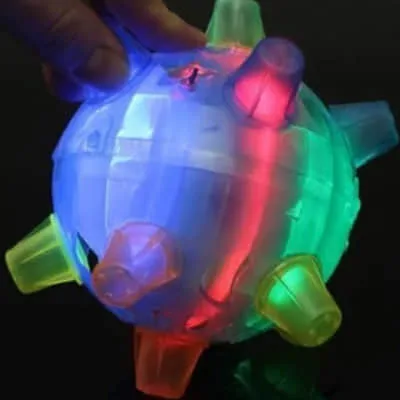
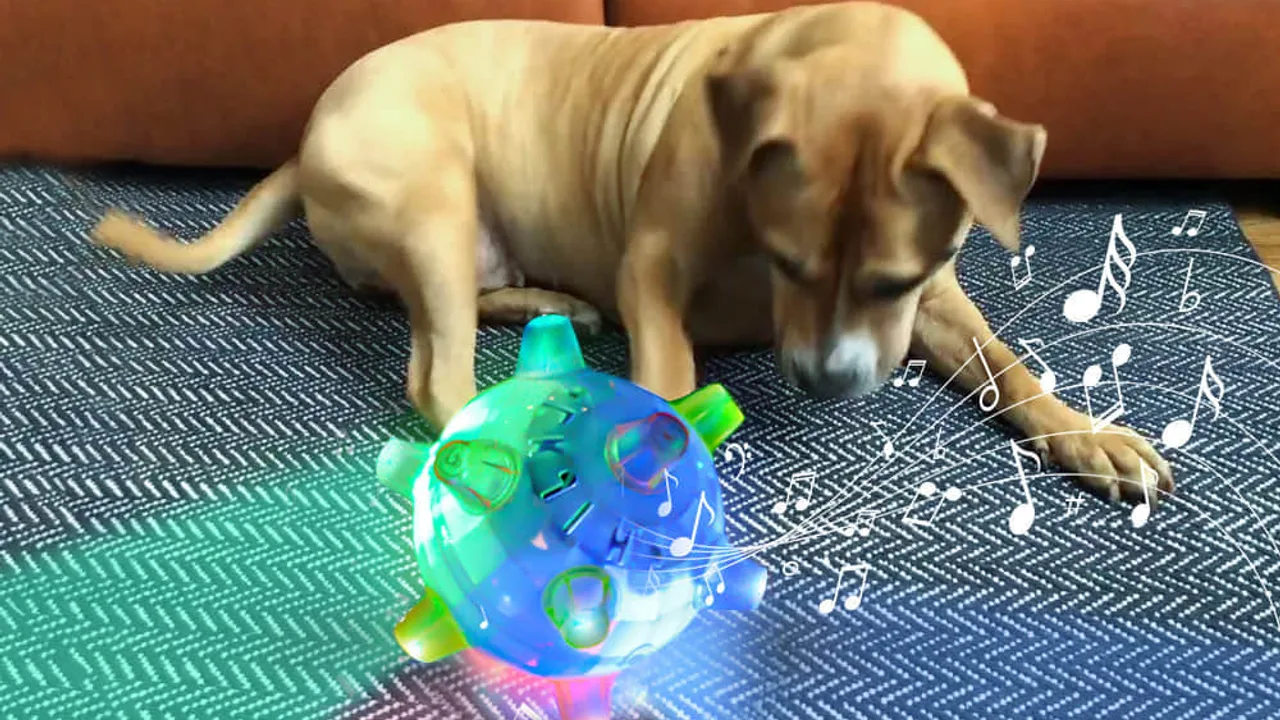
The shell is clear, so the LEDs do the visual work. In a dim room at night the whole ball lights green and blue and throws color across the carpet, which makes it easy to follow under furniture and easy for you to see what your dog is carrying. The nubs are bright rubbery studs pressed into the shell. They give the ball grip and texture, and they are also the part that owners of comparable balls report biting off, so they deserve a look after every session.
The button is firm and slightly stiff, which I like, because a soft button gets pressed by a ball that lands on it. The seam around the battery door is tight on my unit, with no gap you could catch a nail in, though a determined chewer works at exactly that kind of line.
Overall the build feels like what it is, an inexpensive plastic toy, and it has held up to a month of that. Nothing rattles loose, the door has not warped, and the lights still fire on the first press.
Setup and the Mistake I Made
Setup took about two minutes. Open the battery door, drop in four AA cells, close it, press the button. No app, no pairing, no firmware. The box does not come with batteries, so have a set ready before you open it for your dog.
Then I made the mistake that I now tell everyone to avoid. I put the ball on the kitchen tile, pressed the button in front of Juno, and it took off with a hard clatter across the hard floor. She jumped back, ears flat, and ignored it for the rest of the evening. The ball was not the problem. The introduction was.
The fix took one more session. I put the ball down switched off, let her sniff it, rolled it toward her by hand, and only turned it on after she had nudged it twice on her own terms. She went after it within seconds and played for eleven minutes.
The second mistake came a day later. I left the ball out in the middle of the floor, thinking more access meant more play. By day four she walked past it. Toys live on novelty. The pattern that worked was pulling it out of sight after each session and bringing it back later, which is also what the enrichment research on habituation recommends.
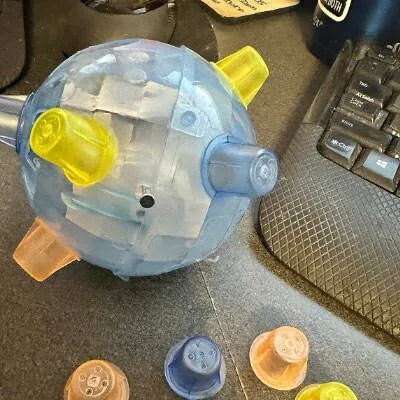
One setup habit worth copying: keep a permanent marker near the battery door and date your cells. You will not remember when you put them in, and a ball that suddenly moves sluggishly is nearly always a tired battery rather than a dead toy.
Four Weeks of Testing
Thirty-one sessions across 28 days, twice a day most days, on carpet, on tile, in the hallway and out on the lawn. Here is how it actually went.
Week 1, days 1 to 7. The slow start. The tile introduction on day one was a bust, as described above, and day two went better once I let her lead. Sessions ran 8 to 12 minutes, and she chased hard for the first four or five, then carried it around like a trophy. Day six was the longest session of the whole test at 22 minutes, because I had kept the ball out of sight all morning. The first set of rechargeable AAs went in on day one and lasted until day nine.
Week 2, days 8 to 14. The turning point came on day 9. I was on a video call I could not pause, and Juno nudged the ball herself, set it off, and played through the whole call. I watched out of the corner of one eye while pretending to nod at a spreadsheet. That was the moment the toy stopped being a novelty I was managing and became something she used on her own. Auto-sleep confirmed itself that week too: when she walked away, the ball went quiet within a couple of minutes instead of buzzing in the middle of the room until the batteries died.
Then days 12 and 13, she ignored it completely. I had been using it twice a day without a break, and the habituation that the research describes arrived right on schedule. I put it away, skipped two days, brought it back on day 15 with a ball of her other toys, and she was on it again. The novelty is the product. Rotation is what keeps it alive.
Week 3, days 15 to 21. The noise test. I ran it on the kitchen tile at 8 PM and could hear it clearly from the next room, a hard plastic clatter that would annoy anyone upstairs. On the hallway runner the same session was a soft rattle. Out on the lawn it was silent and, honestly, the best version of the toy: no noise, no scuffed skirting, and she could take it at full speed. I also tested the glow properly, playing in a half-dark living room at 7:30 PM. The LEDs light the whole ball and make it easy to track, and evening play became the default from here on.
Week 4, days 22 to 28. The durability week. I checked the nubs and the seam after every session. Nothing came loose. The shell picked up scuffs and one visible tooth mark from a visiting Labrador that I interrupted inside a minute, and that dog is exactly the reason this toy is not for heavy chewers. The second battery set, put in on day 9, lasted until day 25, which is about 3 hours of active bouncing per set across roughly 16 days of short sessions. On day 28 I ran a final session and timed it: engaged in under a minute, 14 minutes of chasing, asleep on the rug.

The honest caveat. I tested with one dog, one household and two floors, over four weeks. Nobody has published an independent durability test of this ball, and my non-chewer proves nothing about what a determined chewer will do to it.
What Worked and What Didn’t
Motion activation: 9/10. She woke it herself every time, and I never had to restart it for her. The sensor ignores a light brush, which stops it firing every time you walk past.
Movement quality: 8/10. Genuinely unpredictable. It hops, changes direction and skitters, which is what holds a chase dog rather than a ball rolling in a straight line.
Auto-sleep: 8/10. Quiet within a couple of minutes of her walking away, in every session where she quit. No published timing, so my window is observation, not a spec.
Battery life: 6/10. About 3 hours of active run time per set of four AAs. Fine with rechargeables, an ongoing cost with alkalines, and the type is never stated before you buy.
Noise: 5/10. Fine on a rug, loud on tile. This decided where I could use it more than anything else.
Durability: 7/10 for a non-chewer, 4/10 for a chewer. Four weeks intact for Juno. A strong chewer is a different equation, and the nub-and-seam construction is where those equations go wrong.
Engagement over time: 7/10. Strong in week one, a dip in week two, back up with rotation. A toy that needs rotating is normal, but it is worth knowing before you expect an all-day babysitter.
What Owners Report
Direct reviews of the PetsBoro brand are thin, and several pages that praise it read like paid coverage, including sponsored posts on local news domains that repeat the same phrasing. So the useful signal comes from the same style of ball sold under other names, where buyers have no reason to be kind.
The patterns are consistent, and they line up with what I saw.
- Praise: dogs chase it, the lights work in dim rooms, and it fills short stretches of the day.
- Breakage complaints: the small nubs come off, and owners flag them as a choking risk for dogs and small children.
- Reliability complaints: some units die within a few weeks, and fresh batteries do not bring them back.
- Chewing complaints: a strong chewer can open one in minutes, which matches my minute with the visiting Labrador.
- Ratings: comparable listings sit well below 3 stars, with the weakest around 1.7 out of 5.
My experience sits above those numbers, and I would say why rather than wave it off. My dog does not shred toys, I used it in short supervised sessions instead of leaving it out, and I rotated it. Do those three things and you buy yourself the version of this product the low-star reviewers never got. Do the opposite and you are rolling the same dice they did.
Value Math: Is It Worth $39.99?
Run the numbers rather than the feelings.
- Entry price: $39.99 for two balls, which is $19.99 each. The single-ball price in the ads does not exist at checkout.
- Bundles: four balls are $79.98, six are $89.98 at $14.99 each, nine are $109.99 at $12.22 each. Only the larger bundles make sense with several dogs.
- Running cost: two sets of rechargeable AAs covered the whole month. A quality eight-pack of rechargeables runs around $12 to $15 and lasts for months of this, so call it under $1 a week once you own it.
- Cost per session: 31 sessions on $39.99 works out at about $1.29 a session in month one, and it drops every month the ball survives.
Set that against the alternatives. A Cheerble at about $54 gives you a published rest cycle and a rechargeable battery, which is worth paying for if your dog uses a toy daily. A cheap unbranded ball saves money and carries the durability risk the low-star reviews describe. A month of a mid-range puzzle feeder and chew habit cost me more than this two-pack did.
The value question is simple and you can answer it by day 20. If your dog chases it for more than a few days, $39.99 for two balls is cheap entertainment. If the novelty dies, the guarantee is what lets you get out.
Pricing, Guarantee and Checkout Gotchas
Here is what the checkout showed when I ordered.
- 2 balls: $39.99, struck through from $69.99.
- 4 balls: $79.98, struck through from $139.98.
- 6 balls: $89.98, struck through from $209.97.
- 9 balls: $109.99, struck through from $279.96.
- Guarantee: 30 days on unused purchases, returned in original packaging for a refund or replacement, less shipping and handling.
- Extras: a package protection add-on and a pop-up offering another 10% off.
- Support: an email at a company name that differs from the brand, and no postal address on the page.
Prices and promotions rotate constantly, so treat the list above as a snapshot and check the live figure. Three habits protected my order and will protect yours.
Pay by credit card or PayPal so you keep a dispute route. Uncheck anything you did not choose, including package protection. Photograph the parcel when it arrives and keep the box until the guarantee window closes, because a policy that specifies original packaging means the box is part of your refund.
Is PetsBoro Safe for Dogs?
Safe enough for the right dog and the right habits, with one hard rule. The shell is described as non-toxic PP, and my unit has no rough edges or gaps. Toy safety is bigger than the plastic, though, and four habits cover most of it.
- Match the size to your dog. If the ball can go far enough into your dog’s mouth to reach the throat, it is the wrong ball.
- Supervise. Battery toys have small parts and a battery door. Be in the room.
- Inspect after every session. Check the nubs and the seam. A loose nub or a hairline crack means the ball is finished.
- Keep batteries sealed. A swallowed battery is an emergency, so never hand the ball over with the door open or the cells loose.
I followed all four and had a clean month. The guide on whether self-moving dog balls are safe covers the wider checklist, including what to do when a dog loses interest.
Drawbacks to Know Before You Buy
- Missing specs. No battery type, run time, weight or diameter on the sales pages. The box says four AAs; the site says nothing.
- Two-ball minimum. The $19.99 headline needs a $39.99 order. Single-dog households pay for a spare.
- Hard-floor noise. Loud on tile and hardwood, fine on a rug. Plan where you will use it before you order.
- Chewing risk. Nubs and a seam are weak points, and one strong chewer can end the experiment in a minute.
- Contradictory discount claims. The funnel pages disagree with the checkout about what percentage off you are getting.
- Unproven authority claims. The veterinary behaviorist and the 64,000 customer figure arrive with no names or sources.
- Refund friction. Your money comes back less shipping and handling, and you pay the return postage.
Tips to Get the Most Out of It
- Introduce it switched off first. Let your dog sniff it, roll it by hand, then power it on after your dog chooses to nudge it. My day-one failure was doing this backwards.
- Use it in short sessions. Ten to fifteen minutes, twice a day. Long sessions burn the novelty off fast.
- Put it away between sessions. Back in a cupboard or a drawer. The disappearance is what makes the return exciting.
- Run it on a rug or grass. The clatter on tile is the loudest thing about this product, and soft ground fixes it.
- Rotate it with other toys. Every few days, swap it with the Kong or the flirt pole. Habituation is real and it arrived for me on day 12.
- Use rechargeable AAs. Four cells a set adds up fast on alkalines, and a good rechargeable pack pays for itself inside a month.
- Date the batteries when you install them. A sluggish ball is nearly always a tired cell, and a dated door tells you in a second.
- Check the nubs after every session. One pull with your thumb after play takes five seconds and catches damage early.
- Keep it away from water. The brand says it is not for wet use, and lawn mornings with dew are enough.
- Decide by day 20. That leaves time to use the guarantee if your dog turns out to be uninterested.
Troubleshooting: Five Problems and Fixes
The ball will not start. Nine times out of ten this is battery contact, not a dead unit. Take the cells out, wipe the terminals, and put them back firmly with the polarity markings aligned. If it still refuses, the switch may have been packed against the door. Two days of support email got me an answer, so the route exists even if it is slow.
Your dog is scared of it. This was my day one. Go back a step, leave the ball switched off in the room for a day so it becomes furniture, then introduce movement at a distance while your dog watches. Never chase your dog with the ball to prove it is safe. The ball earns the trust, not you.
Your dog ignores it. Some dogs simply are not chase dogs, and no product fixes that. Before you conclude that, try three things: run it on grass instead of tile, introduce it after a walk when the energy is already up, and hide it for two days first. Curiosity does most of the work.
It is too loud where you play. Move the session to a rug, a hallway runner or outside. The clatter is the shell meeting a hard floor, so soft ground solves it without you doing anything else.
Battery drain feels fast. Check that the ball is actually sleeping between sessions. Put it on the floor, walk away and listen. If the motor keeps ticking after a few minutes of no contact, the sensor is picking up vibration from your floor, and that unit deserves a replacement message rather than your patience.
Who Should Buy PetsBoro and Who Should Skip It
Buy it if:
- You have a small to medium dog that loves to chase and carries toys instead of shredding them.
- Your afternoons have a gap you cannot fill, and you want ten quiet minutes of self-play.
- You have two dogs, so the second ball in the pack earns its place immediately.
- You want a low-cost trial of the self-moving category with a refund window behind it.
- You already rotate enrichment and want one more option that does not need you to throw anything.
Skip it if:
- Your dog is a power chewer, or a puppy in the shredding phase.
- You want to leave a toy with your dog for hours while you are out. This is supervised play.
- Your dog panics at sudden noise or movement.
- You need published specs, a rest cycle and a rechargeable battery, in which case a premium ball is the better buy.
If your actual problem is a dog that chews the house when you leave, no ball fixes that on its own. The guide on how to stop a dog chewing from boredom covers the exercise and enrichment side, which is where the ASPCA points first in its destructive chewing guidance.
Is It Legit? A Closer Look at the Trust Signals
Buyers searching for this product type nearly always type the word “legit,” so it deserves a plain answer. Legit can just mean a real product arrives and the refund route works, without implying every claim on the page is true.
The good signs from my order: a working checkout, a stated 30 day guarantee, a product that matched its description, and a support email that answered my battery question in two days. The soft spots: inconsistent discount math, unnamed authority claims, no postal address on the checkout, and a support address under a different company name.
That combination is ordinary for direct-response pet products, and it is a reason to pay carefully rather than a reason to avoid the ball. The wider trust check lives in the PetsBoro legitimacy review, including what to do if an order goes sideways.
Final Verdict
Four weeks ago my dog stared at a baseboard every afternoon at 3 PM. Today the ball comes out of the cupboard at about 2:45 PM, and she is chasing it down the hallway before I have finished my coffee. That is the whole review in one sentence, and it is why this sits at 7 rather than where the sales pages deserve.
The PetsBoro pet ball does what a self-moving ball should. It wakes on a nudge, moves like something worth chasing, sleeps when she quits, and survived a month of a medium-sized enthusiastic dog. Two balls for $39.99 is a fair price for that, and the guarantee means a disinterested dog costs you return postage rather than the full amount.
What holds it out of the 8s is information, not performance. The site still will not tell you the battery type, the size or the run time, the discount math changes page to page, and the authority claims have no names. Add the durability record of this product style and the hard-floor noise, and you have a good toy that is badly documented.
So here is my call. If your dog chases and carries, order the two-pack, pay by card, keep the box, and make your decision by day 20. If your dog kills toys, skip it entirely and put the money into a solid chew and a longer walk.
Score Breakdown
| Category | Score |
|---|---|
| Proof It Works | 7.0/10 |
| Ease of Use | 9.0/10 |
| Durability Evidence | 6.0/10 |
| Disclosure | 5.5/10 |
| Value | 7.5/10 |
| Seller Reliability | 7.0/10 |
| Overall | 7.0/10 |
If you decide to try it, buy through the official checkout, pay by card, photograph the parcel on arrival and set your own day-20 checkpoint.
Key Specifications
| Type | Self-jumping LED dog ball with sound and motion sensor |
|---|---|
| Material | PP plastic, marketed as non-toxic and BPA-free |
| Power | 4 AA batteries (from my unit; the sales pages do not state it) |
| Active run time | About 3 hours per battery set in my use, stretched by auto-sleep |
| Activation | Motion sensor, starts on a nudge, sleeps when ignored |
| Size and weight | Not published; noticeably larger than a tennis ball |
| Minimum order | 2 balls at $39.99 ($19.99 each) |
| Bundles | 2, 4, 6 and 9 balls |
| Guarantee | 30 days, unused items, refund or replacement less S&H |
PetsBoro Pet Ball earns 7/10: good — worth it for the right buyer. Tested for 4 weeks with my border collie mix across 31 supervised sessions on carpet, tile and lawn.
- Best part: Motion activation works. My dog woke it herself and chased for 10 to 15 minutes at a stretch without me throwing anything
- Best part: Four AA batteries and one button. No app, no charging cable, no pairing, and it sleeps on its own between sessions
- Best part: Two balls for $39.99, so a second dog or a rotation ball is already in the box
- Biggest catch: The sales pages still publish no battery type, run time, weight or diameter, even though the box says four AA cells
Common Questions & Answers
Q: What is the PetsBoro pet ball?
The PetsBoro pet ball, sold as the Jumping Activation Ball, is a battery-powered dog toy: a clear plastic sphere with colored nubs, LED lights, a sound module and a motion sensor. When your dog touches it, it bounces, rolls and hops in unpredictable directions, then sleeps when the chasing stops. It ships as a bundle of 2, 4, 6 or 9 balls, and the two-ball order costs $39.99.
Q: What batteries does the PetsBoro ball use?
Four AA cells, at least on the unit I received. The box and the switch compartment call for them, while the official sales pages never mention power at all. I used rechargeable AAs and got roughly 3 hours of active bouncing out of a set across about 9 days of twice-daily sessions. Budget for a pack of rechargeables, because a toy this fun will flatten a set of alkalines faster than you expect.
Q: Is the PetsBoro pet ball legit?
Yes, in the sense that matters most. I ordered the two-pack, my parcel arrived, the ball matched the description and the checkout carries a stated 30 day guarantee. The softer signs are mixed. The funnel pages disagree about the discount math, and claims such as 64,000 customers and a board-certified veterinary behaviorist arrive with no name or source. Treat it as a normal direct-response dog toy, pay by card and keep the packaging.
Q: How much does the PetsBoro pet ball cost?
The headline says $19.99, but that is the per-ball price on a two-ball order, so the checkout starts at $39.99. Four balls are $79.98, six are $89.98 at $14.99 each, and nine are $109.99 at $12.22 each. Struck-through prices and countdown offers change, so check the live figure at checkout and confirm shipping before you pay.
Q: Will my dog actually play with it?
Some will and some will not. Motion, light and sound pull in most chase-driven dogs, and my border collie mix engaged on day one and again on most sessions after. Nervous dogs can be startled by the sudden hops and the melody, and some dogs sniff a self-moving ball once and walk away. The 30 day window is how you find out cheaply, so introduce it gently and watch the first reaction.
Q: How long do the batteries last?
In my testing, one set of rechargeable AAs covered about 9 days of twice-daily 10 to 15 minute sessions, which works out to roughly 3 hours of active bouncing. The auto-sleep feature matters here. When my dog walked away, the ball went quiet on its own within a couple of minutes instead of running flat in the middle of the room, which is what stretches a set that far.
Q: Is the PetsBoro ball safe for dogs?
For supervised play with the right dog, yes. The shell is described as non-toxic, BPA-free PP, which is a common food-contact plastic. What you cannot check is the strength of the small nubs or the seam, because the site publishes no size or weight. Match the ball to your dog's mouth, supervise, inspect the nubs after each session and retire it the moment a nub comes loose or the shell cracks. Never leave it with a determined chewer.
Q: How loud is the PetsBoro ball?
On a rug it is a soft rattling. On tile or hardwood it clacks hard enough that I would not run it after bedtime. That is the tradeoff of a hard plastic shell with a motor inside, and it is the single thing that surprised me most in the first week. Move play to a carpeted room, a hallway runner or the lawn and the noise problem mostly disappears.
Q: Can it replace a walk or exercise?
No. It adds stimulation and burns some energy, but the ASPCA lists exercise, play and attention as the first fixes for boredom behaviors such as chewing. Use it as a top-up for the hours you cannot get outside, or as the thing that occupies your dog while you cook dinner. Dogs still need walks, sniff time and people, and no ball substitutes for that.
Q: What is the PetsBoro refund policy?
The checkout states a 30 day guarantee on unused purchases. You send the item back in its original packaging for a full refund or replacement, minus shipping and handling, and you pay the return postage. Because the wording says unused, do a short supervised trial rather than a long one. Decide by about day 20, photograph everything and keep the box and your proof of postage.
Q: Which dogs is the PetsBoro ball best for?
Small to medium dogs that chase, carry and pounce rather than shred. It suits toy-motivated dogs whose owners need a short self-play session during the day, and households with two dogs where the second ball in the pack gets used. It is a poor match for a power chewer, a very large dog that could crush it, or a noise-sensitive dog that reacts badly to sudden movement.
Q: Is the PetsBoro ball the same as the balls sold on Amazon?
It is the same style of product. These jumping activation balls are sold under dozens of brand names, and nobody outside the factory can prove they share one. What you pay for with PetsBoro is the bundle pricing and the stated guarantee. If you compare, check the ratings and read the one and two star complaints on the cheaper listings before assuming a $12 ball is equal to this one.
Related Guides & Articles
Browse all 3 Pet Tech articles »

Pet gear researcher and dog-owner advocate. Digs into owner reviews, materials, and battery specs to tell you which interactive toys and pet gadgets are worth buying and which are just packaging.