
Cordless vs Shiatsu Neck Massager: Which One Actually Relieves Your Neck?
Cordless TENS collar vs shiatsu kneading massager compared. I used both for 3 weeks. Relief quality, noise, weight, and who should buy which.

Tech Reviewer
In This Article
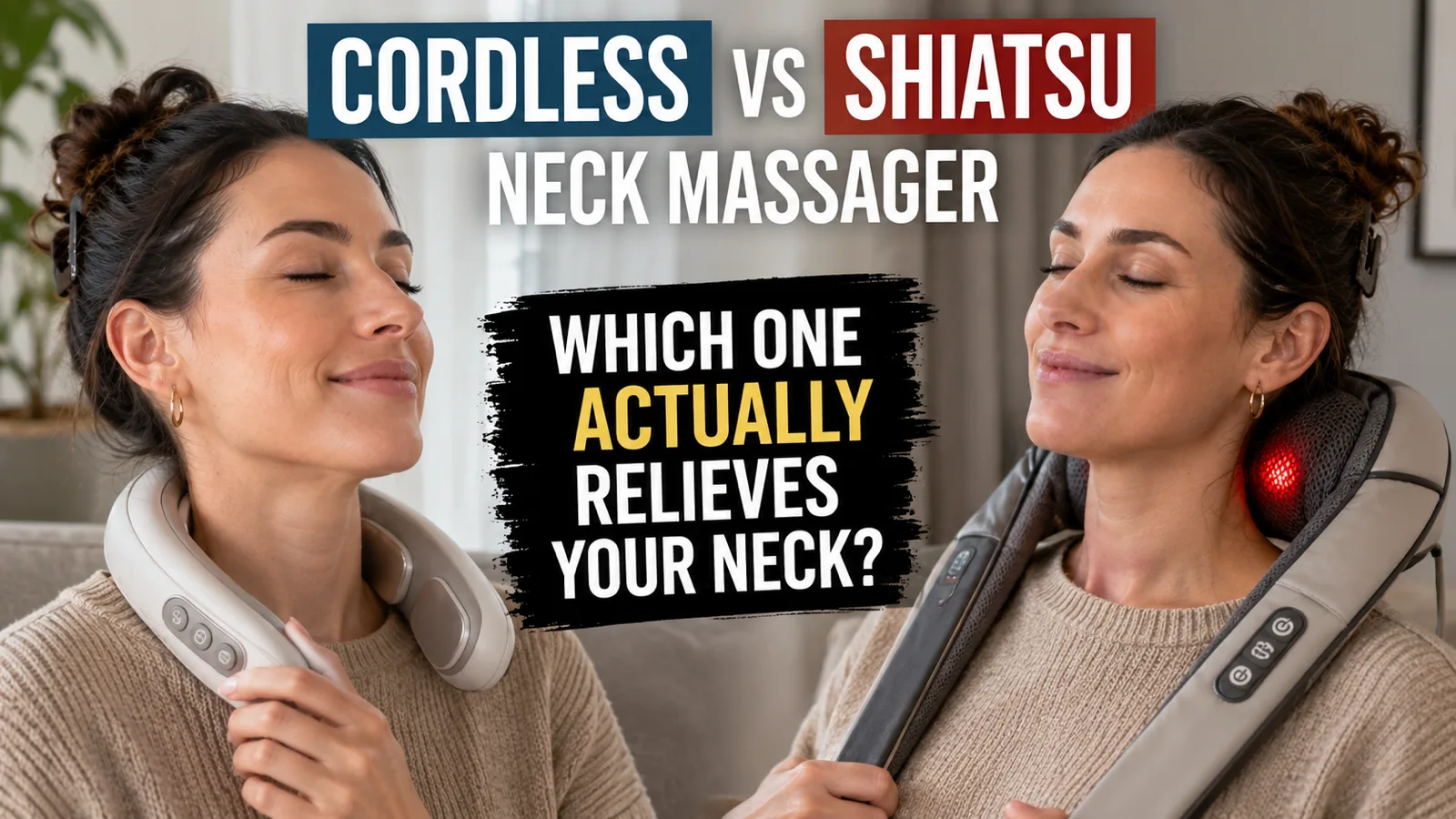
I tested both types of neck massager for three weeks each. Not back to back, but across the same kind of daily use: 15-minute sessions during desk work, after long days, and on genuinely stiff mornings. The Hilipert TENS collar represented the cordless electrical approach, and a classic shiatsu wrap with rotating kneading nodes represented the mechanical side.
The result was not a landslide in either direction. Both relieve neck tension, and both have fans who swear by them. But they relieve tension in completely different ways, for completely different situations, and the type that works for you depends on how and where you experience neck pain. It’s the classic choice at the center of our wellness gadgets hub, and this comparison tells you which side you are on.
If you want the wider field, the best cordless neck massagers of 2026 ranks the full category. This page is the type-versus-type decision.
Quick Verdict
If you work at a desk, buy the TENS collar. It is hands-free, 100 grams, and nearly silent, so it works while you work. The heat-plus-pulse combination is excellent for the everyday stiffness that builds up over a workday.
If you have hard knots that need pressure, buy shiatsu. A rotating-node wrap physically kneads a knot in a way electricity cannot. But you sit still, it is loud, and it takes 15 dedicated minutes.
| TENS Collar | Shiatsu Wrap | |
|---|---|---|
| Mechanism | Electrical pulses | Rotating kneading nodes |
| Best for | Desk stiffness, headaches, nerve tension | Hard knots, deep muscle relief |
| Weight | ~100g | 1-2 lb |
| Noise | Near silent | Audible hum |
| Use while working | Yes, hands-free | No, sit still |
| Battery | 2-4 hours | 60-120 minutes |
| Heat | Built into most | Built into most |
| Price | ~$40-70 | ~$40-80 |
| Wear on neck | Yes, collar | Wraps over shoulders |
How Each One Works
The mechanisms could not be more different, and that difference drives everything else.
TENS collars use transcutaneous electrical nerve stimulation. Small metal or gel contact plates rest against the back of your neck and deliver low-voltage electrical pulses that travel along sensory nerves. The Cleveland Clinic confirms this is the same approach used in physical therapy to help relieve pain. There are no moving parts. The device is a light U-shaped band that wraps around your neck, and many versions add constant heat. The sensation is a pulsing tingle.
Shiatsu wraps use motor-driven nodes that rotate and knead, mimicking a therapist’s fingers pressing into muscle. The nodes press into the neck and shoulders as they spin, physically working the tissue. The device is a heavier U-shaped wrap that sits over your shoulders, and most versions add heat. The sensation is mechanical pressure, ranging from gentle kneading to genuinely deep compression. The kneading-and-heat combination mirrors how massage therapy relaxes muscle tissue and improves local circulation.
The key difference: TENS works on nerves, shiatsu works on muscles. TENS interrupts pain signaling and relaxes the muscle’s response to pain. Shiatsu physically loosens the muscle tissue itself.
Relief Quality: Two Weeks of Testing
I tracked relief quality separately for both, using the same yardstick: how loose my neck felt for the two hours after each session.
TENS delivered consistent, gentle relief. Fifteen minutes with the collar at a strong-but-comfortable intensity loosened the stiffness that builds up across a workday, and the constant heat made the effect more pronounced. It felt like the tension quietly released rather than being forcibly removed. On days when I already had a tight, rubber-band neck, the relief was real but mild.
Shiatsu delivered deeper, more aggressive relief. When I had a genuine knot, usually from sleeping wrong or a heavy gym session, the kneading nodes were the only thing in the test that physically worked it out. The relief after a shiatsu session felt more dramatic and lasted longer on knot days. But on ordinary days, the deep pressure could be too much, and it was never something I wanted on while working.
Neither is better overall. TENS wins on ordinary desk days. Shiatsu wins on knot days. The honest recommendation for daily users: if you can own one, TENS; if knots are your main problem, shiatsu.
Desk Use: Where TENS Wins Clearly
This was the most one-sided result of the test. The Hilipert collar weighs about 100 grams, runs in near silence, and sits on your neck hands-free. I wore it while writing, while answering email, and while on calls, and it disappeared into the workday. Fifteen minutes passed without me noticing.
The shiatsu wrap could not do any of this. It weighs 1-2 pounds, the motor hums audibly, and the kneading means you cannot move your neck naturally while it runs. It demands your attention for its full 15-minute cycle. That is fine, even pleasant, if you set aside time for it. But it is a ritual, not a background companion.
If your neck pain is desk-related, which most modern neck pain is, the hands-free TENS collar is the more practical purchase. The whole point of cordless is that you can use it where the tension happens, at your desk.
Noise and Distraction
A smaller point, but one that matters in shared spaces. TENS collars have no moving parts, so they run in near silence. The Hilipert is genuinely office-safe; nobody around you can hear it.
Shiatsu wraps run a motor that hums and thumps through the session. In a quiet room, it is audible. It would be disruptive in an open office or while watching TV with someone. Not a deal-breaker, but a real difference if you will use the device around other people.
Battery Life
I measured both to empty. The TENS collar managed about 4 hours on a charge, which covered my daily 15-minute sessions for more than a week. The shiatsu wrap came in around 90 minutes, so I recharged it roughly every six sessions.
The practical difference: a TENS collar is the better travel companion. It charges from USB-C, is light, and lasts days. Shiatsu wraps are heavier and need more frequent charging. If you will use the device on the road or in an office, battery life favors TENS.
Heat: Both Have It, Neither Perfect
Almost every neck massager in both categories includes heat now, and both delivered it consistently in my testing. The Hilipert held a steady 107°F for the full session. The shiatsu wrap’s heat was comparable, if slightly less even across the larger surface.
Heat matters because warmth increases blood flow and relaxes muscles, which is why heat-plus-massage consistently outperforms massage alone. If you are comparing two devices, take the one with heat. Both categories have it, so this rarely decides the type question.
Comfort and Fit
TENS collars fit like a comfortable neck pillow: the U-shape rests around your neck and the flexible arms adapt to your size. The Hilipert at 100 grams is genuinely forgettable. Some people find the electrical tingling unusual at first, but it becomes familiar within a few sessions.
Shiatsu wraps fit over your shoulders like a heavy scarf. The weight sits on your shoulders rather than pulling your neck, which is comfortable, but the nodes press with real force, and that pressure is the entire point. If you like deep pressure, it feels great. If you find massage painful, it can be too much.
Which One Should You Buy?
Run your neck through these four questions.
- Do you work at a desk? Get the TENS collar. Hands-free, silent, and it works during the workday when the tension builds.
- Do you get hard knots? Get shiatsu. Only mechanical kneading physically works out a knot.
- Do you get tension headaches? Get TENS with heat. It targets the neck muscles behind most tension headaches without over-stimulating.
- Can you only afford one? Get TENS. It covers more daily situations, and you can add a shiatsu wrap later if knots become your main issue.
If you go with the TENS collar, the how to use a TENS unit for neck pain guide covers safe placement, settings, and session length, because placement is what separates a helpful session from a wasted one.
The Bottom Line
Cordless and shiatsu are not really competing technologies. TENS is a nervous-system tool for everyday tension, and shiatsu is a muscle tool for deeper knots. They solve different problems, and the right choice is the one that matches your pain pattern.
For the majority of people, especially anyone whose neck pain builds up at a desk, the TENS collar is the better buy: lighter, quieter, hands-free, longer battery, and it treats the tension where it happens. For anyone with genuine knots that need physical force, a shiatsu wrap is the honest answer.
Buy the type that matches how you actually experience neck pain, not the one with the more impressive product photo. The best cordless neck massager guide ranks the specific devices in each camp if you want to buy today. For the knee equivalent, the same sit-down vibration logic lives in the Nooro Knee Massager review.
Frequently Asked Questions
What is the difference between a cordless and a shiatsu neck massager?
Are TENS or shiatsu neck massagers better for neck pain?
Can you use a cordless neck massager while working?
Which neck massager type is louder, TENS or shiatsu?
Is a shiatsu neck massager stronger than a TENS collar?
Do TENS neck collars really work or are they a gimmick?
How long does a cordless TENS collar battery last?
Is it safe to use a TENS neck massager every day?
Which neck massager is better for tension headaches?
Should I buy a cordless neck massager or a shiatsu neck massager?
More Wellness Gadgets Articles
Related Product Reviews
Dr. Sarah Kim
Health tech researcher and wellness gadget reviewer. PhD in Biomedical Engineering. Tests sleep trackers, massage devices, and health monitors with clinical precision. Believes in data-driven wellness.
Affiliate disclosure:This article contains affiliate links. If you buy through them, GearPuff may earn a commission at no extra cost to you. It keeps our testing independent and our reviews free.