
How to Use a TENS Unit for Neck Pain: Placement Guide
Step-by-step TENS unit neck placement guide: where to put the pads, correct settings, session length, and safety rules with common mistakes.
In This Article
- How TENS Actually Works on the Neck
- What You Need Before You Start
- TENS Pad Placement for the Neck
- The Two-Key Rule
- Where to Put the Pads (Back and Sides Only)
- Where Never to Put the Pads
- How to Apply the Pads
- What Settings to Use for Neck Pain
- Session Length and Frequency
- Using a Wearable TENS Collar Instead of Pads
- Common Mistakes That Ruin a Session
- When Not to Use a TENS Unit on Your Neck
- The Bottom Line
Learning how to use a TENS unit for neck pain is one of the most useful things you can do with an at-home recovery gadget. TENS (transcutaneous electrical nerve stimulation) is one of the most common at-home treatments for neck pain, and it has real clinical backing: physical therapy clinics use the same technology to block pain signals and relax tense muscles. But the difference between a helpful session and a useless or uncomfortable one comes down to one thing: where you place the pads and how you set the intensity.
Most people get this wrong in the same ways. They put pads directly on the spine, crank the power to full, run sessions way past 20 minutes, and then conclude TENS does not work. TENS does work, it works well for many people, when you follow the placement and safety rules. This guide, part of our wellness gadget guides, covers exactly how to do that.
If you are new to the category, our cordless vs shiatsu neck massager comparison explains the difference between electrical TENS stimulation and mechanical kneading, so you buy the right type. This guide is the practical part: where the pads go, what settings to use, and how to stay safe.
How TENS Actually Works on the Neck
Before placement, it helps to understand what the device is doing. TENS sends low-voltage electrical pulses through adhesive pads into your skin. Two effects happen.
First, the pulses travel along sensory nerves and can block pain signals before they reach your brain, the gate control mechanism. This is why TENS feels like a distraction from the pain rather than a masking of it. Second, the stimulation encourages the release of endorphins, your body’s natural pain relievers, which the Cleveland Clinic confirms is the same approach used in physical therapy.
Crucially, TENS works on nerves, not on muscles. It does not knead or release tight muscle knots the way a shiatsu massager does. It interrupts pain signaling and relaxes the muscle response to that pain. That distinction matters for expectations: TENS is excellent for nerve-based neck tension, stiffness from desk work, and tension-headache-related neck pain. It is not the tool for a hard, knotted muscle that needs physical pressure, so if knots are your main complaint, look at the best shiatsu neck massager roundup instead.
What You Need Before You Start
Gather four things before your first session.
A TENS unit. Any TENS unit works for the neck. Dedicated TENS machines come with wires and replaceable pads. Wearable TENS collars like the Hilipert build the electrodes into a U-shaped band that wraps around your neck, which is more convenient for desk work. The placement principles below apply to both.
Conductive pads. Pads are consumables. They last roughly 10-30 sessions before the adhesive weakens. If your pads are old, dried out, or not sticking, the session will feel weak and uneven. Replace them.
Clean, dry skin. The pads make best contact with clean, dry, oil-free skin. Wash your neck and shoulders and dry thoroughly before applying. Lotions, oils, and sweat all reduce conductivity.
A chair. Sit upright for neck sessions. Do not lie down. Lying down shifts the pads and makes the intensity harder to judge.
TENS Pad Placement for the Neck
Placement is the single most important factor in whether a TENS session on the neck works and stays safe.
The Two-Key Rule
Keep every pad at least 1 inch away from the spine on either side. The neck’s bony vertebrae stick out slightly, and stimulating directly over them can cause muscle twitching, discomfort, and ineffective treatment. You want the pads on the muscle tissue beside the spine, not on the spine itself.
Where to Put the Pads (Back and Sides Only)
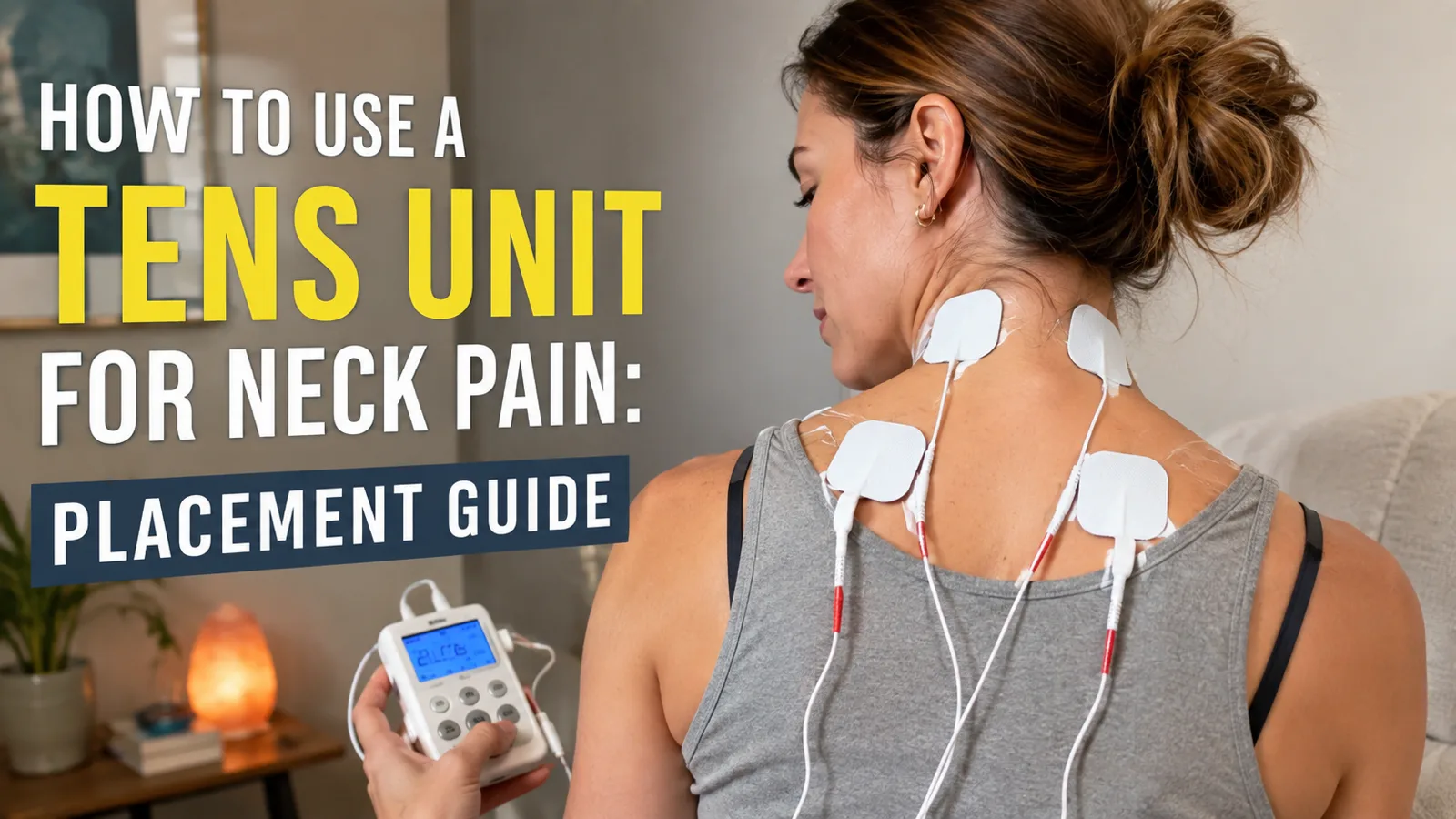
For upper neck tension, place two pads horizontally on either side of the spine, about an inch out from the vertebrae, at the level of your upper neck just below the skull. The current travels through the muscle between the two pads.
For tension that runs into the shoulders, the trapezius placement works best: one pad on each shoulder, over the thick muscle between your neck and shoulder joint, level with your collarbone line. Run both channels so the neck and shoulders get treated at once.
For stiffness between the shoulder blades, move the pads lower: one on each side of the spine at the mid-back level, again at least an inch off the spine.
Where Never to Put the Pads
- The front of the neck. The front and front-sides of the neck contain the carotid sinus, which helps regulate blood pressure and heart rate. Stimulating it can cause lightheadedness and heart rate changes. Never place pads on the front of the neck under any circumstances.
- Over the heart. No pads on the left chest near the heart.
- The eyes, temples, or mouth.
- On broken, irritated, or numb skin.
How to Apply the Pads
Follow this sequence every session.
- Clean and dry your neck and shoulders. No lotion, no oil.
- Attach the leads to the pads and the unit, or open the wearable collar and make sure the electrode surface is clean.
- Place the pads on the muscle tissue beside the spine, at least 1 inch out from the vertebrae, and press firmly to seat the adhesive.
- Clip loose leads to your collar or shirt so they do not pull on the pads.
- Turn the unit on at the lowest intensity setting and confirm you feel a tingling on both channels.
- Raise the intensity slowly until you feel a strong but comfortable pulsing. It should never feel painful, sharp, or like a stabbing sensation. A good benchmark: you feel it clearly, but you could still comfortably have a conversation.
- Run the session for 15-20 minutes.
What Settings to Use for Neck Pain
Intensity matters more than mode. Start at zero and raise the dial slowly. The right level is strong but comfortable, a pulsing tingle you feel clearly but can tolerate easily. If it feels sharp, burning, or stabbing, it is too high. Turn it down.
Pulse rate, measured in hertz (Hz), controls the type of sensation and its effect:
- 80-100 Hz (high frequency): a rapid, buzzing tingle. Good for acute, sharp neck pain and for a general “blocking” effect on pain signals. This is the best starting point for most neck tension.
- 2-10 Hz (low frequency): a slower, deeper pulsing that triggers endorphin release. Better for chronic, ongoing neck pain. Sessions at low frequency can be harder to tolerate and are typically run shorter.
- Moderate rates (15-50 Hz): a middle ground that produces a massaging feel and works for both acute and chronic tension. Many wearable devices default here.
If your unit has preset modes named after body parts (Neck, Back, Shoulder), the Neck preset usually runs a moderate rate that is fine to use. If it has modes like “pulse,” “tap,” or “knead,” these change the waveform shape rather than the medical effect, so pick whichever feels comfortable.
Session Length and Frequency
Keep neck TENS sessions to 15-20 minutes, matching the auto-shutoff timer most units have built in. There is no added benefit to longer sessions, and longer sessions increase the risk of skin irritation under the pads and muscle fatigue.
Wait at least 30 minutes between sessions. Most people who find TENS helpful run one session in the morning and one in the evening. Using it more than twice a day for longer than two weeks is a signal to see a doctor rather than to keep increasing usage.
Using a Wearable TENS Collar Instead of Pads
A wearable TENS collar like the Hilipert removes most of the placement guesswork. The electrodes are fixed inside a U-shaped band that wraps around the back and sides of your neck, which means they are always the right distance from the spine and never on the front of the neck.
The trade-off is that you cannot reposition the electrodes for your specific pain pattern the way you can with loose pads. The collar treats the upper neck as a whole. If your tension is mostly in the shoulders, a collar reaches less of it than a four-pad setup does.
The collar’s advantage is convenience. It weighs about 100 grams, runs in near silence, and stays put while you type, read, or fold laundry. That hands-free nature is what makes it realistic to use daily, and daily use is what produces results. It also adds constant heat, which increases blood flow and relaxes muscles, and heat is one of the few things proven to improve the experience and outcome of neck massage.
Common Mistakes That Ruin a Session
These are the errors I see most often in TENS user reports and in my own testing.
Pads on the spine. Directly over the vertebrae, the current triggers shallow muscle twitching instead of treating the deeper muscle tissue. Move the pads an inch out toward the muscle.
Intensity too high. Cranked to max, TENS becomes sharp and uncomfortable, and many people tense up against the sensation, which defeats the purpose. The goal is strong but comfortable. Back off until it feels good.
Sessions too long. Thirty or forty minutes in front of the TV is the most common way to overdo it. Skin under the pads gets irritated, and the muscles get over-stimulated. Set the 15-20 minute timer and stop.
Using old, dried pads. Weak, uneven, or nonexistent sensation is usually just dead adhesive. Pads are disposable. Replace them every 10-30 sessions.
Sleeping with the unit on. Never. Placement shifts while you sleep, which can move pads into an unsafe spot. Use it awake.
Lying down. Pads slide and the intensity reads differently lying down. Sit upright.
Pads on the front of the neck. This is the one non-negotiable. Front-of-neck placement over the carotid sinus can affect heart rate. Back and sides only.
When Not to Use a TENS Unit on Your Neck
TENS is low-risk for most people when the placement rules are followed, but some people should not use it at all.
Do not use TENS if you have a pacemaker or implanted defibrillator. The electrical pulses can interfere with the device. This is the hard line across every TENS manufacturer’s manual.
Consult a doctor first if you are pregnant, have a heart condition, or have a history of seizures. The research on TENS in these populations is limited, so medical guidance comes first.
Do not use it over an area with reduced sensation. If you cannot feel the pads properly, you cannot judge the intensity.
Do not use it on an injury site where the cause is unknown. If your neck pain came on suddenly, was caused by an accident, or includes numbness, tingling, or weakness in your arms, get medical advice before self-treating.
Do not use it as a replacement for medical care. TENS manages symptoms. If neck pain persists beyond two weeks of regular use, disrupts your sleep, or spreads into your arms, see a doctor. The NIH describes TENS as an adjunct therapy, a complement to treatment rather than a standalone cure.
The Bottom Line
TENS is a genuinely useful tool for neck pain when you get the fundamentals right. Keep the pads on the back and sides of the neck at least an inch off the spine, start the intensity low and raise it to strong-but-comfortable, run 15-20 minute sessions, and never sleep in it or place pads on the front of the neck.
Used that way, TENS blocks pain signals, relaxes the tension response, and gives you a daily ritual that takes 15 minutes. It is not a cure, and it will not physically knead a knot out of a tight muscle. But for the everyday neck stiffness that builds up at a desk, it is one of the most effective tools you can keep at home.
If you want the hands-free version that pairs the TENS pulses with constant heat, the Hilipert TENS collar is what I tested for three weeks, and the best cordless neck massager guide compares it against the shiatsu alternatives. Start with the placement rules from this guide, keep sessions short, and give it two weeks before judging whether it helps you.
Frequently Asked Questions
Where do you put TENS pads for neck pain?
Can you use a TENS unit on your neck?
How long should I use a TENS unit on my neck?
What settings should I use for neck pain?
Is it safe to sleep with a TENS unit on?
Why is my TENS unit making my neck worse?
Can a TENS unit hurt your neck?
How many TENS pads do I need for my neck?
Should I use a TENS unit or a neck massager for neck pain?
How often can I use a TENS unit for neck pain?
More Wellness Gadgets Guides
Related Product Reviews

Dr. Sarah Kim
Health tech researcher and wellness gadget reviewer. PhD in Biomedical Engineering. Tests sleep trackers, massage devices, and health monitors with clinical precision. Believes in data-driven wellness.
Affiliate disclosure:This article contains affiliate links. If you buy through them, GearPuff may earn a commission at no extra cost to you. It keeps our testing independent and our reviews free.