
Memory Foam vs Down Pillow: Which Should You Sleep On?
Memory foam vs down pillow, compared. Support, cooling, durability, and price tested over 6 weeks. Which fill is right for your sleep position.

Tech Reviewer
In This Article
- The Two Philosophies of Fill
- Support and Alignment: Memory Foam Wins
- Cooling and Feel: Down Wins
- Durability: Memory Foam Wins, With a Caveat
- Allergy: Down-Alternative Wins
- Real Down vs Down-Alternative: The Third Comparison
- Which Fill for Your Position
- The One Person Who Should Avoid Memory Foam Entirely
- Why Everyone Struggles to Compare These Two
- How the Three Fills Actually Sleep, Night by Night
- The Price Question
- The Maintenance Contract, Fill by Fill
- The Environmental Angle
- Making the Final Call in 60 Seconds
- The Honest Verdict
Pick any two pillow brands and you can find them arguing opposite sides of this question. The foam company says support. The down company says luxury. Both are right, and both are useless without the one variable that matters: your sleep position.
We tested memory foam, down, and down-alternative pillows over six weeks, matching each fill to testers of every position the way we did in our side sleeper pillow roundup. The results surprised no one and contradicted most of the marketing. Here is the honest comparison.
The answer in one sentence: position decides the fill. Side and back sleepers need the consistent loft of memory foam, stomach sleepers need the soft compression of down, and down-alternative is the compromise for hot sleepers and allergy sufferers. Everything below is that decision worked through the evidence.
The Two Philosophies of Fill
A pillow fill has one job: hold your head at the right height all night. Memory foam and down do it in opposite ways.
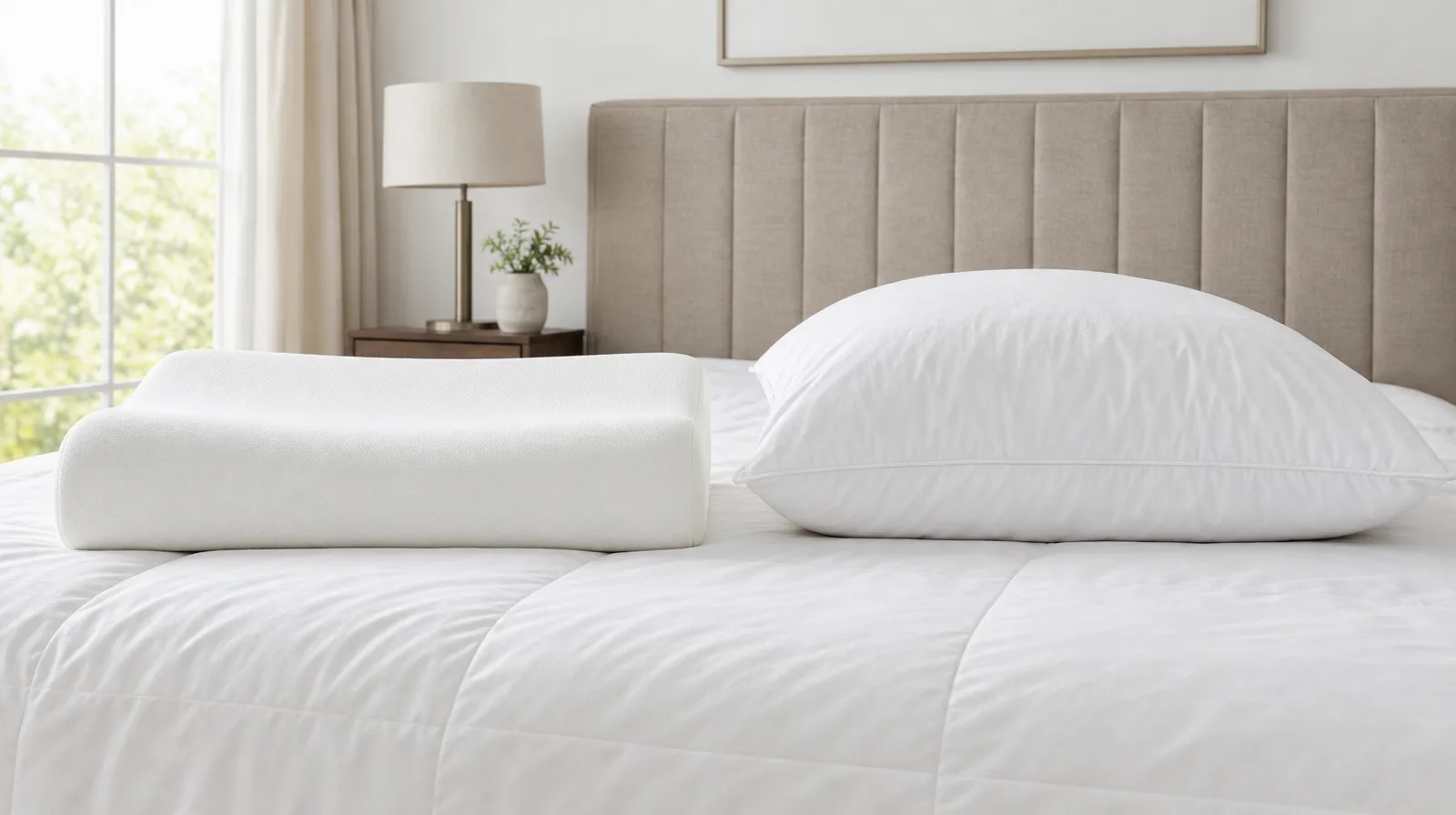
Memory foam is viscoelastic. It absorbs pressure, conforms to your head, and then holds its shape. Once you set the loft, it stays set. A side sleeper’s head stays level because the foam does not move. That is why memory foam dominates the medical and sleep-therapy recommendations for people with neck pain and snoring: consistent height means a neutral spine.
Down is the opposite. Thousands of tiny clusters compress under weight and spring back when the weight lifts. That makes it soft, moldable, and luxurious. But under your head all night, down compresses to a fraction of its loft. Your head sinks, your neck drops, and unless you fluff at 2 AM, it stays dropped.
The Sleep Foundation frames the choice in these terms: support and loft are the priorities for most sleepers, which favors structured fills like foam. Soft down serves the sleepers who specifically want minimal support, which is almost exclusively stomach sleepers.
Support and Alignment: Memory Foam Wins
| Factor | Memory foam | Down | Down-alternative |
|---|---|---|---|
| Loft consistency | Excellent | Poor, flattens | Fair, flattens over time |
| Neck support | High | Low | Medium |
| Sleep positions served | Side, back | Stomach | All, weakly |
| Cooling | Warm | Cool | Neutral |
| Lifespan | 5-10 years | 3-5 years | 1-2 years |
| Price | $35-150 | $80-250 | $20-60 |
| Hypoallergenic | Yes | No (dust mites) | Yes |
| Machine washable | No | Yes | Yes |
If consistent loft matters to you, which it does for the majority of sleepers, memory foam wins on every support metric. The fill holds the head up, keeps the airway open, and does not drift toward flatness by 4 AM.
This matters for side sleepers especially. A side sleeper’s head must span the ear-to-shoulder gap all night. Memory foam at 4-5 inches does that. Down at 4-5 inches becomes 1 inch under your head, which is why down and side sleeping are a bad combination.
Cooling and Feel: Down Wins
Memory foam’s weakness is heat. The same density that holds your head level also traps body heat against it. For hot sleepers, a foam pillow is a warm night’s sleep unless the cover and construction breathe.
Down sleeps cooler. The air pockets between clusters let heat escape, and a 100% cotton cover helps it along. For a hot sleeper, down’s breathability is a genuine advantage, which is part of why it is sold at luxury prices.
Down-alternative sits between: it does not absorb heat like foam, and it compresses more slowly than real down, but it also lacks both the support of foam and the softness of real feathers.
Durability: Memory Foam Wins, With a Caveat
Memory foam lasts 5-10 years because the material does not break down quickly. Down lasts 3-5 years before the clusters lose their loft and need replacement. Down-alternative is the least durable, often losing meaningful loft within 18 months.
The caveat is memory foam’s care burden: you can never machine wash it. It absorbs water, degrades, and loses shape. You spot clean it and air it out. Down and down-alternative are machine washable, which is a real convenience advantage even with their shorter lifespan.
Allergy: Down-Alternative Wins
Down is less allergenic than the myth suggests, but the dust mites that colonize feathers are a real trigger. If you have allergies, a down-alternative pillow is the safer choice: synthetic fill, naturally hypoallergenic, and machine washable to remove what accumulates.
This is the strongest argument for FluffCo-style down-alternative pillows over real down. You get a soft, supportive feel without the allergen risk or the feather prickle that real down sometimes has.
The allergy point deserves precision, because it is often overstated. Real down is a protein material, and a small share of people are genuinely allergic to it. But the far more common trigger is dust mites, which can colonize any fill, foam included. The difference is that down-alternative is machine washable, so mites can be washed away, while foam cannot be washed and must be replaced when the mite population builds. That makes the practical allergy winner down-alternative, with the runner-up being a memory foam with a washable cover and a zealous vacuum routine.
Real Down vs Down-Alternative: The Third Comparison
Once you leave foam behind, you still face the choice between real down and down-alternative, and they are not the same product. Real down is feathers with higher loft, more compressibility, and a longer life when cared for. Down-alternative is polyester microfiber that mimics the feel at a fraction of the price.
The differences matter for specific people:
Weight and warmth. Real down is lighter and warmer for the same loft, which matters if you run cold. Down-alternative is heavier and cooler, which suits hot sleepers.
Price. A quality down pillow runs $80-250. Down-alternative runs $20-60. If the maintenance and the allergen profile are equal in your eyes, the price difference alone decides it.
Ethical sourcing. Real down has a sourcing story that matters to some buyers, with traceability standards for responsible producers. Down-alternative has no animal-welfare question at all.
Longevity. Real down, maintained, lasts 3-5 years. Down-alternative lasts 1-2. If you price per year, a $100 down pillow at 4 years is $25 a year, beating a $40 down-alternative at 18 months, which runs $27 a year, and the gap widens because the down ages better.
The takeaway is that the gap between down and down-alternative is narrower than the marketing suggests, and both are only worth choosing over foam when you need the softness or the cool sleep. For the support majority, foam remains the anchor of this comparison.
Which Fill for Your Position
Side sleepers: memory foam. Your head needs consistent loft for 8 hours. Foam delivers it; down does not. The Sleepgram 3-in-1 is the best foam option because its adjustable insert lets you tune the loft to your shoulders, and the Derila is the firm budget pick.
Back sleepers: memory foam, medium loft. Back sleepers need 3-4 inches and support under the curve of the neck. Foam wins again, with adjustability covering the loft range.
Stomach sleepers: down or thin down-alternative. Stomach sleepers need the pillow to flatten, and down is the only fill that reliably does. Our stomach sleeper testing found the thin configuration and soft fills winning.
Hot sleepers who want support: firm down-alternative. If you hate foam’s heat but need loft, a firm down-alternative like FluffCo is the compromise: structured enough to hold height, breathable enough to sleep cool.
The One Person Who Should Avoid Memory Foam Entirely
The heat problem is a dealbreaker for a specific group: hot sleepers who wake sweating even in a cool room. If you already sleep with the fan on and a thin sheet in winter, a memory foam pillow may add the last degree that tips you over.
The fix is not to buy down and accept flat support. It is to buy a firm down-alternative with enough fill to hold 4-5 inches, or a foam pillow with a phase-change or gel cover that pulls heat away. That is why the down-alternative tier exists: it is the fill for people who need support and refuse to sleep hot. If you fall into that group, the FluffCo class of pillows is where your search ends.
Why Everyone Struggles to Compare These Two
The marketing makes this comparison harder than it needs to be, and it is worth naming the trick. Pillow brands describe fills with feel words, “cloud,” “plush,” “supportive,” and none of them tell you the two numbers that matter: loft height and loft consistency.
Feel words are subjective. Loft height and consistency are not. Measure the height under a 10-pound weight and watch whether it holds for ten minutes. That single test separates foam from down faster than any review, and it is the test we ran on every pillow in this comparison. A fill that loses half its height under head weight in ten minutes will lose it at 3 AM, which is when support matters.
How the Three Fills Actually Sleep, Night by Night
The differences show up in the night, not in the showroom. Here is what our six weeks produced:
Night 1: Memory foam feels firm and takes a few nights to break in. Down feels perfect immediately. This is the trap: the pillow that feels best on night one is often the wrong long-term choice.
Night 10: Memory foam has molded to your head and feels natural. Down has compressed under your head and needs a fluff. The foam pillow now outperforms on alignment; the down pillow still wins on softness.
Night 30: Memory foam holds its loft unchanged. Down has started to clump in the head zone unless you fluff it daily. Down-alternative shows the first signs of losing loft entirely.
Month 12: Memory foam is unchanged. Down is serviceable with care. Down-alternative is visibly flatter and is the first of the three to feel worn.
The pattern is the same across every duration: foam improves with breaking in, down declines without daily maintenance, and down-alternative declines regardless. None of this makes down wrong; it makes down a maintenance commitment, and that is the honest tradeoff the price tags never show.
The Price Question
The honest answer: price does not track with what your neck needs. A $40 memory foam pillow at the right loft beats a $200 down pillow at the wrong loft every night. You are paying for materials and feel, not for alignment.
Buy for your position first, then spend on quality within that category. Side sleepers should spend on adjustable foam. Stomach sleepers should spend on soft compressible fill. And no one should buy a luxury down pillow for side sleeping because the pillow will fight them all night.
The Maintenance Contract, Fill by Fill
Every fill comes with a care routine, and the routine is as much a part of the decision as the feel.
Memory foam: spot clean only. Never machine wash or machine dry memory foam. It absorbs water, breaks down, and loses shape. You spot clean the foam and wash the removable cover, which is why a washable cover is a real feature on a foam pillow. This is the simplest maintenance of the three, and also the least flexible: you cannot give a foam pillow a deep clean.
Down: the highest-maintenance fill. Down needs daily fluffing, and it needs machine washing every few months to remove the oils that make clusters clump. Washing is its own project: gentle cycle, dedicated down detergent, and drying with tennis balls to break up the clumps, which can take two or three dryer cycles. Get the drying wrong and you get a lumpy, musty pillow.
Down-alternative: washable but short-lived. Down-alternative machine washes easily and dries faster than real down, but it loses loft faster too. You trade the feather maintenance for more frequent replacement.
Our how to wash a pillow guide covers the fill-specific routine in detail. If you will not commit to the routine, buy the fill that matches your tolerance, not the one that matches your position alone.
The Environmental Angle
If the materials matter to you, the three fills have different profiles. Down is a byproduct of the food industry, which makes it arguably the most sustainable use of material that would otherwise be waste, and responsibly sourced down is traceable. Memory foam is petrochemical-based and does not compost. Down-alternative is polyester, which is also petroleum-derived and does not biodegrade.
The durability angle cuts the other way: a memory foam pillow that lasts 8 years produces less waste over time than down-alternative replaced every 18 months, even though the down-alternative uses less material per unit. If you weigh sustainability, the longer-lived foam is usually the greener choice on a per-year basis, and responsibly sourced down is the greener choice on a per-material basis.
Making the Final Call in 60 Seconds
If you want a decision path instead of a spec sheet, use this:
- What position do you sleep in? Side or back means you need consistent loft, which points to foam or firm down-alternative. Stomach means you need flattening, which points to down.
- Do you sleep hot? Yes points to down-alternative or a cooled foam. No points to plain foam.
- Will you maintain it? Fluffing daily and washing quarterly? Down works. You want set-and-forget? Foam works.
- Do you have allergies? Yes points to down-alternative, always.
Two answers point the same way in every case: side or back sleeping plus “I want it to just work” means memory foam, and the adjustable Sleepgram is the flexible version of that answer. Stomach sleeping plus “I want the softest thing” means down. Everything else is the down-alternative middle, and FluffCo is the firm end of that middle.
The Honest Verdict
Memory foam and down are not competitors; they are tools for different jobs. Memory foam serves the majority, the side and back sleepers who need consistent loft and neck support. Down serves stomach sleepers and softness lovers who need compression and cooling. Down-alternative bridges the gap for hot sleepers and allergy sufferers.
Identify your position, match the fill, and you will save yourself a lot of confused pillow shopping. For more on how the fills behave in real life, our comparison of memory foam vs latex for neck pain covers the third corner of the pillow fill triangle. And if you are sleeping on your side, the side sleeper roundup applies this fill logic to the position that is most demanding on loft.
Frequently Asked Questions
Is memory foam or down better for a pillow?
Why do memory foam pillows sleep hot?
Do down pillows last as long as memory foam?
What is a down alternative pillow?
Which pillow is best for neck pain?
Are down pillows bad for allergies?
Can you wash a memory foam pillow?
Which pillow is better for side sleepers: memory foam or down?
More Wellness Gadgets Articles


Related Product Reviews
Dr. Sarah Kim
Health tech researcher and wellness gadget reviewer. PhD in Biomedical Engineering. Tests sleep trackers, massage devices, and health monitors with clinical precision. Believes in data-driven wellness.
Affiliate disclosure:This article contains affiliate links. If you buy through them, GearPuff may earn a commission at no extra cost to you. It keeps our testing independent and our reviews free.