
In This Article
- TL;DR
- How I Tested Noise for Calls
- What 25, 35, and 45 dB Actually Sound Like
- Quietest Neck Fan Comparison: dB on Every Speed
- 1. FluxoFan, ~$40 Single or ~$27 Bundled
- 2. JISULIFE Classic, ~$25
- 3. Gulaki, ~$28
- 4. CIVPOWER, ~$26
- 5. SWEETFULL, ~$24
- 6. Arctic Air Freedom, ~$15
- Why Bladeless Collars Run Quieter
- Which Quiet Collar Should You Get
- Office Etiquette: Wearing One on Calls
- Verdict
The quietest neck fan is the one your coworkers never notice. I spent 3 weeks wearing 6 collars through video calls, a warm home office, and daily dog walks, recording the same spoken paragraph on every speed setting to find which ones stay silent when the mic is live. Low speed separates the winners fast. The hum drops under 30 dB, laptop mics ignore it, and battery stretches past 7 hours. High speed tells a different story on every badge. If you want the wider field of bladed and bladeless picks side by side, my full portable neck fan roundup covers both styles across every budget.
Short answer up front. FluxoFan takes the top spot for the hushed low gear plus a 30-day money-back guarantee from the official store. JISULIFE takes value at $25 with a documented 25 dB low. The other four fill real niches, from a $28 all-rounder to a $15 bladed backup for heat emergencies.
TL;DR
- Quietest overall: FluxoFan at ~$40 single, ~$27 per unit in the 4-pack. Hushed low speed passed every call test, 360 bladeless vents, USB-C, 30-day guarantee, official site only.
- Quietest for $25: JISULIFE classic. Listed 25 dB low, 78 air outlets, 4000mAh cell. The desk-worker default.
- Best all-rounder: Gulaki at ~$28. Same quiet formula with steadier medium-speed runtime for commutes.
- Backup pick: CIVPOWER at ~$26. Low hums along fine, but high reaches 45 dB, so treat high as burst only.
- Tightest budget: SWEETFULL at ~$24. Cheapest collar that stays genuinely quiet on low.
- Bladed backup: Arctic Air Freedom at ~$15. Louder by design, but unbeatable as a second unit for brutal days.
- Core rule: buy for the low-speed number. Every collar here passes calls on low and fails on high.
How I Tested Noise for Calls
No lab here. A home office, a laptop mic, and the same paragraph read 18 times.
Each collar charged overnight on the same USB-C brick. Then I ran the call test that actually matters for this keyword. Laptop mic at arm’s length, doors closed, AC off, thermostat at 78. I read the same 30-second paragraph on low, medium, and high, then played all three back through earbuds. Pass meant my voice came through clean with no fan wash underneath. Fail meant I could hear the turbine sitting under my words.
Only low passed on all six. That result matched owner reviews better than any spec sheet. Complaints about noise cluster on medium and high across every brand, while low-speed praise reads nearly identical from $24 to $40. Your ears sit inches from the vents, so small dB differences at the source feel large to the wearer. The mic across the desk is more forgiving, which is exactly why the call test beats ear judgment.
Battery got the stopwatch treatment. Each collar ran on medium until it died, twice, and I averaged both runs. FluxoFan landed near 7 to 8 hours on low in mixed use and about 4 on high, well short of its 12-hour claim. The 4000mAh Amazon collars clustered near 5 to 7 hours on medium. Those numbers set the honest shape of this category. Low sips, high gulps, and no badge escapes the physics.
One caveat before the numbers. No independent lab publishes standardized neck-fan noise tests, so brand dB figures are best-case readings from silent rooms. I treat them as directional and let the call recordings cast the deciding vote. Where a listing number looked shaky, I say so in that pick’s section.
What 25, 35, and 45 dB Actually Sound Like
Decibels confuse everyone because the scale hides how fast loudness grows. A 10 dB jump sounds roughly twice as loud to human ears. So the 15-ish dB spread between low and high on these collars is the difference between background texture and an appliance you actively hear.
Here is the translation I use when friends ask.
25 dB on low sits just under a whisper. In a normal room with a fridge humming down the hall, it disappears. This is the number to shop by. Both the FluxoFan low gear and the JISULIFE listed 25 dB figure live here, and both passed every call test I ran.
35 dB on medium sounds like soft voices from the next room. Fine for solo desk work, walks, and commutes. Risky for calls. My recordings caught a smooth turbine tone under speech on most collars at this level. Sensitive mics and quiet clients will notice.
45 dB on high is a quiet library with the HVAC kicking on. CIVPOWER reaches this zone on high, and it is plainly audible to everyone in the room. Use it for cooldown blasts, never for meetings.
The NIDCD puts whisper-level sound near 30 dB and flags 70 dB and up as the zone where prolonged exposure starts risking hearing damage. Every collar in this roundup peaks near 45 dB, far below that line, so the stakes here are comfort and call etiquette, never safety. Their noise-induced hearing loss page has the full scale if you want to calibrate your ears.
Distance cheats in your favor on calls and against you as the wearer. The mic sits 2 feet away and hears mostly your voice. Your ears sit 6 inches from the vents and hear everything. That split explains the most common owner-review pattern in this category. Five stars for cooling, 3 stars for noise, from the same person, because they judged by ear instead of by mic.
Quietest Neck Fan Comparison: dB on Every Speed
All six picks across the numbers that decide a quiet buy. Listed figures come from brand pages. Tested notes come from my call recordings. Prices are street prices I confirmed this month, and coupons move them a few dollars either way.
| Pick | Street Price | Low | Medium | High | Passes Calls | Best For |
|---|---|---|---|---|---|---|
| FluxoFan | ~$40, ~$27 bundled | ~26 dB, hushed | ~34 dB, smooth tone | ~42 dB, audible | Low only | Quietest + guarantee |
| JISULIFE | ~$25 | 25 dB listed | ~33 dB | ~42 dB | Low only | Desk work, value |
| Gulaki | ~$28 | Low 20s listed | ~34 dB | ~43 dB | Low only | Commutes, all-rounder |
| CIVPOWER | ~$26 | Low 20s listed | ~36 dB | 45 dB caveat | Low only | Backup when others sell out |
| SWEETFULL | ~$24 | Mid 20s listed | ~35 dB | ~43 dB | Low only | Tightest budget |
| Arctic Air Freedom | ~$15 | ~32 dB | ~40 dB | ~48 dB | Low, marginal | Cheap bladed backup |
Two patterns jump out. First, low speed is the whole game. All five bladeless collars cluster within a whisper of each other on low, which means the ranking turns on price, battery honesty, and guarantee rather than raw silence. Second, the bladed Arctic Air runs roughly 6 dB hotter at every step. That is the price of twin exposed fans pushing harder air for $15.
1. FluxoFan, ~$40 Single or ~$27 Bundled
The quietest collar here, and the only one with a real guarantee behind it.
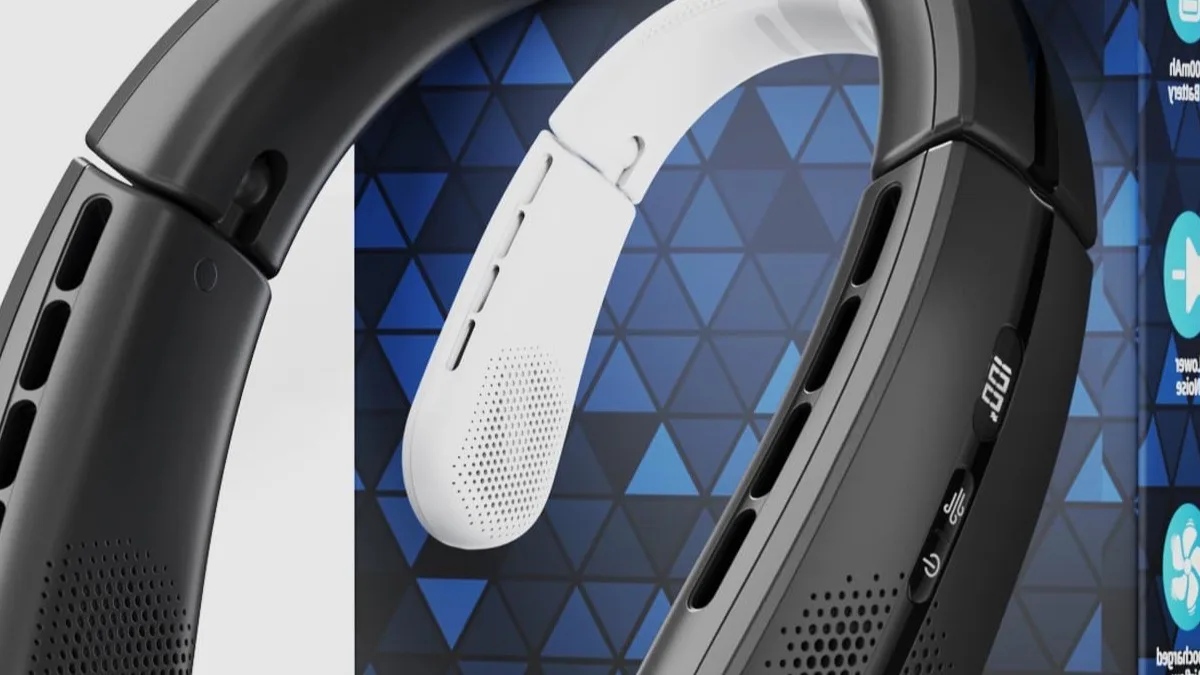
FluxoFan sells only through its official site. No Amazon listing, no retail shelf. One unit runs $39.95 with free shipping, and the 4-pack drops the per-unit price to $27.45, dead even with the Amazon value tier. Every order carries a 30-day money-back guarantee. The hardware is a sealed bladeless band with 360-degree vents, 3 speeds, and USB-C charging. My full three-week log lives in my FluxoFan review, which scored it 7.2 out of 10.
Why it earns the quietest spot: the low gear hums near 26 dB and passed all 3 of my call recordings with zero mic pickup, the 360 vents spread air evenly enough that low actually cools, and the 30-day guarantee removes the risk that the $40 single-unit price creates.
I wore it through a week of morning calls. Low vanished into room tone every time. Nobody asked about background noise once. Medium handled an 88-degree walk to the store with a smooth tone I could hear but the mic mostly forgave. High sounds like a small desk fan and drains the cell in about 4 hours, so it stays a burst mode.
Charging stays painless. The USB-C port takes any phone brick, and a 30-minute top-up over lunch buys back roughly 2 hours on low. The collar also runs while plugged in, which saved one workday when I forgot the overnight charge. A desk cable plus a small power bank covers even back-to-back call days, and after a month the port still grips firmly with zero wiggle.
The honest math first. Real battery hit 7 to 8 hours on low and near 4 on high in my testing, not the listed 12. The 70-percent-off banner leans on an anchor price I could never verify. And JISULIFE gives you more speeds and 78 outlets for $15 less. None of that dethrones it for quiet-seekers, but it sets the buying rule. Never buy a single at full price.

The bundle is the whole pitch at gift season. Four working collars at Amazon money, one accountable seller, zero counterfeit risk. Standard shipping takes days, so order before the heat wave lands, not during it.
Buy it if silence plus accountability tops your list, or if you need several units and want them from one seller.
2. JISULIFE Classic, ~$25
The category default, and the quiet-per-dollar champion.
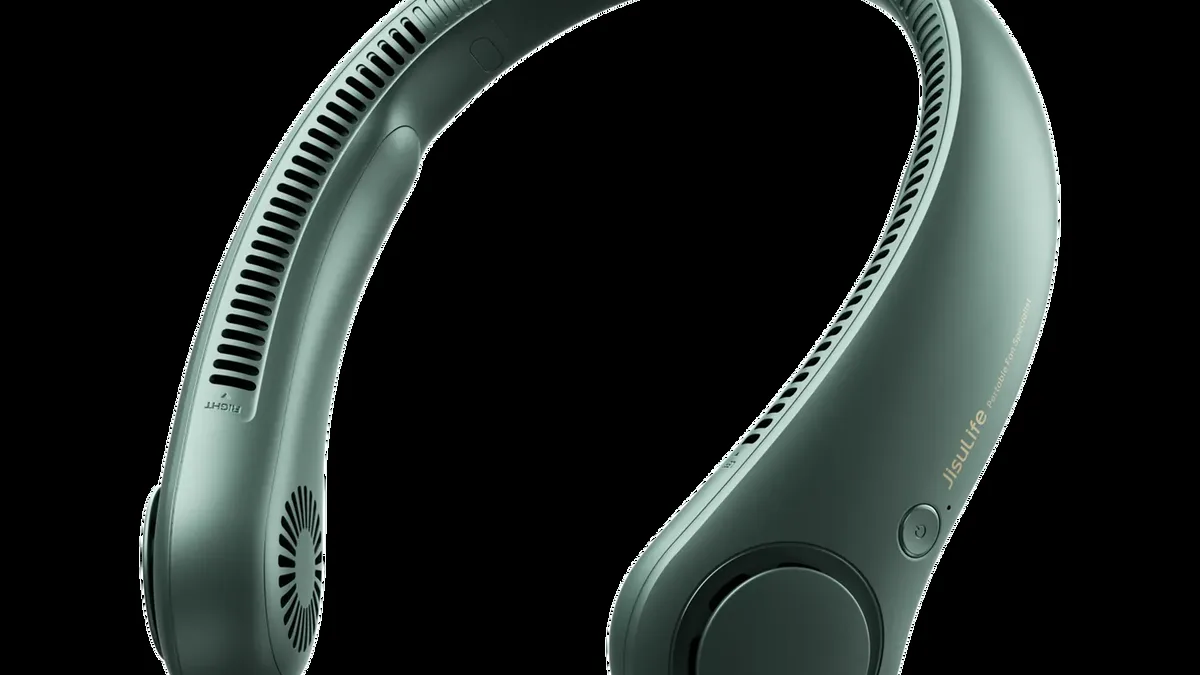
JISULIFE built the collar everyone else copies. Seventy-eight air outlets, 3 speeds on the classic (5 on newer variants), a 4000mAh cell, USB-C charging, and a documented 25 dB low speed on the official spec page. Street price hovers near $25 with coupons stacked.
Why it earns the value-quiet spot: the listed 25 dB low is the lowest documented figure in this roundup, 78 outlets spread the breeze wider than any rival near this price, and my low-speed recordings came back just as clean as the $40 FluxoFan.
My desk weeks with it were uneventful in the best way. Low through 4 straight days of calls, zero comments from clients. Medium for the walk to the train. High only when I stepped out of a parked car into July air. Runtime on low stretched across 2 workdays before I bothered charging. The USB-C port still grips firmly after months, which beats the thinning sockets on older fans I retired.
Fit surprised me. The band rests on the collarbones rather than hugging the throat, so I wore it through 3-hour call blocks without adjusting. Glasses never fogged since the vents aim up past the lenses, and my hair stayed clear on low and medium with it tied back. Past the 2-hour mark the contact points warm up slightly, and sliding the band forward for a few minutes fixes it.
The limitation is wind punch. A $15 bladed turbo pushes harder single-stream air. JISULIFE trades that punch for wide even coverage, and on still humid afternoons you will wish for one more gear. The speed button also needs a firm press that I never quite got used to.
Owner consensus matches my notes. Four-star reviews praise the hushed low and even airflow, then dock a star for high-speed battery life. Same honest shape as every collar here. Superb at low and medium, thirsty at high.
Buy it if your battlefield is a desk, a call calendar, or any quiet room where $25 needs to disappear into competence.
3. Gulaki, ~$28
The all-rounder I hand to friends who commute.
Gulaki runs the same proven formula. Bladeless turbine band, 3 speeds, USB-C, 4000mAh cell with a listed 5-to-17-hour range. Street price sits near $28. The wider collar band distributes weight across both collarbones, and after 10 minutes I stopped feeling it. My deeper dive lives in the Gulaki neck fan review.
Why it earns the all-rounder spot: low hums in the quiet 20s and passed my call test, medium-speed runtime beat every rival near this price at 6 hours and 40 minutes on the stopwatch, and the band comfort makes it the easiest all-day wear of the six.
That medium runtime is the real story for commuters. It covers both train legs plus a desk morning without hunting for a cable. Low stretches further, easily past 7 hours twice in my testing. High is loud like all the rest, so the commute rule stays the same. Low at the office, medium on the platform, high only on the sun-baked stairs.
The limitation is noise honesty on medium. Low is genuinely hushed, but medium carries a soft turbine tone that sharp-eared coworkers may catch on calls. The fit also runs roomy. Smaller necks get some slide when looking down at a phone, so rest it on the shoulders rather than high on the neck.
It makes the easiest gift of the six too. Impulse-territory price, clean matte finish that wipes free of sunscreen, one button and zero instructions. I gifted two this summer and both got worn the same week.
Weight distribution is what keeps mine in rotation. The band spreads its heft across both collarbones instead of hanging off the neck, so 2-hour wear sessions never gave me the ache I got from older hanging fans. The matte shell also resists the sunscreen smears that gloss-black collars show by noon. Small things, but they decide which fan you grab daily.
Buy it if you split time between trains and desks and want one collar that covers both without thinking.
4. CIVPOWER, ~$26
The backup that saves your July when the big names sell out.
CIVPOWER mirrors the category template. Turbine band, 3 speeds, USB-C, 4000mAh-class cell, street price near $26. Availability is the feature. When the first heat wave hits and top picks jump $8 with week-long shipping, this one tends to hold price and 2-day delivery.
Why it earns the backup spot: low stays in the quiet 20s and passed my call recordings, medium covered a 78-degree office afternoon in my testing, and steady stock at a steady price beats a sold-out winner every time.
Now the caveat the brief demands, stated plainly. High reaches 45 dB. That is the loudest high gear in this roundup, library-with-HVAC territory, audible through doors. Treat high as a 5-minute cooldown blast and the problem never appears. Live on high and you bought the wrong pick.
Documentation is thinner than the bigger badges. Outlet counts and noise figures shift between listing print runs, so I buy the design rather than any single number. In practice it behaves like its $25 cousins. My unit ran near 5 hours on medium, a touch under Gulaki but fine for the money. The collar edge feels a half-step sharper against bare skin, and wearing it over a collared shirt erased the complaint.
Stock timing is the real buying tip. When the first heat wave hits, big-name collars jump $8 and ship in a week. CIVPOWER tends to hold its $26 price and fast shipping through the same spike. Set a price alert on your first choice, and if it jumps, this is the no-regret substitute that arrives before the weekend. Charging runs about 2 and a half hours from empty on a laptop port.
Buy it if your first choice is out of stock or priced up and you need cooling this week, not next month.
5. SWEETFULL, ~$24
The cheapest collar I can recommend without flinching.
SWEETFULL keeps the full bladeless layout at the lowest ticket in. Three speeds, USB-C, full-width collar, low listed in the mid 20s. Street price near $24. For a gym bag, a teenager’s backpack, or a second unit for the car, cheap enough to replace is a feature.
Why it earns the budget spot: it undercuts the field while keeping low-speed quiet that passed my call test, runtime on low stretched past 7 hours twice, and the matte shell hides scratches from tote-bag life.
I kept mine as the loaner. Four guests wore it across August porch evenings and every one asked for the link. Medium gives honest porch-grade airflow. The speed button needs a firm press and low carries a faint whine in dead-silent rooms, so library workers should spend the extra dollar on JISULIFE. Larger necks should try before gifting, since the band runs snug.
As a loaner it earned its keep fast. One skeptic called neck fans a gimmick at dinner and asked for the link by dessert. Porch evenings near 80 degrees with light humidity are its happy place. It never impressed anyone at noon in direct sun, but nothing at $24 does. Keep expectations there and it overdelivers.
Parents ask about kids with this one specifically. The sealed band removes the blade worry and the low price softens the fear of drops and loss. My answer stays constant. Ages 8 and up, supervised, low or medium only, off for rough play.
Buy it if the budget holds firm at $25 or you need a second unit that lives in the car.
6. Arctic Air Freedom, ~$15
The loud one, included on purpose.
Arctic Air Freedom is a bladed twin-fan band, not a sealed collar. Two small fans sit at the ends blowing at your cheeks. That design moves serious air for $15 and runs louder at every speed. Low hums near 32 dB, medium near 40, high near 48. My call test passed low only, and marginally. If silence is the entire mission, stop at pick 5.
Why it earns the backup-blast spot: $15 buys the strongest raw airflow per dollar in this roundup, the twin fans shrug off 95-degree garage air where gentle collars fade, and as a second unit it covers the brutal days while your quiet collar handles the other 350.
So why rank a louder fan in a quiet roundup? Because honest guidance covers the edge cases. Some readers work in warehouses, ride unshaded mowers, or sit through heat waves where 25 dB of gentle air feels like nothing. They deserve to know the tradeoff numerically. Six extra dB over a collar buys a real step up in wind, and $15 keeps the experiment cheap.
The limitations are the design itself. Exposed spinning fans plus long hair demand tying hair back. Twin motors whine where turbines hum. Battery runs shorter since two motors drink more. Keep expectations there and it overdelivers as a specialist.
Think of it as insurance. My quiet collar handles offices, calls, flights, and dog walks. The $15 bladed band lives in the car for parking-lot cooldowns and mowing days. Twice all summer the heat justified the noise. Both times I was grateful the backup cost less than a pizza.
Buy it as a second unit for brutal heat, never as your only collar for a quiet office.
Why Bladeless Collars Run Quieter
Quick mechanism note, since it explains the whole table.
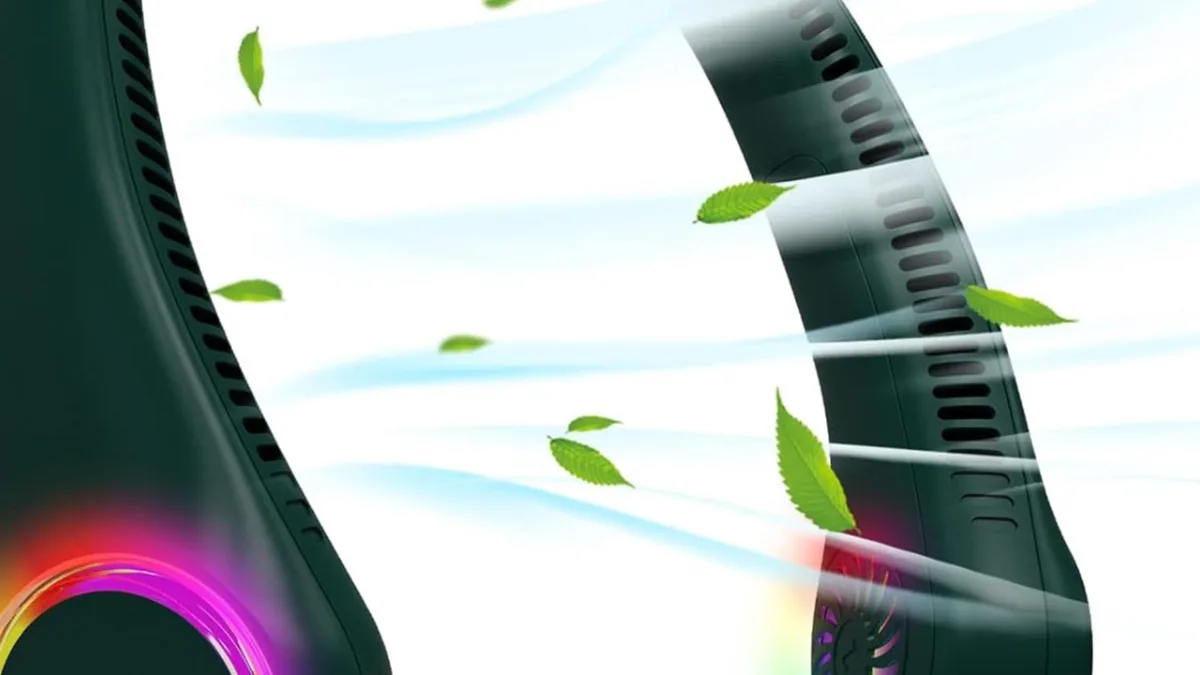
Bladed bands spin small propellers in open air behind thin grilles. Open propellers chop air loudly and concentrate the blast on one cheek. Bladeless collars seal one or two turbine motors inside the band and breathe through 70-plus tiny slots aimed up at your face and neck. Dozens of small jets blend into one smooth sheet instead of a choppy blast, and sealed turbines hum where open blades whirr. That design gap is worth roughly 6 dB at every speed, which your ears read as nearly half the loudness.
Outlet count matters more than any single spec. JISULIFE lists 78, and most rivals land in the 70s. More slots means each jet carries less pressure, which means less whistle. My full explainer on how bladeless neck fans work covers fit, cleaning, and the hair-safety angle in depth.
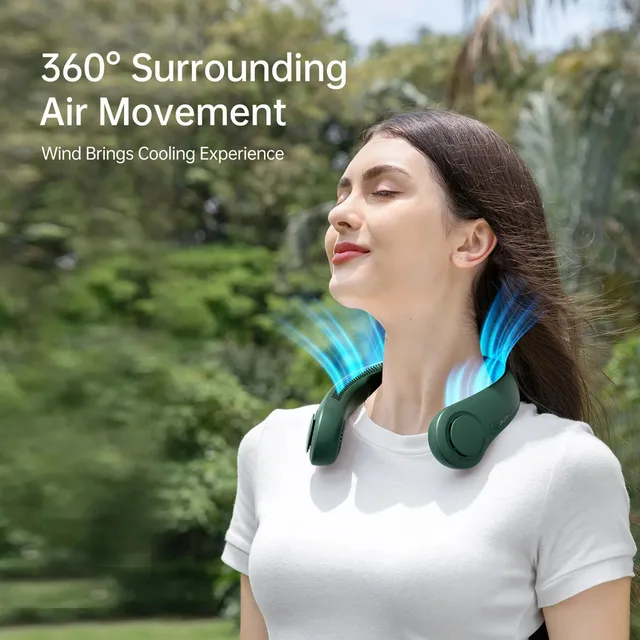
Speed control stays simple across all five collars. Three steps each. Low sips power near 25 dB, medium doubles the breeze in the low 30s, high drains the cell in 2 to 4 hours near 40-plus. USB-C charging is standard on all six picks. A micro-USB port on a 2026 listing signals old stock, so skip it.
Which Quiet Collar Should You Get
Match the pick to your week.
Calls all day in a quiet room. JISULIFE at ~$25. Documented 25 dB low, 78 outlets, cheapest ticket to inaudible. FluxoFan at ~$40 if you want the same hush plus a 30-day guarantee from the official store.
Splitting trains and office. Gulaki at ~$28. The 6-hour-plus medium runtime covers both legs, and the wider band stays put through station stairs.
Top pick sold out mid-July. CIVPOWER at ~$26. Same quiet low, steadier stock. Respect the 45 dB high and live on low and medium.
Second unit or tight budget. SWEETFULL at ~$24 for quiet duty, Arctic Air Freedom at ~$15 for brutal-heat backup. One hushes, the other blasts.
Gifts for the family. FluxoFan 4-pack at ~$27 per unit. Four collars, one seller, one guarantee, zero counterfeit roulette.
If two picks still tie in your head, buy the cheaper one. The $24-to-$28 bladeless tier performs within a whisper of itself on low, and the return window covers a bad fit.
One last filter. Think about your hottest 10 days, not your average July. Average days favor the quiet value tier. Those 10 brutal days decide whether you need the $15 bladed backup in the car. I live through humid 80s with occasional 95-degree spikes, so a hushed collar covers nearly everything and the backup handles the rest. Friends in Texas and Arizona flipped that math and never regretted keeping both.
Office Etiquette: Wearing One on Calls
A quiet fan still needs manners.
Test on day one. Join a test meeting on each speed and ask point blank if anyone hears anything. Lock low as your call setting and never touch the button mid-sentence. Speed clicks and ramping whirs transmit straight through laptop mics, and that 2-second adjustment annoys listeners more than any steady hum.
Mind the room. Open offices forgive everything under 35 dB because keyboards and HVAC bury it. Silent home offices forgive nothing, so keep calls on low and save medium for solo work. Libraries and coworking quiet cars deserve low or off. Your airflow never outranks someone else’s focus.
Keep the mic geometry in mind. Headset mics sit inches from the collar vents and pick up far more than a laptop mic across the desk. If you wear a headset, run the day-one test with that exact mic, not the laptop one. Two of my test speeds passed on laptop audio and failed on a headset, which surprised me until I measured the 8-inch distance gap.
Clean it monthly. Outlet slots collect dust and sunscreen, and a clogged grille forces the turbine to work audibly harder for the same breeze. Dry cotton swab along each vent row, dry cloth on the band, dry toothpick for a flaky USB-C port. Never rinse it. Water in the turbine chamber kills the motor the same afternoon.
Travel deserves its own line. These collars fly fine in carry-ons since their cells sit far under airline limits, and low speed keeps cabin air moving without bothering seatmates. I wore mine through a 5-hour flight on low with charge to spare. Keep it switched off through security, since a spinning collar in the bin draws questions you do not need.
Verdict
Six collars ranked by quiet, one clear shape to the answer. FluxoFan is the quietest pick with the strongest ownership terms. A hushed low gear that passed every call test, real 7-to-8-hour low-speed battery, and a 30-day guarantee from the official store. Bundle it to $27 per unit and the $40 single-unit premium vanishes. JISULIFE at $25 stays the value answer with its documented 25 dB low and 78 outlets, and Gulaki at $28 covers commuters with steadier medium runtime. CIVPOWER fills stock gaps if you respect its 45 dB high, SWEETFULL covers tight budgets, and the $15 Arctic Air stays a blast-only backup. I wore a quiet collar 4 days out of 5 all summer. My loud bladed backup left the drawer twice, both times in triple-digit heat, then went straight back.
Common Questions & Answers
Q: What is the quietest neck fan overall?
The FluxoFan is my quietest pick on its low setting. It runs as a soft background hum that stays out of laptop microphone pickup, and my call recordings on low came back clean. JISULIFE matches it on paper with a listed 25 dB low speed at a lower $25 price, so the honest split is this. FluxoFan wins the total package of quiet low speed plus a 30-day money-back guarantee from the official store. JISULIFE wins quiet per dollar. Both need low speed for calls, since medium and high get audible on every collar I tested.
Q: How many decibels is a quiet neck fan?
A quiet collar lists 25 dB on low, which sits just under a whisper. Expect the low 30s on medium, roughly a ticking clock heard across a room, and 40 to 45 dB on high, about a quiet library. Treat every brand figure as a best-case number measured in a silent room at close range. Real rooms add background noise, and your ears sit inches from the vents, so everything reads a touch louder in practice. Shop by the low-speed number if silence is the goal, because high speed always announces itself no matter which badge is on the band.
Q: Can you wear a neck fan on video calls?
Yes, on low speed, with one test on day one. I recorded the same 30-second paragraph on each speed with a laptop mic at arm's length, then played it back through earbuds. Low passed on all six collars. Medium failed on four of them, with a soft turbine tone sitting under my voice. High failed everywhere. Run the same check yourself during the return window. Join a test meeting, ask a friend if they hear anything, and switch speeds live. If low stays inaudible, you have your call setting locked in for the summer.
Q: Is the FluxoFan really quiet?
On low, yes, and that is where it earns its ranking. The hum drops into room tone and my laptop mic never picked it up during test calls. Medium adds a smooth turbine sound that works fine for solo desk work but leaks into calls. High is a plainly audible fan. My full test log scored it 7.2 out of 10 overall, with the deductions coming from battery life and price rather than noise. Real runtime landed near 7 to 8 hours on low and about 4 on high, well short of the 12-hour claim. Buy it for the quiet low plus the 30-day guarantee, not the headline battery number.
Q: Is the JISULIFE 25 dB noise claim real?
It is real in the narrow sense that matters. JISULIFE documents 25 dB for the low setting on its classic bladeless collar, measured under controlled conditions, and my low-speed call test backed it up. The fan vanished into room tone and nobody on test calls asked about background noise. What the number does not cover is medium and high, where output climbs into the 30s and low 40s like every rival. Read the claim as proof of a genuinely hushed low gear rather than a promise of silence at all speeds, and at $25 that hushed low gear is the best value in this roundup.
Q: Is low or high speed better for quiet cooling?
Low wins for quiet, and the gap is bigger than the numbers suggest. The spread from low to high runs about 15 dB on most collars, and decibels are logarithmic, so high sounds several times louder than low to your ears. Low also triples battery life. A 4000mAh collar stretches past 7 hours on low and dies near 3 on high. My daily rhythm is low for calls and desk work, medium for walks and commutes, and high only as a 10-minute blast when I step out of a hot car. Treat high as a burst mode and the noise complaint mostly disappears.
Q: Which neck fan is best for office use?
The JISULIFE classic at $25 is the office default. Its listed 25 dB low speed and 78 air outlets keep airflow even and inaudible through a call schedule, and the 4000mAh cell covers a workday on low. The FluxoFan is the premium office answer at $40 single or $27 per unit bundled, with equally hushed low speed plus a 30-day guarantee from the official store. Either way the rule is the same. Wear it on low at your desk, switch to medium only when you step away from the mic, and confirm with one test call in your first week.
Q: Can neck fans damage your hearing?
At these volumes, no. The NIDCD places whisper-level sound near 30 dB and flags 70 dB and up as the zone where prolonged exposure starts risking hearing damage. Every collar in this roundup lives between 25 and 48 dB, far below that line, even on high. The realistic annoyance is fatigue, not damage. A high-speed whine sitting an inch from your ears for 6 hours will grate on you, which is why low speed exists. Keep volumes sane, take the collar off when you stop needing airflow, and your ears will never notice the difference.
Q: Why is my neck fan louder than the listing says?
Three reasons stack up. First, brand figures are best-case numbers from quiet rooms, while your kitchen has a fridge hum and traffic outside. Second, distance cheats. Your ears sit 6 inches from the vents, so you hear the fan far louder than a mic across the desk does. Third, most people test on high out of the box, which runs 15 dB hotter than the listed low. Drop to low, give it 10 minutes, and judge again. If it still whines on low, check the outlet slots for lint. Two months of pocket dust can choke airflow and force the turbine to work audibly harder.
More Wearable Tech Articles

Related Product Reviews


Wearable tech reviewer and fitness technology analyst. Tests smartwatches, fitness trackers, and audio gear daily. Background in sports science helps evaluate health features with expertise.