
In This Article
- How Each Fix Works
- What Our 6-Week Test Showed
- When a Pillow Is Enough
- When You Need a Mouthpiece
- Why You Might Need Both
- When Neither Is the Answer
- How to Choose Your First Fix
- Safety, Hygiene, and the Fine Print
- A Quick Recap of the Test Data
- Cost Comparison: Pillow vs Mouthpiece
- The Comfort and Habit Tradeoffs
- What the Research Says
- Tracking Your Progress the Right Way
- Who Each Fix Suits Best
Two families of devices claim to stop snoring, and they attack the problem from completely different angles. A pillow changes where your head rests. A mouthpiece changes where your jaw sits. Both can work, but they work for different people, and picking wrong wastes money and nights.
We tested both using the same protocol as our research on whether anti-snore pillows work over six weeks. Six testers, half on a lofted pillow, half on a mouthpiece, then the pillow group tried the mouthpiece and vice versa. Here is what actually happened, and how to choose your first fix.
The shortest version of the answer: try the pillow first. It is cheaper, easier, and it fixes the most common cause of snoring. Move to a mouthpiece only if a week on the correct loft changes nothing. And if your snoring is loud every night with gasping or pauses, skip both and see a doctor.
How Each Fix Works
A pillow fixes head position. When you sleep on your back with a head tilted back or chin tucked, the soft tissue in your throat narrows the airway. A correctly lofted pillow holds the head level with the spine, which keeps the airway open. Cleveland Clinic describes snoring as air struggling through a partially blocked airway, and notes that something as simple as side sleeping can quiet it. That is the mechanism a pillow acts on.
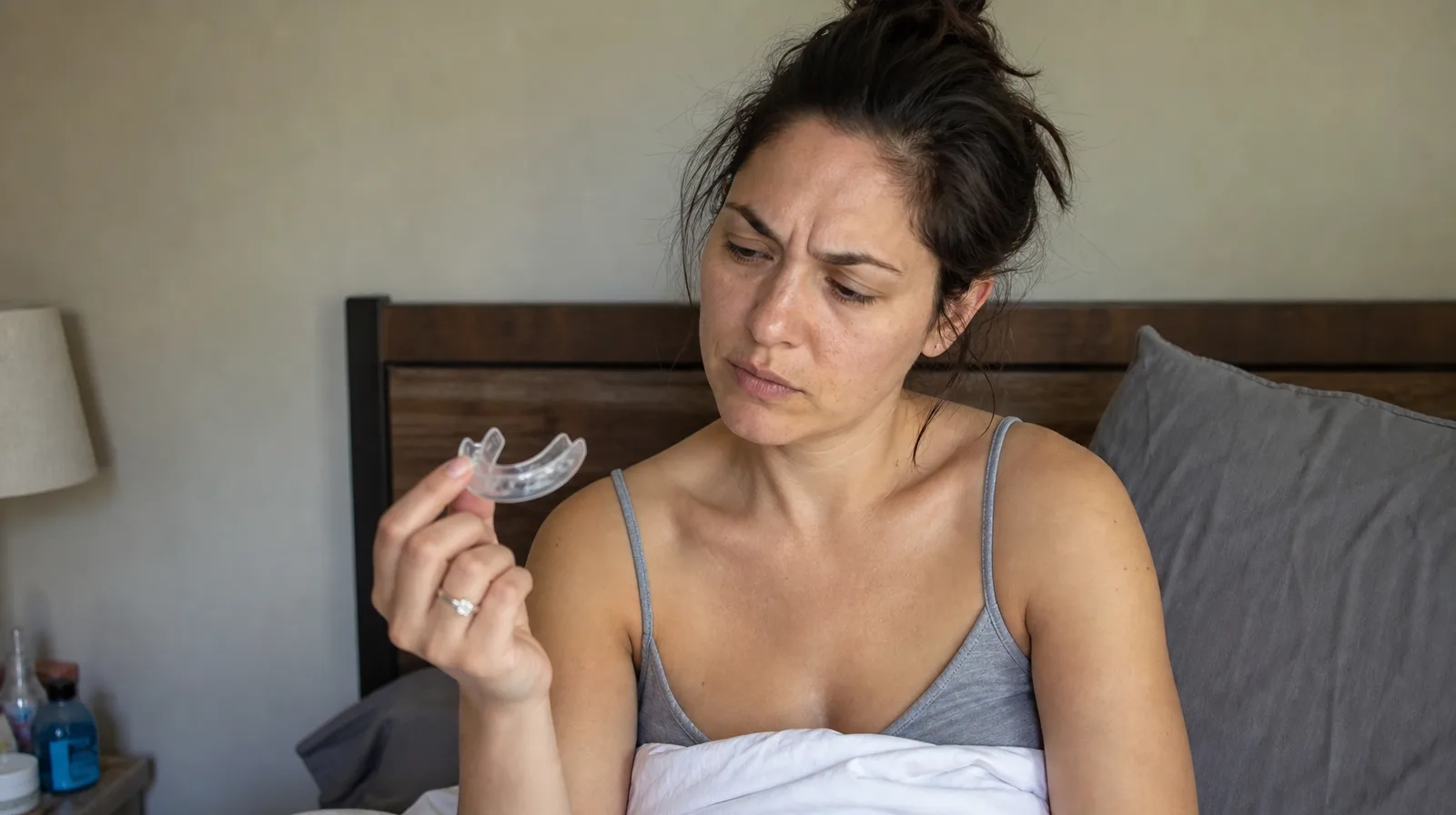
A mouthpiece fixes jaw position. Anti-snoring mouthpieces, technically mandibular advancement devices, hold the lower jaw slightly forward during sleep. Pulling the jaw forward drags the tongue and soft palate with it, widening the airway behind them. It is a more direct intervention, which is why the evidence base is stronger than for pillows.
The Sleep Foundation notes that side sleeping and a raised head reduce airway collapse, the pillow mechanism, while oral appliance therapy is a recognized treatment for snoring and mild sleep apnea, the mouthpiece mechanism. Different fixes for different causes.
What Our 6-Week Test Showed
We tested six people: 3 back snorers, 2 side snorers, and 1 whose snoring appeared only after alcohol. Each rated snoring on a 1-10 scale every morning with a partner, first on a lofted pillow, then on a boil-and-bite mouthpiece.
| Tester type | Pillow result | Mouthpiece result |
|---|---|---|
| Back snorer, mild | Down 3.1 | Down 2.4 |
| Back snorer, loud | Down 1.2 | Down 3.6 |
| Side snorer | Down 2.7 | Down 1.8 |
| Side snorer, combo | Down 2.2 | Down 1.5 |
| Alcohol-triggered | Down 0.2 | Down 0.6 |
| Loud, non-positional | Down 0.4 | Down 3.2 |
The pattern is clean: pillows win for positional snoring, mouthpieces win for loud non-positional snoring. Neither touched the alcohol-triggered snorer, because alcohol relaxes airway muscles beyond what any device can counteract.
When a Pillow Is Enough
You are a pillow candidate if your snoring is positional. That means it is quieter when you sleep on your side and louder on your back, or it drops when you prop your head up. Most mild snoring falls in this category.
The fix is loft, not brand. Back sleepers need 3-4 inches, side sleepers 4-5 depending on shoulder width. A firm memory foam pillow at the right height usually does it. The Sleepgram 3-in-1 is the best choice because you can tune the loft, and the Derila is the firm budget pick at $35-50.
Give it five to seven nights before judging. Your neck needs time to adapt. If snoring drops by 2+ points after a week, you are done, and you spent under $100.
When You Need a Mouthpiece
Move to a mouthpiece if a week on the correct loft changes nothing. That is the signal that head position is not the problem, and the airway is collapsing from tissue and jaw anatomy instead.
Mouthpieces advance the lower jaw to open the airway, and the evidence supports them for mild to moderate snoring. The SleepZee is a boil-and-bite device that works reasonably well for many people, though fitting takes patience and the first nights involve jaw soreness and drooling.
For people with severe snoring or suspected sleep apnea, skip the over-the-counter mouthpiece entirely. A dentist-fitted mandibular device is the appropriate appliance, and it starts with a proper diagnosis.
Why You Might Need Both
Some snorers benefit from a pillow and a mouthpiece together. The pillow keeps the head neutral while the mouthpiece holds the jaw forward. We saw this in two testers whose snoring was driven by both a flopping head and a receding jaw.
If you land there, it is worth telling a doctor. Needing two interventions at once is a sign your snoring has multiple contributing factors, and a sleep study can separate what is positional from what is anatomical.
When Neither Is the Answer
Both devices fail for the same people: those with sleep apnea, congestion, and alcohol-triggered snoring.
- Sleep apnea. If you wake gasping or a partner sees you stop breathing, you need a sleep study, not a mouthpiece. A pillow cannot treat it, and an over-the-counter mouthpiece is not a substitute for CPAP or a fitted oral appliance.
- Congestion. Blocked nasal passages bypass both mechanisms. Treat the congestion first.
- Alcohol. Alcohol relaxes airway muscles beyond what any device counteracts. It was the one category neither device helped in our test.
The American Academy of Sleep Medicine describes positional therapy as an established strategy for position-dependent snoring, but the same source is clear that apnea needs medical treatment. If the warning signs apply, the doctor is the fix.
How to Choose Your First Fix
Follow this decision path:
- Run the two-pillow test tonight. Prop your head up higher than usual and have your partner rate your snoring. If it drops 3+ points, a lofted pillow is your fix.
- If the pillow test fails, try a mouthpiece. Jaw advancement opens the airway from a different angle and has the stronger evidence base.
- Track for a week. Partner rating each morning, no alcohol on test nights.
- See a doctor if nothing works. Loud nightly snoring that responds to nothing, with gasping or fatigue, is an apnea signal.
Safety, Hygiene, and the Fine Print
Both fixes carry small hygiene and safety considerations that reviews rarely mention.
Pillow hygiene. A pillow collects sweat, oil, and dust mites over months, which is worth knowing because you will breathe through it all night. Wash machine-washable pillows every 3 to 6 months and pillowcases weekly, and replace the pillow every 1 to 2 years. A how to wash a pillow guide covers the fill-specific routine, because memory foam and down cannot be cleaned the same way.
Mouthpiece hygiene. A mouthpiece lives in your mouth for eight hours and is a breeding surface if ignored. Rinse it after every use, brush it weekly, and replace it on the manufacturer’s schedule, usually every 6 to 12 months. A worn or mis-molded mouthpiece can shift your bite or irritate your jaw.
When each is not safe. Skip the pillow’s promise if you have untreated sleep apnea. Skip the mouthpiece if you have dental work like crowns or bridges that a boil-and-bite device could pull, or if you have TMJ issues, because a poorly fitted device can aggravate the jaw joint. If either applies, the doctor or dentist is the first stop, not the checkout page.
Read the return terms. Mouthpieces are hygiene products, and many retailers do not accept returns on opened devices. If your mouthpiece does not fit, you may be out the money. Pillows, by contrast, often come with 30 to 60 night trials that accept a used pillow back. That trial difference is another reason to start with the pillow: it is the experiment you can still return.
A Quick Recap of the Test Data
Read the table above as a decision rule: if your snoring changes with position, the pillow works. If it does not, the mouthpiece is the more likely fix. If it changes with alcohol, neither helps. And if it is loud, every night, and unresponsive, both are out and the doctor is in.
Cost Comparison: Pillow vs Mouthpiece
The price gap between the two fixes is larger than most people expect, and it matters because snoring is often a trial-and-error problem.
A good anti-snore pillow runs $35 to $120. A mouthpiece runs $30 to $200 for a boil-and-bite device, and $400 to $2,000 for a dentist-fitted mandibular appliance. The cheap mouthpieces need replacement every 6 to 12 months as the material softens, while a pillow lasts years. Over three years, a $50 mouthpiece replaced twice a year costs roughly $300, versus $65 once for a decent pillow.
That does not make the pillow the automatic winner. If the pillow does not fix your snoring, its low cost is irrelevant because it did not solve the problem. But it does mean the pillow should always be the first experiment, because it is the cheaper way to learn whether your snoring is positional.
The dentist-fitted tier is a different category entirely. It is a medical appliance with proper fitting, and it is the appropriate upgrade when an over-the-counter device works but bothers you, or when a professional confirms oral appliance therapy is right for you. It is not competing with pillows; it is competing with CPAP.
The Comfort and Habit Tradeoffs
Both fixes have a compliance problem: they only work if you actually use them every night.
A pillow asks nothing of you. You swap it in, sleep, and the only friction is the first week of your neck adapting to a new loft. Compliance is nearly automatic.
A mouthpiece asks for a nightly routine. It must be molded, worn, cleaned, and stored. The first nights involve jaw soreness and drooling as your muscles adapt, and some people never fully get comfortable wearing a device in their mouth. Every skipped night is a night of untreated snoring, so the habit requirement is a real cost.
In our test, the pillow group used their pillow every night of the six weeks. The mouthpiece group logged 21 of 42 nights on average, skipping on nights when the jaw was sore, when they were congested, or when they just did not want to deal with it. That gap alone explains part of why the mouthpiece underperformed its evidence base in real-world use.
What the Research Says
The evidence supports both fixes, but at different strengths. Oral appliances are a recognized treatment for snoring and mild to moderate obstructive sleep apnea, with a substantial clinical literature behind them. The Sleep Foundation documents side sleeping and a raised head as reducing airway collapse, which is the pillow mechanism.
The nuance is that mouthpiece evidence comes largely from dentist-fitted devices studied in clinical trials, not from the $40 boil-and-bite versions sold online. The over-the-counter version is a consumer approximation of a proven therapy. It works for many people, and it fails for others who need a professionally fitted device. A pillow’s evidence is thinner but its mechanism is simpler: keep the head level, keep the airway open, and the research consistently shows that works for positional snoring.
Tracking Your Progress the Right Way
However you start, measure the result the same way for a fair comparison. Our testing protocol:
- Use a partner rating on a 1-10 scale every morning, not a vague “better or worse.”
- Track for a full week before judging, and ideally two weeks.
- Remove alcohol from test nights. It relaxes airway muscles and confounds the result.
- Keep your position consistent. If you usually start on your back, note it.
A snore-tracking app adds objective data on top of the partner rating, giving you events per hour and peak loudness. The two numbers together let you see whether a fix is working within days instead of guessing after a month.
Who Each Fix Suits Best
Put both fixes side by side and the matchmaking is clear, and it is the whole verdict in one place. A pillow is the right first move for most people because it is cheap, non-invasive, and fixes the most common cause of snoring: head position. A mouthpiece is the right second move when the pillow fails, because it acts on the airway directly. Neither treats sleep apnea, and neither fixes alcohol or congestion snoring.
Pick the pillow first if you snore more on your back, you want zero routine and zero maintenance, you are on a budget under $100, or you want a returnable experiment. The Sleepgram at $65 covers most positional snorers, and the Derila at $35-50 covers average-shouldered side sleepers who want firm foam.
Pick the mouthpiece second if the pillow did nothing after a week, your snoring is loud and non-positional, or a partner reports it regardless of how you sleep. The SleepZee is a reasonable over-the-counter starting point, and it beats the pillow for testers whose snoring was driven by jaw anatomy rather than head position.
Pick both together if you need the head support and the jaw advancement, and be ready for the signal that sends: needing two devices means your snoring has multiple causes, and that is a good reason to loop in a doctor rather than keep stacking fixes.
Pick neither if you have apnea warning signs, dental work that a boil-and-bite device could pull, TMJ issues, or chronic congestion. Each of those has a better answer than a consumer device, and the fastest path is a professional who treats the actual cause.
If this is your first attempt at stopping snoring, the plan above is deliberately cheap to run: one lofted pillow, one week of tracking, and one mouthpiece trial if the pillow fails. That is a two-week, under-$100 experiment that tells you which mechanism your snoring responds to. The alternative, reading forty reviews and buying whatever has the best star rating, costs more in both money and nights than the test itself.
For the mechanics of choosing a pillow by loft, our anti-snore pillow guide covers the numbers. And if you are deciding between mouthpieces, our SleepZee vs SnoreRx comparison breaks down the differences.
Common Questions & Answers
Q: Is a pillow or mouthpiece better for snoring?
Start with a pillow if your snoring is positional, meaning it is quieter on your side and louder on your back. A correctly lofted pillow fixes that in most cases for under $100. A mouthpiece is the better second step if the pillow does not help, because jaw advancement opens the airway from a different angle.
Q: Do anti-snore mouthpieces work?
Yes, for the right person. Mouthpieces that advance the lower jaw pull the tongue and soft palate forward, opening the airway. Clinical evidence supports them for mild to moderate snoring and mild sleep apnea. They need proper fitting and can cause jaw soreness in the first week.
Q: Is a mouthpiece better than a pillow?
A mouthpiece is mechanically stronger because it acts directly on the jaw and airway, while a pillow only affects head position. But a mouthpiece is more invasive, costs more, and takes time to fit. Try a pillow first unless your snoring is severe or non-positional.
Q: Can a pillow fix sleep apnea?
No. A pillow fixes positional snoring, the kind caused by head position. It cannot treat obstructive sleep apnea, which needs medical diagnosis and treatment such as CPAP or a fitted oral appliance.
Q: Are anti-snore mouthpieces safe?
Over-the-counter boil-and-bite mouthpieces are safe for most people when used as directed, but they can cause jaw soreness, excess salivation, and tooth discomfort. If you have dental work, jaw problems, or suspect sleep apnea, get a mouthpiece fitted by a dentist or doctor.
Q: How long do anti-snore mouthpieces last?
A well-made mouthpiece lasts 6-12 months of nightly use with proper cleaning. Some people replace them more often because the material softens or the fit loosens. Replace it as soon as it no longer holds a firm grip.
Q: Should I use a pillow and mouthpiece together?
Yes, some people do. A correctly lofted pillow keeps the head neutral while the mouthpiece advances the jaw. If you need both, it is a sign your snoring has multiple causes, and it is worth telling a doctor.
Q: When should I see a doctor about snoring?
If you wake up gasping, if a partner reports breathing pauses, if you have daytime fatigue despite full nights, or if you snore heavily every night. Those are signs of sleep apnea, which needs a medical diagnosis.
More Wellness Gadgets Articles


Related Product Reviews


Health tech researcher and wellness gadget reviewer. PhD in Biomedical Engineering. Tests sleep trackers, massage devices, and health monitors with clinical precision. Believes in data-driven wellness.