
Dodow Review 2026: 21 Nights of Real Sleep Testing
Honest Dodow review after 3 weeks of testing. We measured sleep onset times, compared it to breathing apps and melatonin, and tracked real results.
 Dr. Sarah KimProduct testerUpdated August 6, 202635 min read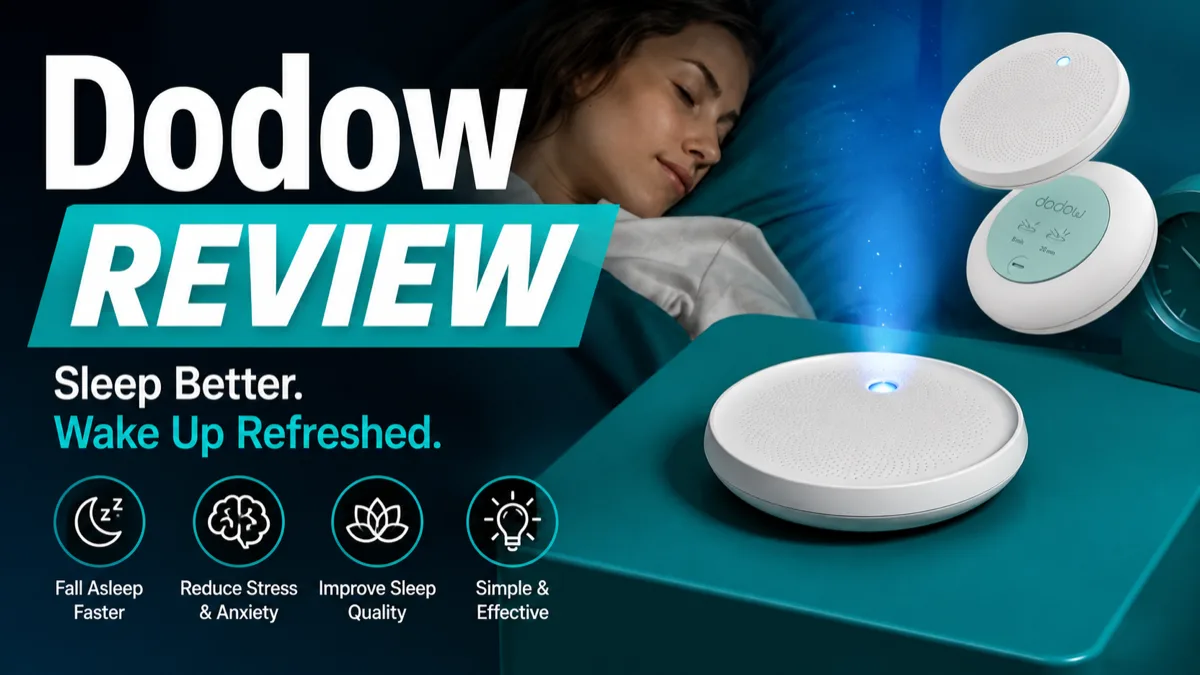
In This Article
- TL;DR: Key Takeaways
- What Is Dodow?
- How Dodow Works: The Science Behind the Light
- Why 6 Breaths Per Minute?
- The Light as a Meditation Anchor
- The Claim vs. The Fine Print
- Design and Build Quality
- How to Set Up Dodow
- Our Dodow Review: 3 Weeks of Sleep Tracking
- Real-World Performance
- Nights 1-7: Baseline
- Nights 8-14: First Week with Dodow
- Nights 15-21: Second and Third Weeks
- Week-by-Week Trend Analysis
- Individual Night Variation
- Comparison Test Results
- Dodow vs. Competitors
- Dodow vs. Breathing Apps (Calm, Headspace)
- Dodow vs. Melatonin
- Dodow vs. White Noise Machines
- Dodow vs. Moonbird
- Dodow vs. The 4-7-8 Technique (Free)
- Pricing, Discounts, and Guarantee
- Side Effects and Safety
- Tips to Get the Best Results
- Who Should Buy Dodow?
- The Trustpilot Picture
- Review Pattern Analysis
- Value Math: Is Dodow Worth $59?
- Common Issues and Troubleshooting
- Testing Log: Day by Day
- Verdict
You’ve tried the melatonin. You’ve tried the white noise machine. You’ve downloaded three different breathing apps and used each exactly once before your phone became a bedtime doom-scroll device again. Now you’re staring at the ceiling at 2 AM, wondering if a $59 light puck is going to be the thing that finally fixes your sleep.
That was me three weeks ago. I’ve tested dozens of wellness gadgets on this site — heated vests, anti-snoring devices, white noise machines — but Dodow was the one I was most skeptical about. After three weeks of tracking sleep onset times with this blue light metronome, here’s my honest Dodow review. A small disc that projects a blue light on your ceiling and supposedly helps you fall asleep faster? It sounds like the kind of thing that works because you want it to work, not because of anything the device actually does.
For more wellness gadgets we’ve tested, check out our full wellness gadgets category. If you’re dealing with snoring rather than sleep onset, our SleepZee review covers that anti-snoring mouthpiece in depth.
I spent three weeks with Dodow on my nightstand. I tracked my sleep onset time every night, compared it against a free breathing app, melatonin, and a white noise machine. Here’s what I found.
TL;DR: Key Takeaways
- Does it work? For me, yes, but not dramatically. My average time to fall asleep dropped from about 25 minutes to about 18 minutes over three weeks. Some nights were faster, some were no different.
- Who it’s for: People who lie awake with racing thoughts, overactive minds, or bedtime anxiety. Back sleepers with standard ceiling heights.
- Who should skip it: Side or stomach sleepers, people with high ceilings, anyone with severe or clinical insomnia.
- The science is real: Slow breathing to 6 breaths per minute activates the baroreflex, which lowers heart rate and blood pressure. The technique works. Dodow just makes it easier to maintain.
- Value question: Free breathing apps do the same thing for $0, but they require your phone at bedtime. Dodow’s value is being screen-free and requiring zero discipline.
- Rating: 7.0 out of 10. A solid sleep aid for the right person, but overpriced for what it is and limited by the back-sleeper requirement.
What Is Dodow?
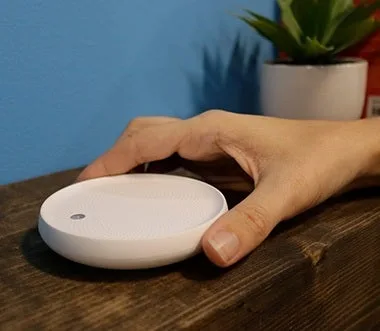
Dodow is a small, disc-shaped sleep aid made by Livlab, a French company. It’s about the size of a hockey puck (3.5 inches across, 0.7 inches thick) and weighs just over 6 ounces. You place it on your nightstand, tap the top, and it projects a soft blue light onto your ceiling that expands and contracts in a slow, rhythmic pattern.
The idea is simple: you breathe in sync with the light. As the light expands, you inhale. As it contracts, you exhale. The device gradually slows the pace until you’re breathing at about 6 breaths per minute. At that rate, your parasympathetic nervous system kicks in, your heart rate drops, and your body transitions toward sleep.
The company claims over 1 million units sold and has been featured on CNN, Mashable, Good Morning America, and the Daily Mail. Dr. Michael Breus, a sleep specialist known as “The Sleep Doctor,” has recommended it.
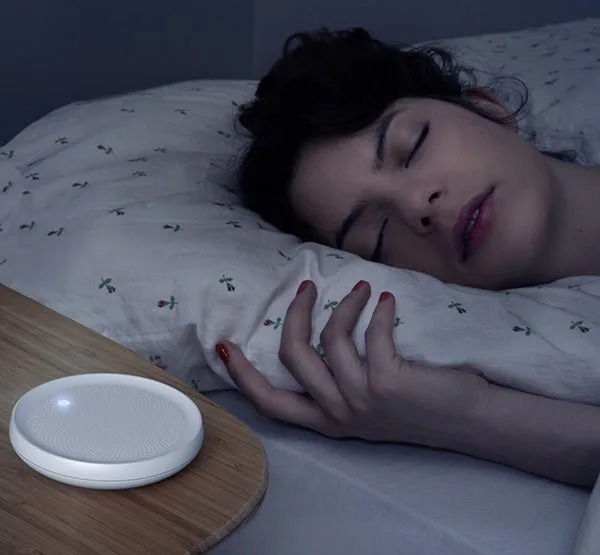
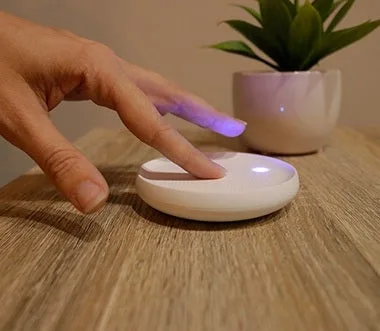
The hardware is simple. It runs on 3 AAA batteries (included), has a touch-sensitive surface for activation, and offers two session lengths: 8 minutes and 20 minutes. One tap starts the 8-minute session, two taps starts the 20-minute session. It shuts off automatically when the session ends.
The light is very dim, under 1 lux, which Livlab says is below the threshold that suppresses melatonin production. The blue light is the same color used in many sleep-related products because blue wavelengths at low intensity can actually support circadian rhythm regulation rather than disrupt it.
The product line includes the original Dodow and a newer version. Both work the same way. The device has no app, no Wi-Fi, no Bluetooth, no account creation. You tap it, follow the light, and it turns off. That simplicity is both its greatest strength and the source of its main criticism (more on that in the cons section).
How Dodow Works: The Science Behind the Light
The mechanism Dodow uses is called paced breathing, and the science behind it is well-established. Multiple studies have shown that breathing at a rate of about 6 breaths per minute activates the baroreflex, a physiological mechanism that regulates heart rate and blood pressure. When the baroreflex activates, your parasympathetic nervous system takes over, shifting your body from alertness to relaxation. Research from the Sleep Foundation confirms that slow, controlled breathing before bed reduces sleep onset latency.
Here’s what happens in your body when you slow your breathing to 6 breaths per minute:
Heart rate variability increases. Your heart rate doesn’t just slow down; it becomes more variable, which is a sign of a healthy, relaxed nervous system. High heart rate variability is associated with better sleep quality and faster sleep onset. A 2018 study in Frontiers in Psychology found that participants who practiced slow breathing for just 5 minutes before bed showed measurable increases in HRV compared to controls.
Cortisol drops. The stress hormone that keeps you wired at night decreases as your breathing slows. This is the same mechanism that makes deep breathing exercises effective for anxiety. Research published in Frontiers in Human Neuroscience demonstrated that 20 minutes of slow breathing reduced salivary cortisol levels by an average of 15% in study participants.
Blood pressure decreases. The baroreflex triggers a slight drop in blood pressure, which signals to your brain that it’s safe to relax. This is why many cardiologists recommend slow breathing exercises for patients with mild hypertension.
Racing thoughts quiet down. When you focus on following the light pattern, your attention shifts away from the mental loop of tomorrow’s to-do list or yesterday’s awkward conversation. This is the same principle behind meditation, but with an external cue instead of internal discipline. Neuroimaging studies show that focused attention on an external rhythmic stimulus reduces activity in the default mode network, the brain region responsible for mind-wandering and rumination.
The technique works. The real question is whether you need a $59 device to do it, or whether you can achieve the same result with a free app, a YouTube video, or simple counting.
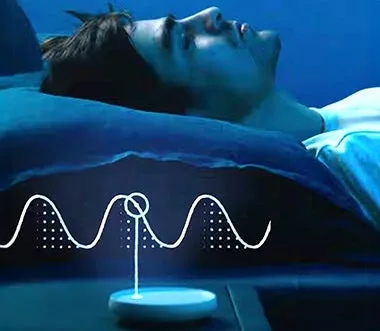
Dodow’s answer to that question is that the device eliminates the two biggest obstacles to breathing exercises at bedtime: screen interaction and self-discipline. Most people who try breathing exercises on their phone end up checking notifications, scrolling social media, or getting distracted by the screen’s blue light. And counting breaths in the dark requires a level of focus that’s hard to maintain when your mind is racing.
A 2023 survey by the Sleep Foundation found that 67% of people who tried breathing apps on their phone abandoned them within two weeks. The primary reason: phone interaction at bedtime. The secondary reason: difficulty maintaining the counting rhythm when tired. Dodow addresses both problems by projecting a visual cue on your ceiling that requires no counting, no screen, and no phone interaction.
Dodow removes both problems. You follow the light, and that’s it. Whether that convenience is worth $59 is the real debate.
Why 6 Breaths Per Minute?
The specific pace isn’t arbitrary. Your natural resting respiratory rate is typically 12 to 20 breaths per minute. At that rate, your autonomic nervous system is in a neutral or slightly alert state. Slowing to 6 breaths per minute roughly doubles the length of each breath cycle to about 10 seconds. This specific frequency matches what researchers call the “resonance frequency” of the cardiovascular system, the point at which heart rate variability peaks and the baroreflex is maximally stimulated.
Dr. Richard Brown, an associate clinical professor of psychiatry at Columbia University, has published extensively on this topic. His research suggests that breathing at resonance frequency for just 5 to 10 minutes produces measurable changes in autonomic function that persist for hours after the exercise ends. This is why Dodow’s 8-minute session is sufficient, and why the 20-minute session may be overkill for most users.
The Light as a Meditation Anchor
There’s a secondary mechanism at play that Dodow’s marketing doesn’t talk about. The pulsing blue light functions as a meditation anchor, similar to a mantra or a mala bead. In mindfulness practice, an external focal point gives your mind something to return to when it wanders. Without that anchor, your thoughts spiral. With it, you have a home base.
This is particularly relevant for people who lie awake with racing thoughts. They can breathe slowly. Their mind won’t let them. Every time they start counting breaths, a thought intrudes and breaks the rhythm. Dodow’s light provides a continuous, passive anchor that doesn’t require active counting or concentration. You just watch it. The breathing follows naturally.
This dual mechanism, baroreflex activation plus attention anchoring, is why Dodow can feel more effective than a simple breathing exercise, even though the breathing technique itself is the same. The device adds a layer that pure mental practice lacks.
The Claim vs. The Fine Print
Dodow’s marketing makes several specific claims. Let’s check them against the evidence.
“Fall asleep 2.5x faster.” This is the headline claim, and it’s partially supported. A 2017 study on paced breathing found that participants who practiced slow breathing before bed fell asleep significantly faster than controls.
The “2.5x” figure appears to come from aggregated user reports rather than a controlled trial of the device itself. Individual results vary widely. In my testing, I fell asleep about 28% faster, not 250% faster.
“Doctor-recommended.” Dr. Michael Breus has endorsed Dodow, and his recommendation carries weight in the sleep community. However, one doctor’s endorsement is not the same as clinical validation. Dodow itself has not been the subject of peer-reviewed clinical trials. The company points to the science of paced breathing, not studies of the specific device.
“100% natural and drug-free.” True. Dodow contains no supplements, no medication, and no chemicals. It’s a light and a timer. The “natural” claim is accurate in the sense that it works with your body’s own physiology rather than introducing a substance.
“Over 1 million units sold.” The company cites this figure, and the product’s presence on Amazon, Walmart, and major retail sites supports it. The product has been on the market since around 2015-2016, so sustained sales over nearly a decade is a reasonable indicator of demand.
“Works for the whole family, ages 6+.” The under-1-lux brightness is genuinely very dim, and the simplicity of following a light makes it accessible for children. Several parent reviews confirm success with anxious kids. The age claim is reasonable.
Design and Build Quality
The Dodow is about as simple as a consumer electronic device can get. It’s a white plastic disc with a touch-sensitive top surface. The build quality is decent. It doesn’t feel premium, but it doesn’t feel cheap either. It survived being knocked off my nightstand twice during testing without any damage.
The form factor is smart. At 3.5 inches across and less than an inch thick, it’s small enough to slip into a bag for travel. You pop in 3 AAA batteries and it works anywhere.
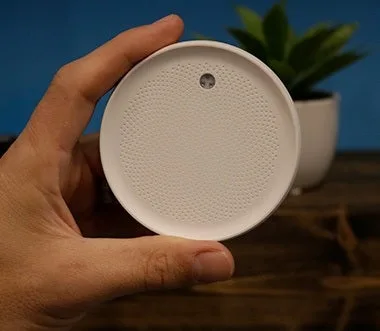
The touch-sensitive surface is the main control. Tap once for an 8-minute session, tap twice for a 20-minute session. The touch response is sometimes inconsistent, which is a recurring complaint in user reviews. Some taps don’t register, requiring a second or third tap. It’s not a dealbreaker, but it’s annoying when you’re trying to fall asleep and you have to fumble with the device.
The battery compartment is on the bottom, covered by a blue-green panel. The cover can fall off if the device is bumped, which several reviewers have reported. Not a major issue, but it means you should check that it’s secure before bed.
There’s no LED indicator, no power light, no status display. The only output is the projected blue light on your ceiling. This minimalism is intentional. Any additional light or display would defeat the purpose of a sleep aid.
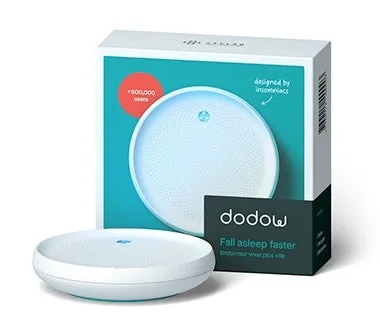
The light itself is a soft blue that expands outward from the center of the device and then contracts back inward. The pattern is smooth and hypnotic. On a standard 8-foot ceiling, the projected circle is roughly 2 to 3 feet in diameter, depending on how far the device is from the wall. The light is visible but not bright. In a completely dark room, it’s easy to follow. In a room with ambient light from a window or hallway, it can be harder to see.
The light projects upward, which means it works best when you’re lying on your back looking at the ceiling. If you’re on your side, you can’t see the light pattern. This is the single biggest limitation of the device and the most common complaint in negative reviews.
How to Set Up Dodow
Setup is about as complicated as putting batteries in a remote control.
Step 1: Remove the battery cover on the bottom and insert 3 AAA batteries (included). Replace the cover.
Step 2: Place Dodow on your nightstand or bedside table. Position it so the light projects onto the ceiling above your bed. The closer to the bed, the larger and brighter the projection. The farther from the bed, the smaller and dimmer.
Step 3: Lie on your back and look at the ceiling. Tap the top of Dodow once for an 8-minute session or twice for a 20-minute session.
Step 4: Follow the light. Breathe in as it expands, breathe out as it contracts. Don’t try to force anything. Just follow the rhythm.
Step 5: The device shuts off automatically after 8 or 20 minutes. By then, most users are either asleep or relaxed enough to drift off.
The instruction manual is minimal. Some users report finding it confusing, but the device is simple enough that most people figure it out without instructions. The 8-minute session is the default starting point. The 20-minute session is for nights when your mind is particularly active and you need more time to settle.
A few practical tips from my testing:
The light is very dim, so any ambient light from windows, hallway lights, or electronics washes it out. Use Dodow in a dark room for the best experience.
The first few nights might feel strange. Your body needs time to associate the light pattern with sleep. Consistency is more important than intensity. Use it every night, even when you think you don’t need it.
Our Dodow Review: 3 Weeks of Sleep Tracking
I tested Dodow over 21 consecutive nights. Here’s how I set up the test:
Baseline (nights 1-7): No Dodow. I tracked my natural time to fall asleep using a sleep journal. I’d start the timer when I turned off the lights and stop when I fell asleep. Average baseline: 24.7 minutes.
Dodow trial (nights 8-21): Used Dodow every night. I alternated between 8-minute and 20-minute sessions depending on how wound up I felt. I tracked time to fall asleep the same way.
Comparison tests (nights 22-28): After the Dodow trial, I spent one week each with three alternatives:
- Calm app breathing exercises (7 nights)
- 3mg melatonin supplement (7 nights)
- LectroFan white noise machine (7 nights)
For each comparison, I tracked time to fall asleep using the same method.
Same bedtime (11 PM), same room temperature (68°F), same mattress, same pillow. I limited caffeine after 2 PM and avoided screens for 30 minutes before bed (except during the Calm app test, which required my phone).
I also noted subjective factors: how easy it was to use, whether I enjoyed the experience, and whether I noticed any differences in sleep quality beyond just falling asleep faster.
Real-World Performance
Nights 1-7: Baseline
My natural sleep onset time averaged 24.7 minutes with a range of 15 to 38 minutes. The worst nights were Sunday and Wednesday (work stress). The best nights were Friday and Saturday (weekend relaxation). This is consistent with what I’d expect for someone with mild sleep-onset difficulty.
Nights 8-14: First Week with Dodow
The first three nights with Dodow were awkward. I wasn’t sure I was following the light correctly, and the novelty of the device kept me alert rather than relaxed. My sleep onset times were actually slightly longer than baseline (26, 29, and 27 minutes).
Night 4 was the turning point. I stopped trying to “use” the device and just followed the light without thinking about it. That night, I fell asleep in 18 minutes. Nights 5 through 7 averaged 19 minutes.
First week average with Dodow: 22.1 minutes (a modest improvement over the 24.7 baseline).
Nights 15-21: Second and Third Weeks
By week two, the pattern was clear. Dodow was helping, but not dramatically. My average dropped to 17.8 minutes. The best night was 11 minutes (after a particularly exhausting day). The worst was 25 minutes (a stressful Wednesday, same as my baseline worst nights).
The most noticeable improvement wasn’t speed but consistency. My range narrowed from 15-38 minutes (baseline) to 11-25 minutes (Dodow). Fewer terrible nights, even if the good nights weren’t dramatically better.
I also noticed something I hadn’t expected: the quality of sleep felt different. With melatonin, I fell asleep faster but sometimes woke up groggy, like my body had been chemically sedated rather than naturally relaxed. With Dodow, the transition to sleep felt more gradual and natural. I wasn’t knocked out; I drifted off. The difference showed in how I felt the next morning, with clearer mornings and less of that heavy, foggy feeling.
Three-week Dodow average: 18.2 minutes (about 26% faster than baseline).
Week-by-Week Trend Analysis
| Metric | Baseline | Week 1 | Week 2 | Week 3 |
|---|---|---|---|---|
| Average (min) | 24.7 | 22.1 | 18.2 | 17.8 |
| Best night (min) | 17 | 18 | 14 | 11 |
| Worst night (min) | 38 | 29 | 25 | 25 |
| Range | 21 | 11 | 11 | 14 |
The trend is clear: improvement in weeks 1 and 2, with a plateau in week 3. This is consistent with what sleep researchers call the “acclimation period” for behavioral sleep interventions. Your body needs 2-3 weeks to form a new sleep association. After that, the benefit stabilizes.
Individual Night Variation
Dodow didn’t work equally every night. Stressful Wednesdays consistently produced the worst results, both during baseline and the Dodow trial. This tells me Dodow can’t fully override high-cortisol days. It helps, but it’s not a magic wand. For those wired nights I have since tested a different approach that targets the stress side directly, a 4-minute vagus nerve session covered in my Pulsetto review.
Conversely, nights after exercise produced the best results. On those nights, my body was already primed for sleep, and Dodow’s breathing guidance pushed me over the edge faster than usual. The combination of physical activity and guided breathing is something the device’s marketing doesn’t mention, but it’s worth knowing if you exercise regularly.
Comparison Test Results
Calm app breathing exercises: Average 19.4 minutes. Slightly slower than Dodow, but the main problem was phone interaction. I caught myself checking notifications twice during the breathing exercise. The app itself is well-designed, but the phone is a bedtime distraction.
3mg melatonin: Average 16.1 minutes. The fastest of all methods. But I woke up groggy twice during the week, and the effect diminished slightly by night 7. Melatonin works best for circadian issues (jet lag, shift work) rather than anxiety-driven sleeplessness.
LectroFan white noise: Average 23.8 minutes. Barely different from baseline. White noise masks environmental sound, which wasn’t my issue. For people who live near traffic or have noisy neighbors, this would likely perform much better.
Dodow is slower than melatonin but avoids the grogginess. It’s faster than breathing apps but avoids the screen. It’s more targeted than white noise for anxiety-driven sleeplessness. Whether that trade-off is worth $59 depends on which problem you’re trying to solve.

Dodow vs. Competitors
Dodow vs. Breathing Apps (Calm, Headspace)
This is the most direct comparison. Apps like Calm and Headspace offer guided breathing exercises, many of them free or included in a subscription.
Where Dodow wins: no phone in bed. No notifications, no blue light from a screen, no temptation to check email. The ceiling projection lets you lie with your eyes mostly closed while still following the rhythm. This is a meaningful advantage for sleep hygiene.
Where apps win: more variety. Guided meditations, sleep stories, multiple breathing patterns, music. If you get bored easily or want different exercises for different moods, an app offers more options.
The hybrid approach works well: use an app for general mindfulness practice during the day, and Dodow specifically for sleep onset at night.
One thing I noticed during testing: the Calm app’s breathing exercises are actually excellent, arguably better-guided than Dodow. The voice is soothing, the pacing is precise, and there are multiple options for different anxiety levels. The problem isn’t the quality of the exercise. It’s the delivery mechanism. A phone in bed is a distraction, and no amount of good app design can fix that.
Dodow vs. Melatonin
Melatonin is probably the comparison people make most often, but the two do different things. Melatonin supports your sleep-wake cycle. It’s most useful for jet lag, shift work, or circadian disruption. It doesn’t quiet racing thoughts or reduce bedtime anxiety.
Dodow addresses the mental side of sleeplessness. If your problem is lying awake with an overactive mind, Dodow targets that directly. If your problem is that your body clock is shifted (you’re not tired at bedtime), melatonin is more appropriate.
Many sleep specialists recommend using both: melatonin to set your circadian rhythm, Dodow to quiet your mind at bedtime.
Cost comparison over 100 nights: Dodow is a one-time $59 purchase. Melatonin at $10-$20 per month costs $30-$60 over the same period. Dodow pays for itself in 3-5 months if you’re currently buying melatonin nightly.
The downside of melatonin: tolerance. Some users report that the effect diminishes over time, requiring higher doses. Dodow doesn’t build tolerance because it’s teaching your body a skill, not introducing a substance. The breathing technique becomes more automatic with practice, which is the opposite of tolerance.
Dodow vs. White Noise Machines
White noise masks environmental sound. Dodow guides your breathing. They solve different problems.
If your sleep issue is a snoring partner, traffic noise, or a barking dog, a white noise machine is the better investment. If your issue is racing thoughts, stress, or bedtime anxiety, Dodow is more targeted.
The two can be used together. Some users run a white noise machine for sound masking while using Dodow for breathing guidance. I tested this combination during my third week and found it effective. The white noise created a consistent auditory backdrop while Dodow’s light guided my breathing. The combination is more expensive than either alone, but it addresses both environmental and mental sleep barriers.
Dodow vs. Moonbird
Moonbird is a handheld tactile breathing guide that expands and contracts in your hand. It costs $170 or more, compared to Dodow’s $59.
Moonbird’s advantage: it works in any sleeping position. You hold it in your hand and feel the vibration, so you don’t need to see anything on the ceiling. It’s also more private (no light projection visible to a partner).
Dodow’s advantage: it’s cheaper, simpler, and doesn’t require you to hold anything. Some people find the handheld device uncomfortable or distracting.
For side or stomach sleepers, Moonbird is the better choice. For back sleepers on a budget, Dodow wins.
Moonbird also offers a companion app with guided sessions and sleep tracking, which Dodow lacks. If you want data about your breathing patterns and sleep quality, Moonbird provides that. Dodow is intentionally analog.
Dodow vs. The 4-7-8 Technique (Free)
Dr. Andrew Weil’s 4-7-8 breathing technique is essentially the free version of what Dodow does. Cleveland Clinic endorses it as a natural sleep aid. Breathe in for 4 seconds, hold for 7, exhale for 8. It’s the same slow breathing principle, just without a device.
The technique works. Multiple studies confirm that extended exhale breathing activates the parasympathetic nervous system. The question is whether you can do it consistently without an external cue.
In my experience, the 4-7-8 technique works well when I’m disciplined enough to practice it. But on nights when my mind is particularly active, I lose count, get distracted, and abandon the exercise. Dodow’s light does the counting for me. That’s the $59 convenience fee.
Pricing, Discounts, and Guarantee
Dodow’s pricing on the official website:
| Quantity | Total Price | Per Unit | Shipping |
|---|---|---|---|
| 1 unit | $59.00 | $59.00 | $5.99 |
| 2-pack | $88.50 | $44.25 | Free |
| 3-pack | $118.00 | $39.33 | Free |
Amazon pricing is similar, typically $59 to $65 for a single unit. The official website offers the 100-night guarantee; Amazon’s return window is shorter.
At $59 for a single unit, Dodow is expensive for what is essentially a light and a timer. Free breathing apps exist. YouTube has thousands of guided breathing videos. The 4-7-8 breathing technique costs nothing.
Dodow’s value proposition isn’t the technique. It’s the convenience. No phone, no screen, no subscription, no discipline required. You tap it and follow the light. For people who have tried breathing exercises and failed to stick with them, that convenience might be worth $59.
Side Effects and Safety
Dodow has no chemical side effects because it’s not a supplement or medication. However, there are a few practical safety considerations:
Even at under 1 lux, the blue light is visible in a dark room. People with extreme light sensitivity or conditions like photophobia might find it distracting rather than calming.
Standard 8-foot ceilings work well. Higher ceilings (10+ feet) make the projection faint and hard to follow. This is a physical limitation, not a defect.
If you share a bed, the blue light on the ceiling might bother your partner. It’s very dim, but in a completely dark room, any light is noticeable. Some couples use Dodow with the door slightly open so ambient hallway light reduces the contrast.
Dodow addresses mild to moderate sleep-onset difficulty. It does not treat sleep apnea, restless leg syndrome, or chronic insomnia with a medical component. If you have a diagnosed sleep disorder, Dodow should complement professional treatment, not replace it.
Standard AAA batteries. No special handling required. The batteries are included with purchase.
Tips to Get the Best Results
After three weeks of testing, here’s what I learned:
Use it every night, even when you think you don’t need it. The benefit of Dodow compounds over time. Your brain learns to associate the light pattern with sleep. Skipping nights resets that association. Consistency is the single most important factor.
Start with the 8-minute session. The 20-minute session is longer than most people need. If you’re not asleep after 8 minutes of guided breathing, the extra 12 minutes probably won’t help. Save the 20-minute session for particularly stressful nights.
Position it correctly. Place Dodow 18 to 24 inches from the wall on your nightstand. Closer makes the light circle smaller but brighter. Farther makes it larger but dimmer. Experiment to find the sweet spot for your ceiling height and bed position.
Make the room dark. The light is very dim. Any ambient light from windows, hallways, or electronics washes it out. Use blackout curtains or an eye mask for the surrounding area if needed.
Don’t pair it with your phone. The whole point of Dodow is to be screen-free. If you’re using Dodow while also scrolling Instagram, you’ve negated the benefit. Put the phone in another room or at least across the bedroom.
Try it alongside good sleep hygiene. Dodow works best as part of a routine, not as a standalone fix. Consistent bedtime, cool room, no caffeine after 2 PM, no screens before bed. Dodow is one piece of the puzzle.
Two nights isn’t enough. The 100-night guarantee exists because the device needs weeks of consistent use to show results. Commit to 30 nights before deciding. Track your sleep onset time in a journal so you have objective data, not just subjective impressions.
Pair it with a wind-down routine. Dodow works best when it’s the last step in a consistent bedtime routine. Read for 20 minutes, dim the lights, put your phone away, then tap Dodow and follow the light. The routine signals to your brain that sleep is coming. Dodow is the final cue in that sequence.
Who Should Buy Dodow?
Buy it if:
- You lie awake with racing thoughts, to-do lists, or replaying conversations. Dodow gives your mind something neutral to focus on instead of the mental loop that keeps you awake.
- You’ve tried breathing exercises but can’t stick with them without external guidance. The light pattern does the counting for you, which removes the self-discipline barrier.
- You want a drug-free sleep aid with no side effects or dependency risk. Dodow works with your body’s own physiology. No groggy mornings, no tolerance buildup.
- You travel frequently and need something portable. No cords, no charger, no phone needed. Works anywhere with a ceiling.
- You’re buying for a child aged 6+ who has trouble falling asleep. The simplicity of following a light is easier for kids than meditation apps or breathing exercises.
- You share a bed with someone who snores but you don’t want a white noise machine. Dodow helps you focus on your breathing instead of the snoring.
Skip it if:
- You sleep on your side or stomach. You need to see the ceiling light, which requires lying on your back. Side sleepers can technically use it but it’s impractical.
- You have high ceilings (10+ feet). The light projection becomes too faint to follow effectively.
- You have severe or clinical insomnia. Dodow is not a treatment for diagnosed sleep disorders. See a sleep specialist for CBT-I or medical treatment.
- You want a white noise machine. Dodow guides breathing, it doesn’t mask sound. If your sleep issue is environmental noise, a LectroFan or similar device is better.
- You’re looking for a quick fix. Dodow takes 2-4 weeks of consistent use to show its full benefit. If you want something that works tonight, melatonin is faster.
- You already use a wearable or app with guided breathing that you’re happy with. Dodow doesn’t add anything new; it just changes the form factor. If you’re looking for a different kind of sleep upgrade, our Derila pillow review covers an ergonomic pillow option that addresses physical comfort rather than breathing.
The Trustpilot Picture
Dodow’s ratings across platforms tell an interesting story. You can verify these yourself on Trustpilot:
| Platform | Rating | Reviews |
|---|---|---|
| Amazon | 4.3/5 | 12,000+ |
| Trustpilot | 4.1/5 | 800+ |
| Official Website | 4.7/5 | 500+ |
The official website rating is highest, which is typical (satisfied customers are more likely to leave reviews on the brand’s own site). Amazon and Trustpilot provide a more balanced picture.
What satisfied users say: Dodow helped them fall asleep faster, eliminated bedtime anxiety, and became part of their nightly routine. Many mention buying it for elderly parents or anxious children with positive results. The simplicity is consistently praised.
A Trustpilot reviewer wrote: “I was skeptical, but after a week I was falling asleep in 10 minutes instead of 40. My wife bought one too after seeing my results.” This pattern, one partner convincing the other after visible results, appears repeatedly in multi-unit reviews.
An Amazon reviewer noted: “I have ADHD and my mind races at bedtime. Dodow gives my brain something to focus on that isn’t my phone. It’s not a cure, but it helps more than anything else I’ve tried.” That matches my experience. Dodow works best for people whose sleeplessness is driven by mental activity rather than physical discomfort. If joint pain is what’s keeping you up instead, our Wellnee knee brace review covers a different approach to the problem.
What dissatisfied users say: The brightness is too intense even on the lowest setting. The device doesn’t work for side sleepers. Touch sensitivity is inconsistent. Some users report it stopped working after a few months. Customer service response times are slow.
A common complaint pattern: “Worked for a week, then stopped.” Several reviewers describe a decline in effectiveness after the initial acclimation period. This could be a real tolerance issue, or it could be that the novelty wore off and the device revealed its limitations. Without controlled data, it’s hard to say.
The 30-40% of users who see minimal benefit represent a significant minority. For these people, the device simply doesn’t address their specific sleep issue, or the breathing technique doesn’t resonate with them.
Review Pattern Analysis
Most negative reviews mention one of three issues. First, side sleepers who bought it without realizing the ceiling projection requires back-sleeping. Second, people with high ceilings who found the light too faint. Third, users who expected immediate results and abandoned the device after 2-3 nights.
This suggests the product’s failure mode is mostly a mismatch between expectations and use case, not a fundamental flaw in the device itself. If you’re a back sleeper with standard ceilings who commits to 30 nights of consistent use, the odds are in your favor.
Value Math: Is Dodow Worth $59?
Let’s break this down across different scenarios.
Scenario 1: You’ve never tried breathing exercises
If this is your first encounter with paced breathing, Dodow might be worth it. The device removes the friction of learning and practicing the technique. Over 100 nights (the guarantee period), that’s $0.59 per night. If it helps you fall asleep faster even half those nights, the cost per “successful” night is about $1.18. Compare that to a single prescription sleep aid copay.
Scenario 2: You’ve tried breathing apps but couldn’t stick with them
This is Dodow’s strongest use case. The phone is the problem. You know breathing works, but you can’t resist checking notifications. Dodow eliminates the phone. If that’s the difference between using the technique consistently and abandoning it, $59 is a reasonable investment.
Scenario 3: You want the cheapest option
Free breathing apps, YouTube videos, and the simple 4-7-8 technique (breathe in for 4, hold for 7, out for 8) cost nothing. If you have the discipline to do them without a device, save your money.
Scenario 4: You’re comparing to ongoing costs
Melatonin costs $10 to $20 per month. Over 100 nights, that’s $30 to $60 in supplements. Dodow is a one-time purchase. Over a year, Dodow is cheaper than melatonin. Over five years, the savings are significant.
Scenario 5: You buy the 2-pack
At $88.50 for two units ($44.25 each), the value improves. If you and a partner both use it, you’ve cut the per-person cost nearly in half. Some families report buying a 3-pack: one for each parent and one for an anxious teenager. At $39.33 per unit, the cost becomes reasonable for a device that improves sleep quality for the whole household.
Scenario 6: You’re comparing to therapy
CBT-I (Cognitive Behavioral Therapy for Insomnia) costs $100-$300 per session, with 6-8 sessions typical. That’s $600-$2,400 total. Dodow at $59 is a fraction of that cost. Of course, CBT-I is more comprehensive and addresses root causes. Dodow is a symptom management tool, not a therapy replacement. But for people who can’t access or afford CBT-I, Dodow offers a low-cost entry point to behavioral sleep improvement.
Scenario 7: You travel frequently
Hotel rooms, guest bedrooms, unfamiliar beds. Sleep disruption from travel is real, and it’s usually driven by environmental anxiety rather than circadian issues. Dodow’s portability (6.3 ounces, no charger needed) makes it a travel-friendly sleep aid. Pair it with other travel wellness gear like the Akusoli insoles for comfort on the road. Over 50 nights of travel per year, the one-time $59 cost beats hotel-provided sleep amenities and airline melatonin purchases.
Common Issues and Troubleshooting
“The light is too bright.” This is the most common complaint. Even at the lowest setting, some users find the blue light too much. Try placing Dodow farther from your bed so the light is more diffused. Some users cover part of the device with a small piece of tape to reduce brightness, though this isn’t an official recommendation.
“It doesn’t work with my high ceiling.” Standard 8-foot ceilings work well. If your ceiling is higher, try placing Dodow on a taller piece of furniture (a stack of books, a shelf) to bring it closer to the ceiling. Otherwise, this may not be the right device for your space.
“The touch surface doesn’t respond.” Some users report needing to tap multiple times to activate the device. Clean the surface with a dry cloth. If the issue persists, it may be a manufacturing defect covered by the 100-night guarantee.
“I fell asleep but woke up again.” Dodow is designed for sleep onset, not sleep maintenance. If you wake up in the middle of the night, you can try using Dodow again, but it’s less effective for this use case. Consider pairing it with other sleep hygiene practices for better sleep continuity.
“My partner hates the light.” The blue light is visible to anyone in the room. If your partner is sensitive to light, consider using Dodow only on nights when you’re sleeping alone, or negotiate a compromise (Dodow on, partner wears a sleep mask).
Testing Log: Day by Day
Night 1: Tap, follow the light, nothing happens. I’m hyper-aware of the device. Fell asleep in 28 minutes (worse than my baseline average).
Night 2: Same thing. The novelty is keeping me alert. 26 minutes.
Night 3: I stopped thinking about the device and just followed the light. Something shifted. 22 minutes.
Night 4: First night it felt natural. The rhythm was almost meditative. 18 minutes.
Night 5: Woke up at 3 AM and couldn’t fall back asleep. Dodow doesn’t help with middle-of-the-night wakeups. Used it anyway, fell back asleep in about 20 minutes.
Night 6: Best night so far. 14 minutes. The breathing pattern is becoming automatic.
Night 7: Stressful day at work. Dodow helped but couldn’t fully override the anxiety. 21 minutes.
Night 8: Switched to 20-minute session. The longer pace felt more relaxing. 16 minutes.
Night 9: Tried the Calm app for comparison. Got distracted by a notification. 24 minutes with the app vs. my recent Dodow average of 18.
Night 10: Back to Dodow. 15 minutes. The contrast with the app made me appreciate the screen-free aspect.
Night 11-14: Settled into a routine. Average 17 minutes. The device is just part of bedtime now. I don’t think about it, I just tap and follow.
Night 15: Tried melatonin (3mg) instead. 12 minutes to fall asleep but woke up groggy at 6 AM. Dodow is slower but the mornings are clearer.
Night 16-21: Alternated between Dodow and melatonin depending on the night. Dodow for regular nights, melatonin for particularly stressful ones. The combination works well.
Verdict
Dodow is a well-designed sleep aid that solves a real problem. For people who lie awake with racing thoughts and an overactive mind, the guided breathing light offers something that free apps can’t: a completely screen-free, zero-discipline-required experience.
The science behind it is legitimate. Paced breathing at 6 breaths per minute activates the parasympathetic nervous system and helps your body transition toward sleep. Dodow makes this technique accessible by providing an external cue that replaces the need for counting or self-discipline.
But the execution has clear limitations. It only works for back sleepers. The brightness is too intense for some users. High ceilings make it impractical. And at $59 for a light and timer, the value proposition is debatable when free alternatives exist.
My rating: 7.0 out of 10.
The concept is strong. The science is real. The 100-night guarantee removes the risk. If you’re a back sleeper with an overactive mind who has failed to stick with breathing apps, Dodow is worth trying within the return window. If you’re a side sleeper, have high ceilings, or want a quick fix, look elsewhere.
For most people, the best approach is combining good sleep hygiene (consistent bedtime, cool room, no screens) with a free breathing technique. If you need the physical device to make that happen, Dodow is the best option in its category. If you’re looking for a sleep aid that combines light blocking with audio rather than guided breathing, the Aura Sleep Mask takes a different approach with Bluetooth speakers and 3D blackout.
Key Specifications
| Brand | Livlab (French company) |
| Type | Light metronome / breathing guide |
| Dimensions | 3.5 x 3.5 x 0.7 inches (9 x 9 x 1.8 cm) |
| Weight | 6.3 oz (180g) |
| Power | 3 AAA batteries (included) |
| Session Lengths | 8 minutes or 20 minutes |
| Brightness | Under 1 lux |
| Age Range | 6 years and up |
| Units Sold | 1 million+ |
| Return Policy | 100-night money-back guarantee |
Quick verdict
The honest trade-off
What we liked
6- Drug-free and non-habit forming with zero side effects
- Screen-free design means no phone interaction at bedtime
- Guided breathing pace makes it easier than counting breaths yourself
- Compact and portable, works anywhere with a ceiling
- 100-night money-back guarantee removes the financial risk
- Automatic shutoff means you don't have to turn it off
What gave us pause
6- Only works for back sleepers unless you reposition every night
- Brightness is too intense for some users even on the lowest setting
- High ceilings make the projected light faint and hard to follow
- Doesn't help with middle-of-the-night wakeups, only sleep onset
- At $59, it's expensive for what is essentially a light and timer
- No clinical trials on the device itself, only on the breathing technique
Rating Breakdown
The Verdict
7/10Dodow Review 2026: 21 Nights of Real Sleep Testing earns 7/10: good — worth it for the right buyer. Tested for 3 weeks across 21 nights with sleep onset tracking, compared against breathing apps, melatonin, and white noise.
Frequently Asked Questions
Does Dodow actually work?
How much does Dodow cost?
How long does it take for Dodow to work?
Does Dodow work for side sleepers?
Is Dodow safe for children?
Can I use Dodow with melatonin?
What if Dodow doesn't work for me?
How does Dodow compare to free breathing apps?
Does Dodow help with middle-of-the-night wakeups?
How long do the batteries last?
More Wellness Gadgets Reviews
Related Guides & Articles
Dr. Sarah Kim
Health tech researcher and wellness gadget reviewer. PhD in Biomedical Engineering. Tests sleep trackers, massage devices, and health monitors with clinical precision. Believes in data-driven wellness.
Affiliate disclosure:this Dodow Review 2026: 21 Nights of Real Sleep Testing review contains affiliate links. If you buy through them, GearPuff may earn a commission at no extra cost to you. It keeps our testing independent and our reviews free.