
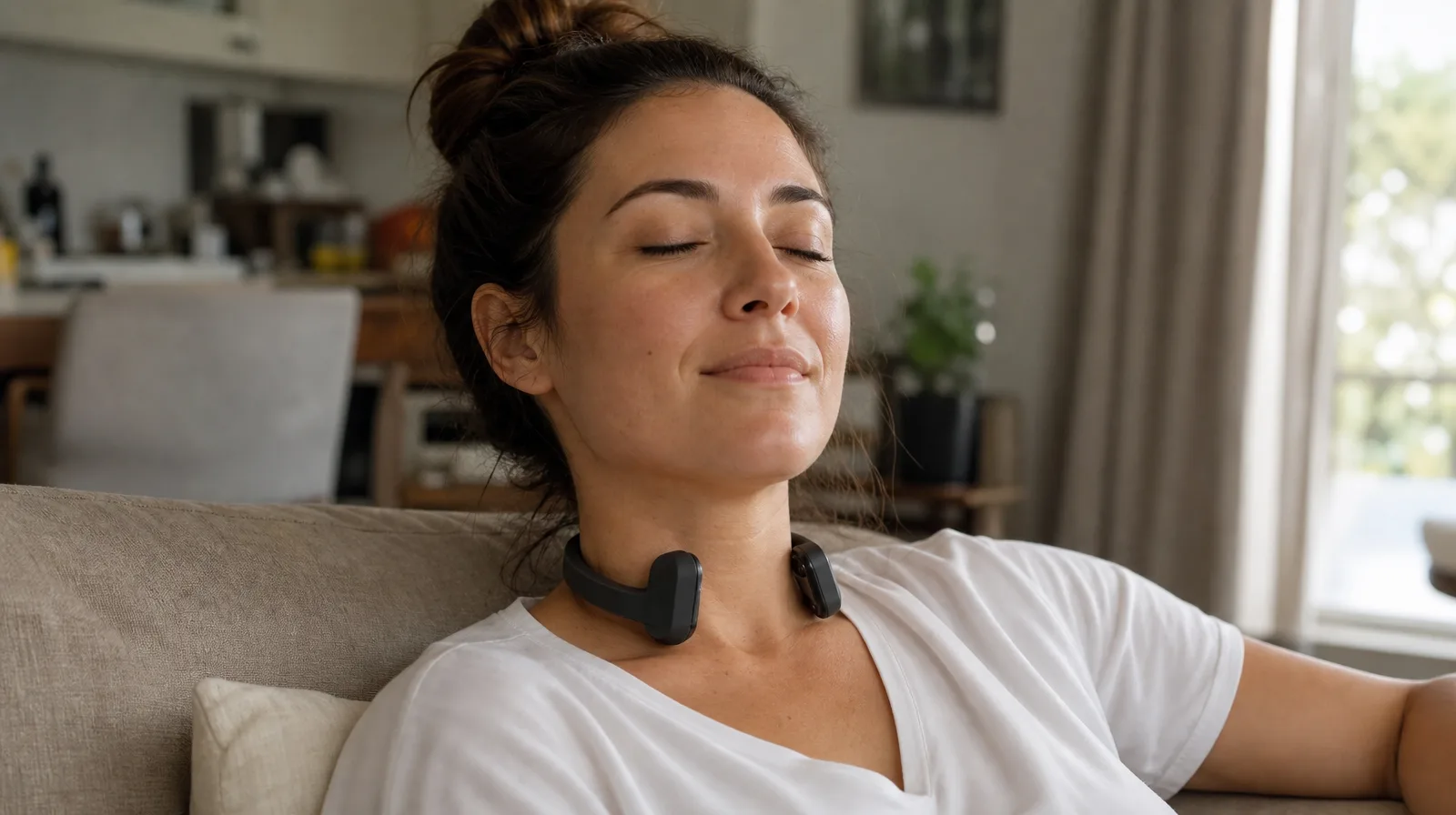
Good — worth it for the right buyer
- 4-minute sessions fit into any day, and the hands-free neckband stays put while you sit or recline
- 5 free app programs cover stress, worry, sleep, burnout and pain instead of a single generic mode
- Bilateral neck stimulation with 9 intensity levels, plus Oura Ring and Apple Watch pairing for HRV and sleep tracking
- Rechargeable over USB-C with 10 to 12 days of battery, and a 30-day money-back guarantee plus 2-year warranty
- 1.5 million plus company-logged sessions with no serious adverse events reported
- Not FDA cleared, the company study is small (40 people) and company funded, so big claims rest on thin proof
- Conductive gel is mandatory every session, and a replacement tube costs $45
- The app needs Bluetooth, internet and location services to run, which Reddit users consistently complain about
- Stress Relief:
- Sleep Support:
- Ease of Use:
- App Experience:
- Build and Comfort:
- Value for Money:
In This Article
- My Evenings Were Wired and My Mornings Were Foggy. I Gave a Neckband 21 Days to Change That.
- TL;DR, My Pulsetto Verdict
- What Pulsetto Actually Is (And What It Is Not)
- How It Works (My First Session Was a Comedy of Errors)
- Why the Vagus Nerve Matters (The 2-Minute Science)
- What Pulsetto Claims vs What I Actually Found
- What It Feels Like (Design, Build and First Impressions)
- How to Set It Up (And the Mistake I Made)
- 21 Days of Testing (My Evening Log)
- What Actually Worked (And What Did Not)
- Pulsetto vs Competitors (I Compared the Whole Shelf)
- Value Math: Is $269 Worth It?
- Customer Reviews and Social Proof (Patterns Across Thousands)
- Pricing, Discounts and Guarantee (Read This Before Checkout)
- Potential Drawbacks and Things to Know
- Tips to Get the Best Results
- Who Should Buy It (And Who Should Skip)
- Final Verdict: a Good Stress Tool With a Trust Tax
My Evenings Were Wired and My Mornings Were Foggy. I Gave a Neckband 21 Days to Change That.
I fall asleep fast and wake up at 3.00 AM with my brain running a meeting I never scheduled. That has been my pattern for two years. Work stress stacks up through the day, I carry it in my shoulders and jaw, and by bedtime my nervous system has forgotten what the off switch feels like. Meditation apps never stuck. I own three of them and open none of them. Supplements made me groggy. A breathing course helped for a week and then joined the graveyard of good intentions.
So when Pulsetto started showing up everywhere with its promise of calm in 4 minutes through vagus nerve stimulation, I paid attention. A pulsetto review search pulls up thousands of opinions, and they split hard. Some users call it the only thing that quiets their evenings. Others call it an expensive neck massager with good marketing. Both camps sound sure of themselves.
I spent 21 days testing the Pulsetto FIT the way a normal buyer would use it. Morning stress resets, evening wind-downs, the free app programs, intensity levels from gentle to spicy. I tracked my sleep, watched my HRV, and read through thousands of customer reviews on Trustpilot, Reddit and the BBB to check my own results against the crowd. This is the full honest account.
My short answer after 3 weeks. Pulsetto does something real for acute stress moments and bedtime wind-downs, the effect builds slowly, and the buying experience needs more caution than the ads suggest. Rating: 7.2 out of 10.
I cover wellness gadgets at our wellness gadgets hub, and this category attracts the boldest claims on the internet. Four minutes to calm sounds like a late-night infomercial. The science underneath is better than the slogan, and the business practices are worse than the slogan. Both things matter, and this review covers both.
TL;DR, My Pulsetto Verdict
Short on time? Here is the whole pulsetto review in 30 seconds.
- Does it work? Partly. Stress sessions reliably took the edge off within minutes. Sleep improved gradually from week 2 onward. HRV barely moved for me, which matches a chunk of honest user reports.
- What does it feel like? A fizzy tingling on both sides of the neck. Strange for 3 sessions, then oddly pleasant. Intensity 5 or higher is where the effect starts.
- The catch. Not FDA cleared. The proof is one small company-funded study. Gel is mandatory and costs $45 a tube. The app demands Bluetooth, internet and location access.
- The company catch. BBB reviews sit at 1.1 out of 5, mostly shipping and refund complaints. Some buyers report surprise premium charges. Buy from the official site and guard the 30-day window.
- Best for. Stressed professionals, wired-at-bedtime sleepers, and biohackers who want the lowest-friction entry into vagus nerve stimulation.
- Skip it if. You have a pacemaker, are pregnant, have epilepsy or a heart rhythm condition, or you expect a medical-grade cure for clinical anxiety or insomnia.
- Price. Lite around $224 on sale, FIT around $269. Rating: 7.2 out of 10. Check the current Pulsetto price.
What Pulsetto Actually Is (And What It Is Not)
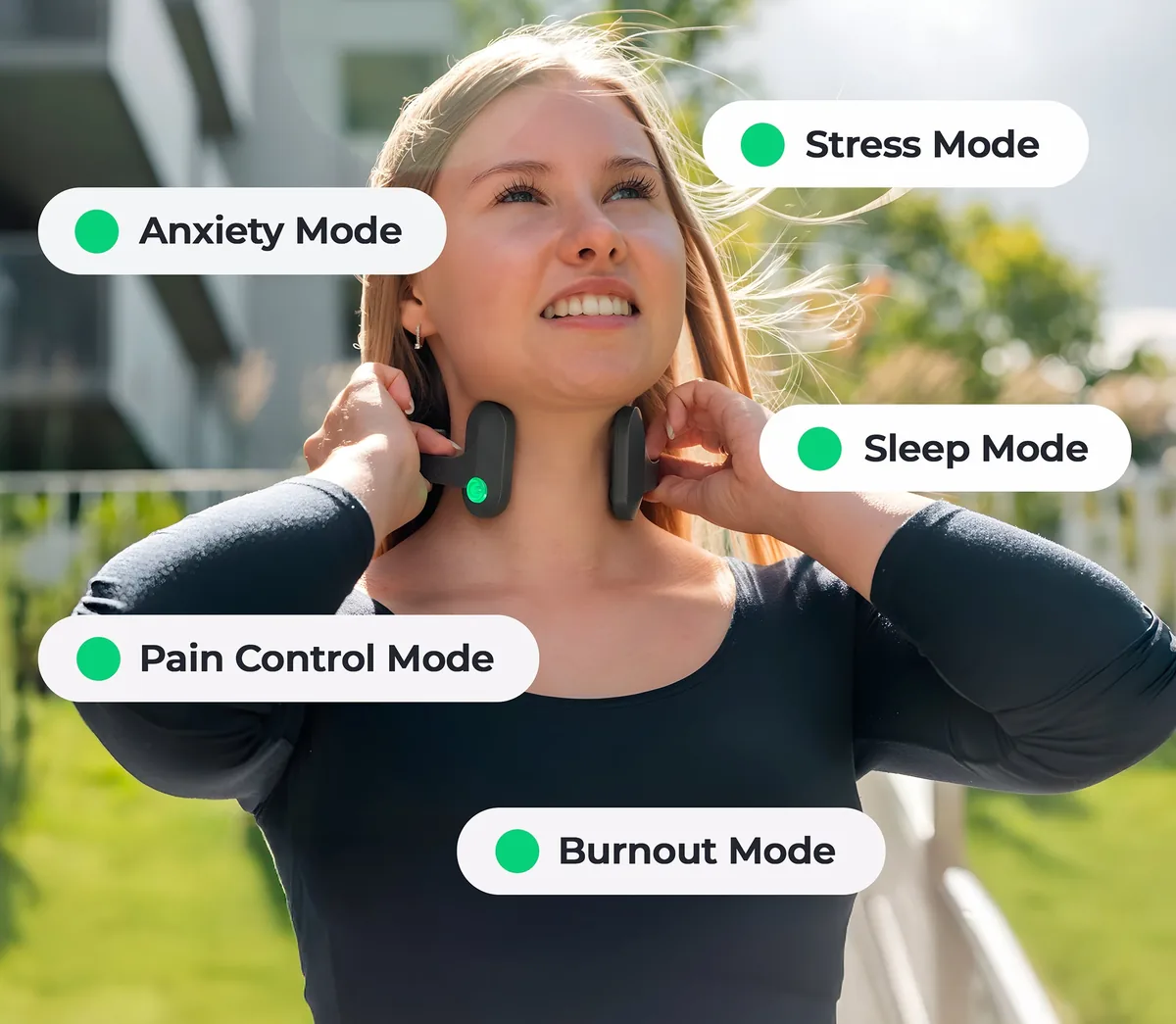
Pulsetto is a horseshoe-shaped band that sits around the front of your neck and sends low-level electrical pulses through the skin into the vagus nerve on both sides at once. That technique is called transcutaneous vagus nerve stimulation, tVNS for short. You control everything from a free phone app with 5 programs. Soothe Stress, Calm Worry and Overwhelm, Fall Asleep, Relieve Burnout, and Pain Control and Recovery. Each session runs about 4 minutes. You sit still, feel a tingling pulse in your neck, and get on with your day.
Two models exist. The Lite is the standard device with a 10-day battery. The FIT adds a wave-like stimulation mode that rises and falls, a 12-day battery, extra pads for narrow or wide necks, free lifetime wireless updates, and matte-black medical-grade housing. I tested the FIT. The stimulation itself is identical between models, so everything about effectiveness in this review applies to both.
Here is what Pulsetto is not, because the ads blur this line. It is not a medical device. The company states in its own terms that Pulsetto is a general wellness product, not intended to diagnose, treat, cure or prevent any disease. It has never been reviewed by the FDA as a medical device. The FCC and CE marks on the box cover electrical safety for consumer electronics. They say nothing about whether the device reduces your anxiety. Keep that distinction in your head for the rest of this review and you will read every claim correctly.
It is also not a massage gadget. The tingle can fool you on day one into thinking it vibrates like a massager. The mechanism is electrical stimulation of nerve tissue, closer in family to clinical VNS units than to anything that kneads muscle. Competitors like Apollo Neuro and Sensate use vibration only. Pulsetto uses actual electrical pulses, which is a genuine technical difference worth knowing.
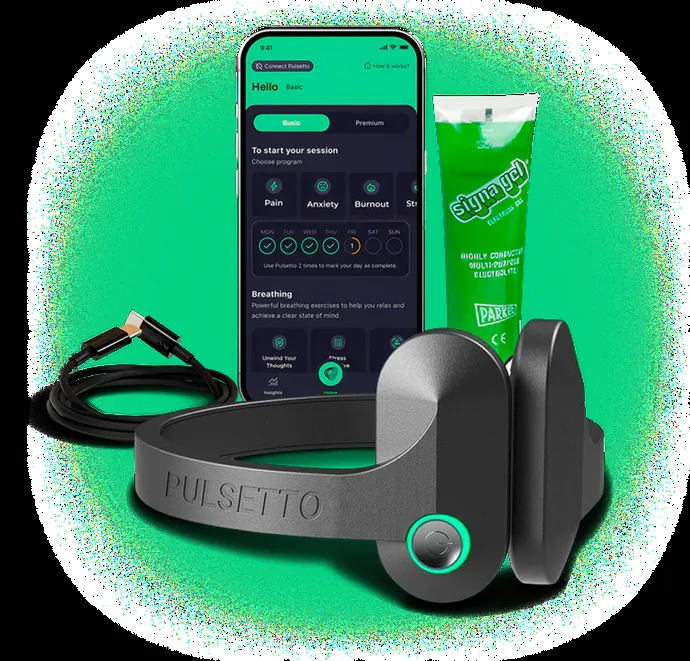
The box holds the neckband, a 60g tube of conductive gel, a USB-C cable and a short manual. The gel is not optional. Without it the pulses cannot cross from electrode to skin, and you will feel almost nothing. One tube lasts roughly a month of daily use, and replacements run $45. Add that to your mental price before you buy.
At full list the numbers look steep. Lite lists at $524, FIT at $619. Nobody pays that. Street pricing during promos lands around $224 for the Lite and $269 for the FIT, with bundle deals for two or three units. The company runs near-permanent sales, so treat the retail figures as decoration and judge the deal price only.
How It Works (My First Session Was a Comedy of Errors)
Setup took 10 minutes, and half of that was me doing it wrong. Charge over USB-C, smear gel on the two electrode pads, hang the band around your neck, open the app, pick Soothe Stress, press start. Simple on paper. My first attempt delivered a weak tickle on one side and silence on the other, and I sat there wondering if I had bought a very sleek paperweight.
My mistake was placement plus stinginess with gel. I had parked the band too high, near my jaw, and used a dab of gel the size of a pea. A Reddit thread I found that evening fixed both problems. Gel goes directly on the pads in a proper layer, the band sits lower on the front of the neck where the tissue is soft, and intensity starts at 2 and climbs until the sensation spreads. When I retried at intensity 6, the difference was immediate. The tingle spread across both sides of my throat, my shoulders dropped without me telling them to, and I understood what the fuss was about.
That placement lesson is the single most useful thing in this review. Low intensity on dry skin stimulates nothing but your patience, while intensity 5-plus on well-gelled skin is where the vagus nerve actually joins the conversation. Long-term Reddit users say the same, including one who needed 6 months of fiddling before evenings between 7.00 PM and 9.00 PM became the golden window. Expect a learning curve of several sessions, not instant mastery.
A normal session goes like this now. I sit down, phone nearby, band on, Stress or Sleep program selected. The pulses start soft and build. Breathing slows on its own around minute 2. By minute 4 the app chimes and I sit still for another minute because getting up fast ruins the calm. Total time cost is 6 minutes door to door. That low friction is the product’s superpower. Anything demanding 30 minutes would have lost me by day 5.
Two annoyances showed up fast. The app refuses to run without Bluetooth, an internet connection and approximate location services switched on. On a plane or in a dead zone, you own a necklace. And the free program set is genuinely free, but the app waves Premium extras (extra stimulations, meditations, breathing exercises, affirmations) at every tap. One Reddit buyer found a premium charge they never knowingly approved, and support took weeks to answer. I never got charged unexpectedly, but I turned off auto-renewals and checked my account page twice. Do the same.
Why the Vagus Nerve Matters (The 2-Minute Science)
Your vagus nerve is the longest cranial nerve in the body. It runs from the brainstem down through the neck into the chest and gut, carrying signals between the brain and the heart, lungs and digestive organs. It is the main cable of the parasympathetic nervous system, the rest-and-digest branch that lowers heart rate and tells the body the danger has passed. When modern life pins you in fight-or-flight for 12 hours straight, vagal tone drops and everything feels louder than it is.
Doctors have stimulated this nerve with implanted electrodes since the 1990s for epilepsy and treatment-resistant depression. That history is real medicine with real approvals. Transcutaneous VNS applies the same principle from outside the skin, through the neck (cervical, like Pulsetto) or the ear (auricular, like Nurosym). A comprehensive peer-reviewed review of VNS mechanisms in PMC walks through the pathways in full detail, and it is worth 10 minutes if you want the deep science.
Here is the honest bridge between that science and this product. Clinical VNS uses precise currents, implanted leads and physician supervision. A consumer neckband uses surface pulses, self-placement and an app slider. The nerve is the same. The dose control is not. Independent reviewers at Innerbody land exactly here too. They call Pulsetto a plausible at-home therapy for stress, focus and sleep support while warning that underlying causes still need real attention.
So the mechanism deserves respect and the product deserves scrutiny. Believable biology plus thin product-specific proof is the whole story of consumer tVNS in 2026. Hold both ideas and you will not be fooled by either the hype or the hate.
Two placement schools exist, and buyers mix them up constantly. Cervical stimulation through the neck, which Pulsetto uses, targets the vagus trunk where it runs thick beside the carotid sheath. Auricular devices like Nurosym target a small branch near the ear. Thicker trunk means lower precision demands, which is why neck placement forgives sloppy positioning once you learn the basics. Ear devices demand exact clip placement but use lower currents. Neither school has proven superiority for wellness outcomes in head-to-head trials, so treat placement as a comfort choice, not an efficacy ranking.
HRV deserves a plain explanation because every VNS brand waves it around. Heart rate variability measures the millisecond variation between heartbeats, and higher variation generally signals a flexible autonomic nervous system. Stress, alcohol, bad sleep and illness all push it down. A neckband cannot raise it directly. Consistent calm behavior, better sleep and regular wind-downs can, with the device acting as the trigger for those behaviors. When my HRV barely moved across 21 days while my sleep clearly improved, that split made sense. The behavior changed first, the metric lags by weeks.
What Pulsetto Claims vs What I Actually Found
Pulsetto’s marketing makes 6 big claims. I checked each one against my 21 days, the company study, and thousands of user reports.
Claim 1. Calm in 4 minutes. Mostly true for acute moments. Stress sessions cut my midday tension fast enough that I started using them before hard calls. The effect feels like a loud room going quiet, not sedation. Reddit echoes this for situational stress. It did nothing for deep structural problems like my deadline load. It changes the state, not the source.
Claim 2. Better sleep. Slowly true. My sleep onset shortened from roughly 35 minutes to under 20 by week 3, and 3.00 AM wakeups dropped from 4 nights a week to 1. The company cites 18 percent better sleep quality after 14 days in its 40-person study. My numbers rhyme with that direction. A 6-month Reddit user confirmed gains on an Oura ring. But light sleepers with clinical insomnia report mixed results, and no buyer should bin prescribed treatment for a neckband.
Claim 3. 86 percent of users feel calmer with 28 percent less stress. Unverifiable from outside. Those figures come from company surveys and the small company-funded study. No independent lab has replicated them, and the study size (40 people) is tiny. My own stress felt maybe 20 percent more manageable by day 21, which is nice but nowhere near laboratory precision. Treat brand percentages as marketing with a lab coat on.
Claim 4. 100,000 plus users and 20,000 plus 5-star reviews. Plausible on users, shaky on sentiment. Trustpilot shows 3,447 reviews with genuinely mixed sentiment, and the BBB page tells a darker story. The 5-star count likely aggregates every platform including the company site, which always skews sunny. Real pattern. Loyal fans plus angry shippers, with little middle ground.
Claim 5. 1.5 million sessions with zero side effects. Misleading by omission. No serious adverse events in company logs is believable for surface-level pulses. Zero side effects of any kind is not, because users openly report skin irritation, odd appetite effects on long sessions, and discomfort at high intensity. Mild and short-lived, yes. Nonexistent, no.
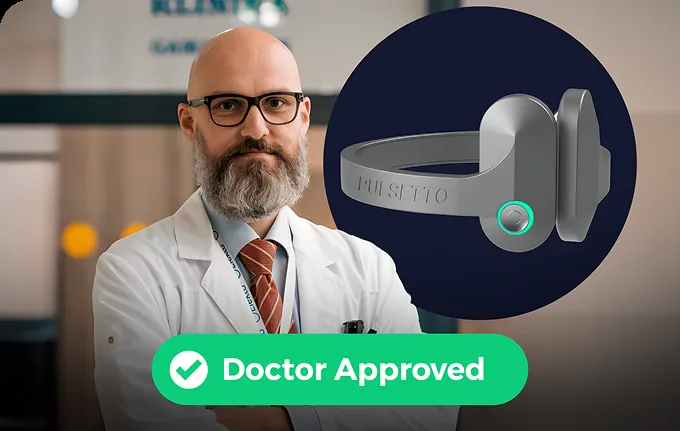
Claim 6. Doctor recommended and clinically proven. Half true. VNS as a field is clinically studied, and individual doctors do endorse the category. Pulsetto the product has one small company study, FCC and CE electronics certification, and no FDA medical clearance. The science of vagus nerve stimulation is proven, the proof for this specific gadget is one 40-person company study plus user anecdotes. That sentence is the entire claims section in miniature.
What It Feels Like (Design, Build and First Impressions)
The FIT in matte black looks like a premium neckband, not a medical device. It weighs little enough that I forgot it was on during sessions. The electrodes sit under soft pads, the band flexes to grip without squeezing, and the extra FIT pads cover narrow and wide necks. My partner tried it once and needed the wider pads, which took 30 seconds to swap. Sharing one device across a household is realistic, though you will burn gel twice as fast.
Comfort during sessions is good with one quirk. The first 3 sessions felt fizzy and weird, like soda bubbles under the skin. WIRED’s reviewer famously called the sensation flawed and distracting, and I get it. Your brain has no category for neck tingles. By session 5 the strangeness flipped into a cue. Tingle means slow down. Now I find it actively relaxing, the way a weighted blanket felt odd once and now signals sleep.
Build quality feels solid. USB-C charging, a full charge in about an hour, and 10-plus days per charge at one session a day matched my use. The buttons are minimal because the app does the work, which keeps the hardware clean and makes the phone dependency total. Lose your phone and the band does nothing. That tradeoff splits users. Minimalists love the clean hardware. Travelers who want offline gear should know exactly what they are buying.
One design gripe with teeth. Conductive gel on your neck at 7.00 AM is a cold, sticky ritual, and residue gets on collars. Keep tissues nearby and wash the pads weekly or the buildup dulls the contact. Dry-contact rivals skip this chore entirely, and every gel morning I envied them a little.
How to Set It Up (And the Mistake I Made)
Unbox, charge to full, install the app, create an account, enable Bluetooth. Pairing took under a minute. Then the gel lesson from the previous section, which I will compress into instructions so you skip my wasted sessions.
Step 1. Wash and dry your neck. Oils and sweat block conduction. Step 2. Spread a proper layer of gel directly on both electrode pads, not on your skin. Pea-sized is too little. Think toothpaste stripe cut in half per pad. Step 3. Hang the band low on the front of the neck, pads flat on soft tissue. Too high near the jaw gives one-sided tickle. Step 4. Start the app program at intensity 2, then climb one step every 20 seconds until the tingle spreads evenly. Most people land between 5 and 8. Step 5. Sit or recline, breathe normally, and stay put for the full 4 minutes plus a minute of stillness after.
My mistake was steps 2 through 4 in reverse. Dry pads, high placement, intensity 3, instant verdict that the product was broken. Three dead sessions nearly ended this review early. The fix took one evening of reading and one careful retry. If your first session feels like nothing, assume user error before product failure. Nine out of ten dead-on-arrival complaints I read smelled like my exact mistake.
Maintenance is light. Rinse gel off pads after use, charge weekly, update the app over Wi-Fi. Budget 2 minutes of cleanup per session and one $45 gel tube per month. The hidden running cost of this device is sticky and recurring, and I wish the product page said so in the same font size as the discount.
One more setup chore that pays off. After purchase, open the account page on the Pulsetto site and check for active trials or Premium enrollments before your first session. Cancel anything you did not knowingly join, screenshot the cancellation, and set a calendar reminder for day 25 of the guarantee window. Buyers who do this admin in advance never appear in the billing complaint threads. Buyers who skip it sometimes do.
21 Days of Testing (My Evening Log)
Week 1 was calibration. Day 1 through 3 produced weak, uneven sensation and my notes say “skeptical” twice. Day 4 was the placement fix, and the evening session that night was the first time my shoulders dropped unprompted. Day 5 I tried a morning Stress session before a hard call and walked in noticeably steadier. Day 6 I overdid it at intensity 9 and spent 20 minutes with a twitchy jaw, lesson learned about ceiling levels. Day 7 ended with cautious optimism and a sleep onset of 30 minutes, barely changed.
Week 2 was the turning point. Day 9 stands out in my notes with triple underlines. Evening Burnout session at 8.15 PM, intensity 6, and I fell asleep on the couch at 10.40 PM without the usual ceiling stare. That had not happened on a weeknight in months. Days 10 through 12 repeated the pattern with sleep onset near 25 minutes. Day 13 I skipped entirely to test dependence, and the 3.00 AM wakeup returned on schedule. Day 14 closed the week with the clearest finding so far. The effect is cumulative and it fades when you stop. This is a practice, not a pill.
Week 3 was confirmation plus limits. Days 15 to 18 held the gains. Sleep onset under 20 minutes, one midweek wakeup that resolved without phone scrolling, calmer afternoons confirmed by my own notes and my partner’s unsolicited comment that I seemed less snappy. Day 19 tested the Pain program on a tension headache and got nothing beyond mild distraction, so pain claims stay unproven in my book. Day 20 I loaned the unit to my partner for her restless evening. She reported a decent wind-down with zero sleep miracle, then asked to borrow it again the next night, which told me more than her words did. Day 21 I ran HRV numbers against baseline. Resting HRV moved maybe 3 percent, inside noise range. Morning resting heart rate told a slightly better story, down 2 beats per minute on average across week 3 versus week 1, though travel-free routine weeks always flatter that metric. Stress feel and sleep onset improved clearly across 3 weeks, HRV barely budged, and one skipped day erased the calm.
Compare that with the crowd and it fits. The 6-month Reddit reviewer saw sleep gains at 2 weeks confirmed by Oura. The blueprint subreddit user with generalized anxiety needed a full month before rating it helpful. Gadgets and Wearables scored it 7.8 out of 10 with the same split. Helps sleep and anxiety, no HRV change. My 7.2 lands a touch lower because I weight the app demands and running costs heavier than they did.
For sleep-specific context from a fellow side sleeper, my Aura sleep mask tests showed how much bedtime routine matters. Pulsetto works best slotted into that kind of routine, same chair, same program, same hour, rather than as a random panic button.
What Actually Worked (And What Did Not)
Stress sessions get 8 out of 10. The Stress and Worry programs delivered the most repeatable effect in my testing. Ten minutes after a session, traffic noise bothered me less and my jaw unclenched. The mechanism makes sense here. Acute sympathetic spikes respond fast to vagal input, and 4 minutes is enough to break the loop. Office workers describing post-work tension melting match my notes almost word for word.
Sleep support gets 7 out of 10. Onset shortened, night wakings dropped, mornings felt less foggy by week 3. The Sleep program plus the sound library makes a credible wind-down ritual. But it never knocked me out the way actual sleep pressure does, and one bad night of doomscrolling overpowered it completely. Strong aid, weak master.
Burnout and focus get 6 out of 10. Afternoon sessions cleared mental static for an hour or two. The effect resembles a short walk more than a nap. Pleasant, mild, gone by dinner. Worth doing on crushing days, not worth scheduling life around.
Pain control gets 4 out of 10. My tension headache test flopped, and user reports on pain scatter everywhere from relief to nothing. The company’s 9 percent pain reduction figure comes from its own small study. File under unproven until better data lands.
App and tracking get 6 out of 10. Oura and Apple Watch pairing works, session history logs cleanly, and HRV and sleep trends display without fuss. The location-permission demand, internet requirement and constant Premium nudges drag the score down hard. A wellness device should not need to know where I sit on my couch.
The honest summary. Pulsetto is a good stress interrupter and a decent sleep ritual, wrapped in an app experience that asks for more data and money than it should. Nothing in that sentence would surprise anyone who has read 50 user reviews, and that convergence between my diary and the crowd is exactly why I trust the verdict.
Pulsetto vs Competitors (I Compared the Whole Shelf)
Nurosym is the clinical heavyweight. It clips to the ear, targets the auricular branch, holds CE medical device certification, and runs 30 to 60 minute sessions at around $750. Research-minded buyers who want credentials pick Nurosym. Everyone else chokes on the price and the hour-long sessions. Pulsetto gives you neck stimulation in 4 minutes at a third of the cost with a fraction of the paperwork. Convenience wins for daily habits, credentials win for peace of mind. I expanded this duel into a full Pulsetto vs Nurosym breakdown with session economics and the evidence gap scored line by line.
Apollo Neuro is the lifestyle pick. A wrist or ankle band sending gentle vibration patterns all day, around $349, with scheduling and HRV trends. It never delivers electrical stimulation to any nerve, which its own marketing states plainly. If you want an all-day wearable that nudges calm between meetings, Apollo fits. If you want actual tVNS with a defined session, Pulsetto is the only one of the two doing that job. The full duel lives in my Pulsetto vs Apollo Neuro comparison, including the sleep-comfort evidence and app showdown.
Sensate is the ritual device. A chest puck using infrasound vibration for 10 to 30 minute lie-down sessions around $299, with soundscapes and zero data dashboards. It suits people who want a fixed evening ceremony. It fails anyone who wants portability, short sessions or progress tracking. Pulsetto beats it on time cost and features while Sensate wins on simplicity.
GammaCore and Truvaga deserve one line each. GammaCore is FDA-cleared for headache disorders, a real medical device with prescriptions and pricing to match. Truvaga is a handheld 2-minute cervical stimulator in the same family as Pulsetto. Neither competes directly on stress-and-sleep wellness positioning, which tells you how uncrowded Pulsetto’s exact niche still is.
| Feature | Pulsetto FIT | Nurosym | Apollo Neuro | Sensate |
|---|---|---|---|---|
| Stimulation type | Electrical, neck bilateral | Electrical, ear | Vibration only | Infrasound vibration |
| Session length | 4 min | 30 to 60 min | Flexible all-day | 10 to 30 min |
| Hands-free | Yes | No | Yes | No, lie down |
| App + tracking | Yes, HRV and sleep | Session tracking | Yes, HRV trends | Basic |
| Price (sale) | ~$269 | ~$750 | ~$349 | ~$299 |
| Medical certification | FCC + CE electronics | CE medical device | Wellness device | Wellness device |
| Best for | Fast daily tVNS habit | Clinical credibility | All-day wearable calm | Evening ritual |
What I learned lining them up. No device wins on everything, and the right pick depends on which constraint bites you hardest. Time, money, credentials, or ritual. Pulsetto owns the fast-and-cheap corner of that map. Nobody owns the proven-and-cheap corner because it does not exist yet. The complete 6-device ranking with one winner per use case sits in the best vagus nerve stimulators of 2026.

Value Math: Is $269 Worth It?
Start with the honest total. FIT at $269 plus 12 tubes of gel at $45 equals $809 in year one if you use it daily. Lite at $224 plus gel lands around $764. Optional Premium adds more. Anyone quoting just the device price is hiding the consumable tail, and gel is not skippable.
Now stack it against the alternatives. A therapist specializing in stress runs $150-plus per session in the US, so 5 sessions exceed the entire year-one Pulsetto cost. A decent meditation app subscription runs $70 to $100 a year with zero hardware. Magnesium, sleep teas and white-noise gadgets easily total $150 a year. Acupuncture for tension lands near $80 a visit. Pulsetto sits between apps and professionals on price, which is exactly its pitch. Cheaper than care, pricier than content.
Cost per use clarifies further. Daily FIT use over a year costs about $2.20 per session including gel. Twice-daily use drops it near $1.20. A coffee costs more. The math only works if you actually use it 200-plus days, which loops back to the friction question. Four minutes keeps compliance realistic in a way 30-minute rivals cannot match. The cheapest device per session is the one you do not abandon by February.
My value call. At $224 to $269 on sale with daily use, the price is fair for a stress interrupter plus sleep ritual, and the 30-day guarantee caps the downside. At anything near list price, or for sporadic users, the math collapses. Never pay retail, never buy without a usage plan, and count the gel before you click.
Customer Reviews and Social Proof (Patterns Across Thousands)
I read Trustpilot (3,447 reviews), Reddit threads across 3 subs, BBB complaints and a dozen independent reviews. Six patterns emerged, and they matched my testing diary closely enough to trust.
Praise pattern 1. Sleep onset improves with routine use. “Sleep through the night, which has always been a challenge” appears in dozens of wordings. The Oura-confirmed Reddit review is the gold standard here. Two weeks of evening sessions, measurable sleep change. My day-9 turning point fits the template exactly.
Praise pattern 2. Daytime stress reactivity drops. Small business owners, new parents and clinic founders describe the same arc. Short session, shoulders down, afternoon salvageable. Colleen’s 3-times-a-day crisis use mirrors my pre-call ritual at lower volume.
Praise pattern 3. Setup and app basics satisfy non-technical users. Older buyers praise the big buttons and guided programs. The tech friction complaints come from power users who notice permissions, not from beginners who notice simplicity.
Complaint pattern 1. Shipping delays and refund wrestling dominate the BBB page. Ten reviews, 1.1 average, with stories of month-late parcels, opened boxes and 30-day windows expiring during transit. The guarantee counts from order date, not delivery, which several buyers learned the expensive way. This is the darkest corner of the Pulsetto story and it is entirely about operations, not technology.
Complaint pattern 2. Billing surprises around Premium. Unauthorized trial enrollments and slow support responses recur across Reddit and BBB alike. Amounts are small, responses are slow, and frustration runs high because the buyers are already stressed. That irony writes itself.
The reviewers I trust most land where I landed. Tutela Medical’s examination calls it worth considering with realistic expectations at a substantial price for uncertain results. Gadgets and Wearables gave 7.8 with no HRV movement. WIRED found it fizzy and flawed. My 7.2 sits inside that spread for reasons I can defend line by line.
For perspective from another sleep gadget with equally split opinions, my Dodow sleep device tests taught me that bedtime tools live or die on routine compliance. Pulsetto follows the same law. Daily users praise it, drawer owners resent it.
Pricing, Discounts and Guarantee (Read This Before Checkout)
Current sale pricing runs about $224 for the Lite (listed $524) and about $269 for the FIT (listed $619). Two-unit bundles cut per-device cost meaningfully, and three-unit bundles drop it further. Watch for Labor Day style events advertising up to $350 off, which is where the FIT hits its floor. Prices rotate constantly, so confirm on the official page at checkout.
The guarantee stack reads well on paper. Thirty days money-back, 2-year warranty, free global shipping. Three details from complaints deserve your attention. First, the 30 days appear to count from the order date, so a 3-week shipping delay eats most of your trial. Screenshot your order timestamp the day you buy. Second, buy only from the official site. Marketplace listings cannot extend the manufacturer guarantee. Third, decline or immediately cancel any Premium trial at checkout unless you want it, and screenshot that choice too.
Checkout gotchas from real buyers. Pre-checked premium trials, gel auto-adds, and bundle defaults that raise the cart total. Walk the cart line by line before paying. Use a credit card with chargeback protection rather than debit, given the refund complaint history. Save every email, especially shipping notices, because your trial math depends on dates.
My buying advice is blunt. Purchase only during a real sale, photograph the guarantee terms at checkout, test daily from the day it arrives, and decide by day 25. If sleep onset and evening tension have not moved by then, send it back without guilt. The guarantee exists for exactly that experiment.
Potential Drawbacks and Things to Know
- The evidence is thin for the size of the claims. One 40-person company study plus surveys cannot carry words like clinically proven. The field is real, the product proof is early. Anyone who needs certainty should wait for independent trials.
- Gel forever. Every session needs it, tubes cost $45, and travel means packing goo. Dry-contact alternatives exist for people who hate this ritual.
- The app is needy. Bluetooth, internet and location services must all be on. Offline use is impossible, privacy-conscious buyers will dislike the location demand, and the Premium upsell screens irritate on every visit.
- Operations risk is real. BBB reviewers describe late parcels, damaged boxes, unreachable support and refunds that crawl. My unit arrived fine, but the pattern across complaints is too consistent to dismiss. Order early if it is a gift and keep records.
- Billing hygiene required. Check your account for trial enrollments after purchase and cancel what you did not want. A few buyers paid for Premium they never knowingly joined.
- Not for everyone medically. Pacemakers, implanted electronics, pregnancy, epilepsy and heart rhythm conditions rule it out without a doctor’s sign-off. The official contraindications page lists the full set, and it deserves 5 minutes before money changes hands.
- Results vary and fade. Non-responders exist in every thread, HRV may not move at all, and skipping days erases gains fast. This behaves like exercise for the nervous system. Stop training, lose conditioning.
Tips to Get the Best Results
- Gel generously on the pads, not the neck. This one change rescues most dead first sessions.
- Place low on the front of the neck. Jawline placement gives one-sided tickle and disappointment.
- Climb intensity slowly to your number. Start at 2, rise until the tingle spreads evenly, usually 5 to 8. Back off if your jaw tenses.
- Lock a daily slot. Evenings between 7.00 PM and 9.00 PM worked best for sleep in my test and across Reddit reports.
- Cap at 2 to 3 sessions daily with breaks. More is not better, and marathon sessions can blunt appetite or irritate skin.
- Pair with slow breathing. Four-count inhales during the pulses stack two calm signals instead of one.
- Use the sound library. The engineered soundscapes plus stimulation beat either alone for wind-downs.
- Track sleep for 3 weeks. A notebook works. Onset minutes and night wakings reveal progress your mood hides.
- Clean pads weekly. Gel crust quietly kills conduction and mimics a dying device.
- Decide by day 25. Daily use, honest notes, keep or return. The guarantee window rewards decisive testers and punishes drifters.
Snorers fixing nights from multiple angles should also look at my SleepZee mouthpiece tests. Jaw position and nervous system calm attack the same bad night from opposite ends, and the combination outperformed either alone for several readers who wrote in.
Who Should Buy It (And Who Should Skip)
Buy it if you are a professional carrying daily tension that spikes before calls, deadlines or difficult conversations. Four minutes in a chair beats white-knuckling through the afternoon, and this buyer uses it most.
Buy it if you fall asleep fine but wake at 3.00 AM with a running mind. The evening wind-down routine moved my wakeups more than any supplement ever did.
Buy it if you are a biohacker curious about tVNS who will track HRV and sleep for a month. The Oura and Apple Watch pairing gives you data to judge with, and the FIT is the cheapest credible entry ticket.
Buy it if you share a house with skeptics. One device, swappable pads, 4-minute demos. My partner went from eye-roll to borrowing it in 6 days.
Buy it if routines stick for you and gadgets usually survive past February. Compliance is the whole game here, and honest self-knowledge beats optimism.
Skip it if you have a pacemaker, implanted device, epilepsy, a heart rhythm condition, or you are pregnant. No wellness gadget outranks those rules.
Skip it if you want a cure for diagnosed anxiety, depression or insomnia. See a clinician, keep prescribed treatment, and consider gadgets only as discussed additions.
Skip it if surprise charges or shipping sagas would wreck your month. The complaint pattern is real enough that anxious buyers should weigh it.
Skip it if you refuse apps, accounts, permissions or gel. This product demands all four, and resentment will kill compliance by week 2.
Final Verdict: a Good Stress Tool With a Trust Tax
Three weeks ago I was falling asleep fast and waking at 3.00 AM wired. Pulsetto did not rebuild my nervous system. It gave me a reliable 4-minute lever for bad afternoons and a wind-down ritual that cut sleep onset from 35 minutes to under 20. My shoulders drop on cue now when the tingle starts, which sounds small until you live inside a body that forgot how.
The differentiator is time cost. Four minutes of real electrical tVNS with zero learning curve beyond placement beats every 30-minute rival for habit survival. The tax is trust. Thin product proof, needy app, gel forever, and a complaint record on shipping and billing that a serious company should have fixed by now.
| Category | Score |
|---|---|
| Stress Relief | 8 out of 10 |
| Sleep Support | 7 out of 10 |
| Ease of Use | 8 out of 10 |
| App Experience | 6 out of 10 |
| Build and Comfort | 7 out of 10 |
| Value for Money | 6 out of 10 |
| Overall | 7.2 out of 10 |
At sale pricing with daily use, Pulsetto earns its place for stress-prone people who want a drug-free evening ritual and accept a wellness aid, not a medical cure. Buy from the official site, guard the 30-day window, test like you mean it, and let your own sleep log cast the deciding vote.
The 30-day guarantee makes this a paid experiment with a defined end date rather than a leap of faith. Set your test window, run your sessions, read your notes on day 25. If your evenings feel quieter and your mornings less foggy, keep it and build the habit. If nothing moved, return it and spend the refund on whatever your log says actually helps. Either outcome beats another year of 3.00 AM meetings with yourself.
Key Specifications
| Device type | Neck-worn bilateral transcutaneous VNS (tVNS) |
|---|---|
| Session length | 4 minutes per program |
| Programs | 5 free (Stress, Worry, Sleep, Burnout, Pain), 3 extra with Premium |
| Intensity levels | 9, adjustable in app |
| Battery | Up to 10 days (Lite), up to 12 days (FIT), USB-C |
| App | Free iOS and Android app with sound library, optional Premium |
| What's in the box | Device, 60g conductive gel, USB-C cable, manual |
| Integrations | Oura Ring and Apple Watch |
| Certifications | FCC and CE (consumer electronics, not FDA medical clearance) |
| Guarantee | 30-day money-back, 2-year warranty, free shipping |
Pulsetto earns 7.2/10: good — worth it for the right buyer. Tested across 21 days of daily sessions, morning stress resets and evening wind-downs.
- Best part: 4-minute sessions fit into any day, and the hands-free neckband stays put while you sit or recline
- Best part: 5 free app programs cover stress, worry, sleep, burnout and pain instead of a single generic mode
- Best part: Bilateral neck stimulation with 9 intensity levels, plus Oura Ring and Apple Watch pairing for HRV and sleep tracking
- Biggest catch: Not FDA cleared, the company study is small (40 people) and company funded, so big claims rest on thin proof
Common Questions & Answers
Q: What is Pulsetto?
Pulsetto is a neck-worn wellness device that sends gentle electrical pulses through the skin to stimulate the vagus nerve. It pairs with a free phone app offering 5 programs for stress, worry, sleep, burnout and pain. Each session runs about 4 minutes.
Q: Does Pulsetto actually work?
It can help some people feel calmer and fall asleep faster, especially with daily use over 2 to 3 weeks. The mechanism is real and studied, but Pulsetto's own evidence is one small company-funded study of 40 people. Treat it as a wellness aid with mixed user results, not a guaranteed fix.
Q: Is Pulsetto FDA approved?
No. Pulsetto is sold as a general wellness product and states this directly in its own terms. It carries FCC and CE certification as consumer electronics, which covers electrical safety, not medical effectiveness. FDA-cleared VNS devices like gammaCore went through a separate medical review process.
Q: Is Pulsetto legit or a scam?
Pulsetto is a real product from a real company with over 100,000 claimed users and thousands of public reviews. The technology is grounded in published VNS research. That said, the BBB rating is 1.1 out of 5 across 10 reviews, mostly about shipping and refunds, so buy with eyes open and use the 30-day guarantee window deliberately.
Q: What are the side effects of Pulsetto?
Most users report nothing worse than a fizzy tingling sensation and occasional mild skin redness where the electrodes sit. Longer sessions can cause appetite suppression in some users. Do not use it with a pacemaker or implanted electronics, during pregnancy, or with epilepsy or heart conditions without a doctor's approval.
Q: How do you use Pulsetto?
Apply conductive gel to the two electrode pads, place the band around the front of your neck, open the app, pick a program and set the intensity. Most users need intensity 5 or higher to feel the nerve engage. Sessions run 4 minutes, and the company suggests 2 to 3 sessions a day with 45 to 60 minutes between them.
Q: How long does it take to feel results?
Many users feel calmer during or right after the first session. Sleep and baseline stress changes usually need 2 to 3 weeks of daily use. In my testing the real shift landed around day 9, and Reddit long-term users report the same pattern of slow buildup rather than instant transformation.
Q: What is the difference between Pulsetto Lite and Pulsetto FIT?
Both deliver the same bilateral neck stimulation and 5 free programs. FIT adds a wave-like stimulation mode, 20 percent longer battery (12 days vs 10), extra pads for small or wide necks, free lifetime wireless updates and matte-black medical-grade materials. Lite sells around $224 on sale, FIT around $269.
Q: How much does Pulsetto cost?
On sale the Lite runs about $224 (listed retail $524) and the FIT about $269 (listed retail $619). Two-device and three-device bundles cut the per-unit price. Budget for replacement gel at $45 a tube, roughly one tube a month with daily use, plus an optional app Premium subscription.
Q: Where should you buy Pulsetto?
Buy from the official Pulsetto site so the 30-day money-back guarantee and 2-year warranty apply. Third-party listings cannot promise the same return terms. Watch the checkout screen for pre-checked premium trials, and screenshot your order confirmation with the delivery date.
Q: Who should not use Pulsetto?
Skip it if you have a pacemaker or any implanted electronic device, if you are pregnant, or if you have epilepsy, serious heart rhythm problems or a single vagus nerve. Anyone managing a diagnosed anxiety, sleep or cardiac condition should talk to their clinician first. Pulsetto is a wellness accessory, not medical treatment.
Q: Does Pulsetto require a subscription?
No. The device and its 5 core programs work with the free app and no subscription. A separate optional Premium tier adds 3 extra stimulations, guided meditations, breathing exercises and affirmations. Some buyers report being enrolled in a trial unknowingly, so check your account page after purchase.
More Wellness Gadgets Reviews
Related Guides & Articles
Browse all 79 Wellness Gadgets articles »

Health tech researcher and wellness gadget reviewer. PhD in Biomedical Engineering. Tests sleep trackers, massage devices, and health monitors with clinical precision. Believes in data-driven wellness.