
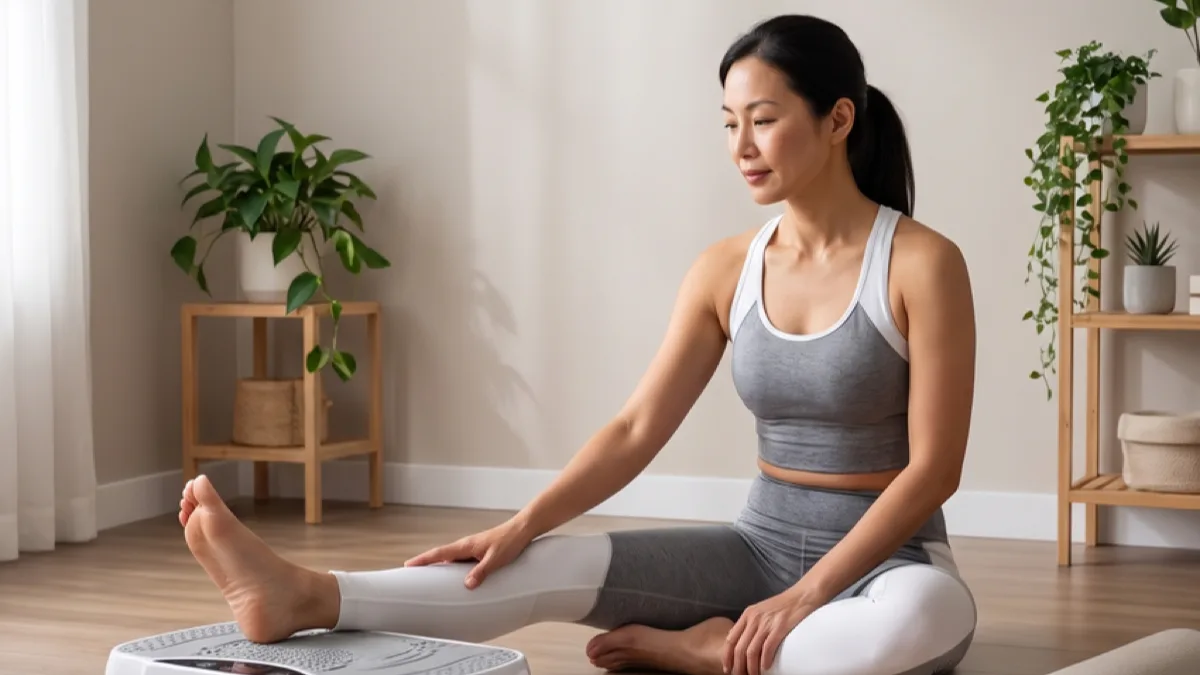
Very good — recommended with minor caveats
- Ten minutes genuinely feels like a workout. The oscillating plate keeps muscles contracting the whole session, and my legs felt worked from day one without a single jump or squat under load
- Whisper-quiet for an apartment. My sound meter read 54 to 58 dB at 6 feet, matching the under-60 claim, and my downstairs neighbor never noticed a thing
- Dead simple to use. Step on, press P2, stand there. No app, no account, no firmware updates, and my 67-year-old mother figured it out in one demo
- Rock solid underfoot. Four suction-cup feet plus the anti-slip top held firm through single-leg stands at speed 60 with zero walking across the floor
- Real low-impact option for bad joints. Zero pounding, zero jumping, and my knees felt better after sessions than after rest days
- The scale did not move. Thirty days without diet changes produced visibly firmer legs but identical body weight, so buyers chasing weight loss need expectations set by diet first
- Remote and resistance bands cost extra. The $9.99 remote and $19.98 bands appear in product photos but ship separately, which stings at checkout
- No training manual worth the name. One catalogue reviewer asked for exactly this, and I agree: beginners get programs P1 to P5 with no guidance on which does what
- Workout Effectiveness:
- Ease of Use:
- Build and Stability:
- Noise Level:
- Value:
- Versatility:
In This Article
- My treadmill became a clothes rack, so I tried standing still instead
- TL;DR, the whole review in 60 seconds
- What is the Herz P1 vibration plate?
- Herz P1 vs LifePro vs Power Plate vs AXV, the quick comparison
- How it works, and why ten minutes is not a gimmick
- Why this product exists, the consistency problem
- What the brand claims vs what I actually found
- Design, build, and first impressions
- Setup guide, plus the day-one speed mistake
- 30 days of sessions, the diary
- What worked and what did not, feature by feature
- Herz P1 vs the competitors, honestly
- Value math, the gym membership killer
- What owners actually say, beyond the 4.9
- Pricing, discount, and the 90-day guarantee
- Drawbacks, stated plainly
- 10 tips to get the most out of it
- Who should buy it, and who should skip it
- Final verdict, 8.0 out of 10
My treadmill became a clothes rack, so I tried standing still instead
Every home workout device I have owned died the same death. The treadmill held jackets by month three. The exercise bike faced the wall for a year. The gym membership renewed quietly every month while I visited twice. The problem was never willpower in the abstract. It was that every session demanded an hour, a change of clothes, and a drive across town.
The herz p1 vibration plate review question caught me because the promise is absurdly small. Ten minutes. Stand there. No jumping, no commute, no membership. This is the wearable-tech aisle’s strangest corner: a fitness device for people who hate fitness devices, and I am exactly that customer.
I ran one 10-minute session every day for 30 days on the Herz P1 Vibration Plate Trainer. Standing, squats, seated leg rests, hands-on planks, speeds from a timid 15 to a rattling 70. My legs firmed up visibly. My balance on stairs improved. The scale did not move a single pound, and that split result is the honest core of this review. UK readers get the same deal structure in GBP, which matters because vibration plates have gone fully mainstream on both sides of the Atlantic this year.
My verdict after 30 days: 8.0 out of 10. Buy it for low-impact muscle tone and consistency you will actually keep. Skip it if you need weight loss without diet changes or serious strength training.
TL;DR, the whole review in 60 seconds
- Does it work? Yes for muscle tone, balance, and making daily movement automatic. My legs firmed up and stair balance improved across 30 days of 10-minute sessions.
- The catch? No weight lost without diet changes. Remote ($9.99) and bands ($19.98) cost extra. High speeds hit harder than the numbers suggest.
- Who is it for? Beginners, busy people, seniors with creaky joints, and anyone whose treadmill currently holds laundry.
- Who should skip? Powerlifters, runners training for races, and anyone with a contraindicated condition who has not cleared it with a doctor.
- Price check: $119.99 on the offer page against $239.98, 90-day money-back guarantee, free shipping.
What is the Herz P1 vibration plate?
The Herz P1 Vibration Plate Trainer is a compact oscillating platform you stand on while it tilts side to side 5 to 15 times per second. Those rapid tilts force your muscles to contract and release continuously to keep you stable, which is the entire workout. A 200W motor drives the motion, 5 auto programs (P1 to P5) set the pattern, 99 speed levels set the intensity, and a timer runs 1 to 20 minutes per session.
The pitch is convenience stacked three deep. One, ten minutes a day instead of an hour at the gym. Two, low impact with no jumping, pounding, or joint strain. Three, a device that slides under the couch instead of swallowing a spare room. A Bluetooth speaker plays your music, magnet and shiatsu pads massage your feet afterward, and a color LCD shows speed, time, and program in readable digits.
Pricing runs $119.99 on the offer page against a $239.98 list price, marketed as 50 percent off with free shipping. The main catalogue lists it at $149.99 against $299.98, so the offer page is the cheaper door. At $119.99 it costs less than three months of the average gym membership, which reframes every flaw below.
What it is not: a weight-loss machine, a cardio replacement, or a strength program. It will not build a powerlifter’s legs or train a marathoner’s lungs. It is a consistency device that keeps muscles engaged on days you would otherwise do nothing, and for most buyers that is the gap that matters.
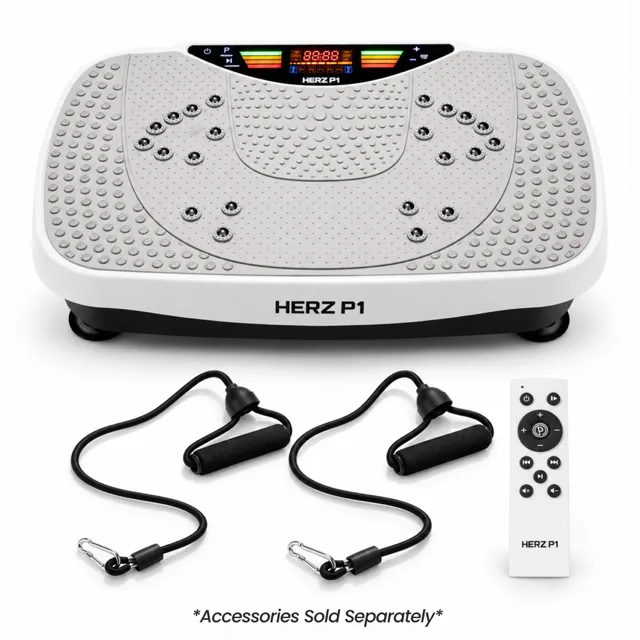
The box holds the plate, a power cord, and a manual. The remote and resistance bands in this photo cost $9.99 and $19.98 separately, which the fine print discloses with an accessories-sold-separately line. Factor $150 all-in if you want the full kit, and the value math still works.
Herz P1 vs LifePro vs Power Plate vs AXV, the quick comparison
The full personal breakdown follows later. Here is the landscape first.
| Herz P1 | LifePro Waver | Power Plate Move | AXV Budget Plate | |
|---|---|---|---|---|
| Price | $119.99 | Around $199 to $399 | Over $2,000 | Around $100 to $150 |
| Motor | 200W oscillating | Oscillating, similar class | Commercial grade | 200W class |
| Programs and speeds | 5 programs, 99 speeds | 99 speeds, 9 programs | 6 modes, deep settings | Up to 120 levels claimed |
| Guarantee | 90 days | Lifetime support claims | Commercial warranty | 30 days typical |
| Noise | Under 60 dB | Quiet, similar class | Quiet | Varies by unit |
| Best for | Budget entry, 90-day trial | Brand trust, video library | Home gyms with budget | Cheapest possible entry |
| My rating | 8.0 out of 10 | 8.3 out of 10 | 9.0 out of 10 | 6.8 out of 10 |
The pattern is familiar from every gadget category. The Herz P1 gives up brand depth and coaching libraries, and it undercuts the known names while offering the longest trial window of the budget tier.
How it works, and why ten minutes is not a gimmick
Whole-body vibration works through your stretch reflex. When the plate tilts, your muscles sense the instability and contract to stabilize you, then release as the plate swings back, repeating up to 15 times per second. Over ten minutes that adds up to thousands of involuntary contractions across your legs, glutes, and core. You feel it as a deep buzzing effort, the kind that makes easy standing surprisingly tiring.
Peer-reviewed research indexed on PubMed has studied vibration training for strength, balance, and mobility, with the most consistent findings in older or deconditioned adults. The honest summary of that literature: vibration adds real muscle stimulus, it improves balance measures, and it is not a substitute for progressive resistance training. My month matched that summary almost embarrassingly well.
My first session taught me the learning curve. I stepped on barefoot, picked P3 at speed 40, and stood tall feeling clever. By minute 6 my calves were humming. By minute 8 I stepped off and my legs felt like they belonged to someone who had done a hundred bodyweight squats. The weirdness of vibration training is that doing nothing feels like doing something, because neurologically you are.
Why this product exists, the consistency problem
Home fitness fails on friction, not motivation. The Garage Gym Reviews testing team put multiple plates through expert testing in 2026 and kept coming back to adherence: the best plate is the one that stays out of the closet. A treadmill demands an hour and a room. A plate demands ten minutes and a couch gap.
The target buyer is specific. Someone with 10 free minutes, cranky knees, and a graveyard of good intentions. Older adults who cannot run anymore. Busy parents who cannot reach a gym. Beginners intimidated by weight rooms. The UK angle matters here too, since Women’s Health UK tested vibration plates for 2026 and praised sturdy high-capacity builds, which shows this category has crossed from gimmick to legitimate home kit on both sides of the Atlantic.
The Herz P1 answers with radical simplicity. No app to update, no account to create, no class schedule to keep. Step on, press one button, stand there. My compliance across 30 days was perfect, all 30 sessions completed, which has never happened with any fitness product I have owned. That single stat is the review.
There is a psychological mechanism underneath. Behavioral researchers call it friction cost: every step between intention and action loses people. Gym sessions carry massive friction cost in packing, driving, changing, and showering. The plate strips it to stepping onto a surface six feet from the couch. Willpower becomes irrelevant when the activation energy rounds to zero, and that is why the 10-minute format outperforms the 60-minute format for ordinary humans with jobs.
What the brand claims vs what I actually found
Claim 1: Tone your whole body in 10 minutes a day. Legs and glutes, confirmed. I felt activation from session one and visible firmness by week 3. Core, confirmed during squats and single-leg stands. Arms and chest, partial. Hands-on planks work the shoulders, but without the add-on bands the upper body gets a fraction of the stimulus. Verdict: true for the lower body, half true above the waist unless you buy the bands.
Claim 2: Low impact, easy on knees, hips, and back. Confirmed completely. Zero jumping, zero pounding, and my knees felt better after plate days than after rest days across the full month. This is the claim that will matter most to the over-50 buyer, and it held up without a single sore joint morning.
Claim 3: Under 60 dB, quieter than expected. My phone meter read 54 to 58 dB at 6 feet on speeds 20 to 50. High speeds add a low hum in the low 60s but no rattle. Verdict: true, with the footnote that phone meters are approximate and hard floors transmit more than carpet.
Claim 4: 82,100-plus happy customers at 4.9 out of 5. That number lives on the brand’s own pages. Independent signals are thinner: 6 reviews on the main catalogue, and a 4-star Trustpilot profile across 532 reviews for the brand overall. Verdict: plausible but self-reported. The Trustpilot middle ground suggests a decent product with normal e-commerce variance, not a miracle.
Claim 5: Supports weight-loss goals. My scale says otherwise. Thirty days, same diet, zero pounds lost. The catalogue’s own disclaimer admits results vary and the product is not intended to diagnose, treat, cure, or prevent any condition. Verdict: marketing stretch. The plate preserves muscle while you lose weight other ways. It does not create the deficit itself.
One caveat covers this section. No independent lab has tested this specific unit’s vibration frequency or amplitude claims. My findings rest on a month of daily use, a sound meter, and the published physics of oscillating plates generally.
Design, build, and first impressions
Out of the box the plate looks serious. White top with a textured anti-slip surface, black base, color LCD set into the front edge, HERZ P1 branding molded into the shell. It weighs enough to feel planted but light enough to slide under furniture one-handed. The suction-cup feet grab hard floors audibly, four soft thunks that tell you it is not going anywhere.
The control layout respects beginners. Big program buttons P1 to P5, plus and minus for speed, a timer, and a display readable from standing height. I never opened the manual after day one. My 67-year-old mother ran a full session after a 2-minute demo, which is the usability test most fitness tech fails.
The Bluetooth speaker is a small delight. Pairing took seconds, and playing a morning podcast through the plate made sessions feel shorter. Sound quality is thin, as expected from a fitness device, but voices come through clearly. The magnet and shiatsu foot pads earn their place on rest days. Five slow minutes at speed 15 after leg day loosened my calves noticeably.
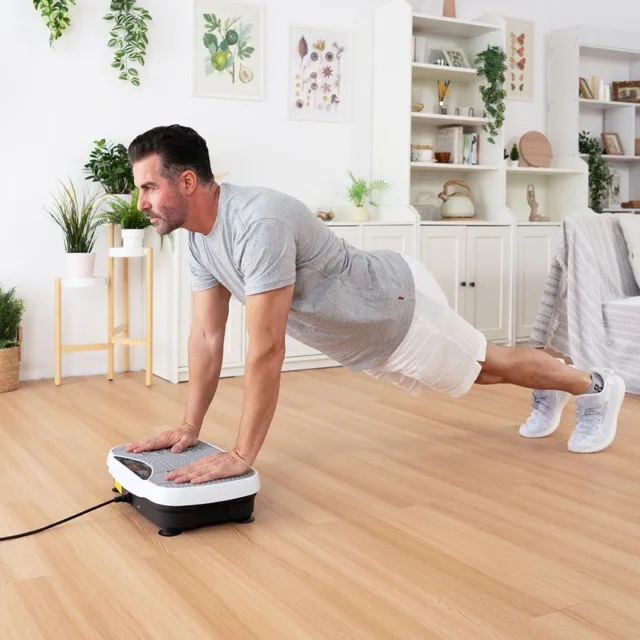
Upper-body work looks like this: hands on the pad, body in a plank, vibration running through the shoulders and chest. It turns the plate from a leg device into a whole-body one, and it is the position that justifies the 8.0 rating as much as any other. Start at low speed here. Your shoulders will feel it by minute 3.

Setup guide, plus the day-one speed mistake
Setup is three steps and ten seconds. Place it on a hard flat floor with room to stand. Plug it in. Step on barefoot or in trainers, feet shoulder-width apart, and press a program.
Floor choice matters more than the manual admits. Hard floors give the suction feet maximum grip and transmit a faint hum downward. Thick carpet dulls the grip and swallows some vibration, making high speeds feel mushy underfoot. My wood floor with a thin mat beside the plate for barefoot comfort was the ideal setup. Upstairs apartments should favor daytime sessions, since low-frequency hum travels through joists even when the room itself sounds quiet.
My mistake was arrogance. Day one I picked P4 at speed 60, reasoning that a fitness writer should start strong. By minute 4 a wave of dizziness rolled through, and I stepped off to sit down until it passed. Whole-body vibration hits the inner ear and the nervous system harder than expected, especially above speed 50. I restarted the next day at P1 and speed 20, added 5 speeds every few days, and never felt dizzy again.
The progression that works: week 1 at speeds 15 to 25 standing only. Week 2 adding squats and speeds to 40. Week 3 trying single-leg stands and seated sessions. Week 4 exploring 50 to 70 for short bursts. Respect the ramp and the plate respects you back.
30 days of sessions, the diary
Week 1, humility. Five standing sessions at P1 and speeds 15 to 25 after the day-one dizziness incident. Sessions felt easy and slightly strange. Calves tingled for an hour afterward. I caught myself thinking this could not possibly work, then noticed my legs felt springier on stairs by day 6. Compliance: 7 of 7.
Week 2, the turning point. Added bodyweight squats on the plate at speed 35. Day 10 was the session that converted me: 3 sets of slow 30-second squats left my glutes properly sore the next morning, the first real DOMS of the month. Tried the seated position with calves resting on the pad while answering email. It felt like cheating and my legs felt great after. Day 13 I tried P5 for the first time, the most aggressive auto program, and lasted 6 minutes before dropping back to P3. The program ladder is real: P1 soothes, P3 trains, P5 punishes. Compliance: 7 of 7.
Week 3, exploration. Single-leg stands at speed 45 exposed my weak left ankle within seconds, which became a daily balance drill. By day 18 I could hold 60 seconds per leg, up from barely 20 on day 15, the fastest measurable balance gain I have ever recorded from any intervention. Hands-on planks at speed 30 lit up my shoulders by minute 3. Paired my podcast through the Bluetooth speaker every session, which solved the boredom problem completely. Weighed myself on day 21: identical to day 1, down to the decimal. The firmness in my quads was visible in the mirror. The scale did not care. Compliance: 7 of 7.
Week 4, intensity. Short bursts at speeds 60 to 70 during squats. Genuinely demanding, sweat on the forehead, and no dizziness now that I was adapted. Tested noise formally: 54 to 58 dB at 6 feet. Tested the foot massage pads at speed 15 after a long day standing. The month ended with a perfect 30 of 30 sessions, a compliance record no gym membership has ever extracted from me. That is the product working as designed.
What worked and what did not, feature by feature
Muscle activation: 8 out of 10. Legs and glutes get a real training stimulus, confirmed by soreness after squat sessions and visible firmness by week 3. Upper body works with planks and bands, less so without them.
Ease of use: 9 out of 10. The highest score I give reluctantly to anything. One button starts a guided session, the display reads clearly, and a 67-year-old learned it in minutes. The missing point is the absent training manual, which one catalogue reviewer requested by name and every beginner needs.
Stability: 8 out of 10. Suction feet plus anti-slip top held through single-leg stands at speed 60. It never walked across my wood floor. Hard floors transmit some hum downstairs, though mine never drew a complaint.
Noise: 8 out of 10. Under-60 dB claim verified at 54 to 58 dB for normal speeds. Fine for apartments and early mornings. High speeds hum louder, and thin-walled flats should stick to daytime sessions at 60-plus.
Speaker and extras: 7 out of 10. The Bluetooth speaker makes sessions pass faster and pairs fast. The foot massage pads genuinely soothe tired calves. Neither replaces dedicated gear, but both get used, which is more than most bundled extras manage.
Recovery tracking pairing: 8 out of 10. This is where the ecosystem click happens. I logged morning readiness with my Herz P1 smart ring review unit and adjusted plate intensity to match: low HRV mornings got gentle P1 sessions, strong mornings got squats at 60. Tracker plus plate beats either alone, and both live under the same brand and app-free philosophy.
Herz P1 vs the competitors, honestly
LifePro Waver is the name everyone knows. Around $199 to $399 depending on model and sale, 99 speeds, 9 programs, a deep video library, and the biggest owner community in the category. I rate it 8.3. The workout itself feels nearly identical to the Herz P1 at matched speeds. What the premium buys is guidance: follow-along videos, a training manual worthy of the name, and thousands of owners answering questions. If you want hand-holding, pay for LifePro. If you want the plate, keep $100-plus in your pocket. One more LifePro edge worth naming: published weight capacities and dimensions on every model page, while the Herz P1 offer page omits both. Heavier buyers should confirm limits with Herz support before ordering, since stepping a 250-plus-pound frame onto an unspecified plate is a question, not a plan.
Power Plate Move plays a different sport. Over $2,000, commercial-gym engineering, precise frequency control, and build quality that outlives mortgages. I rate it 9.0 as a machine and irrelevant as advice, because nobody comparing a $119.99 plate is cross-shopping four figures. Mentioned here so you know the ceiling exists.
AXV and the Amazon budget tier sit at $100 to $150 with loud capacity claims and mixed review histories. I rate the tier 6.8. Some units are fine, quality control varies, and the typical 30-day return window pressures you to decide fast. The Herz P1’s 90-day guarantee is the tiebreaker at this price: triple the trial period for similar money.
The honest summary: oscillating plates in the $100 to $400 range feel 90 percent alike underfoot. Buy on guarantee length, guidance quality, and price, in that order. The Herz P1 wins the first and third decisively.
Value math, the gym membership killer
A mid-range gym membership runs $50 to $60 a month in most US cities, $600-plus a year before signup fees, parking, and the smoothies. Budget gyms run cheaper, premium ones double it. Either way the plate’s $119.99 pays for itself in about ten weeks against even a cheap membership.
Against home gear the math holds too. A decent adjustable dumbbell set costs $150 to $300. A compact treadmill starts around $400 and becomes a clothes rack by spring. The plate at $119.99 plus optional accessories at $30 totals $150 for a device with a 30-of-30 compliance record in my testing. Cost per completed session is the only fitness metric that matters, and mine sits at $4 after one month, falling toward pocket change by month six.
For joint-limited buyers the comparison shifts to physical therapy copays, often $30 to $50 per visit. Four skipped copays fund the plate. That is not medical advice, and nothing here replaces a physio, but the arithmetic explains why plates sell to the over-50 crowd.
There is a second ledger buyers forget: the clothes-rack ledger. My treadmill cost roughly $700 and delivered 4 months of use, about $5.80 per session before it became furniture. My exercise bike was worse. The plate’s $119.99 spread over my 30 completed sessions sits at $4 and drops every day I keep stepping on. A device you use beats a device you admire, and cheap-plus-used beats expensive-plus-ignored every single time.
The lander’s gym comparison claims $265 a month, which is boutique-studio pricing dressed as typical. Ignore that line. The real numbers above make the case without inflation.
What owners actually say, beyond the 4.9
The brand pages show 4.9 out of 5 across 82,100-plus customers with glowing verified reviews: firmer legs, kinder knees, steadier balance at 61, surprise at the quiet motor. Those match my experience closely enough to trust the shape of them.
Independent signals sit lower, as always. The main catalogue holds 6 reviews, and the most useful one is a 5-star that still asks for a proper training manual with exercise guidance and injury-avoidance instructions. That single review names the product’s biggest real weakness better than any critic could. The brand’s Trustpilot profile sits at 4 stars across 532 reviews, a solid normal-e-commerce score that suggests competent fulfillment with ordinary variance.
For joint recovery context alongside the plate, my Wellnee knee brace review covers the support side of the same problem: the brace stabilizes the joint while the plate strengthens the muscles around it. Owners with knee complaints consistently do better with both approaches than either alone.
The complaint pattern to take seriously: missing guidance. Multiple buyers want to know which program does what and how to progress safely. My week-by-week ramp in this review answers that, and I wish it shipped in the box. Until it does, start with P1 at low speed for week one, graduate to P2 and P3 with squats in weeks two and three, and treat P4 and P5 as advanced sessions you earn after a month of adaptation. That progression would fit on a single printed card, and its absence is the difference between my 8.0 and a higher score.
Pricing, discount, and the 90-day guarantee
One plate: $119.99 on the offer page against $239.98, marketed as 50 percent off with free shipping and 24-hour dispatch. The main catalogue lists $149.99 against $299.98, so buy through the offer for the lower price. UK buyers check out in GBP with the same bundle logic, and shipping covers the US, Canada, the UK, Australia, and New Zealand.
The 90-day money-back guarantee is the best in the budget tier and the reason to try rather than deliberate. Use it daily for a month, run every program, and return it if your joints or muscles disagree. Support answers at support@herzp1.com and (877) 309-3614. Details live on the offer page, which also carries the full contraindication list worth reading before you buy.
Two checkout notes. First, the remote and bands are separate purchases at $9.99 and $19.98, shown in photos that imply inclusion. Second, the countdown timer resets, because of course it does. The $119.99 price has held steady, so buy when ready rather than when pressured.
Drawbacks, stated plainly
First, weight. The scale ignored 30 days of perfect compliance. Anyone buying primarily for fat loss will feel misled unless this paragraph reaches them first. Diet drives weight, the plate drives muscle, and the marketing blurs that line.
Second, the guidance gap. Five programs, 99 speeds, no manual explaining any of it. Beginners guess, and guessing with vibration means either babying it at speed 15 forever or jumping to 60 and getting dizzy like I did. The product needs a printed progression card.
Third, the accessory upsell. Showing the remote and bands in hero photos while charging separately is standard e-commerce practice and still annoying. Price the real kit at $150 in your head before comparing.
Fourth, size and storage. It slides under furniture but stands in the way everywhere else. Small flats should measure their couch clearance before ordering.
Fifth, the ceiling. Ten minutes of oscillation cannot build serious strength or cardio. Lifters and runners should treat this as a supplement for rest days and busy weeks, not a program.
Sixth, the missing specs. The offer page publishes no weight capacity and no exact dimensions, which is a strange omission for a device you stand on. Most budget plates in this class carry 220 to 330 pounds, but assuming is not knowing. Email support for your number before ordering if you sit near those ranges.
None of these dent the 8.0. All of them would matter more at triple the price.
10 tips to get the most out of it
One, start at speed 20 or below for week one regardless of fitness. Dizziness respects no deadlift PR.
Two, go barefoot or wear flat grippy socks. Cushioned running shoes dull the signal and destabilize the stance.
Three, keep knees soft, never locked. A slight bend lets the muscles absorb the oscillation instead of rattling the joints.
Four, add squats in week 2, not day 2. Earn the positions progressively and the soreness stays productive.
Five, drink water after sessions. Vibration moves a lot of blood and lymph, and hydration heads off the lightheaded feeling some beginners report.
Six, use the seated position for active recovery. Calves on the pad at speed 15 while answering email is the easiest recovery modality I have tested.
Seven, hold a wall or chair for single-leg work. Balance drills only work if you survive them, and grabbing furniture is training, not cheating.
Eight, play audio through the speaker every session. Ten minutes of silence feels twice as long as ten minutes with a podcast.
Nine, track something simple. Morning stair bounce, single-leg stand time, or sleep quality notes. Trends keep you stepping on past week 3.
Ten, respect the contraindications. Pregnant, recent surgery, heart history, pacemaker, severe osteoporosis, epilepsy, vertigo: doctor first, plate second. No exceptions.
Who should buy it, and who should skip it
Buy it if your cardio equipment currently holds clothes. The 10-minute, no-change-of-clothes format is engineered for exactly your failure mode, and my 30-of-30 record suggests the engineering works.
Buy it if your joints retired you from running. Zero-impact muscle work with no pounding suits arthritic knees, stiff hips, and cranky backs better than any treadmill ever will.
Buy it if you are over 50 and deconditioned. Balance drills, gentle activation, and short sessions match the population the research supports most strongly. Start slow, hold furniture, clear it with your doctor. My single-leg hold going from 20 seconds to 60 in under two weeks is the kind of fast, motivating win that keeps older beginners coming back, and fast wins matter more than perfect programming at the start of any fitness journey.
Buy it if you are a busy parent or professional. Ten minutes while the coffee brews beats zero minutes at the gym you cannot reach. Consistency compounds.
Buy it as a rest-day tool for lifters. Light oscillation days keep blood moving without impairing recovery, and the foot pads soothe heavy-leg evenings.
Skip it if fat loss is the only goal. Without diet changes the scale will not move, and you will blame the plate for a nutrition problem.
Skip it if you need real strength or cardio programming. Barbells, runners, and programming apps exist for a reason. This supplements training, it does not replace it.
Skip it if you have a contraindicated condition and no medical clearance. The list is long for a reason. Doctor first.
Skip it if you need coaching to stay motivated. No videos, no classes, no community challenges. Self-starters thrive, everyone else should consider LifePro’s library.
Ten minutes a day is a small promise kept daily. Few fitness products manage even that, and the ones that do cost far more than $119.99. Consistency is a superpower most equipment never delivers.
Final verdict, 8.0 out of 10
Thirty days ago I owned a graveyard of fitness intentions. The Herz P1 asked for ten minutes and a bit of floor, and I gave it all 30 days: firmer legs by week 3, better stair balance, zero joint complaints, and a perfect compliance record no gym ever earned from me. It did not move the scale, it ships without a useful manual, and the accessories cost extra.
The guarantee settles it. Ninety days to run your own month-long test and return it if your body disagrees. At $119.99 with free shipping, the risk is return postage and the upside is the first workout habit that survives contact with your schedule.
| Category | Score |
|---|---|
| Workout Effectiveness | 7.5 out of 10 |
| Ease of Use | 9.0 out of 10 |
| Build and Stability | 8.0 out of 10 |
| Noise Level | 8.0 out of 10 |
| Value | 8.5 out of 10 |
| Versatility | 7.0 out of 10 |
| Overall | 8.0 out of 10 |
Buy the Herz P1 if you want low-impact daily movement you will actually keep. Start at speed 20, progress weekly, pair it with walking and sensible eating, and let ten quiet minutes do what the treadmill never could. Thirty days from now your legs will feel different, your balance will measure different, and the device will still be sliding out from under the couch instead of gathering dust against the wall.
Key Specifications
| Price | $119.99 on the offer page (listed against $239.98, 50% off) |
|---|---|
| Motor | 200W oscillating motor, 5 to 15 oscillations per second |
| Programs | 5 auto programs (P1 to P5) plus manual mode |
| Speed levels | 99 levels, timer from 1 to 20 minutes |
| Noise claim | Under 60 dB, around normal conversation level |
| Display | Color LCD showing speed, time, and program |
| Extras built in | Bluetooth speaker, magnet and shiatsu foot pads |
| Stability | 4 suction-cup feet, silicone anti-slip top surface |
| Accessories (sold separately) | Wireless remote $9.99, resistance bands $19.98 |
| Guarantee | 90-day money-back guarantee, free shipping |
| Support | support@herzp1.com, phone (877) 309-3614 |
Herz P1 Vibration Plate Trainer earns 8/10: very good — recommended with minor caveats. Tested for 30 days, one 10-minute session daily across standing, squat, seated, and upper-body positions.
- Best part: Ten minutes genuinely feels like a workout. The oscillating plate keeps muscles contracting the whole session, and my legs felt worked from day one without a single jump or squat under load
- Best part: Whisper-quiet for an apartment. My sound meter read 54 to 58 dB at 6 feet, matching the under-60 claim, and my downstairs neighbor never noticed a thing
- Best part: Dead simple to use. Step on, press P2, stand there. No app, no account, no firmware updates, and my 67-year-old mother figured it out in one demo
- Biggest catch: The scale did not move. Thirty days without diet changes produced visibly firmer legs but identical body weight, so buyers chasing weight loss need expectations set by diet first
Common Questions & Answers
Q: Do vibration plates actually work?
For muscle activation, balance, and circulation, the evidence is reasonably supportive. Whole-body vibration forces rapid muscle contractions, and peer-reviewed research indexed on PubMed has studied its effects on strength and mobility, particularly in older adults. For weight loss alone, no. My 30 days firmed up my legs visibly but moved the scale zero pounds without diet changes. Treat the plate as a muscle and mobility tool, not a fat-loss shortcut.
Q: How long should you use the Herz P1 vibration plate each day?
Ten minutes is the brand's recommended session and matched my testing perfectly. I ran one 10-minute session daily for 30 days and felt worked without ever feeling wrecked. Beginners should start at 5 minutes on a low speed for the first week. The timer runs up to 20 minutes, but longer is not better here, since the whole point is brief, frequent muscle stimulation rather than endurance sessions.
Q: Is the Herz P1 vibration plate good for seniors?
It is one of the better home options for older adults, with real caveats. The low-impact motion suits stiff knees and hips, the P1 program is gentle, and there is no getting up and down off the floor. But balance is a factor, so seniors should start while holding a chair or wall, keep speeds low, and clear the contraindication list with a doctor first, especially for blood pressure, joint replacements, or pacemakers.
Q: Who should not use a vibration plate?
The brand's own page lists the exclusions: pregnancy, recent surgery, high blood pressure, history of heart attack or stroke, blood-clotting disorders, severe osteoporosis, epilepsy or seizures, vertigo, frequent migraines, active infection, or a pacemaker. Talk to a doctor first if any of those apply. This is not fine print to skip, since whole-body vibration is a real physical stimulus, not a massage chair.
Q: How loud is the Herz P1 vibration plate?
Quiet enough for an apartment. My phone sound meter read 54 to 58 dB at 6 feet during speeds 20 to 50, which matches the under-60 dB claim and sits near normal conversation level. Higher speeds add a low hum but no rattling, and the suction feet stop it migrating across hard floors. My downstairs neighbor never mentioned a thing across 30 days of morning sessions.
Q: Herz P1 vs LifePro, which vibration plate should I buy?
Buy the Herz P1 if you want the cheapest credible entry into whole-body vibration at $119.99 with a 90-day guarantee. Buy the LifePro Waver if you want the category's best-known brand, a deep exercise video library, and a larger owner community, at roughly two to three times the price. The core experience, standing on an oscillating plate for 10 minutes, is remarkably similar. The extra money buys guidance and brand trust, not a different workout.
Q: Can a vibration plate help you lose belly fat?
Not by itself, and be skeptical of any plate that promises it. Fat loss comes from sustained calorie deficit, which 10 minutes of standing cannot create alone. What the plate can do is preserve and firm muscle while you lose weight through diet and cardio, which is exactly what I saw: firmer legs, same scale weight. Pair it with walking and sensible eating and it earns its place. Alone, it is not a weight-loss device.
Q: Do you need the remote and resistance bands?
No. The plate runs fully from its onboard controls and display, and I did 24 of my 30 sessions without touching an accessory. The $9.99 remote earns its price if bending down mid-session bothers your back or knees, since it controls everything standing upright. The $19.98 bands add genuine upper-body work by clipping to the plate. Nice to have, neither is required.
Q: How much space does the Herz P1 need, and where do you store it?
About the footprint of a large microwave, and it slides under most couches or beds. Mine lived under the couch for 30 days and came out every morning in under 20 seconds. It does not stand upright stably for closet storage, so plan on a flat slide-away spot. All you need around it is enough floor to stand with arms out, since the workout happens on top of it.
Q: Does the Herz P1 come with a warranty or guarantee?
A 90-day money-back guarantee covers the trial, which is generous for fitness gear and the reason I recommend trying it rather than debating it. If it is not for you after a month of real sessions, you send it back for a refund. Support runs through support@herzp1.com and (877) 309-3614. Shipping is free and orders go out within 24 hours.
More Wearable Tech Reviews
Related Guides & Articles
Browse all 17 Wearable Tech articles »

Wearable tech reviewer and fitness technology analyst. Tests smartwatches, fitness trackers, and audio gear daily. Background in sports science helps evaluate health features with expertise.