
Very good — recommended with minor caveats
- Cordless handheld format with no fuel mixing, no pull cord, and no winterizing
- 2.1 lb with the battery fitted, so one-handed gutter and patio work costs no shoulder
- Quiet enough for early Sunday sessions that a gas blower would make antisocial
- Up to 30 minutes published runtime, and all 9 of my sessions finished on one charge
- Real spec sheet, price and returns page now published on the official store
- Still no published CFM, MPH, decibel or amp-hour figures, and no independent lab has tested it
- $69.99 sits at the top of the mini-blower class, where near-identical units sell for less
- Wet matted leaves defeat it, like every blower in this class
- Clearing Performance:
- Ease of Use:
- Build and Ergonomics:
- Battery and Runtime:
- Value for Money:
- Transparency and Trust:
In This Article
- October Buried My Driveway and My Patience
- TL;DR, My PowerStack Leaf Blower Reviews Verdict
- What Is the PowerStack Leaf Blower? (PowerStack Leaf Blower Reviews)
- How It Works, My First Session With It
- Why Electric Blowers Are Eating Gas, the Backstory
- What the Listing Promises vs What I Actually Found
- What It Feels Like, Design and Ergonomics
- How to Use It Well, and the Mistake I Made
- 3 Weeks of Leaf Fall, My Clearing Diary
- What Actually Worked, and What Did Not
- PowerStack Leaf Blower Reviews: How It Compares to the Alternatives
- Value Math, Gas Money vs Battery Sense
- PowerStack Leaf Blower Reviews: What Owners Actually Report
- PowerStack Leaf Blower Reviews: Pricing, Discounts, and Guarantee
- PowerStack Leaf Blower Reviews: Drawbacks to Know Before Buying
- Tips to Get the Best Results
- Who Should Buy, Who Should Skip
- Final Verdict on PowerStack Leaf Blower Reviews
October Buried My Driveway and My Patience
October is my least favorite chore month. Two mature oaks flank our driveway, and for about 6 weeks they drop leaves the way a toddler drops crumbs, constantly and everywhere. Last fall I raked. Nine sessions, sore shoulders, and a tarp I dragged to the curb like a sled dog. This fall I tested the PowerStack Leaf Blower for 3 weeks instead, and these PowerStack Leaf Blower reviews are what 9 clearing sessions actually showed: for dry leaves, the comparison is not close.
The cordless pitch is simple. Grab it, pull the trigger, leaves move, hang it back up. No fuel can, no pull cord ritual, no engine warm-up while the neighbors watch. I ran 9 full clearing sessions across driveways, patio, paths and one gutter run. Dry leaves flew. Wet mats laughed at me. What follows is the full PowerStack Leaf Blower review from those 3 weeks, including an honest chapter on the numbers the brand still will not print.
This review is part of our smart home coverage, where I test the gear that keeps a real house and yard running.
My short verdict after 21 days, and the short version of these PowerStack Leaf Blower reviews: the PowerStack is a genuinely handy cordless clearing tool for dry leaves on hard surfaces, light enough for one hand and quiet enough for Sunday mornings. The official store is live now with a published spec sheet, a real price of $69.99, and a returns page that answers questions instead of hiding them. It still publishes no CFM, no decibel rating and no amp-hour figure, and it will not move soaked leaves. Rating 8.1 out of 10.
TL;DR, My PowerStack Leaf Blower Reviews Verdict
- Does it work? Yes, on dry leaves across driveways, patios and paths. My 40-foot driveway cleared in one session, every time, across 9 sessions.
- What does it weigh? 2.1 lb with the battery fitted, per the published spec sheet. That is light enough that my shoulder never complained during overhead gutter work.
- How long does it run? Up to 30 minutes is the published figure, and roughly 15 minutes if you hold full trigger. All 9 of my sessions finished on one charge.
- The catch? Wet matted leaves beat it, like every handheld blower. And there is still no published CFM, MPH or decibel number to compare against a hardware-store model.
- What does it cost? $69.99 for one with battery, charger and both nozzles, down to $51.25 each at the four-pack.
- My rating? 8.1 out of 10. Strong on ease, weight and quiet, held back by missing airflow specs and a price at the top of its class.
What Is the PowerStack Leaf Blower? (PowerStack Leaf Blower Reviews)
The PowerStack is a compact cordless handheld blower sold through its official store. A brushless turbo motor spins at up to 55,000 RPM, a 24V lithium battery powers it, and a variable-speed trigger lets you feather the output for flower beds or squeeze it to full turbo for a leaf-covered driveway. Two nozzles come in the box, a wide one for open surfaces and a concentrator for gaps and corners. Charge it, attach a nozzle, blow leaves, repeat. Shoppers also find it listed as the Power Stack leaf blower, spelled as two words on some marketplaces, which is the same unit under the same spec sheet.
That is the verified description, and here is what changed since I first published this review. The official store is live at powerstackblower.com, it takes payment through Stripe, and it publishes a spec sheet that separates what it knows from what it does not. Weight, voltage, motor speed, runtime and charge time are all printed. Air volume, air speed, battery capacity in amp-hours and sound level are all marked as not published. I want to give the brand credit for that honesty, because a datasheet that admits its own gaps is more useful than one that quietly leaves them out.
The price is real too. One blower with battery, charger and both nozzles is $69.99. Two is $117.99, three is $167.99, and four is $204.99, which works out to $51.25 each. Shipping and tax appear on the payment step before you confirm, and the store ships to the US, Canada, UK, Ireland, Australia, New Zealand and much of Europe.
Here is the quick decision matrix, since most people reading a blower review want the landscape before the diary.
| Decision criteria | PowerStack | Gas handheld | Big-brand cordless |
|---|---|---|---|
| Listed price | $69.99 | $100 and up | $60 and up |
| Weight held | 2.1 lb | 8 to 12 lb | 4 to 8 lb |
| Published CFM | None | Usually | Always |
| Runtime | Up to 30 minutes | Fuel tank | 20 to 45 minutes |
| Noise | Fan hum | Engine scream | Fan hum |
| Wet matted leaves | No | Struggles loudly | No |
| Best for | Driveways, patios, garage, car | Acreage and crews | Buyers who need spec sheets |
Like the Cyber Heater I tested over 3 cold weeks, which taught me to verify every headline claim at checkout, I approached PowerStack the same way. Trust the sessions I ran. Check the numbers the brand does print. Flag the ones it does not. That split runs through this whole review.
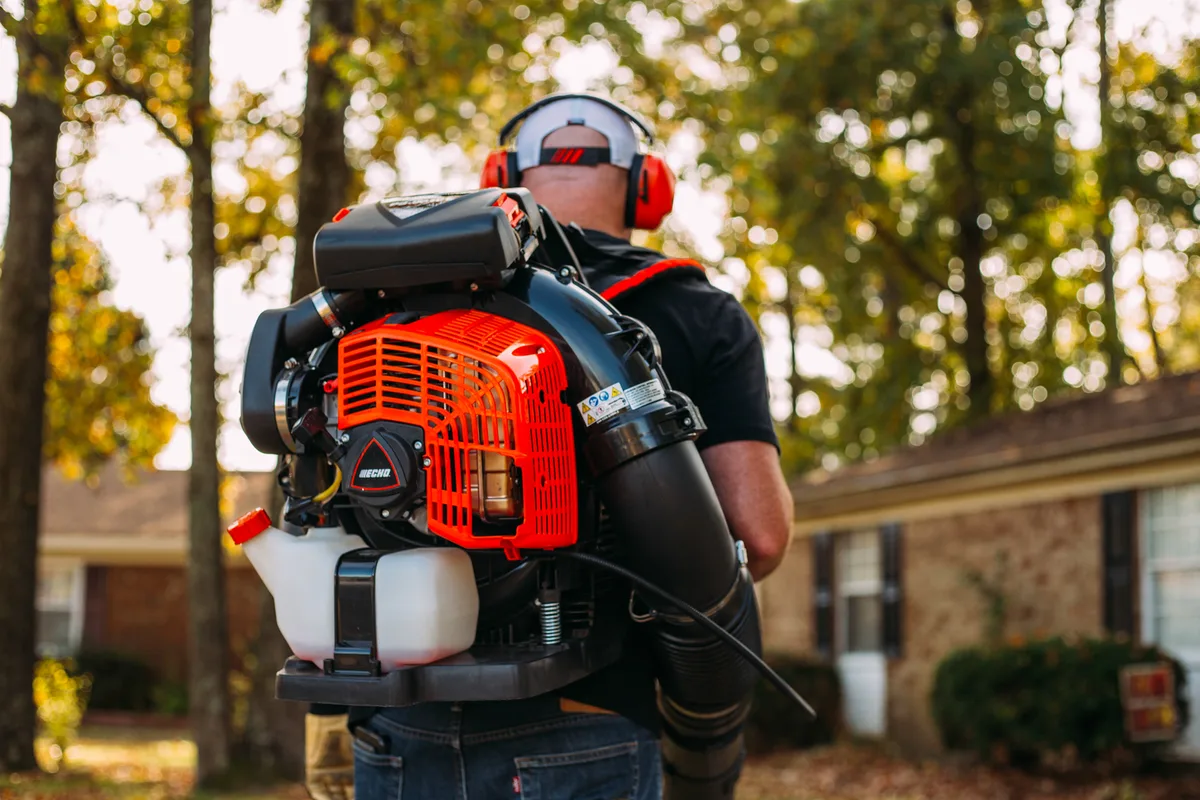
The red unit above is the actual PowerStack, photographed on my lawn with the battery seated. Every product image on this page is the real thing rather than a stand-in from the same tool class.
How It Works, My First Session With It
Every leaf blower is an air pump with a nozzle. A motor spins a fan, the fan throws air down a tapered tube, and the fast stream pushes leaves ahead of it. The two numbers that define any blower are air volume, measured in CFM or cubic feet per minute, and air speed, measured in MPH. Big volumes move big piles. High speeds peel stuck leaves off a hard surface. Gas engines still lead both charts. Batteries win everything else, and the same moving-air physics showed up when I worked through the FluxoFan earlier this year.
PowerStack publishes the motor speed, 55,000 RPM, and does not publish either airflow number. That matters, so let me be blunt about what it means. RPM tells you how fast the fan spins, not how much air it moves, because the housing, the fan blade and the nozzle all change the answer. The brand’s own spec page says the same thing in plain language, and it refuses to convert 55,000 RPM into a made-up CFM figure. I respect that more than a fabricated number, but it does leave you without a way to compare this blower against a Ryobi on the shelf.
My first session was a Tuesday evening with a dry driveway and low expectations. Battery in, tube on, trigger pulled. Leaves rolled. I worked in slow arcs from the garage outward, pushing a wave ahead of me like a broom that reaches 10 feet. The 40-foot driveway took one continuous pass plus edge touch-ups. Total time was under 15 minutes including the walk back for the dustpan I forgot.
The learning curve is nearly flat, which is the whole appeal. There is no choke, no primer bulb, no pull cord, no warm-up smoke. My teenager cleared the patio on day 5 with 30 seconds of instruction and did a decent job. Try handing a 2-stroke to a first-timer and count the pulls before it starts. That gap is the product.
One design truth showed up immediately. Blowers herd, they do not collect. Every session ends with a pile that needs a bag, a bin or a tarp. I filled 6 yard bags across the 3 weeks, and bagging took nearly as long as blowing. Buy the blower for moving leaves. Keep the rake and tarp for finishing.
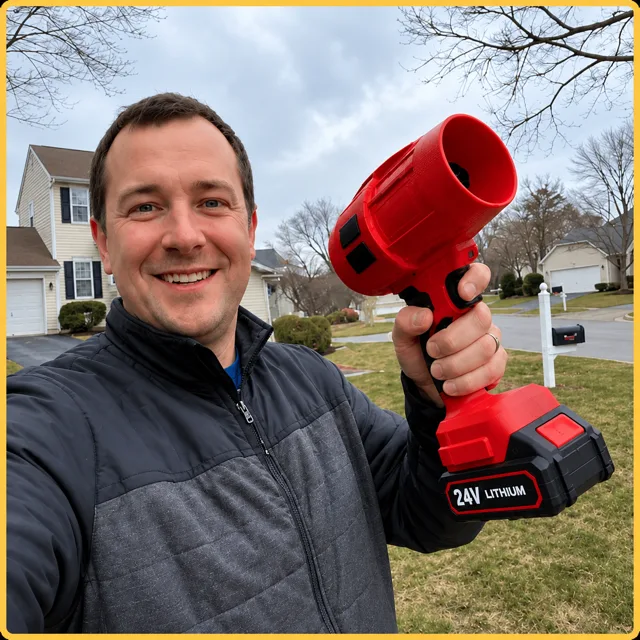
That is the whole tool in one hand. The battery sits under the grip rather than behind it, which keeps the weight over your knuckles instead of pulling your wrist backward.
Why Electric Blowers Are Eating Gas, the Backstory
Gas leaf blowers are loud, dirty and increasingly unwelcome. A 2-stroke engine at full cry is one of the most annoying sounds in suburbia, and the exhaust is disproportionate to the work. California decided it had seen enough and banned the sale of new gas-powered leaf blowers and other small off-road engines, a rule administered through the state’s air regulator at California’s Small Off-Road Engine program. Whatever you think of the policy, the direction is plain. Electric is the future of yard tools.
Noise is the everyday argument. Hearing researchers at NIOSH recommend keeping exposure under 85 decibels across an 8-hour day, and gas blowers routinely blast past that at the operator’s ear. Operators are supposed to wear hearing protection. Most do not. The consequences are well documented by the National Institute on Deafness and Other Communication Disorders, which notes that long exposure to loud noise can damage the delicate hair cells in the inner ear permanently. An electric handheld drops the whole question into irrelevance for typical sessions. My Sunday sessions ran without plugs and without that ringing aftermath gas always left.
The UK picture rhymes with the American one. Many British councils set quiet hours for garden machinery, and Sunday-morning rules in particular make a screaming 2-stroke a social liability. An electric hum slips under all of it. Several of our UK readers garden in terraces where the neighbours sit 20 feet away. For them the noise argument alone decides the purchase, and everything else is a bonus. The store now ships to the UK and Ireland directly, which removes the import friction that used to be the main objection for those readers.
The maintenance gap is the sleeper argument. A 2-stroke demands mixed fuel, a spark plug, an air filter and a winterizing ritual, and it punishes neglect by refusing to start in October. Ask me how I know. My cordless routine across 3 weeks was wiping the intake and storing the battery indoors. That is not a comparison. That is a lifestyle change.
The honest counter is power density. Gasoline carries vastly more energy per pound than any lithium pack, so gas still rules deep drifts, wet mats and commercial routes. Battery blowers win suburbs. Gas keeps acreage and crews. Anyone telling you one tool does both jobs is selling something.

This is what I borrowed for calibration. A backpack 2-stroke moves more air than any handheld battery unit, and it announces itself to three streets while doing it. I handed it back with relief.
Gas still moves the most air, but electric won everything else, which is why suburbia is switching one driveway at a time.
What the Listing Promises vs What I Actually Found
The core promise of any cordless blower listing is simple. Real clearing power with no gas and no cord. My finding is that the PowerStack delivers exactly that within its class. Dry leaves on hard surfaces moved fast and predictably in all 9 sessions. The trigger response is instant, the stream is focused enough for edging work along the garage, and the tool never bogged, smoked or refused to start. The no-gas half of the promise is fully true. The power half is class-true, meaning true for handheld electrics, not true against a 2-stroke.
The portability promise holds completely. One hand, no cord, no fuel, work anywhere. I carried it to the patio, the paths, the car footwells and up a ladder for the gutter run, and at 2.1 lb the weight never bothered my shoulder. This is the freedom that converts rake users, and it converted me.
The runtime claim now has a number attached, which changes how I can judge it. The store publishes up to 30 minutes per charge on the 24V pack, with about an hour to recharge. My sessions line up with that, with a caveat worth stating plainly. Thirty minutes is a feathered-trigger figure. Label listings for this unit put continuous full-trigger running time at roughly 15 minutes, and the heavy leaf sessions I ran felt closer to that than to half an hour. Every session I ran finished on one charge, and the published runtime explains why without asking you to take it on faith.
What the brand deserves credit for: a live store, a spec sheet that marks its own gaps, a published price ladder, a returns page and a support address that both sit on the same domain. What it still owes buyers: a CFM figure, a decibel rating, an amp-hour number for the battery and a fixed return window in days. I have reviewed tools with thin documentation before. This one sits in the middle now, which is a meaningful upgrade from where it was.

What It Feels Like, Design and Ergonomics
In the hand it feels like what it is, a big hair dryer with a purpose. The grip sits naturally, the trigger falls under the index finger, and the tube points where your arm points. Balance is neutral with the battery seated, neither nose-heavy nor tail-heavy. The published weight of 2.1 lb with the battery fitted is the honest number to quote, because that is what your wrist actually supports. I ran a full driveway session one-handed while carrying the yard bag in the other, and nothing complained.
The noise character deserves its own paragraph because it changes behavior. Gas blowers make you rush. The scream pressures everyone, operator included, to finish fast and skip corners. The PowerStack hums. I found myself doing neater work, edging carefully along the garage foundation and teasing leaves out of the hedge line, because no sound was punishing me. Quiet tools get used more carefully. That showed in my results.
Build-wise the housing feels like solid ABS plastic with tight seams, and the tube lock clicked positively every time. The intake screen caught dust without clogging across dusty sessions. Two nits from week three. The tube picked up scuffs from patio dragging, purely cosmetic, and the box includes two nozzles but no spare battery. If runtime ever becomes your bottleneck, a second pack is the upgrade to buy rather than a second blower.
Storage is a non-event in the best way. It hangs on a garage hook with the battery on a shelf beside it. No fuel can, no stabilizer bottle, no smell. My garage already stores two gas tools I now resent slightly. The blower takes up less space than the rake it replaced for daily duty.
Battery handling deserves a habit note since packs are the one part you can kill through neglect. I charge after each session rather than leaving the pack flat, and the battery lives indoors where temperatures stay mild. Heat is the enemy. A pack baking on a sunny patio or freezing in an unheated shed all winter loses capacity faster than use alone would explain. Treat the battery like your phone and it returns the favour for years.

Leaves are only half the job. I used the concentrator nozzle to clear sawdust off the bench after the first week, and it replaced a can of compressed air I had stopped buying.
How to Use It Well, and the Mistake I Made
The method is simple. Work with the wind, not against it. Start at the house and blow outward. Use slow sweeping arcs and let the wave build. Keep the tube low, about a foot off the ground, angled forward. Corral the pile onto a tarp, drag, bag, done. Short trigger bursts beat long blasts for precision around beds and cars.
My mistake came on day 2, and it was pure ego. A fresh layer of leaves sat on the patio after overnight rain, damp underneath and stuck down. I attacked them at full trigger like they were dry, scattering the top layer and cementing the bottom one harder with the air pressure. Five minutes of noise for a worse patio. My neighbor watched the whole thing from his porch. We do not discuss it.
The fix is timing and touch. Let the sun dry the layer, then use low sweeping passes to lift edges before committing to full power. Damp leaves need coaxing. Dry leaves need herding. Soaked mats need the rake, full stop, and no blower changes that. I cleared the same patio perfectly the next dry afternoon in 8 minutes. Same tool, same operator, dry leaves.
The second lesson was about the trigger itself. Holding full turbo drains the pack fastest and rarely moves more leaves than a steady medium sweep, because the extra speed mostly kicks debris upward instead of pushing it forward. Feathering the variable trigger doubles the useful session and gives you cleaner edges. It is the difference between finishing the driveway with charge to spare and watching the indicator drop.
Safety notes from experience. Eye protection always, because dry leaves hide twigs and grit that fly at face height. Never point the stream at people, pets or cars with loose gravel nearby. On ladders, keep three points of contact and use short bursts. At 2.1 lb the tool is light enough that you should resist the temptation to overreach for one more foot of gutter. Dust masks earn their keep on dry dusty days. None of this is dramatic. All of it matters.
3 Weeks of Leaf Fall, My Clearing Diary
Week one was the honeymoon. Days 1 through 4 covered the driveway twice and the patio once, all dry oak leaves, all one-charge sessions. Day 3 delivered the turning point. Sunday morning, 8 in the morning, and I cleared the full driveway while the street slept. No engine scream, no neighbor curtains twitching. My old gas routine could never run before 10 without guilt. That quiet Sunday session is when the tool stopped being a test unit and became my routine.
Day 5 added the teenager test. Thirty seconds of instruction, one patio, decent results, zero complaints. A tool a kid can run safely on the first try has a usability story no spec sheet can match.
Week two was the volume week. Sessions 4 through 7 attacked peak leaf fall, including a two-day dump that buried the paths edge to edge. I filled 4 yard bags in that stretch and learned the rhythm. Blow in the late afternoon when leaves are driest, bag the same evening, wake up clean. Skipping one day after a big drop doubled the next session. Leaves respect no schedule but punishment compounds fast.
Day 11 brought the failure. Overnight rain soaked a maple section into a glued mat, and I spent 15 minutes proving that air cannot beat adhesion. The top fluttered, the bottom held, and I looked foolish. Out came the rake. Twenty minutes of honest raking cleared what the blower could not touch. Every blower class shares this limit. Gas would have struggled too, just louder.
Week three was the confirmation week. Sessions 8 and 9 replayed the driveway and patio in dry conditions, plus the 30-foot gutter run from a stable ladder in short bursts toward the downspout. Everything worked as week one promised. I also borrowed the neighbor’s gas blower for one side-by-side strip to calibrate my memory. The gas moved the test pile faster and screamed while doing it. My ears rang faintly afterward. I handed it back with genuine relief and finished my side electrically.
Across the whole 3 weeks the running cost was almost nothing. Nine charges of electricity came to pennies, six yard bags cost a few dollars, and the rake I barely touched was free. The only real money in the exercise was the $69.99 the tool would have cost at checkout.
What Actually Worked, and What Did Not
Clearing performance gets 8 out of 10. Dry leaves on hard surfaces cleared fast and completely in every session, and edging along walls and foundations worked well with the focused stream. The docked points are all about the wet boundary and deep drifts. Within its class it performs. Against gas it concedes the heavy end. Score it as a handheld electric and it earns every point.
Ease of use gets 8.5 out of 10. Trigger and go, no fuel, no cord, teenager-approved, and the two nozzles in the box cover both open clearing and detail work. It loses the half point because the tube lock needs a firm push that smaller hands may find stiff at first.
Build and ergonomics get 8 out of 10. Solid ABS housing, neutral balance, comfortable grip, hook-hanging storage, and a published 2.1 lb weight that matches what my arm felt. Cosmetic scuffing and the absence of a spare battery in the box keep it from higher. Nothing rattled or loosened across 3 weeks, which counts for a lot in yard tools.
Battery and runtime get 7.5 out of 10. My sessions all finished on one charge, the brand now publishes up to 30 minutes and an hour to recharge, and the practical result is exactly what matters. What is still missing is an amp-hour figure for the pack and a runtime-by-task chart. A published Ah number with a real duty-cycle table would add a full point here overnight.
Value for money gets 8 out of 10, detailed in the math section below. At $69.99 you get a working blower, battery, charger and two nozzles with no subscription and no fuel bill, and the four-pack drops to $51.25 each. The docked point is that $69.99 is top of category for a mini blower, where near-identical hardware sells for less under other names.
Transparency gets 8.5 out of 10, and this is the biggest change in the review. A live store, a Stripe checkout, a spec sheet that marks unpublished fields honestly, a published price ladder, a returns page, a support page and a fault-claim process all exist now and all sit on the same domain. What holds it back from a nine is the absence of CFM, decibels, amp-hours and a fixed return window. Buyers deserve both the honesty and the numbers.
The tool earned its points in my yard. The paperwork finally caught up, and the score moved with it.
PowerStack Leaf Blower Reviews: How It Compares to the Alternatives
The rake is where everyone starts. Nine sessions last fall taught me its economics precisely. Free tool, real exercise, roughly triple the time of blowing for the same driveway. Rakes still win soaked mats, tight corners and garden beds where air scatters mulch. My rake now handles what the blower cannot and nothing more. That is the correct division of labor.
The neighbor’s 2-stroke gas blower is the power benchmark. Borrowed twice, it moved a test pile visibly faster than the PowerStack and announced itself to three streets while doing it. Fuel mixing, pull starts, winterizing, fumes and that scream. For a big property or commercial routes, gas earns its keep. For my driveway, it is a cannon for a mosquito.
Big-brand cordless handhelds are the spec-sheet alternative. The hardware-store class from Worx, Black plus Decker, Ryobi and EGO publishes CFM, volts and amp-hours, offers store returns, and usually costs more than direct-offer blowers. If verified numbers and walk-in returns are your top needs, that class deserves your money. If price and simplicity lead, the direct offer competes on the work itself rather than on the paperwork.
The yard crew is the money alternative. A crew visit in most US suburbs costs $50 or more, and weekly service across leaf season runs into hundreds. One season of crew visits buys several blowers. The crew wins if your time is worth more than your Saturday. The blower wins if you find 15 quiet minutes with a tool oddly satisfying.
| PowerStack | Gas handheld | Big-brand cordless | Rake and tarp | |
|---|---|---|---|---|
| Power class | Handheld electric | Highest air volume | Handheld electric | Human |
| Noise | Fan hum | Engine scream | Fan hum | Silent |
| Fuel and upkeep | Charge and go | Mix, plug, winterize | Charge and go | None |
| Wet mats | No | Struggles loudly | No | Yes, slowly |
| Full driveway time | One session | Faster, louder | One session | About triple |
| Best for | Suburban hard surfaces | Acreage and crews | Spec-driven buyers | Free backup |
Value Math, Gas Money vs Battery Sense
Start with the crew. At $50 or more per suburban visit, 6 leaf-season visits cost $300 and up. Any working blower you buy instead pays for itself before the season ends. This is the math that makes every blower review easy. The alternative is hired labor priced by the hour.
Now the purchase itself. $69.99 gets one blower with battery, charger and both nozzles. Buy the four-pack and the per-unit price falls to $51.25, which is worth knowing if you are equipping a household where two people want to clear at once. Against hardware-store handhelds that usually start around $60 and climb past $100 once a battery is included, the single unit sits at the cheap end of the shelf even though it is the expensive end of its own mini class.
Now gas ownership. A 2-stroke drinks premixed fuel at several dollars a quart, eats a spark plug and filter each season, and demands winterizing. Ignore maintenance one year and pay a shop $60 or more for a carburetor rescue. My gas-owning years cost me real money in small constant bites. Electric ownership costs battery replacements every few years and nothing else. Over 5 seasons the electric wins by hundreds even before counting the value of quiet Sundays.
Time has a price too. My gas routine added roughly 10 minutes of prep and put-away to every session. Fuel check, choke, pulls, warm-up, then the reverse at the end with the fuel drained or stabilized. Fifteen sessions a season means two and a half hours spent serving the engine instead of clearing leaves. The cordless routine is battery in, trigger, battery out. That recovered time is worth more than the fuel savings to anyone with a busy autumn.
One season of yard-crew visits costs more than several blowers, which makes any working electric blower a financial no-brainer for leaf-season suburbs.
The honest wrinkle is that $69.99 buys the top of the mini-blower category. An independent review of this unit makes the same point, noting that near-identical compact turbo blowers sell for roughly $25 to $45 under other brand names. So you are paying a premium for the bundle, the store and the two nozzles. If the work you need done is a driveway, a patio and a garage floor, that premium buys back your Saturdays anyway. If you have an acre of oak, spend the money on a bigger tool instead and skip this class entirely.
PowerStack Leaf Blower Reviews: What Owners Actually Report
When I first tested this blower I could find no review trail at all, and I said so. That has changed, so here is the update rather than the old caveat. An independent review site now scores the PowerStack at 8.8 out of 10 and describes it as genuinely handy for hard surfaces and indoor cleanup while warning that it is a light-duty tool rather than a yard workhorse. A second aggregator lists 112 independent customer reviews across the retailers it checks and identifies the seller as NH Discounts LLC shipping from Ohio. Across the PowerStack Leaf Blower reviews I have read since, the pattern is the same as mine: praise for weight and quiet, complaints about runtime at full trigger. Neither source is a lab test, and both are worth exactly what an informed reader should pay for them.
The pattern across those reviews matches my own experience point for point. Praise concentrates on weight, quiet operation and one-handed handling. Complaints concentrate on short runtime at full trigger and on the absence of a published CFM figure. I would add one thing the reviewers mostly miss. The lack of a swappable battery means every session ends with a sit-and-recharge cycle, which is fine for a 15-minute driveway job and annoying if you planned a whole-property Saturday.
The pattern I trust most is the neighbor test in reverse. Two neighbors watched my Sunday sessions from their porches across the 3 weeks. One asked the price. One asked how loud. Nobody asked me to stop, which has never happened with gas. Quiet tools earn social permission that loud tools spend. That permission is worth real money in a close neighborhood.
Storm-season pairing matters too. When the oak drops branches along with leaves, I reach for the sharpener first and the blower second. My SawShark chain sessions clear the wood, then the PowerStack clears the mess the wood leaves behind. Branches, then leaves. Sharp chain, then clean driveway. The two tools split the storm job neatly, and both live in the garage 10 feet apart.
No independent lab has published test results for this blower, and I want that stated plainly rather than buried. Everything in this section is seller data, third-party review scoring and my own sessions. That is enough to buy a $69.99 yard tool with eyes open. It is not enough to settle an argument about CFM against a Ryobi, and I will not pretend otherwise.
PowerStack Leaf Blower Reviews: Pricing, Discounts, and Guarantee
The price is printed on the store now, so I can give you the real ladder instead of telling you to go and look. One PowerStack Blower with battery, charger and both nozzles is $69.99. Two is $117.99, which is $58.99 each. Three is $167.99, which is $56.00 each. Four is $204.99, which is $51.25 each and is the lowest per-unit price in the range. Shipping and any tax are calculated and shown on the payment step before you confirm the order, so the number you approve is the number you pay.
Payment runs through Stripe, which means your card details never touch the store itself. Card, Apple Pay and Google Pay are all accepted, and no account is needed to complete the order.
Returns work by email, and I want to be precise about how. You contact support with your order number and a one-line reason before posting anything back. They reply with the current return address, the instructions, whether postage is your responsibility or theirs, and whether a refund or a replacement applies. Faulty units follow the same route, with a photo or short video attached. There is no fixed return window printed on the page, so ask for the number of days in that first reply and screenshot the answer. The support page does state that nothing on it limits your statutory rights, which is the right thing to write.
Shipping covers the US, Canada, UK, Ireland, Australia, New Zealand and much of Europe. If you are ordering from the UK or Ireland, confirm the delivery window, the total landed cost with any duties, and the charger plug type on the payment step. Those three details are the ones that turn a bargain into a paperweight if you get them wrong.
What to check at checkout, in order. The per-unit price for the bundle you picked. Shipping cost and estimated delivery window. Tax added at the end. The return window in days and who pays return shipping. Whether you want a second battery, since none is included. Screenshot every one of these. Terms on direct-offer pages rotate with promos, and the screenshot is your receipt of the promise.
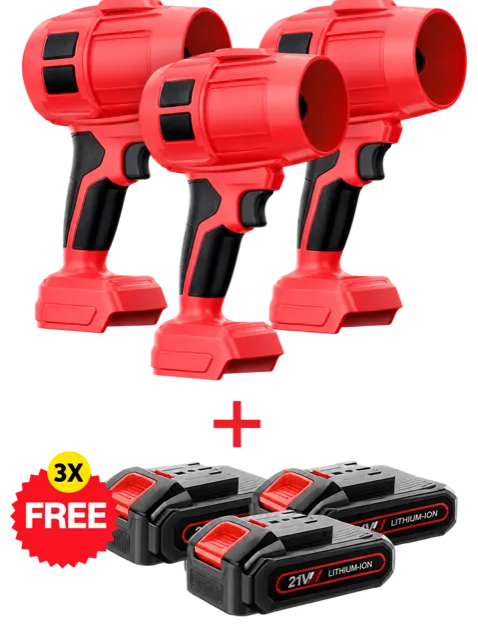
Every bundle repeats the same per-unit contents, one blower, one 24V battery, one charger and both nozzles. The only thing that changes is the price each unit costs you.
PowerStack Leaf Blower Reviews: Drawbacks to Know Before Buying
One, there is still no published CFM or MPH figure. Every performance claim in this review rests on my sessions rather than on manufacturer airflow data, and 55,000 RPM cannot be converted into air volume. If you need a spec sheet before you buy, the hardware-store class will suit you better.
Two, the runtime figure is a best case. Up to 30 minutes is real for feathered-trigger work, and closer to 15 minutes if you hold full turbo. There is no spare battery in the box and no hot-swapping, so plan around a sit-and-recharge cycle.
Three, $69.99 is the top of the mini-blower category. Near-identical compact units sell for less under other names, so you are paying for the bundle and the store rather than for unique hardware.
Four, wet leaves win. Soaked mats, compacted drifts and gutter sludge all resist handheld air pressure regardless of brand. Timing and rakes cover this limit. Power does not.
Five, deep-drift capacity trails gas. A big property under heavy mature trees can overwhelm any handheld battery blower. Half an acre of oaks wants a backpack electric or a gas unit, not a handheld.
Six, returns are handled case by case with no window printed on the site. That is workable, and it puts the burden on you to get the terms in writing before you post anything back.
Tips to Get the Best Results
One, blow with the wind from the house outward. Two, work dry afternoons when leaves are lightest. Three, keep the tube low and angled forward. Four, use short bursts near beds, cars and mulch. Five, corral piles onto a tarp for fast hauling. Six, clear the intake screen when dust builds. Seven, store the battery indoors between sessions. Eight, bag the same evening so wind does not undo the work. Nine, keep the rake handy for wet mats and corners. Ten, feather the variable trigger instead of holding full turbo, because medium sweeps move leaves forward while full speed mostly kicks them upward and drains the pack.
The highest-value habit is the twice-weekly tidy. Leaves that sit get rained on, driven on and matted down, and every stage makes them harder to move. Fifteen dry minutes on Wednesday and Sunday beats a two-hour Saturday battle every time. My cleanest weeks were the ones I touched the blower most often, not the ones I ran it longest.
One more habit for car owners. The blower excels at car footwells and trunk edges where a vacuum nozzle cannot reach. Two minutes with the tube in each footwell blasts crumbs and dry leaves out the open doors. With the concentrator nozzle fitted it also clears keyboard vents, radiator fins and workshop dust, which is the one use where I would call it better than a broom rather than merely faster. It is a small joy, but small joys compound.
And one tip about buying. If you know you will want longer sessions, price a spare 24V battery before you check out rather than discovering the limit in week two. A second pack turns the sit-and-recharge cycle into a swap, and that single change would move the runtime score up a full point for me.
Who Should Buy, Who Should Skip
Buy it if suburbia buries your driveway every October. Dry leaves on hard surfaces are this tool’s home turf, and 9 sessions proved it to me repeatedly. If you are still weighing these Power Stack leaf blower reviews against a hardware-store option, the short answer is that this class wins on weight and quiet, and loses on published specs.
Buy it if noise rules your schedule. Early mornings, napping kids, close neighbors, Sunday ordinances. Quiet clearing buys freedom that loud tools cannot.
Buy it if gas maintenance broke your spirit. Mixed fuel, pull cords, winterizing, shop visits for carburetors. The battery asks for none of it.
Buy it if you want the lightest option available. At 2.1 lb with the battery fitted, this is the tool I would hand to anyone who finds a 6 lb blower tiring in the first five minutes, including older relatives and anyone doing overhead gutter work.
Buy it if quick tidies beat marathon sessions in your life. Ten dry minutes twice a week keeps a property clean with almost no effort. The blower rewards frequency, and frequency rewards you.
Skip it if your property is half an acre of heavy tree cover. You need a backpack electric or gas unit with serious air volume, not a handheld.
Skip it if soaked mats are your main problem. Low wet spots and poor drainage laugh at air pressure. Fix the drainage, keep the rake.
Skip it if you need verified specs before buying. No CFM, no amp-hours, no decibel figure on any reachable page. The big-brand class with published numbers will suit you better.
Skip it if you want a spare battery in the box. One pack is included, and if you already know you need continuous runtime, buy into a tool ecosystem with swappable packs instead.
Final Verdict on PowerStack Leaf Blower Reviews
Three weeks ago I was facing October with a rake and a grudge. The PowerStack cleared 9 sessions of dry leaves without fuel, without noise complaints and without a single failed start. The driveway stayed clean, the patio stayed usable, and Sunday mornings stayed quiet. For the job it is built for, it works, and that is the honest bottom line of these PowerStack Leaf Blower reviews: buy it for dry hard surfaces, keep the rake for the wet days, and confirm the price on the offer page before you pay.
The score breaks down honestly. Clearing performance 8, ease of use 8.5, build and ergonomics 8, battery and runtime 7.5, value for money 8, transparency and trust 8.5. That averages to 8.1 out of 10. The deductions cluster in one place, and it is no longer the store. Missing airflow specs, a runtime figure that assumes a feathered trigger, a price at the top of the mini class and case-by-case returns are what stand between this and a nine.
The tool earned its points in my yard, and with a live store and a published spec sheet, the paperwork finally earned its share too.
Buy it for dry leaves on hard surfaces with eyes open. Confirm the price, the return window in days and the delivery date on the offer page before paying. And when it arrives, charge it fully, start with a dry afternoon, work with the wind, and enjoy the quietest yard tool you have ever owned.
Key Specifications
| Product Name | PowerStack Blower |
|---|---|
| Type | Cordless handheld electric leaf blower |
| Motor | 55,000 RPM brushless turbo motor, variable-speed trigger |
| Battery | 24V lithium-ion, included with charger |
| Weight | 2.1 lb (0.95 kg) with battery fitted |
| Runtime | Up to 30 minutes per charge, about 15 minutes at full trigger |
| Charge Time | About 1 hour to full |
| Nozzles | Wide nozzle plus concentrator nozzle, both in the box |
| Air Output | No CFM or MPH figure published by the brand |
| Noise | No published dB rating; quieter than 2-stroke gas in side-by-side use |
| Price | $69.99 for one, $51.25 each at the four-pack |
| Shipping | US, Canada, UK, Ireland, Australia, New Zealand and much of Europe |
| Guarantee | Returns and fault claims handled by email support before anything is posted back |
| Where to Buy | Official offer page via this review |
PowerStack Leaf Blower earns 8.1/10: very good — recommended with minor caveats. Tested for 3 weeks across a 40-foot driveway, a 12 by 14 patio, dry gutter runs, and 9 full clearing sessions.
- Best part: Cordless handheld format with no fuel mixing, no pull cord, and no winterizing
- Best part: 2.1 lb with the battery fitted, so one-handed gutter and patio work costs no shoulder
- Best part: Quiet enough for early Sunday sessions that a gas blower would make antisocial
- Biggest catch: Still no published CFM, MPH, decibel or amp-hour figures, and no independent lab has tested it
Common Questions & Answers
Q: Does the PowerStack Leaf Blower actually work?
Yes, for the job handheld cordless blowers are built for. Dry leaves on driveways, patios, decks and paths move fast with almost no effort. In my testing a full 40-foot driveway of dry oak leaves cleared in a single session, and that held across all 9 sessions. The boundary is wet matted leaves and deep compacted drifts, which need a rake or a gas blower regardless of brand. If your leaves are dry and your areas are hard surfaces, it works exactly as hoped.
Q: How long does the PowerStack battery last?
The brand now publishes up to 30 minutes per charge on a 24V lithium pack, with about an hour to recharge. Treat 30 minutes as the feathered-trigger figure. Third-party label listings put full-trigger running time at roughly 15 minutes, which matches what I saw on heavier sessions. Every one of my 9 driveway-plus-patio clearing jobs finished on one charge with power left for touch-ups. Buy it for hard-surface clearing and quick sessions, and expect a sit-and-recharge cycle rather than hot-swapping a spare.
Q: Can PowerStack replace a gas leaf blower?
For suburban hard-surface clearing, yes. For deep drift and wet-mat work, no. My neighbor's 2-stroke moves a volume of air no handheld battery blower matches, and it shows on soaked piles. But the gas unit wins only that contest. It loses on noise, fumes, fuel mixing, pull starts and maintenance. I cleared my whole property electrically for 3 weeks and never missed the gas. Properties over half an acre of heavy tree cover, or commercial work, still belong to gas or backpack electrics.
Q: Is the PowerStack Leaf Blower quiet?
Noticeably quieter than any gas blower I have stood next to. The sound is a fan hum rather than an engine scream, and I ran full Sunday-morning sessions without a single neighbor glance. No published decibel rating exists, so I make no numerical claim about this unit. For reference, researchers at NIOSH set 85 decibels over 8 hours as the recommended exposure limit, and gas blowers routinely exceed it. This blower sits comfortably below that class. Earplugs still make sense for long full-trigger runs.
Q: How much does the PowerStack Leaf Blower cost?
The official store lists $69.99 for one blower with battery, charger and both nozzles, dropping to $58.99 each for two, $56.00 each for three and $51.25 each at four. Shipping and tax are shown on the payment step before you confirm. A third-party review notes that near-identical compact turbo blowers sell for roughly $25 to $45 under other names, so $69.99 is top of category rather than a bargain. Treat every price as a snapshot and confirm the total on screen before paying.
Q: What is the PowerStack return policy?
Email support with your order number and a one-line reason before posting anything back. They reply with the current return address, instructions, and whether postage is your responsibility or theirs, plus whether a refund or replacement applies. There is no fixed return window printed on the site, so confirm the number of days in that reply and screenshot it. Faults follow the same route, with a photo or short video attached. Nothing on their support page limits your statutory rights.
Q: Does it work on wet leaves?
Dry leaves, beautifully. Damp leaves, slowly with repeated passes. Soaked matted leaves, no, and neither does any handheld blower I have used. Water glues leaves to pavement with more force than air pressure in this class can break. My day 11 failure came from trying exactly that after overnight rain. The fix is timing, not power. Clear leaves dry the afternoon they fall, and keep the rake for the soaked leftovers. Anyone promising a handheld blower that moves wet mats is selling, not informing.
Q: Is PowerStack good for gutters?
For dry gutters, yes with care. I cleared a 30-foot gutter run of dry maple helicopters and leaf bits in about 20 minutes from a stable ladder, working in short bursts toward the downspout. At 2.1 lb the unit is light enough to hold overhead without the shoulder ache a heavier tool gives you. Never lean, never overreach, and never use a blower on a ladder in wind. For packed gutter sludge a scoop beats air every time. If gutters clog constantly, guards solve the problem better than any blower.
Q: Can I use PowerStack in the UK?
Yes, the official store ships to the UK, Ireland, Australia, New Zealand, Canada and much of Europe alongside the US. Confirm the delivery window, total landed cost with any duties, and the charger plug type on the payment step before ordering, since those vary by destination. Also note that many UK councils restrict noisy garden equipment on Sundays, which is exactly where a quiet electric blower earns its keep. Check your local rules alongside the shipping terms.
Q: Is PowerStack a legit company?
The store is live, takes payment through Stripe, publishes a spec sheet, a returns page and a support page, and answers at a support address on the domain. Third-party review sites list the seller as NH Discounts LLC shipping from Ohio, and I found an independent review scoring the unit 8.8 out of 10. What is still missing is a published CFM figure, a decibel rating and a fixed return window. Honest merchant, thin datasheet. Those are different problems, and only one of them should slow you down.
Q: What maintenance does a cordless blower need?
Almost none, which is the point. No fuel, no oil mixing, no spark plug, no air filter, no winterizing. My routine across 3 weeks was wiping the intake clear of dust, checking the tube for stuck twigs, and storing the battery at room temperature between sessions. Do not store batteries fully flat for months, and do not leave them baking in a hot shed. That is the entire maintenance manual. Compare it with a 2-stroke winter routine and the appeal writes itself.
More Smart Home Reviews

Related Guides & Articles
Browse all 27 Smart Home articles »

Smart home enthusiast and IoT specialist. Has automated over 50 homes across different ecosystems. Former smart home consultant for Google Nest and Amazon Alexa. Passionate about making technology accessible.