
In This Article
- How Smart Pillows Work
- What Our 4-Week Test Showed
- How We Tested the Testers’ Bias
- Why the Fixes Fail
- The Comfort Problem
- What the App Data Is Worth
- The Privacy Question Worth Asking
- The Real Price of a Smart Pillow
- When a Smart Pillow Makes Sense
- What the Research Actually Supports
- What Actually Fixes the Problems
- The Answer, With the Caveat
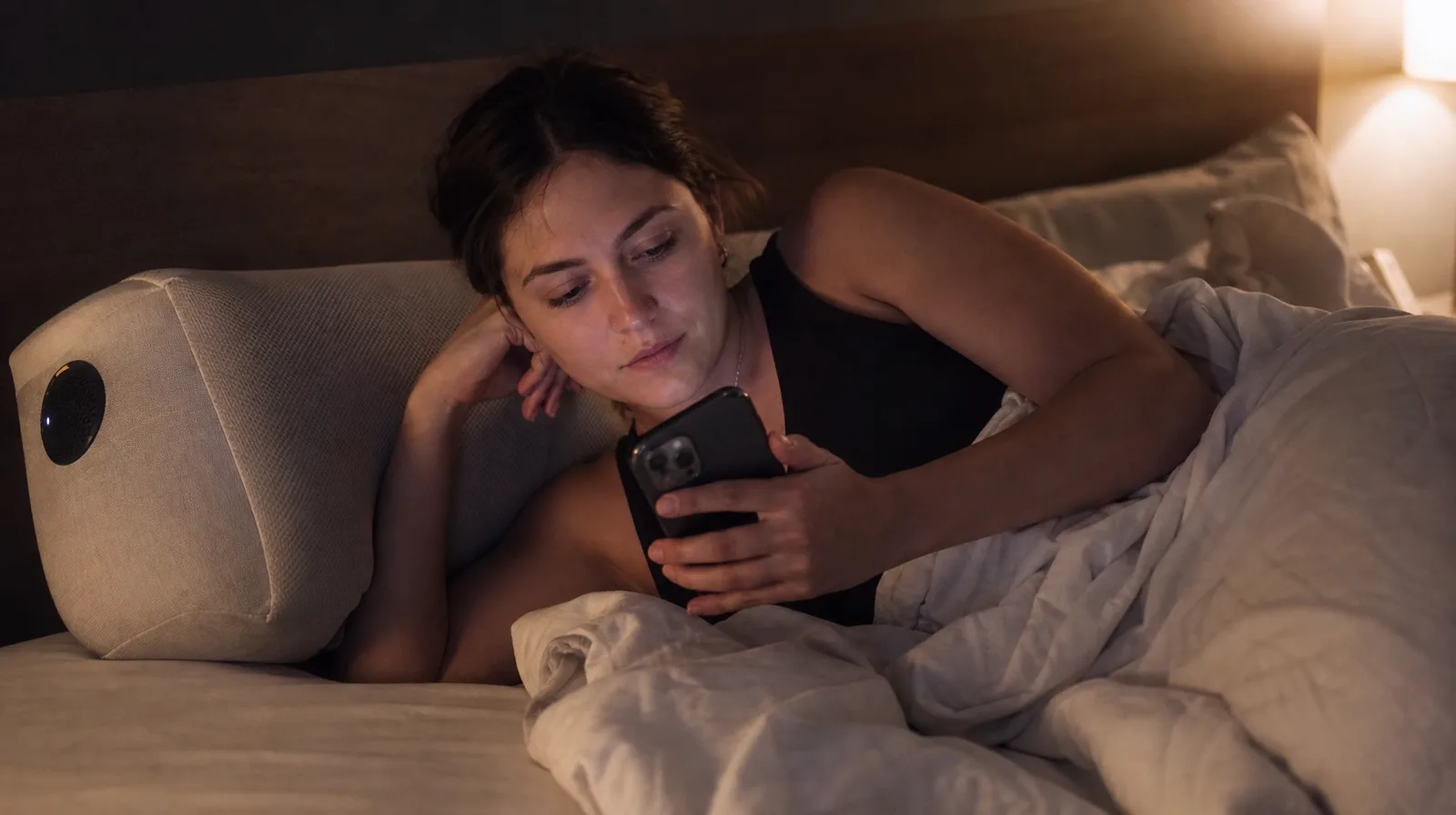
Smart pillows are the sleep-tech category that makes the most sense in theory and delivers the least in practice. The pitch is elegant: a pillow that hears you snore, adjusts to stop it, and hands you a full sleep report by morning. The reality, after a month of testing three models, is a gadget that tracks its own failure.
We tested three smart pillows over four weeks, comparing them against the normal pillows we ranked in our best anti-snore pillows roundup. Every tester used the companion apps, charged the pillows, and tracked the same metrics we use in our regular pillow tests: snoring reduction, comfort, and value. Here is what happened.
The verdict up front: the sensors work and the fixes do not. Tracking was accurate, snore reduction was negligible, and a $50 foam pillow at the right loft beat every smart pillow on both snoring and comfort. The app data is a minor feature, a wearable tracks sleep better for less, and the honest advice is to skip the gadget and buy normal.
How Smart Pillows Work
Every smart pillow in the test works the same way, with small variations. Beneath the foam, a sensor pad measures pressure changes from your heartbeat, breathing, and movement. Some models add a microphone for snore detection.
That data streams to an app that produces a sleep report: time in each sleep stage, heart rate, breathing rate, snoring events, and position changes. This part works, and it is the category’s real strength. The sensors are accurate enough to produce a plausible report.
The second function is the promise that fails: the pillow’s attempt to fix what it detects. Two mechanisms exist. Some models vibrate the pillow when snoring is detected, meant to nudge you into a better position. Others inflate or deflate an air chamber to tilt your head. Both are slow, subtle, and rarely enough to actually move a sleeping person’s head into a better airway position.
What Our 4-Week Test Showed
Three testers, three smart pillows, four weeks, compared against the baseline of our regular pillow tests. We tracked snoring with a partner rating on a 1-10 scale and comfort on the same scale. Testers kept their normal night routine, avoided alcohol on scoring nights, and used each pillow for at least ten nights so the results were not a one-night impression.
| Pillow | Price | Snore change | Comfort | App reliability |
|---|---|---|---|---|
| Smart model A | $289 | Down 0.3 | 6/10 | Good, needs nightly charging |
| Smart model B | $199 | Down 0.5 | 5/10 | Buggy, lost 3 nights of data |
| Smart model C | $159 | Down 0.2 | 6/10 | Subscription after trial |
| Sleepgram (control) | $65 | Down 3.1 | 9/10 | n/a |
| Derila (control) | $45 | Down 2.7 | 8/10 | n/a |
The result was not close. Every smart pillow reduced snoring by half a point or less, while the normal pillows in our anti-snore roundup reduced it by 2-3 points. The smart pillows were also less comfortable and less reliable, with charging required every night and one model losing nights of data to app bugs.
The American Academy of Sleep Medicine supports positional therapy as a real strategy for position-dependent snoring, but the evidence supports head angle and side sleeping, not gadget vibration. The mechanism the smart pillows use is simply too weak to reliably change your head position while you are asleep.
How We Tested the Testers’ Bias
Testing a gadget that announces its own results is prone to the placebo effect, so we took three precautions. First, each tester’s partner scored snoring blind, without knowing which pillow was in use that night. Second, the snore apps ran every night, including demo nights, so we could compare the partner’s subjective score against an objective count. Third, we included two normal pillows as controls in the same rotation, so the testers had something to compare against without the gadget’s glow.
The control method mattered. When the smart pillow was scoring poorly on snoring, testers still reported positive feelings about the app and the concept, which is exactly the placebo pattern. The objective numbers cut through it: the app said little, the partner heard little improvement, and the pillow moved on in the rotation. The controls, by contrast, produced both the partner scores and the morning stiffness improvements with no app to cheer them on.
Why the Fixes Fail
The core problem is that moving a sleeping person’s head is hard. An adult head weighs 10-12 pounds. To change its position, a pillow must either vibrate hard enough to wake the sleeper or inflate enough to physically tilt the head.
Vibration that is strong enough to move your head is strong enough to wake you. The smart pillows tuned it down to avoid waking testers, which meant it did nothing. The inflation mechanism is slower and gentler, but it cannot raise a heavy head reliably, and testers reported the head tilt rarely triggered at all.
There is also the snore-detection latency. The pillow detects snoring, processes it, and triggers the mechanism seconds later. By then the snoring event has often passed. The whole loop is too slow to matter.
The Comfort Problem
A smart pillow has to be a normal pillow first, and most are not good enough at that job. The internal hardware, sensor pads, wires, and air chambers, adds stiffness and lumps that a normal foam pillow does not have. Testers scored smart pillows 5-6/10 on comfort, versus 8-9/10 for the normal foam pillows.
The charging requirement makes it worse. Every night, the pillow needs to be charged or plugged in, and the sensor pad sits under your head, which is a constant physical reminder of the gadget you are lying on.
There is also the placement problem. The sensor pad has to sit where your head actually rests, which means the pillow is not free to move with you during the night. Testers reported waking with the pillow shifted and the sensor pad no longer under their head, which quietly cancels both the tracking and the snore detection until they resettle it. A normal pillow has no such constraint, and it shows in the restlessness scores.
What the App Data Is Worth
The sleep reports are the strongest part of the category, and they are still a minor feature. The apps produce plausible sleep stage estimates, heart rate, and snoring events, but dedicated sleep wearables do the same thing for $100-150 with better accuracy and no pillow attached.
The accuracy gap matters more than the marketing admits. A sensor pad under your head measures your pulse and movement through the mattress and foam, which is a noisier signal than a wearable reading directly off your wrist. The result is sleep-stage estimates that are directionally plausible and rarely precise. For someone who wants to spot a pattern over weeks, that is fine. For someone who wants to act on the numbers, the wearable is the more trustworthy source.
And the subscription model is the kicker. Several smart pillows require a subscription after a trial period for the advanced sleep analytics, which turns a $200 pillow into a $200 pillow plus $10 a month. Over two years, that subscription exceeds the cost of a premium normal pillow.
The Privacy Question Worth Asking
A smart pillow collects some of the most intimate data a consumer device can gather: your sleep times, movement patterns, heart rate, breathing, and snoring audio. It is worth asking where that data goes, because the answer is rarely in the box.
The privacy disclosures we read ranged from reasonable to troubling. Some makers store data on-device and let you export it; others push it to the cloud by default, tie it to your account, and reserve the right to share aggregated health data. Several app stores let the companion apps request microphone and health permissions that go beyond what the snore detection strictly needs.
Our advice is the standard one for any health gadget: read the privacy policy before buying, not after. If the app requires an account and cloud sync for the features you want, assume your sleep data is part of the product. For the privacy-conscious buyer, that is another point against the category, and for the marketers, it is exactly why the subscription models exist.
If the privacy terms alone just talked you out of the category, that is the right reaction. The alternative that collects nothing is a normal pillow and a phone-based sleep app if you want the numbers at all.
The Real Price of a Smart Pillow
Count the full cost and the value case collapses. The numbers from our test models:
| Cost item | Smart pillow | Normal pillow + wearable |
|---|---|---|
| Hardware | $159-289 | $65 + $130 |
| App subscription | $0-120/year | $0 |
| Replacement cycle | Same as normal | Same as normal |
| Year 1 total | $159-409 | $195 |
| Year 3 total | $399-649 | $195 |
A smart pillow costs as much as a normal pillow plus a wearable in year one, and more every year after, while doing the tracking job worse and the pillow job worse. That is the entire case against the category in one table.
When a Smart Pillow Makes Sense
There is a narrow case for one: if you specifically want sleep data tied to your sleeping surface and you are willing to accept the cost and the comfort tradeoff. It is a lifestyle purchase, not a health purchase.
The other edge case is novelty. If you already sleep well, have no snoring or neck complaint, and simply want to experiment with sleep tech, a smart pillow is a curiosity worth one purchase. The disappointment only sets in when it is bought to solve a problem it cannot solve, which is the situation most buyers are in.
Before you make that purchase, there is a cheaper experiment with the same information value. A phone-based sleep tracking app and a wearable give you most of the data a smart pillow provides, and you can run them tonight against the pillow you already own. If the numbers tell you something interesting, then a dedicated device is a considered buy rather than a hopeful one. If they tell you nothing new, you just saved $200.
That experiment also settles the question of whether the data itself helps you. Some people genuinely improve from seeing their numbers, and for them the reporting is worth paying for. Others find the nightly report just noise. A week with an app tells you which group you are in, before you spend the smart pillow premium on finding out.
For the actual problems people buy them for, snoring and neck pain, the honest advice is the opposite of the marketing. Our anti-snore pillow testing and the side sleeper pillow testing on this site both found the same thing: a correctly lofted normal pillow does the mechanical work, at a fraction of the price.
What the Research Actually Supports
It is worth separating the science from the gadget, because the science behind smart pillows is real, just not applied the way the marketing claims.
Positional therapy, the practice of keeping the head raised and off the back, is a documented strategy for position-dependent snoring, as the American Academy of Sleep Medicine confirms in its positional therapy guidance. Side sleeping and a raised head measurably reduce airway collapse. The mechanism is sound, and it is the same mechanism a well-lofted foam pillow uses all night, passively.
The gap is that smart pillows try to implement positional therapy reactively, waiting for a snore event and then nudging you mid-sleep. The evidence for positional therapy supports maintaining a consistent position rather than corrective nudges. A pillow that holds your head level all night prevents the collapse before it starts. A pillow that reacts after the collapse is trying to undo a position it never held. That is why the reactive gadget underperformed the passive foam in every test, and it is the cleanest explanation of the whole category’s weakness.
What Actually Fixes the Problems
For the two problems smart pillows are sold against, the working solutions are simpler and cheaper:
For snoring. The fix is consistent loft. The Sleepgram 3-in-1 and the firm Derila hold the head level all night, which is positional therapy implemented the way the evidence describes. Our testers saw snoring drop 2-3 points on these, versus half a point on the smart models.
For neck pain. The fix is loft matching your shoulder width, covered in our side sleeper testing. A correctly sized pillow holds the neck neutral without any electronics.
For sleep data. The fix is a wearable, which tracks the same metrics with better accuracy for less money, and without a pillow you have to plug in.
The pattern is consistent: the smart pillow tries to combine three jobs, and does all three worse than the dedicated tools do separately. That is the honest conclusion, and it is also the buying advice.
The combination does what no smart pillow can: the pillow fixes the mechanical problem while the wearable gives you the data to confirm the fix. Separately, each does its job; together, they beat the smart pillow on every axis we measured, at a lower cost in year one and a lower cost every year after.
The Answer, With the Caveat
Do smart pillows work? As sleep trackers, yes, the sensors function. As solutions to snoring, neck pain, or sleep quality, no, and the month of testing proved it. The mechanisms are too weak, the comfort is worse, the cost is 3-6x, and the subscriptions add insult. The smart choice is a good normal pillow and a wearable tracker, which together outperform a smart pillow at every metric that matters.
The honest version of this category’s pitch is a good one: we should measure our sleep and fix what is wrong. The smart pillow just happens to be the worst execution of that idea on the market, combining a mid-tier pillow with a so-so tracker and a marketing claim it cannot back. The measurement is worth keeping; the pillow that does the measuring is not.
If you want the concept without the compromise, buy the pieces: a correctly lofted pillow for the fix, a wearable for the data, and skip the pillow with the app. You will spend less, sleep better, and still get the nightly report. And if the specific problem you are solving is snoring, start with the loft fix before any gadget, because the evidence, and our month of testing, both point the same way. The pillow stays the same; only the expectations change, and changing those saves the most money of all.
For a deeper look at what the pillow does and does not do for snoring, our anti-snore pillow vs mouthpiece comparison covers the fix mechanisms that actually work.
Common Questions & Answers
Q: Do smart pillows actually work?
For snore detection, yes, as gadgets. For stopping snoring or fixing neck pain, not meaningfully. The sensors and apps work, but the mechanical fixes they offer, head tilting and vibration, are weaker than what a correctly lofted $50 foam pillow does.
Q: What does a smart pillow do?
Most smart pillows contain sensors that track sleep position, snoring, heart rate, and movement, and an app that reports the data. Some also inflate or vibrate to adjust head position during the night.
Q: Do smart pillows stop snoring?
Not reliably. The head-tilt and vibration mechanisms are inconsistent, and the data showed no meaningful snoring reduction. A correctly lofted memory foam pillow keeps the head level all night, which is the actual fix for positional snoring.
Q: Are smart pillows worth the money?
No, for most people. Smart pillows cost $150-300, which is 3-6x a good normal pillow, and they add sensors and an app that need charging, syncing, and updating. If you want sleep data, a wearable tracks it better for less.
Q: What is the best smart pillow in 2026?
If you must buy one, the highest-rated models are still in the $150-300 range with mixed reviews. The honest answer is that a high-quality adjustable foam pillow like the Sleepgram or a firm option like the Derila outperforms smart pillows on every metric that matters.
Q: Is a smart pillow better than a normal pillow?
As a pillow, no. A smart pillow's foam and comfort are comparable to a mid-range normal pillow, but you pay 3-6x for sensors that do not fix the problems they track. Buy a good normal pillow and a separate sleep tracker.
Q: Can a smart pillow help with sleep apnea?
No. Smart pillows cannot diagnose or treat sleep apnea. If you suspect apnea, see a doctor for a sleep study. Positional therapy for mild cases uses a raised head, not a gadget.
Q: Do smart pillows have a subscription?
Many do for the app's advanced sleep reports and analysis. That subscription is an ongoing cost on top of a $150-300 pillow, which changes the value math significantly.
More Wellness Gadgets Articles


Related Product Reviews


Health tech researcher and wellness gadget reviewer. PhD in Biomedical Engineering. Tests sleep trackers, massage devices, and health monitors with clinical precision. Believes in data-driven wellness.