
Alternator Replacement Cost in 2026: New vs Remanufactured
Alternator replacement costs $350-$1,000 depending on your vehicle. Compare new vs remanufactured vs rebuilt, symptoms of failure, and how to test with a multimeter.

Tech Reviewer
In This Article
- What the Alternator Does
- Symptoms of a Failing Alternator
- Early Warning Signs
- Moderate Signs
- Severe Signs (Act Now)
- How to Test Your Alternator with a Multimeter
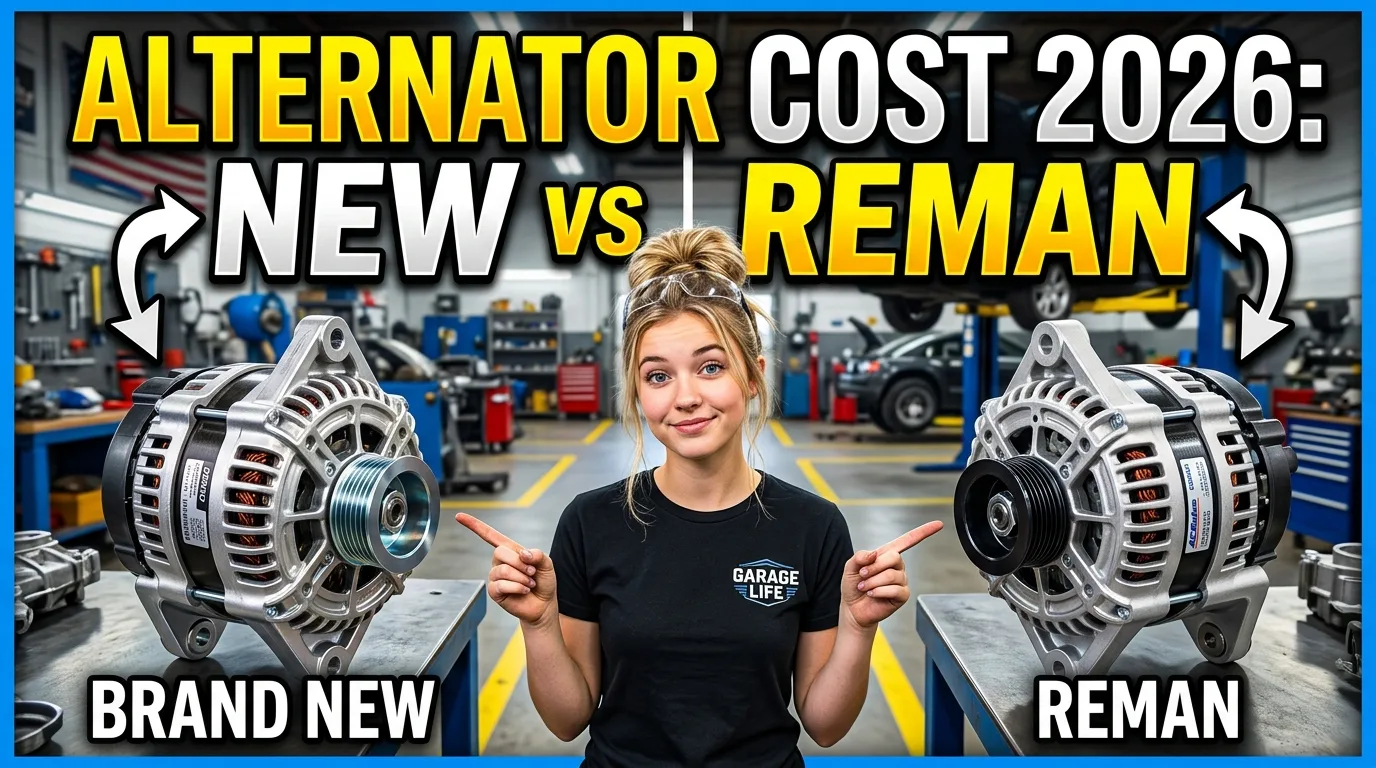
- New vs Remanufactured vs Rebuilt Alternators
- New Alternator
- Remanufactured Alternator
- Rebuilt Alternator
- Alternator Replacement Cost by Vehicle
- Economy Cars (Civic, Corolla, Sentra, Elantra)
- Mid-Size Sedans and SUVs (Camry, Accord, RAV4, CR-V, Rogue)
- Trucks and Full-Size SUVs (F-150, Silverado, Tahoe, RAM, 4Runner)
- Luxury and Performance (BMW, Mercedes, Audi, Lexus, Porsche)
- European vs Japanese vs American
- DIY Alternator Replacement
- Tools Required
- Step-by-Step (General Process)
- Common DIY Mistakes
- How Long Alternators Last
- Signs the Battery Is Fine but the Alternator Is Bad
- What Happens If You Don’t Fix It
- Seasonal Considerations
- Summer Heat
- Winter Cold
- Brand-Specific Alternator Pricing
- How FIXD Helps
- The Bottom Line
Your battery light came on. The headlights are dimming at idle. The radio cuts out when you stop at a red light. These are the classic signs of a dying alternator, and ignoring them means you’re driving on borrowed time before the battery dies and you’re stuck on the side of the road.
Alternator replacement isn’t the most expensive car repair, but it’s not cheap either. The cost depends on whether you go new, remanufactured, or rebuilt, and how accessible the alternator is on your specific engine. I’ve seen people spend $300 on a Honda alternator swap and $1,200 on a BMW. The difference is mostly labor and part markup, not difficulty.
What the Alternator Does
The alternator is a generator that runs off a belt connected to the engine. When the engine is running, the alternator:
- Charges the battery. It converts mechanical energy into electrical energy to keep the battery topped up.
- Powers the electrical system. Every electrical component in your car (lights, radio, power windows, ECU, ignition) runs off the alternator when the engine is running.
- Regulates voltage. The internal voltage regulator keeps output between 13.5 and 14.5 volts.
When the alternator fails, the battery takes over. A fully charged car battery lasts 30-60 minutes before it’s dead. Then everything shuts off. No lights, no ignition, no power steering. You’re coasting to the shoulder with nothing but momentum.
Symptoms of a Failing Alternator
Catching a failing alternator early saves you from getting stranded. Here are the telltale signs, roughly in order from earliest to most severe:
Early Warning Signs
- Dimming headlights: The most obvious early sign. Lights are bright at higher RPMs and dim at idle because the alternator can’t keep up with demand. Watch the dashboard lights too; they’ll dim when you accelerate hard (high electrical load) if the alternator is struggling.
- Battery warning light: The dash light comes on when the alternator output drops below a threshold. This is your car’s built-in warning system. Don’t ignore it.
- Electrical accessories acting weird: Power windows moving slowly, radio cutting out, dashboard lights flickering, or the heated seats cycling on and off. These are all signs the alternator can’t maintain consistent voltage.
Moderate Signs
- Dead battery (that tests fine): The battery isn’t bad. The alternator just isn’t charging it. If you’ve jumped the car and it runs fine for a while but dies again, the alternator is the problem.
- Whining noise from the engine bay: Worn bearings inside the alternator produce a growling or whining sound that changes pitch with engine RPM. The sound gets louder as the bearings deteriorate.
Severe Signs (Act Now)
- Stalling: If the alternator can’t power the ignition system, the engine stalls. This is dangerous in traffic.
- Multiple warning lights: When voltage drops low enough, the ECU can’t function properly, and you’ll see the check engine light, battery light, and sometimes the ABS or traction control lights all at once.
- Burning smell: A failing alternator can overheat and produce a hot, electrical burning smell from the engine bay.
A dead battery that keeps dying is almost always the alternator. Before you buy a new battery, test the alternator.
How to Test Your Alternator with a Multimeter
This takes 2 minutes and saves you from misdiagnosing a $50-$100 battery replacement when the real problem is a $350-$1,000 alternator.
- Set your multimeter to DC volts (20V range).
- Test the battery with the engine off. Touch red to the positive terminal, black to negative. A healthy battery reads 12.4-12.7V.
- Start the engine. Test again. The reading should jump to 13.5-14.5V.
- Rev the engine to 2,000 RPM. The voltage should stay in the 13.5-14.5V range.
- Turn on accessories (headlights, radio, AC) and test again. Voltage should stay above 13V.
Results:
- 13.5-14.5V with engine running: alternator is fine
- Below 13V with engine running: alternator is failing
- Same voltage with engine on and off: alternator is dead
- Above 15V: voltage regulator is bad (part of the alternator)
New vs Remanufactured vs Rebuilt Alternators
This is the decision that determines 50% of your total cost. Here’s the full breakdown:
| Feature | New | Remanufactured | Rebuilt |
|---|---|---|---|
| Part Cost | $300-$700 | $150-$400 | $100-$300 |
| Lifespan | 120,000-150,000 mi | 80,000-120,000 mi | 40,000-80,000 mi |
| Warranty | 1-3 years | 1-2 years | 30-90 days |
| Quality | Best | Good | Varies |
| Core Charge | None | $20-$50 refund | $0-$30 refund |
New Alternator
Brand new components, longest lifespan, full manufacturer warranty. The downside is cost. You’re paying premium prices for parts you don’t always need. Most daily drivers don’t need a new alternator unless they’re under warranty or you’re putting one in a performance build.
Brand pricing (2026):
- Bosch new: $350-$600
- Denso new: $300-$550
- Remy new: $280-$500
- Aftermarket new: $200-$400
Remanufactured Alternator
The sweet spot for most drivers. The alternator gets new bearings, seals, and diodes. The housing and windings are reused, which is fine since those rarely fail. Quality depends on who did the remanufacturing, so buy from established brands.
Brand pricing (2026):
- Bosch reman: $200-$400
- Denso reman: $180-$380
- Remy reman: $150-$350
- Cardone reman: $120-$300
Rebuilt Alternator
The cheapest option. The old alternator gets rebuilt with new bearings and diodes, usually at a local shop or a budget rebuild center. Quality varies wildly. A good local rebuilder can produce a solid unit. A cheap rebuilder uses the cheapest parts possible.
Best for: Older vehicles where you’re not sure the car is worth a $400+ alternator.
Alternator Replacement Cost by Vehicle
The alternator itself is only half the bill. Labor varies dramatically based on how buried the alternator is under the hood.
Economy Cars (Civic, Corolla, Sentra, Elantra)
- Part: $150-$400
- Labor: $100-$200 (1-2 hours)
- Total: $250-$600
These are the easiest alternators to replace. Most sit on top of the engine and are accessible with basic tools. A Honda Civic alternator swap is a 45-minute job for an experienced DIYer.
Mid-Size Sedans and SUVs (Camry, Accord, RAV4, CR-V, Rogue)
- Part: $200-$500
- Labor: $100-$250 (1.5-3 hours)
- Total: $300-$750
Slightly more involved. Some V6 models have the alternator tucked behind other components, adding 30-60 minutes of labor.
Trucks and Full-Size SUVs (F-150, Silverado, Tahoe, RAM, 4Runner)
- Part: $250-$600
- Labor: $150-$300 (2-4 hours)
- Total: $400-$900
Trucks often have bigger, higher-output alternators (150-220 amps vs 90-120 for cars). The alternator is often larger and heavier, and some models require removing the air intake, cooling fans, or other accessories to access it.
Luxury and Performance (BMW, Mercedes, Audi, Lexus, Porsche)
- Part: $400-$800
- Labor: $200-$400 (3-5 hours)
- Total: $600-$1,200
These vehicles use proprietary alternators with built-in smart charging systems. BMW and Mercedes often require coding or registration after replacement. The alternator itself is more expensive, and labor rates at dealer or specialist shops run $150-$250/hour.
European vs Japanese vs American
| Category | Japanese (Honda, Toyota) | American (Ford, GM) | European (BMW, Mercedes) |
|---|---|---|---|
| Part Cost | $150-$400 | $200-$500 | $400-$800 |
| Labor Time | 1-2 hours | 2-4 hours | 3-5 hours |
| DIY Difficulty | Easy | Moderate | Hard |
| Total Cost | $250-$600 | $400-$900 | $600-$1,200 |
DIY Alternator Replacement
If you’re comfortable turning wrenches, replacing an alternator yourself saves $100-$300 in labor. Here’s what you need to know.
Tools Required
- Socket set (10mm, 12mm, 14mm common sizes)
- Wrench set
- Serpentine belt tool or long ratchet
- Multimeter
- Safety glasses
Step-by-Step (General Process)
- Disconnect the battery. Always start here. Remove the negative terminal first.
- Locate the alternator. Check your repair manual for the exact location on your engine.
- Remove the serpentine belt. Use a belt tensioner tool to release tension and slip the belt off the alternator pulley.
- Disconnect the electrical connectors. There’s usually a main power wire (held by a 10mm nut) and a plug connector.
- Remove the mounting bolts. Typically 2-3 bolts hold the alternator to the bracket.
- Swap the pulley if needed. Some replacement alternators don’t come with a pulley. Transfer the old one using a pulley tool.
- Install in reverse order. Bolt it up, reconnect electrical, reinstall the belt, reconnect the battery.
- Test. Start the engine and check voltage at the battery. Should read 13.5-14.5V.
Common DIY Mistakes
- Forgetting to disconnect the battery. You can short the main power wire to the alternator housing and cause sparks, blown fuses, or damage to the ECU.
- Wrong belt tension. Too loose and the alternator won’t spin fast enough. Too tight and you’ll wear out the bearings prematurely.
- Not transferring the pulley. Some budget alternators ship without a pulley. If you install it without one, the belt has nothing to spin.
- Ignoring the core charge. Most auto parts stores charge a $20-$50 core charge that you get back when you return the old alternator. Don’t throw it away.
- Skipping the voltage test. Always verify 13.5-14.5V at the battery after installation. If the voltage is wrong, the replacement unit may be defective.
How Long Alternators Last
Most alternators last 100,000 to 150,000 miles. Factors that shorten lifespan:
- Heat: Alternators mounted near the exhaust run hotter and die sooner. This is a bigger problem in desert climates and in engine bays with poor airflow.
- Water: A deep puddle or car wash can splash water into the alternator. Corrosion kills it. If you drive through deep water regularly, inspect the alternator for corrosion.
- Electrical loads: Aftermarket stereos, amplifiers, light bars, and winches push the alternator harder. If you’ve added significant electrical accessories, consider upgrading to a high-output alternator (160-220 amps vs the stock 90-120 amps).
- Belt tension: A loose or worn serpentine belt reduces alternator output and causes premature bearing wear. Replace the belt every 60,000-90,000 miles.
- Age: Even with low mileage, the diodes and voltage regulator degrade over time. A 15-year-old alternator with 80,000 miles may fail even though it hasn’t hit the typical mileage threshold.
Test your alternator once a year with a multimeter. It takes 2 minutes and catches problems before you’re stranded.
Signs the Battery Is Fine but the Alternator Is Bad
This is the most common misdiagnosis. People spend $100-$200 on batteries they don’t need because they don’t test the alternator first. Here’s how to tell the difference:
It’s the battery if:
- The car struggles to start (slow crank) even with accessories off
- The battery is more than 4 years old
- The battery tests below 12.4V with the engine off
- Jump-starting fixes the problem for more than a day
It’s the alternator if:
- The battery is relatively new (under 3 years)
- The battery tested fine but keeps dying
- The battery warning light is on
- Headlights dim at idle but brighten at higher RPMs
- The car runs fine after a jump-start but dies again within an hour
Our guide on battery replacement cost covers battery diagnostics in detail if you’re not sure which one is failing.
What Happens If You Don’t Fix It
Ignoring a bad alternator escalates fast:
- Day 1-3: Battery light on, dimming lights, minor inconveniences.
- Day 3-7: Battery dies, car won’t start. You jump it, drive 30 minutes, battery dies again.
- Week 2-4: Battery gets deeply discharged repeatedly. Deep discharges permanently damage the battery, so now you need both an alternator AND a new battery.
- Month 2+: Low voltage causes the ECU to behave erratically. You may get false check engine lights, the transmission may shift poorly, and other electronic modules can be damaged.
- Worst case: The alternator seizes, the serpentine belt snaps, and you lose power steering, water pump, and AC all at once. This is a breakdown, not just an inconvenience.
Fix the alternator when you notice the symptoms. The cost goes up every week you wait.
Seasonal Considerations
Summer Heat
Heat is the number one killer of alternators. High underhood temperatures cook the bearings, diodes, and voltage regulator. If you live in Arizona, Texas, or anywhere with brutal summers, expect your alternator to fail closer to 80,000-100,000 miles rather than the typical 120,000-150,000.
Summer also means heavy AC use, which puts more load on the alternator. If your AC is already putting strain on the system and the alternator is marginal, you’ll notice the dimming lights first on hot days with the AC running.
Winter Cold
Cold weather doesn’t kill alternators directly, but it makes a weak alternator’s problems worse. Cold batteries have less cranking power, and a weak alternator can’t charge a cold battery fast enough. This is why cars that barely start in fall become no-starts in January.
If your battery light flickers on cold mornings but goes away once the car warms up, the alternator is probably on its last legs.
Brand-Specific Alternator Pricing
Not all alternators are created equal. Here’s what the major brands cost for common vehicles:
| Brand | Economy Car | Mid-Size | Truck/SUV | Luxury |
|---|---|---|---|---|
| Bosch | $250-$400 | $300-$500 | $350-$550 | $500-$700 |
| Denso | $200-$350 | $250-$450 | $300-$500 | $450-$650 |
| Remy | $180-$350 | $220-$400 | $280-$450 | N/A |
| Cardone | $120-$250 | $150-$300 | $200-$350 | N/A |
| Aftermarket | $100-$250 | $130-$300 | $170-$350 | $250-$450 |
Bosch and Denso are the OEM suppliers for most Japanese and European vehicles. Remy and Cardone dominate the American remanufactured market. Aftermarket units are fine for budget repairs but check the warranty carefully.
How FIXD Helps
The FIXD OBD2 scanner reads electrical system codes that point to alternator problems. Codes like P0562 (System Voltage Low) and P0620 (Generator Control Circuit) indicate charging system issues. FIXD tells you whether the code points to the alternator, the voltage regulator, or the wiring.
That distinction matters. A P0562 code could mean a bad alternator, corroded battery terminals, or a wiring issue. FIXD narrows it down so you don’t replace a good alternator when the real problem is a $5 terminal cleaning.
If your check engine light is on alongside the battery light, read the code first. Our guide on check engine light repair cost covers every common CEL code and what it costs to fix. A bad alternator can also trigger false O2 sensor codes, so check our oxygen sensor replacement cost guide before replacing sensors that are actually fine.
The Bottom Line
Alternator replacement costs $350-$1,000 at a shop. Remanufactured units save 30-50% over new. Test with a multimeter before buying a battery you don’t need. If you’re handy, the DIY savings are $100-$300 depending on your vehicle. The key is catching it early before a dead alternator kills your battery and leaves you stranded.
Frequently Asked Questions
How much does it cost to replace an alternator?
How do I know if my alternator is bad?
Can I drive with a bad alternator?
Is it better to buy a new or remanufactured alternator?
How long do alternators last?
How do I test my alternator with a multimeter?
What happens if I don't fix a bad alternator?
Can a bad alternator cause the check engine light?
Alex Thompson
Consumer electronics reviewer specializing in smart gadgets and innovative tech. Tests 100+ gadgets annually. Previously wrote for The Verge and Wired. Focus on practical daily-use value.
Affiliate disclosure:This article contains affiliate links. If you buy through them, GearPuff may earn a commission at no extra cost to you. It keeps our testing independent and our reviews free.