
Catalytic Converter Replacement Cost in 2026: OEM vs Aftermarket
Catalytic converter replacement costs $800-$4,000+ depending on your vehicle. Compare OEM vs aftermarket vs used options, P0420 codes, and theft replacement costs.

Tech Reviewer
In This Article
- What Does a Catalytic Converter Do?
- How the Catalyst Works
- How Many Catalytic Converters Does Your Car Have?
- Why Catalytic Converters Fail
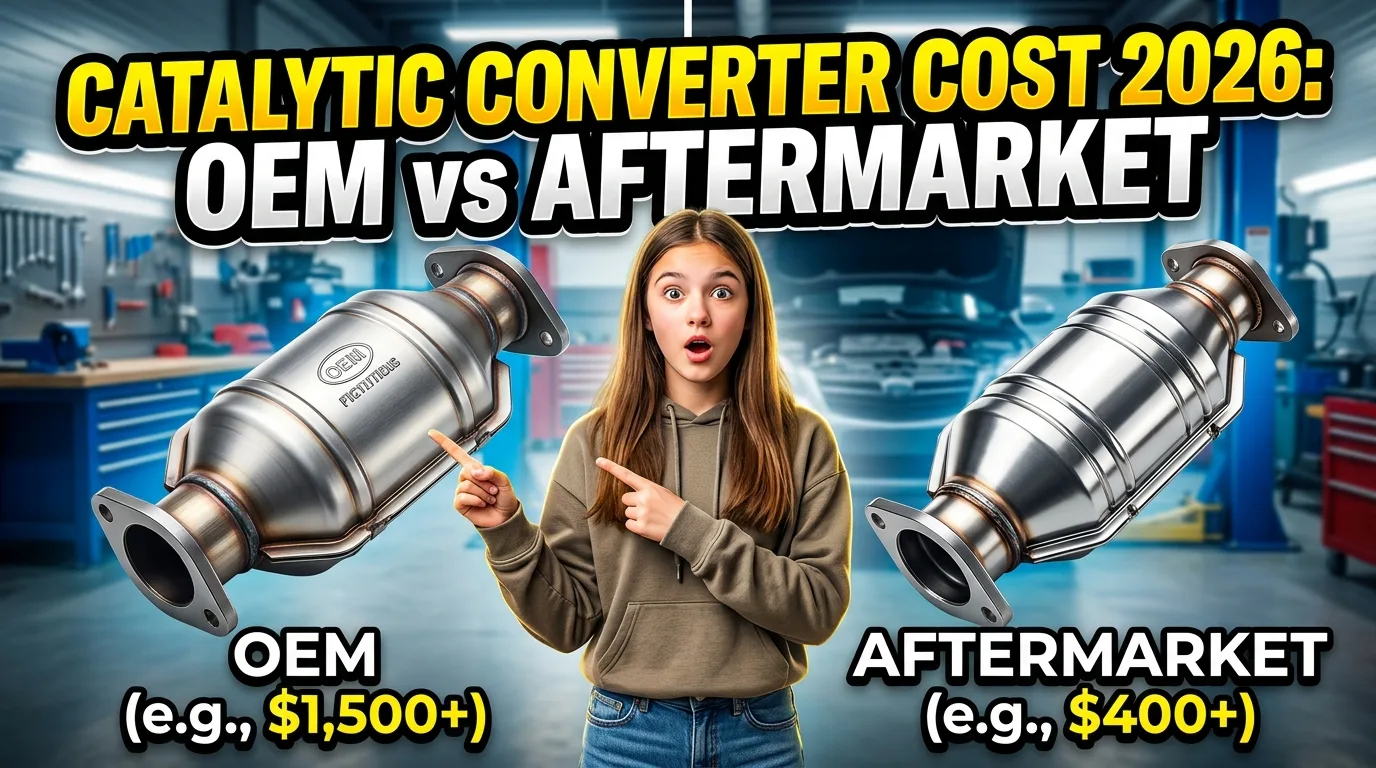
- OEM vs Aftermarket vs Used: The Price Difference
- OEM (Original Equipment Manufacturer)
- Aftermarket (Direct-Fit Replacement)
- Used/Recycled
- California/NY Note
- Brand-Specific Pricing
- Cost by Vehicle Type
- Economy Cars (Civic, Corolla, Sentra, etc.)
- Trucks and SUVs (F-150, Silverado, RAV4, etc.)
- Luxury and Hybrid (Lexus, Tesla, Prius, etc.)
- Vehicle-Specific Cost Examples
- Theft Replacement: A Special Case
- Anti-Theft Device Options
- Most Targeted Vehicles
- Labor Costs Explained
- Labor Time by Vehicle Type
- How to Pass Emissions Temporarily
- How to Tell If It’s the Sensor or the Converter
- How to Choose: Decision Guide
- DIY Catalytic Converter Replacement
- Mistakes to Avoid
- How FIXD Helps
- The Bottom Line
A P0420 code on your OBD2 scanner means your catalytic converter isn’t converting exhaust gases efficiently anymore. It’s one of the most expensive common check engine light fixes, and the repair quotes can be brutal.
Before you assume the converter is dead, check whether a bad oxygen sensor is feeding the ECU bad data. A $150 sensor fix beats an $800+ converter replacement. And if your engine has been misfiring, worn spark plugs might be the root cause. Our check engine light repair cost guide covers how to diagnose P0420 alongside other codes.
But the sticker shock depends on your vehicle, whether you go OEM or aftermarket, and whether you’re replacing it because it failed or because someone stole it off your driveway. Here’s what the repair actually costs in 2026.
What Does a Catalytic Converter Do?
Your catalytic converter sits in the exhaust system between the engine and the muffler. It uses precious metals (platinum, palladium, rhodium) coated on a ceramic honeycomb structure to convert harmful exhaust gases into less harmful ones:
- Carbon monoxide (CO) becomes carbon dioxide (CO2)
- Hydrocarbons (HC) become water and CO2
- Nitrogen oxides (NOx) become nitrogen and oxygen
When the converter degrades, these pollutants pass through untreated. That’s what triggers the P0420 code (Catalyst System Efficiency Below Threshold, Bank 1) or P0430 (Bank 2 on V6/V8 engines).
How the Catalyst Works
The ceramic honeycomb inside the converter has thousands of tiny channels coated with precious metals. Exhaust gases pass through these channels, and the metals catalyze chemical reactions that convert pollutants. Over time, the metal coating degrades from heat, contamination, and age. Once enough coating is gone, the converter can’t clean the exhaust effectively.
How Many Catalytic Converters Does Your Car Have?
- 4-cylinder engine: 1 converter (sometimes 2 on newer models)
- V6 engine: 2 converters (one per bank)
- V8 engine: 2 converters minimum, sometimes 4
- V6/V8 with dual exhaust: Up to 4 converters
Each converter that needs replacement adds $200-$2,000+ to the repair. V6 and V8 engines with two converters face a decision: replace both at once (since the second is probably degraded too) or replace one and hope the other holds.
Why Catalytic Converters Fail
Age and mileage: Most converters last 100,000 to 150,000 miles. After that, the precious metals degrade.
Oil burning: Worn engines that burn oil send contaminants into the exhaust that coat the converter’s catalyst.
Coolant leaks: A blown head gasket sends coolant into the exhaust. The coolant destroys the catalyst.
Overheating: A rich fuel mixture (from a bad oxygen sensor or leaking injector) puts unburned fuel into the converter, which ignites inside it. The converter overheats and melts internally.
Physical damage: Road debris, off-roading, or bottoming out can crack the converter housing.
Contaminated fuel: Lead-based fuel (still used in some aviation and racing applications) coats the catalyst immediately. Even trace amounts of lead in regular fuel can cause cumulative damage.
Excessive stop-and-go driving: Short trips where the engine never fully war up prevent the converter from reaching operating temperature. Condensation builds up inside and corrodes the catalyst over time.
The FIXD OBD2 scanner reads the P0420 code and tells you whether it’s the converter or the oxygen sensors causing the reading. Sometimes a bad upstream O2 sensor mimics a dead converter. Replacing the sensor ($150-$400) beats replacing the converter ($800-$4,000).
OEM vs Aftermarket vs Used: The Price Difference
OEM (Original Equipment Manufacturer)
- Cost: $1,000-$2,500+ for the part alone
- Pros: Guaranteed fit, meets all emissions standards, longest lifespan (100,000+ miles warranty on some)
- Cons: Most expensive option, may need to be ordered from the dealer
Aftermarket (Direct-Fit Replacement)
- Cost: $200-$800 for the part
- Pros: 40-60% cheaper than OEM, direct-fit options bolt right in
- Cons: Quality varies wildly, may trigger P0420 again within 1-2 years, not CARB-compliant in all states
Used/Recycled
- Cost: $100-$400 for the part
- Pros: Cheapest option, OEM quality if from a low-mileage vehicle
- Cons: Unknown remaining lifespan, may not pass emissions in your state, limited availability
California/NY Note
California and New York require CARB-compliant (California Air Resources Board) catalytic converters. Aftermarket CARB-compliant converters cost $400-$1,200 for the part, more than standard aftermarket but less than OEM. If you live in these states, make sure any aftermarket converter is CARB-stamped or you’ll fail emissions.
Brand-Specific Pricing
| Brand | Type | Price Range | Warranty | Best For |
|---|---|---|---|---|
| Bosal | Aftermarket | $200-$600 | 2 years | Budget-friendly direct-fit |
| Magnaflow | Aftermarket | $300-$800 | 3 years | Quality aftermarket |
| Eastern Catalytic | Aftermarket | $250-$700 | 5 years | Long warranty coverage |
| Walker | Aftermarket | $150-$500 | 1 year | Economy option |
| DEQ (Dorman) | Aftermarket | $200-$600 | 2 years | Wide vehicle coverage |
| OEM (Dealer) | OEM | $800-$2,500+ | Varies | Guaranteed fit and function |
Cost by Vehicle Type
Economy Cars (Civic, Corolla, Sentra, etc.)
- Part: $200-$800 (aftermarket) / $800-$1,500 (OEM)
- Labor: $100-$250
- Total: $300-$1,750
These are the cheapest to fix. The converter is usually accessible from underneath, and there are tons of aftermarket options.
Trucks and SUVs (F-150, Silverado, RAV4, etc.)
- Part: $400-$1,200 (aftermarket) / $1,200-$2,500 (OEM)
- Labor: $150-$350
- Total: $550-$2,850
Trucks often have two converters (one per bank on V6/V8 engines). Replacing both doubles the part cost.
Luxury and Hybrid (Lexus, Tesla, Prius, etc.)
- Part: $800-$2,500 (aftermarket) / $2,000-$4,000+ (OEM)
- Labor: $200-$500
- Total: $1,000-$4,500+
Hybrids like the Toyota Prius are targeted by thieves because their converters contain higher concentrations of precious metals. The OEM replacement is painfully expensive, which is why aftermarket CARB-compliant options are worth researching.
Vehicle-Specific Cost Examples
| Vehicle | OEM Converter | Aftermarket Converter | Total at Shop |
|---|---|---|---|
| Honda Civic (2016-2022) | $800-$1,200 | $250-$500 | $350-$1,400 |
| Toyota Corolla (2014-2022) | $900-$1,300 | $250-$550 | $350-$1,500 |
| Ford F-150 (2015-2022) | $1,200-$2,000 | $400-$800 | $550-$2,200 |
| Toyota Camry (2012-2022) | $1,000-$1,500 | $300-$600 | $400-$1,700 |
| BMW 3 Series (2012-2022) | $1,500-$2,500 | $500-$1,000 | $700-$2,800 |
| Toyota Prius (2010-2022) | $1,500-$3,000 | $500-$1,200 | $700-$3,500 |
Theft Replacement: A Special Case
Catalytic converter theft has exploded in recent years. Thieves can cut one off in 2 minutes with a reciprocating saw and sell it for $500-$1,500 in scrap value.
If yours gets stolen:
- Insurance: Comprehensive coverage usually pays for replacement minus your deductible. Call your insurer first.
- Without insurance: $1,500-$5,000+ depending on your vehicle. Aftermarket converters are the move here.
- Anti-theft devices: A catalytic converter lock or shield costs $100-$300 installed and deters most thieves.
Hybrid owners (Prius, Insight, NX Hybrid) should seriously consider an anti-theft device. Your converter is a prime target.
Anti-Theft Device Options
| Device Type | Cost (Installed) | Protection Level | Best For |
|---|---|---|---|
| Catalytic converter lock | $100-$200 | Moderate | All vehicles |
| Cat clamp (cable lock) | $150-$250 | Good | Most vehicles |
| Shield/cover plate | $200-$350 | High | Trucks, SUVs |
| Etching/marking | $50-$100 | Deterrent | All vehicles |
| Full underbody shield | $300-$500 | Very high | High-theft risk vehicles |
The best approach is combining a physical lock with etching. Etching your VIN on the converter makes it harder for scrap yards to buy stolen parts, and the physical lock adds 5-10 minutes to the theft attempt. That’s usually enough to make a thief move on.
Most Targeted Vehicles
- Toyota Prius (highest concentration of precious metals)
- Honda Insight
- Toyota Tacoma
- Honda CR-V
- Ford F-Series
- Chevy Silverado
- Subaru Crosstrek and Outback
- Lexus RX and NX hybrids
If you drive one of these, an anti-theft device pays for itself after preventing one theft.
Labor Costs Explained
Catalytic converter labor is $100-$350 depending on:
- Accessibility: Front converters (bolted to the exhaust manifold) are easier than rear converters (welded into the exhaust pipe).
- Vehicle: Cars with the converter built into the exhaust manifold cost more because the whole manifold must come off.
- Region: Labor rates range from $75/hr in rural areas to $150+/hr in cities.
- Cut and weld vs bolt-on: Direct-fit converters bolt in. Universal converters need to be cut, fitted, and welded, adding $50-$150 in labor.
Labor Time by Vehicle Type
| Vehicle | Converter Location | Labor Hours | Labor Cost |
|---|---|---|---|
| Economy (4-cyl) | Under car, bolted | 1-2 hours | $100-$250 |
| Midsize (4-cyl) | Under car, bolted | 1-2.5 hours | $100-$300 |
| Truck/SUV (V6) | Under car, per bank | 2-3 hours | $150-$350 |
| Luxury (V6/V8) | Built into manifold | 2-4 hours | $200-$500 |
| Hybrid (Prius) | Under car, special handling | 2-3 hours | $200-$400 |
How to Pass Emissions Temporarily
If your P0420 code came on but you need to pass emissions soon:
-
Drive 50-100 miles after clearing the code. Sometimes the converter efficiency is borderline, and a few drive cycles bring the monitors back to “ready.”
-
Fix upstream issues first. A bad oxygen sensor or rich fuel mixture kills converters. Fix those, clear the code, and see if the P0420 comes back.
-
Use a catalytic converter cleaner. Products like Cataclean ($20-$30) poured into the gas tank can temporarily improve converter efficiency. This works if the converter is partially degraded, not dead.
-
Replace the upstream O2 sensor. If the sensor is reading incorrectly, the converter might be fine. This is a $150-$400 fix vs $1,000+ for the converter.
The FIXD OBD2 scanner helps you check whether the upstream O2 sensor is the problem before you assume the converter is dead.
How to Tell If It’s the Sensor or the Converter
A bad upstream O2 sensor can trigger P0420 even when the converter is working fine. Here’s how to tell:
- Read live data. With the engine at operating temperature, the upstream O2 sensor should oscillate between rich and lean (0.1V to 0.9V). The downstream sensor should stay steady around 0.45V.
- If both sensors are oscillating the same way: The converter is likely degraded.
- If the upstream sensor is stuck or reading erratically: Replace the sensor first. The converter might be fine.
- If the upstream is normal but downstream is oscillating: The converter has failed.
This test takes 5 minutes with a scan tool that reads live data. It saves you from replacing a $1,000 converter when a $150 sensor was the real problem.
How to Choose: Decision Guide
If your converter is failing at 100,000+ miles: Replace it. You’ve gotten your money’s worth from the original. Aftermarket is the smart play here.
If your converter failed before 80,000 miles: Something else killed it. Check the oxygen sensors, fuel injectors, and for oil/coolant leaks. Fix the root cause before replacing the converter, or the new one will fail too.
If your converter was stolen: Check your insurance first. Comprehensive coverage usually covers it. If not, aftermarket is the way to go. Budget $500-$2,000 depending on your vehicle.
If you’re in California or New York: Buy CARB-compliant. Non-CARB converters will fail emissions, and you’ll be buying another one.
If you want the longest life: OEM converters last 100,000+ miles. Aftermarket lasts 50,000-80,000 miles. If you plan to keep the car long-term, OEM might be worth the premium.
If you’re on a tight budget: Aftermarket Walker or DEQ converter ($150-$500) plus a local shop installation ($100-$250). Total: $250-$750. It won’t last as long as OEM, but it’ll pass emissions and get you back on the road.
DIY Catalytic Converter Replacement
Replacing a catalytic converter is an advanced DIY job. Here’s what’s involved:
Tools needed:
- Jack and jack stands
- O2 sensor socket
- Reciprocating saw or angle grinder (for universal converters)
- Exhaust clamps and hangers
- Penetrating oil
- Torque wrench
- Safety glasses and gloves
Steps:
-
Support the exhaust. Use exhaust hangers or a exhaust clamp to keep the system from falling when you disconnect the converter.
-
Remove the O2 sensors. Both upstream and downstream sensors need to come out. Use the O2 sensor socket and penetrating oil.
-
Remove the old converter. Bolt-on converters unbolt from the flanges. Welded converters need to be cut with a reciprocating saw.
-
Install the new converter. Bolt it in or weld it. Use new gaskets at the flanges.
-
Reinstall the O2 sensors. Apply anti-seize to the threads.
-
Check for leaks. Start the engine and listen for exhaust leaks at the flanges and welds.
Realistic DIY cost:
- Aftermarket converter: $200-$800
- Tools (if you don’t have them): $50-$100
- Total DIY: $250-$900
When to skip DIY:
- The converter is built into the exhaust manifold (most luxury cars)
- You need CARB-compliant and want the certification paperwork
- You don’t have welding equipment for universal converters
- The converter is buried under the vehicle and requires a lift
Mistakes to Avoid
-
Replacing the converter without checking the O2 sensors first. A bad upstream sensor triggers P0420 even when the converter is fine. Spend $150-$400 on a sensor before spending $1,000+ on a converter.
-
Buying the cheapest aftermarket converter. Budget converters from unknown brands degrade fast. Some trigger P0420 again within 1-2 years. Spend the extra $100-$200 on a reputable brand like Magnaflow or Eastern Catalytic.
-
Ignoring the root cause. If your converter failed before 100,000 miles, something killed it. Oil burning, coolant leaks, or a bad O2 sensor will destroy the new converter too. Fix the root cause first.
-
Not checking state emissions requirements. California and New York require CARB-compliant converters. Buying a standard aftermarket converter in these states means failing emissions and buying another one.
-
Topping off the gas tank. Pumping past the first click saturates the charcoal canister, which can eventually damage the converter. Stop at the first click.
-
Driving with a flashing check engine light. A flashing light means severe misfire. Raw fuel is entering the converter and overheating it. Stop driving and fix the misfire before you destroy the converter.
How FIXD Helps
FIXD reads the P0420 code and helps you determine whether the problem is the converter itself or the oxygen sensors feeding it bad data. That distinction matters. A sensor replacement costs $150-$400. A converter replacement costs $800-$4,000+. FIXD’s repair cost estimate tells you what you’re looking at before you call a shop.
The Bottom Line
Catalytic converter replacement ranges from $800 for an economy car with an aftermarket converter to $4,000+ for a luxury vehicle with OEM. The best way to save is to diagnose the problem correctly first (bad sensor vs bad converter) and choose aftermarket when your state allows it.
Frequently Asked Questions
How much does a new catalytic converter cost?
Can I drive with a bad catalytic converter?
Why do catalytic converters get stolen?
How do I know if my catalytic converter is bad?
Is it worth replacing with an aftermarket catalytic converter?
What is the difference between OEM and aftermarket catalytic converters?
Can a bad oxygen sensor cause a P0420 code?
How can I prevent catalytic converter theft?
Alex Thompson
Consumer electronics reviewer specializing in smart gadgets and innovative tech. Tests 100+ gadgets annually. Previously wrote for The Verge and Wired. Focus on practical daily-use value.
Affiliate disclosure:This article contains affiliate links. If you buy through them, GearPuff may earn a commission at no extra cost to you. It keeps our testing independent and our reviews free.