
Do UV Light Air Purifiers Really Work? What the Evidence Says
Do UV light air purifiers really work? What UV-C does to germs, why airflow and dose matter, the ozone caveat and when a UV air cleaner is worth it.

Tech Reviewer
In This Article
- Quick Answer
- How UV-C Air Purifiers Work
- What Tests of Household UVC Devices Found
- UV-C Lamp Types: Mercury, LED and Far-UV
- How to Read UV Marketing Claims
- What UV Cannot Do
- The Ozone Question for UV Units
- Portable UV Units vs UV in Ducts
- Maintenance, Lamp Life and Disposal
- UV vs HEPA vs Ionizer
- When a UV Air Purifier Is Worth Considering
- Walk-Through: Evaluating a UV Purifier Listing
- UV Compared With Other Germ-Reduction Steps
- How to Buy a UV Air Purifier Sensibly
- UV and Mold: What to Expect
- What to Tell Your Doctor
- Common Myths About UV Air Purifiers
- If You Already Own a UV Purifier
- Bottom Line
If you have shopped for an air purifier lately, you have seen the little purple light. “UV-C sterilization.” “Kills 99.9 percent of germs.” The pitch is tempting, and it raises a fair question: do UV light air purifiers really work?
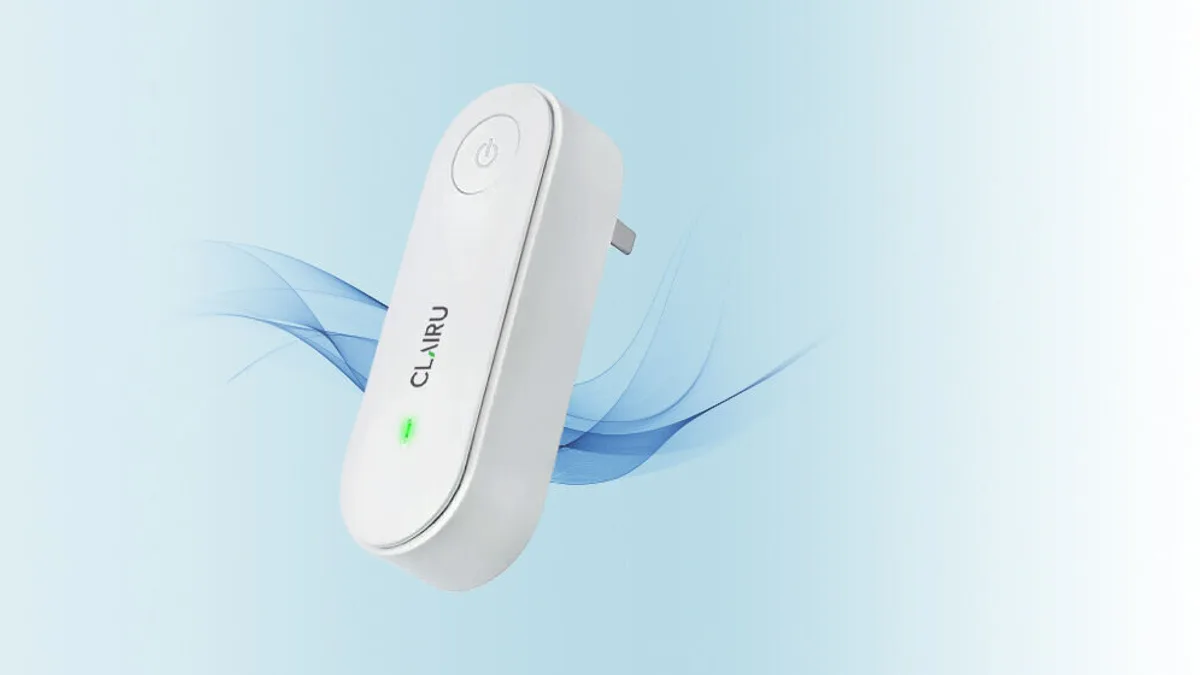
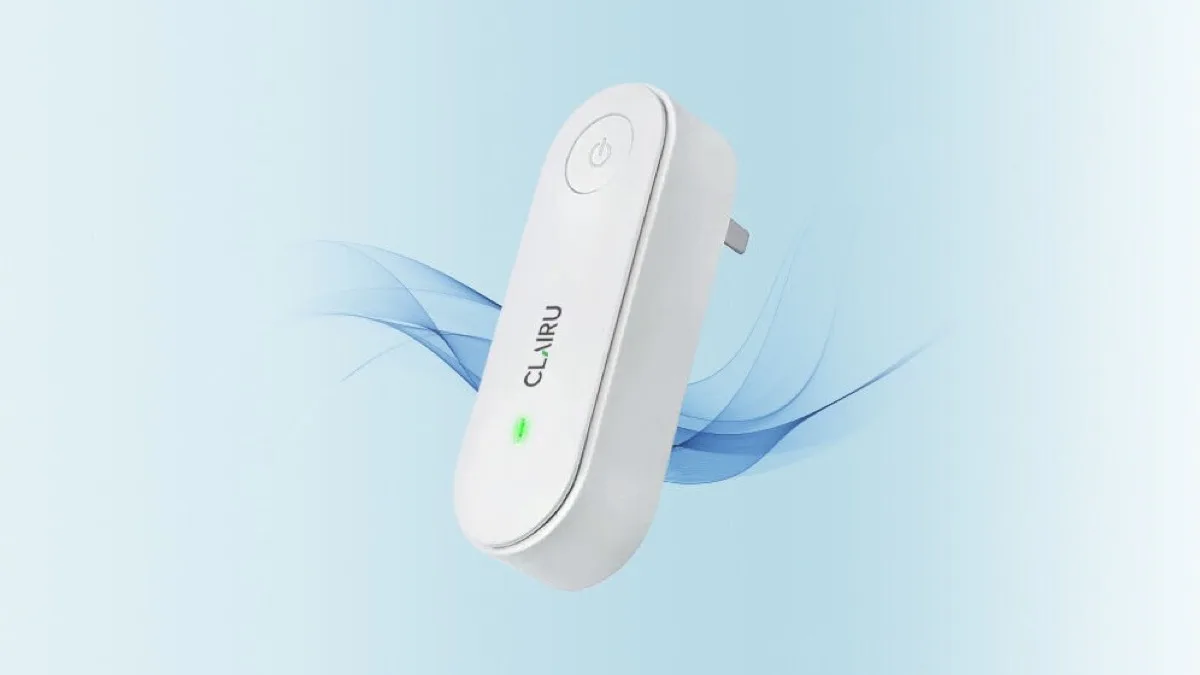
The honest answer has three parts. UV-C light does inactivate germs. It does that only when the dose is right, and in a moving-air appliance, getting the dose right is hard. And it does nothing for dust, pollen, smoke or smells. This guide explains how UV works, what tests of household devices found, what EPA says about UV and ozone, and how it compares with HEPA and ionizers. If you are comparing gadgets, our Clairu air purifier review covers a plug-in ionizer that uses no UV, and the smart home category covers more home-comfort tech.
Quick Answer
- What it does. UV-C light can inactivate bacteria, viruses and mold spores that pass close enough to the lamp for long enough.
- What it does not do. It does not remove dust, pollen, dander or smoke, and EPA says research has not yet shown UV can remove gases effectively in portable residential air cleaners.
- The catch. Dose depends on lamp strength and exposure time. Fast airflow means short exposure.
- The safety flag. EPA notes that UV lights without adequate lamp coatings may emit ozone.
- Best use. As an add-on to a HEPA filter, not a replacement for one.
How UV-C Air Purifiers Work
Ultraviolet light comes in several wavelengths. The one used for germicidal purposes is UV-C, roughly 200 to 280 nanometers. It damages the genetic material of microorganisms so they cannot reproduce or infect. That process is called inactivation.
In an air purifier, a UV-C lamp sits inside the housing. A fan pulls room air past the lamp, and microbes in that air receive a dose of UV. The cleaned air is pushed back into the room.
Three ideas decide whether it works.
- Dose. UV dose is the light’s intensity multiplied by exposure time. Doubling either doubles the dose.
- Exposure time. The faster air moves past the lamp, the less time each particle spends in the light.
- Wavelength and lamp type. Low-pressure mercury lamps and UV-C LEDs behave differently. LEDs are more compact but often weaker.
Everything else follows from these. A UV unit with a strong lamp and a slow, long airflow path can be effective. A small unit with a weak lamp and fast airflow gives a small dose, whatever the box says.
What Tests of Household UVC Devices Found
Independent testing of consumer-grade UV devices is limited, but there is useful research. One peer-reviewed study evaluated ten commercial household UVC devices, seven using low-pressure mercury lamps and three using UVC LEDs, across handheld disinfection tools, disinfection chambers and movable air purifiers. It looked at whether the devices delivered enough UVC to inactivate SARS-CoV-2.
The findings, in plain terms:
- Five of the seven mercury-lamp devices delivered enough UVC irradiance for inactivation.
- The study reports that the required UVC dosage could not be achieved by either of the UVC LED devices.
- The movable air purifiers and the mercury-lamp chambers proved effective in the study, while handheld tools were far less effective.
- The researchers noted a lack of standardization in the distances and cycle times for each application, and said standard usage guidelines for UVC devices are required.
You can read the study on household UVC germicidal devices for the details. Two cautions apply. Lab results with a specific virus do not automatically transfer to your living room, and the study does not certify any particular product. What it does show is that quality varies a lot between devices, and that lamp type and dose matter.
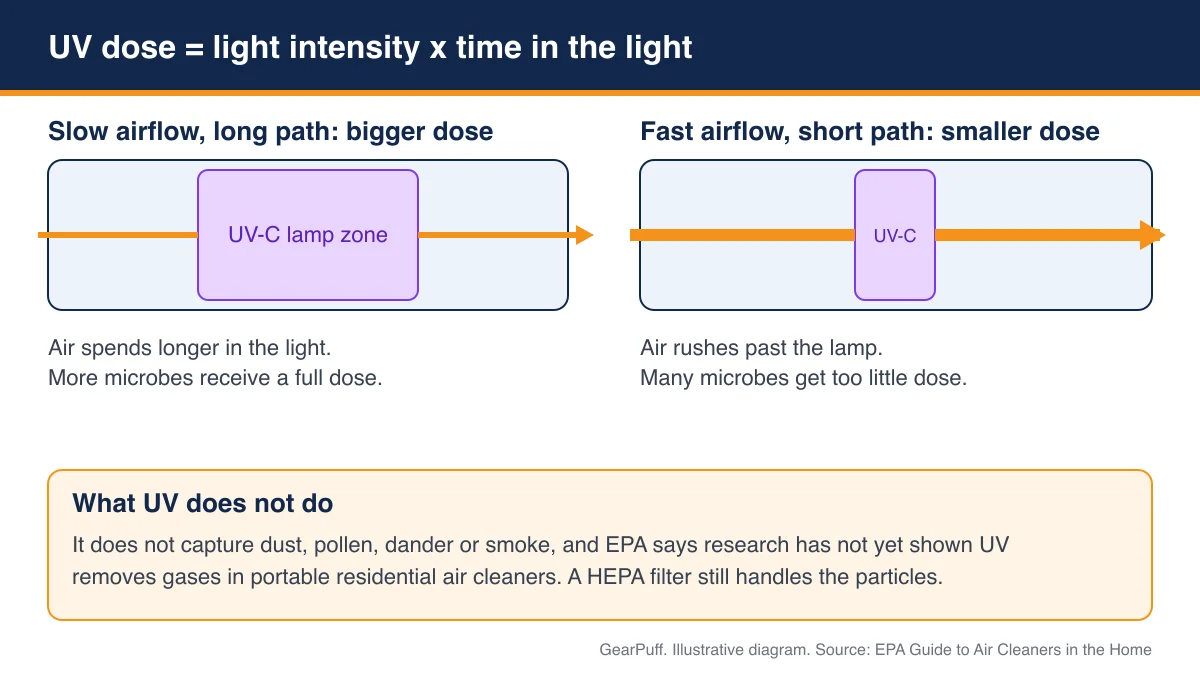
The diagram above shows the core problem in a portable unit. If air races past the lamp, the same light delivers less dose to each particle.
UV-C Lamp Types: Mercury, LED and Far-UV
Not all UV lamps are alike, and the type affects both performance and safety.
- Low-pressure mercury lamps. The long-established technology. They emit strongly at about 254 nanometers, which is very effective for inactivation. They contain a small amount of mercury, so they need careful handling and disposal at end of life.
- UV-C LEDs. Small, mercury-free and increasingly common in compact appliances. Their output has historically been weaker per unit, and in the household device study we cited, the LED devices could not achieve the required UVC dosage.
- Far-UV around 222 nanometers. A newer approach that is being studied as a way to inactivate microbes with different exposure characteristics. Evidence and product standards are still developing, so treat it as emerging, and check ozone behavior and safety documentation for any product that uses it.
Whatever the lamp, what matters is delivered dose in the air path, lamp life, enclosure design and ozone control. A listing that names only “UV-C” and nothing else tells you very little.
How to Read UV Marketing Claims
UV product pages love big numbers. Here is how to decode them.
“Kills 99.9 percent of germs.” Ask which germ, at what dose, in what test setup and over what time. A figure measured on a plate in a lab is not the same as a reduction in a living room.
“Log reduction.” A 1 log reduction is 90 percent, 2 log is 99 percent, 3 log is 99.9 percent. It is meaningful only if the test conditions match how you will use the unit.
“Used in hospitals.” Hospitals use engineered systems, often in ducts or upper-room fixtures, with proper dose calculations and maintenance. A small household appliance is a different thing.
“Ozone free.” Helpful if backed by CARB certification or a test report. Otherwise just a phrase.
“Sterilizes the air.” Sterilization is a strong word. Reduction is more honest.
What UV Cannot Do
Here is where marketing and reality part ways.
It does not remove particles. UV inactivates microbes. It does not capture them. Dust, pollen, pet dander and smoke stay in the air unless a filter catches them. Even inactivated germs and spores are still particles that can remain in the room.
It does not clear gases and odors. EPA’s guide says research has not yet shown that technologies such as plasma, photocatalytic oxidation or ultraviolet light can remove gases effectively in portable residential air cleaners. For smells and chemical vapors, activated carbon and ventilation are the tools that have support.
It does not fix the source. If you have mold, the fix is drying the space and cleaning, not a lamp in a purifier.
It does not replace filtration. EPA’s guidance is that filtration works alongside reducing sources and ventilating with clean outdoor air.
That is why the strongest household setup for particles is a true HEPA filter matched to the room. Our guide on how many hours a day to run an air purifier shows how to size one.
The Ozone Question for UV Units
Ozone matters for UV purifiers for a specific reason. Some UV lamps emit light at wavelengths that split oxygen and create ozone. Lamp coatings can block that.
EPA’s guide lists UV lights without adequate lamp coatings among the technologies that may have the potential to emit ozone, and it calls ozone a lung irritant. EPA advises avoiding portable air cleaners that intentionally produce it, and suggests looking for models tested and shown to emit little or no ozone, including certification from the California Air Resources Board.
CARB states that all portable indoor air cleaning devices sold in California must be certified to meet ozone and electrical safety standards. In practice, that certification is the easiest check for a UV purifier: search the model in the certified list before you buy.
Portable UV Units vs UV in Ducts
You will see UV in two very different places.
Portable room units pull air through a small chamber. Dose is limited by the short path and the airflow speed, and by whatever lamp fits inside. These are the products this article focuses on.
Duct or coil systems install in a home’s HVAC system. A lamp inside the ductwork irradiates air passing through, or the cooling coil, which can reduce microbial growth on the coil. These are professionally installed and are designed around the system’s airflow.
Neither is a replacement for filtration, and neither removes gases. If you are considering a duct system for mold on the coil, talk to an HVAC professional rather than relying on a marketing page.
Maintenance, Lamp Life and Disposal
UV lamps age, and an aging lamp still glows while delivering less dose.
- Replace on schedule. Follow the manufacturer’s lamp life, often around a year of continuous use, though it varies.
- Track the date. Note when the lamp was installed, since you cannot judge it by brightness.
- Handle mercury lamps with care. They should be recycled through hazardous-waste channels rather than thrown in general waste.
- Keep enclosures intact. Never run a unit with a damaged housing or with the UV chamber exposed.
- Clean the intake. Dust on the lamp or reflector lowers the dose.
Add lamp replacement to the running cost when you compare units.
UV vs HEPA vs Ionizer
| UV-C purifier | True HEPA purifier | Plug-in ionizer | |
|---|---|---|---|
| What it targets | Bacteria, viruses, spores (inactivation) | Airborne particles (capture) | Airborne particles (clumping) |
| Removes dust and pollen | No | Yes | Partly, by settling |
| Removes gases and odors | No (EPA) | Limited, better with carbon | Weak |
| Published CADR | Sometimes | Yes | Rarely |
| Ozone concern | Possible without proper lamp coating | None | Possible |
| Filter costs | Lamp replacement | Filter replacement | None |
| Best use | Extra germ-reduction step | Everyday air cleaning | Light freshening in small rooms |
If you are comparing a UV unit against a plug-in ionizer, the deciding factors are documentation and safety. A UV purifier with a proper enclosure, ozone-free lamp and CADR beats an ionizer that publishes nothing. An ionizer with CARB certification beats a UV unit that publishes nothing.
When a UV Air Purifier Is Worth Considering
UV can be a reasonable extra in a few cases.
- A household with someone immunocompromised, where you want every added layer, and your doctor agrees.
- Shared indoor spaces with frequent illness, as one layer alongside ventilation and filtration.
- A combined unit you are already buying, where the UV lamp is a bonus on top of a good HEPA filter and a proper CADR.
It is a poor reason to buy when:
- Your problem is dust, pollen, smoke or pet dander. Buy filtration.
- Your problem is smell. Buy carbon and fix the source.
- The unit publishes no CADR, no ozone information and no lamp details.
If you have asthma, COPD or a compromised immune system, talk to your own doctor before you rely on any air cleaner for health protection.
Walk-Through: Evaluating a UV Purifier Listing
Imagine a listing that reads “UV-C germicidal air purifier, kills 99.9 percent of germs, covers 500 square feet, ozone free.” Here is how to test each claim in five minutes.
- “Kills 99.9 percent.” Look for a test report. Which organism, what dose, what exposure time, which lab? If there is no report, treat the number as advertising.
- “Covers 500 square feet.” Look for a CADR. Then apply the two thirds rule from EPA, where a 300 square foot room needs a CADR of about 195. If the CADR is well below the rule for 500 square feet, the coverage claim is inflated.
- “UV-C.” Look for the lamp type and lamp life. LED or mercury? Replaceable? How long?
- “Ozone free.” Search for CARB certification or an AHAM Verified label.
- “Germicidal.” Check that the lamp is fully enclosed with a safety interlock, so light cannot escape.
If a listing passes four of five, it is a serious product. If it passes one, it is a gamble.
UV Compared With Other Germ-Reduction Steps
If your goal is fewer airborne germs at home, UV is one of several options, and often not the most effective per dollar.
| Step | What it does | Cost and effort |
|---|---|---|
| Ventilation with clean outdoor air | Dilutes airborne pollutants and germs | Free, weather permitting |
| True HEPA filtration | Captures airborne particles including those carrying germs | Moderate, with filter costs |
| Humidity around 40 to 60 percent | Helps reduce some microbial growth and irritation | Low, needs a hygrometer |
| Source control, such as staying home when sick | Stops germs entering the air | Free |
| UV-C add-on | Inactivates microbes that pass the lamp with enough dose | Moderate, with lamp costs |
EPA emphasizes that the most effective ways to improve indoor air are reducing sources and ventilating, with filtration as a supplement. UV sits below those in the priority list.
How to Buy a UV Air Purifier Sensibly
- Insist on a filter first. A true HEPA filter and a published CADR should come before any UV claim.
- Look for an enclosed lamp. UV-C can harm eyes and skin, so the lamp should be fully enclosed with no exposed light.
- Check ozone safety. Search for CARB certification or an AHAM Verified label, and read the seller’s ozone statement.
- Ask about lamp type and life. Mercury lamps and LEDs differ, and lamps need replacing on a schedule.
- Ignore “kills 99.9 percent” without context. Ask what organism, what dose and what test.
- Check the refund terms. Especially for lesser-known brands.
Avoid handheld UV wands used on air or on people and pets. The household study we cited found handheld equipment far less effective, and direct UV-C exposure carries its own risks.
UV and Mold: What to Expect
Mold is a common reason people buy UV. A UV lamp may reduce airborne mold spores that pass through a well-designed unit. It will not clean mold from walls, fabric or ceilings, and it does not fix the dampness that lets mold grow.
If you have visible mold, dry the area, fix leaks, lower humidity and clean the surface safely. Use a purifier as a supplement, and use a true HEPA filter for the spores that do get airborne. Large infestations may need professional remediation.
What to Tell Your Doctor
If you are buying a UV purifier because someone in your home is unwell or immunocompromised, be realistic about what it can do. UV may add a layer, but the household guidance we found points to reducing sources, ventilating and filtering first. Ask a clinician who knows the person’s situation what steps matter most.
Common Myths About UV Air Purifiers
“It kills everything in the air.” Only the microbes that receive enough dose, and only those that pass close enough to the lamp.
“It cleans the air, so I can skip the filter.” UV does not remove particles, so this misreads how it works.
“More watts is always better.” Lamp power matters, but so do airflow path, reflectivity and exposure time.
“UV is chemical-free, so it is automatically safe.” The lamp can emit ozone if poorly designed, and UV-C itself needs shielding.
“It works instantly.” Because dose builds up with exposure, room-level effects take time, and depend on the airflow.
If You Already Own a UV Purifier
Plenty of people already have one. These steps make the most of it and reduce risk.
- Check the lamp date. If you cannot remember installing it, replace it, since output fades before the light looks dim.
- Confirm it is a HEPA unit too. If yours has UV and no filter, do not expect it to remove dust or pollen.
- Smell test. If you notice a sharp or electric smell when it runs, turn it off and contact the maker about ozone.
- Never look at the lamp. If the housing is cracked or the lamp is exposed, stop using the unit.
- Keep the intake clear and vacuum dust from the vents monthly.
- Do not rely on it for health protection. Keep ventilating, filtering and staying home when unwell.
Used sensibly, a UV lamp inside a good HEPA purifier is a harmless extra. The trouble starts when it is treated as the main event.
One last point on cost. When you compare a UV unit with a plain HEPA unit, add the lamp replacement to the yearly running cost, and remember that the lamp adds nothing for dust, pollen or smoke. If the price gap is large and your worry is particles, the money is usually better spent on a bigger HEPA unit than on a lamp.
Bottom Line
So, do UV light air purifiers really work? Yes, in the narrow sense that UV-C inactivates microbes when the dose is high enough. In a real living room, with fast airflow and a small chamber, the result depends heavily on the device, and the evidence from independent testing is mixed. UV does not remove dust, pollen, smoke or smells, and EPA notes the ozone risk for UV lights without adequate lamp coatings.
For most homes, a true HEPA purifier sized to the room, with carbon if smells matter, is the better first purchase. Add UV only if you want an extra layer and can confirm the safety details. And if you are weighing a cheap plug-in gadget of any kind, read our guide on what to avoid when buying an air purifier before you order.
Frequently Asked Questions
Do UV light air purifiers really work?
Does a UV air purifier remove dust and allergens?
Can UV air purifiers produce ozone?
Are UV air purifiers safe?
Is a UV air purifier better than HEPA?
Do UV light air purifiers kill viruses and mold?
Do I need a UV light in my air purifier?
How often do UV lamps need replacing?
More Smart Home Articles
Related Product Reviews
Maya Chen
Smart home enthusiast and IoT specialist. Has automated over 50 homes across different ecosystems. Former smart home consultant for Google Nest and Amazon Alexa. Passionate about making technology accessible.
Affiliate disclosure:This article contains affiliate links. If you buy through them, GearPuff may earn a commission at no extra cost to you. It keeps our testing independent and our reviews free.