
Clairu Air Purifier Review 2026: Claims vs the Evidence
Clairu air purifier review: a filter-free plug-in ionizer. See what the sales page proves, what it skips, and the ozone question.
In This Article
- TL;DR: Our Clairu Air Purifier Verdict
- How We Researched This
- What Is the Clairu Air Purifier?
- Clairu Air Purifier vs the Clairu Humidifier
- How Plug-In Ionizers Work (And Where They Fall Short)
- What Clairu Claims vs What the Evidence Shows
- The Ozone Question
- What It Looks Like and How It Sits on the Wall
- Setup: Three Steps and the Mistake Owners Make
- Pets, Cooking Smells and Bedrooms: Where Clairu Might Help
- Where to Put Clairu and How Long to Run It
- What Owners Report
- Clairu on Trustpilot: 1.6 Out of 5
- The Social Proof Problem
- Clairu vs the Alternatives
- Value Math: Is Clairu Worth It?
- Pricing, Guarantee and Checkout Gotchas
- Buying From the UK or Outside the US
- Drawbacks to Know Before You Buy
- Tips to Get the Most Out of Clairu (If You Try It)
- Who Should Buy Clairu and Who Should Skip It
- Final Verdict
- Score Breakdown
I keep a mental list of products that promise a lot and explain very little. A small white plug that “purifies” the air of an entire room, with no filter, no fan and no maintenance, goes straight onto it. So when the Clairu air purifier landed on my desk, I did what I do with every gadget like this. I read everything the brand says, then I went looking for what it left out.
This is a research review. We did not test Clairu in person. It is built from the brand’s sales page and checkout configuration, EPA and California CARB guidance on ion generators and ozone, and the public review coverage we could find. That last part turned out to be thin, and I will show you why. If you want more context on how this fits alongside other room-comfort gadgets, our smart home category covers the rest of the home-air side of the site.
The short version is that Clairu is a plug-in ionizer with almost nothing you can verify, and a seller-reliability record that deserves a careful read before you order. It is not something to buy for asthma, wildfire smoke or a serious pet allergy.
TL;DR: Our Clairu Air Purifier Verdict
- What is it? A small, filter-free plug-in unit that releases negative ions. No fan, no filter, no app.
- Does it work? Unproven. The brand publishes no coverage area, wattage, CADR rating, ozone output or independent test, so no performance claim can be checked.
- Is it legit? It takes orders and advertises a 30-day money-back guarantee. But the Trustpilot profile for getclairu.com scores 1.6 out of 5 across 72 reviews, and the sales page’s own review numbers match a different product’s page.
- The catch: EPA says some ion generators produce ozone. The sales page never mentions ozone or certification.
- Best for: Someone who wants a low-effort, silent freshener for one small room, will buy a single unit and pays in a way that allows a dispute.
- Skip it if: You have asthma, real allergies, smoke exposure or a large room. Get a HEPA purifier with a published CADR.
- Rating: 5.2/10. Simple to use, but almost nothing about it can be verified and the seller record is weak. See the current Clairu price and guarantee terms.

How We Researched This
We did not physically test the Clairu, and nothing in this article says we did. Here is what the review is built on.
- The Clairu sales page and FAQ. We read the whole page, including the fine print, the FAQ and the footer.
- The checkout configuration. The order page loads its text and settings from a config file. We read that too, which is how we found a few details the main page leaves out.
- EPA and CARB guidance. We used the federal and California positions on ion generators, ozone and certification, linked in the sections below.
- Public review coverage. We searched for owner reviews and complaints, and read the Trustpilot profile for getclairu.com on 30 September 2026. Scores change, so check the current page.
- A cross-check against other products. The social proof on the page looked familiar, so we compared it with a product we had already covered.
One caveat before we go on. No independent lab has published test results for Clairu that we could find. Anything positive we say about performance is the brand’s claim, not a measurement.
What Is the Clairu Air Purifier?
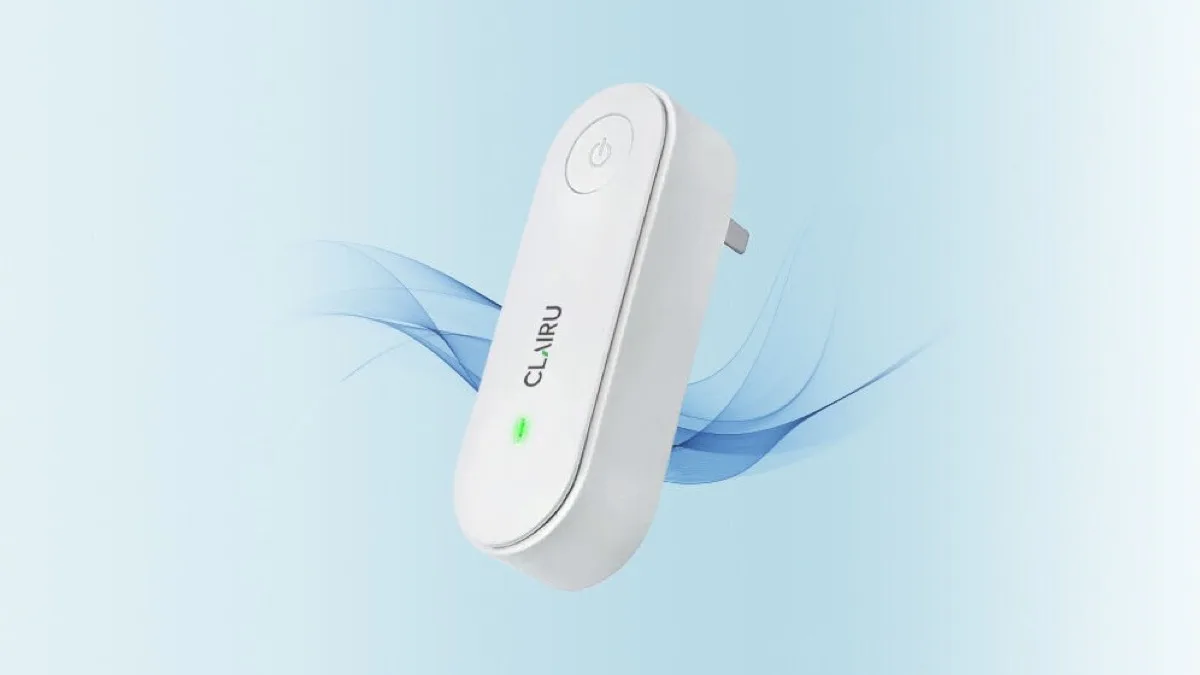
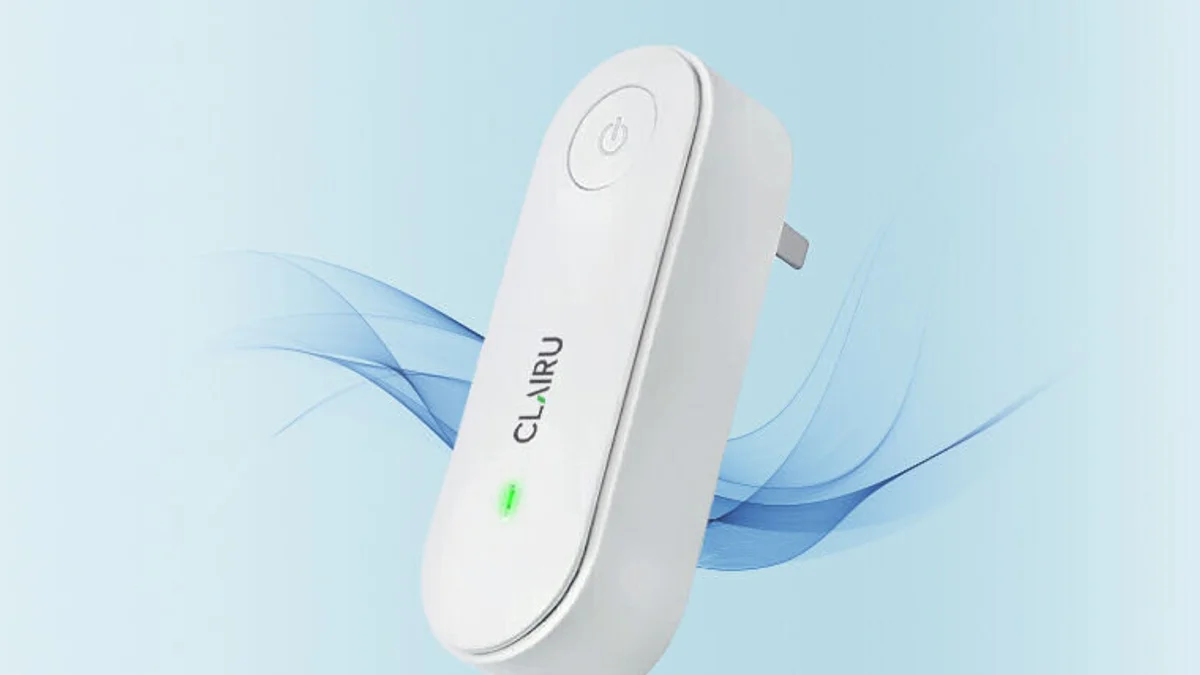
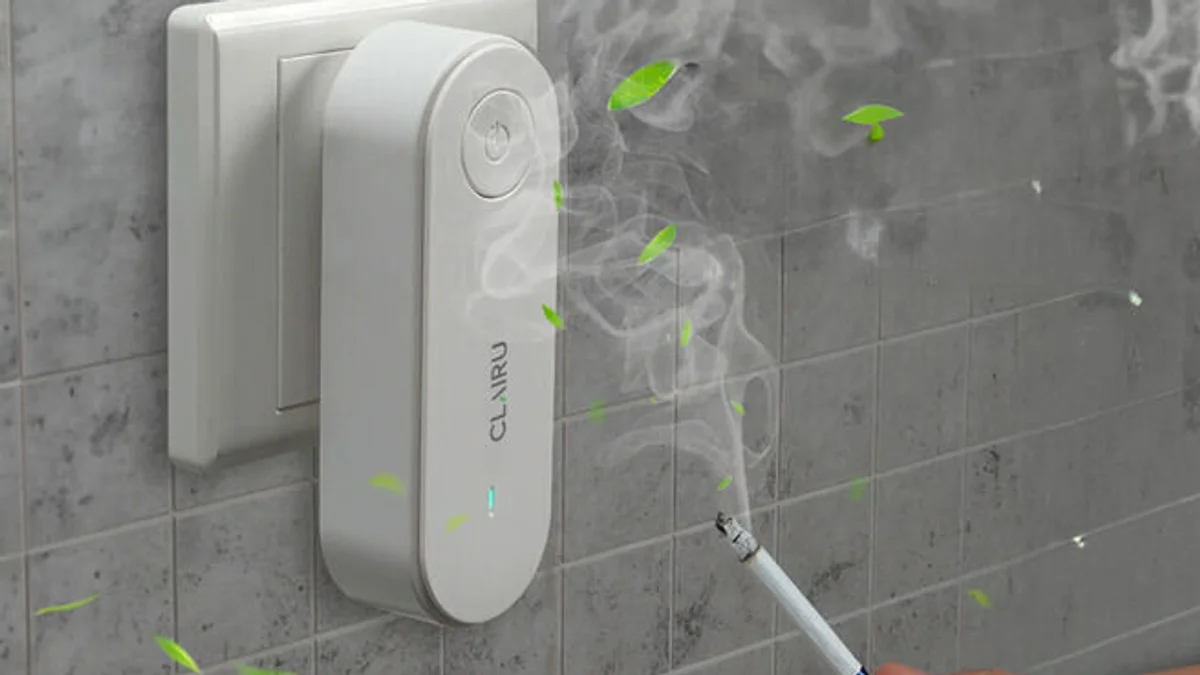
Clairu is a plug-in ionic air purifier. It is a small white oval unit with a power button on one side and a green indicator light. You plug it into a wall socket, and it releases negative ions into the room. There is no filter to change and no fan.
The brand calls it “filter-free,” “whisper quiet,” “small and portable” and “non-toxic.” The page says it targets dust, allergens, odors and mold spores, starts working right after you plug it in, and delivers a “significant improvement in air quality within 2 to 4 hours.”
It is sold as bundles of 1, 3, 6 or 9 units. The page labels them “best for 1 room,” “2 to 3 rooms,” “an apartment or small house,” and “a medium to large house.” The brand’s own FAQ says to buy one per room.
One note on product identity, because it will save you confusion. Some review pages we found describe a Clairu with a 520 ml water tank that needs refilling every night. Nothing on the official page mentions a tank, a humidifier or water. If a review talks about refilling, it is describing something else, so discount it.
The price is not shown on the main sales page. It appears at checkout, and it changes with the bundle. That is worth knowing before you click, because it means you cannot compare cost against a HEPA purifier until you are already in the order flow.
Here is how Clairu stacks up against the two kinds of purifier most buyers are really choosing between.
| Feature | Clairu | True HEPA room purifier | HEPA plus carbon purifier |
|---|---|---|---|
| Removes particles | Claimed, unmeasured | Yes, rated and tested | Yes, rated and tested |
| Removes gases and odors | Claimed, no capture medium | Limited | Yes, carbon layer |
| Published CADR | No | Yes | Yes |
| Filter costs | None | Filter every 6 to 12 months | Filters every 6 to 12 months |
| Noise | Silent (no fan) | Fan noise, adjustable | Fan noise, adjustable |
| Ozone documentation | None found | Not applicable | Not applicable |
| Best for | Mild freshening, tiny rooms | Allergies, dust, dander, smoke | Pets, cooking smells, mixed pollutants |
Clairu Air Purifier vs the Clairu Humidifier
Search “Clairu” and you will find two different stories. Some pages call it an air purifier. Others call it a humidifier, and a few describe a hybrid that cleans and humidifies. This confusion matters because you can end up ordering the wrong thing.
Here is what we can say. The official page we read describes a plug-in ionic air purifier only. It mentions no water tank, no mist and no humidifier. Yet Trustpilot reviewers of getclairu.com talk about ordering a 520 ml humidifier, and some say they received a small aroma diffuser instead. Review pages elsewhere complain about a 520 ml tank that needs refilling nightly.
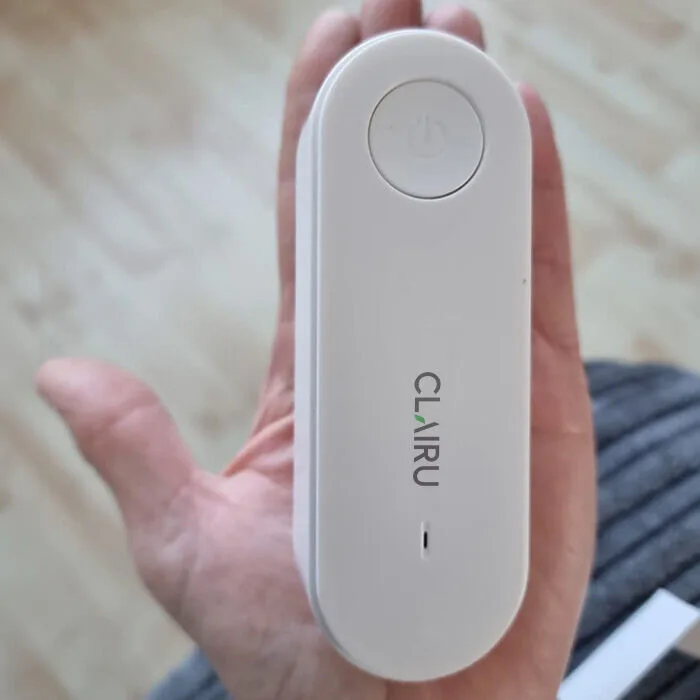
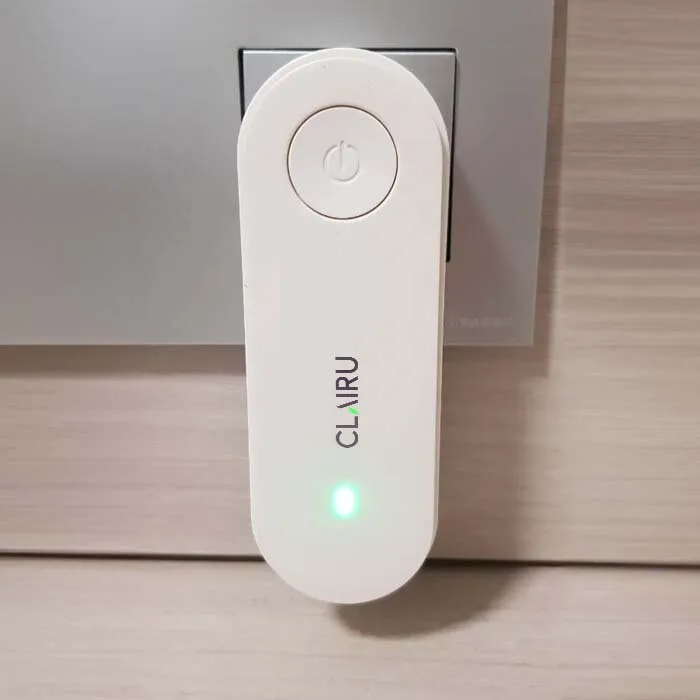
The photo above, taken from the sales page, shows what the air purifier looks like: a smooth oval body, one power button, no grille and no tank. If what arrives has a water reservoir, a mist outlet or a scent pad, it is not this product.
So before you pay, do two things. Confirm on the checkout page exactly which product and model is in your basket, and screenshot it. Then, when the parcel arrives, photograph it as you open it. Both help if you need a refund. The humidifier question also shapes how you should read online reviews, because many of them may be about a different device.
How Plug-In Ionizers Work (And Where They Fall Short)
An ion generator sends charged particles into the air. Those ions attach to tiny airborne particles like dust, pollen and smoke. The particles become charged, clump together or get pulled onto nearby surfaces such as walls, floors and furniture. The air looks cleaner, but the particles have often moved rather than disappeared.
That is different from a HEPA purifier. A HEPA unit pulls room air through a filter, traps particles inside it, and pushes clean air out. It is rated on a standard test and carries a clean air delivery rate, or CADR, that tells you how much filtered air it produces. An ionizer has no equivalent published figure, and Clairu lists none.
Two limits of ion generators matter most.
- They do not remove gases and odors the way an activated carbon filter does. The brand says Clairu “absorbs and eliminates unpleasant odors.” Ions can change how some odor molecules behave, but there is no filter medium in this unit to physically capture them.
- Some can produce ozone. Ozone forms as a by-product of the charging process in some ionizers. EPA’s guide to air cleaners in the home covers ion generators and electronic air cleaners and notes that ozone is a lung irritant that can worsen breathing problems.
We go deeper on the mechanism and the evidence in our explainer on whether plug-in ionic air purifiers actually work. The short version for a Clairu buyer is that ionization can be a supplement, but the strongest evidence for cleaning room air still sits with filtration.
What Clairu Claims vs What the Evidence Shows
Let’s go claim by claim. Each one is quoted or closely paraphrased from the Clairu page.
Claim. “Removes allergens, dust and bad smells.” What the evidence shows. Ions can clump particles, so some dust may settle faster. That is not the same as removing allergens from your breathing zone, and no data on the page shows a reduction. There is no CADR, no particle-count test and no study. For odors, there is no carbon or other capture medium.
Claim. “Significant improvement in air quality within 2 to 4 hours.” What the evidence shows. This is a specific-sounding time frame with nothing behind it. Air quality is measured with a particle counter or a lab test. The page does not say which room size, which pollutant, or which measurement.
Claim. “Non-toxic. Safe around kids and pets.” What the evidence shows. The unit uses no chemicals, which is true of most ionizers. The open question is ozone, which is not a chemical you add but a gas some ionizers emit. The page never mentions ozone. “Non-toxic” and “produces no ozone” are two different statements, and Clairu only makes the first.
Claim. “Combats mold.” What the evidence shows. The page says its “mold control feature captures spores before they settle.” Nothing describes how, and a unit with no filter has nothing to capture spores with. If you have visible mold, the fix is moisture control and cleaning, not a plug-in.
Claim. “Energy-efficient, energy-optimal mode.” What the evidence shows. Plausible, since ionizers draw very little power. But no wattage is published, so you cannot calculate a running cost. We would expect it to be small. That is an expectation, not a fact from the page.
Claim. “Completely silent.” What the evidence shows. With no fan, that is believable. It is also consistent with the design. Still no decibel figure is given.
Claim. “Covers 1 room per unit.” What the evidence shows. No square footage. A bedroom, a garage and an open-plan living room are all “a room.” The recommendation cannot be checked.
The pattern is easy to see. Every claim is qualitative, and the numbers that would let you verify them are missing. That is the core problem with Clairu, and it is why our score for proof of effectiveness is low.
The Ozone Question
This is the part the sales page skips, so it gets its own section.
Ozone is a gas made of three oxygen atoms. In the upper atmosphere it shields us. At ground level, indoors, it irritates the lungs. EPA’s page on ozone generators sold as air cleaners explains that even at levels that do not exceed public health standards, ozone can have adverse health effects and is not an effective way to clean the air.
Not every ionizer produces meaningful ozone. Many produce very little. The point is that you cannot tell from the outside, and the manufacturer has to tell you.
California takes this seriously. CARB states that “all portable indoor air cleaning devices sold in California must be certified by CARB to meet ozone and electrical safety standards,” and notes that some devices are capable of producing ozone. That certification is the closest thing to a public ozone check for a consumer device.
We did not find a CARB certification claim, an ozone emissions figure, or any safety standard listed on the Clairu sales page. That does not prove the unit is unsafe. It means ozone output is undocumented, and that matters most for three groups: people with asthma or lung conditions, households with small children, and anyone using a unit in a small closed bedroom.
If you decide to try one anyway, email support before you order and ask two direct questions. Is the unit CARB certified, and what is its measured ozone output? A brand with a good answer will give it to you in one line. A vague or missing answer tells you what you need to know.
What It Looks Like and How It Sits on the Wall
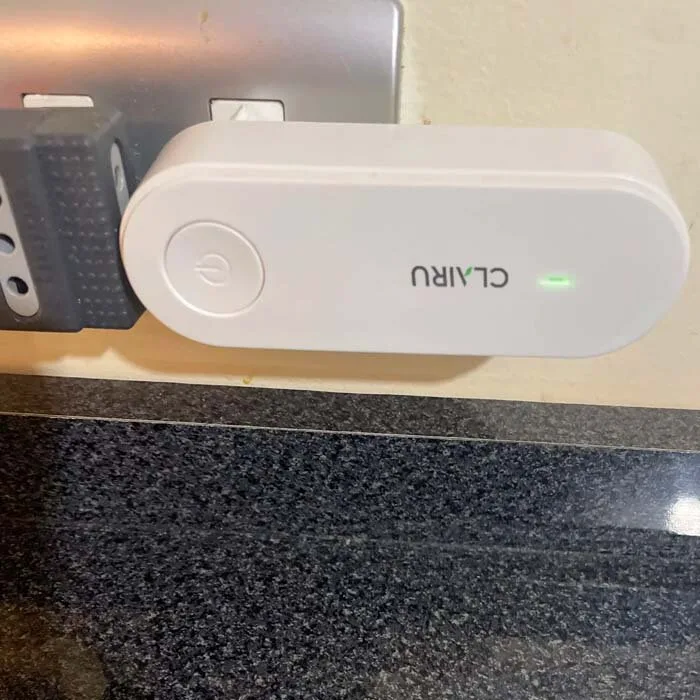
Going by the photos on the sales page, Clairu is a rounded white oval about the length of a hand. One photo shows it held in a palm and it fills the hand from wrist to fingertips. The power button is a round disc on one end. The logo sits on the face, and a small indicator light shows it is on.
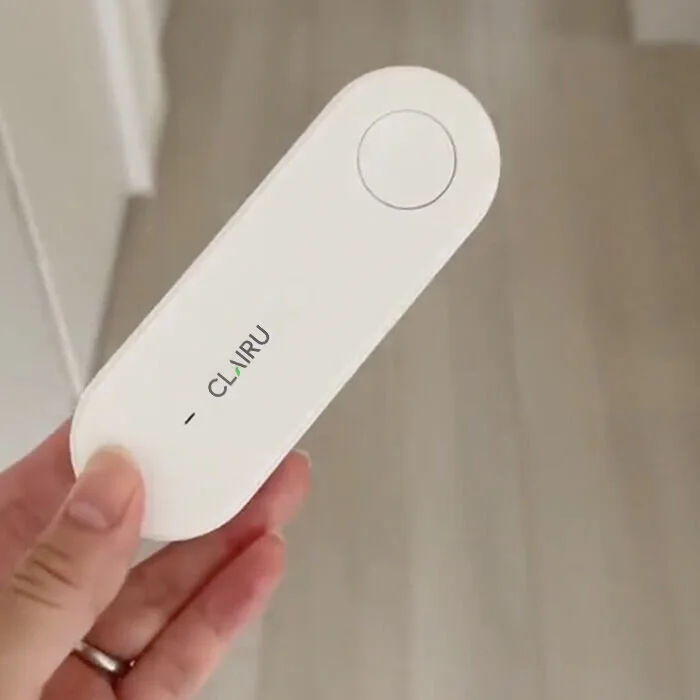
Because there is no fan, there are no vents, no grille and no moving parts. That is what allows it to be so small, and it is also the trade you are making. A HEPA unit is bulky because it needs a fan and a filter with real surface area. Clairu is compact because it does neither.
No dimensions or weight are published. We are describing it from the brand’s own photos. A plug-in that hangs off a wall socket can also block a neighboring outlet, so check the space around your socket first.
The photos also show the unit in more than one socket style. That matters for readers outside the US. The page does not say which plug versions it ships or which voltage it supports. If you are in the UK, ask before you order.
Setup: Three Steps and the Mistake Owners Make
The brand’s own instructions are three lines long. Plug it in, wait a few moments, enjoy pure air. That is genuinely all there is to it, and this is Clairu’s strongest selling point. There is nothing to install, no app to pair and no filter to unwrap.
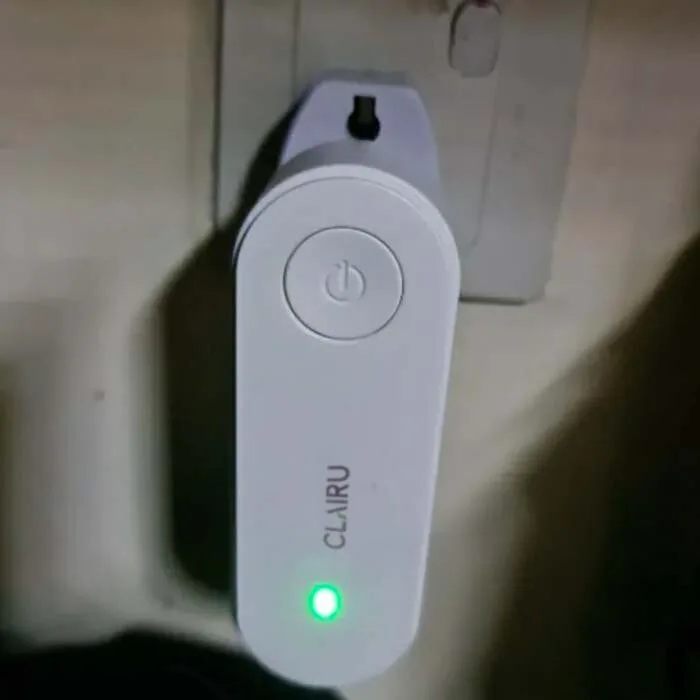
The green light on the front is the only feedback you get. It tells you the unit has power. It does not tell you whether the unit is doing anything useful, because there is no sensor and no air quality readout.
That is where the most common owner mistake comes from, based on the complaint patterns we found. People plug it in, see the light, and assume it is working on the whole room. Then they notice no difference and conclude it is broken, when the real issue is that there is nothing to measure the effect. Set an expectation before you plug it in: decide what you will judge it by.
A few practical setup notes.
- Put it where air moves. A socket behind a couch or curtain will get little air circulation around it.
- Do not hide it in a closet. Small closed spaces are where any ozone by-product would concentrate.
- One room, one unit, one test. Do not buy the 6-pack first.
- Write down your baseline. Note how the room smells and how you feel before you plug it in, so you can judge honestly at day 14.
Pets, Cooking Smells and Bedrooms: Where Clairu Might Help
The sales page pushes three uses hardest: pet odor, cooking smells and bedrooms. Here is a fair read on each, based on how ion generators work and what EPA says about air cleaners.
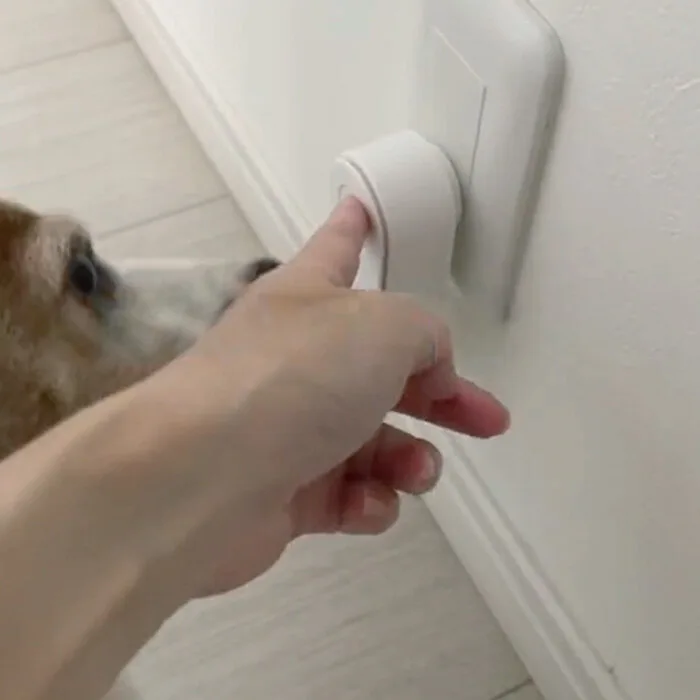
Pets. Pet odor is mostly gases and tiny droplets bound to fabric, not just airborne dust. EPA’s guide says filters that use a large amount of activated carbon are the ones that address odor gases. Clairu has no carbon. Dander is a particle, and an ionizer can make dander clump and settle, which may reduce what floats in the air. But the dander is then on your couch and floor, so vacuuming and washing bedding still do the real work.
Cooking smells. Cooking releases both particles and gases. Ventilation is the best fix: run the extractor fan and open a window. A plug-in ionizer near the kitchen is a light extra, not a replacement. Our sales page reading turned up no test of kitchen air.
Bedrooms. This is the most common use and also where ozone questions matter most. A small closed bedroom is where any by-product would build up over a night. Silent operation is a real plus for sleep, but only if the unit is safe to run for eight hours in that room, and Clairu publishes nothing to confirm it.
The pattern across all three is the same. Ionization is a maybe. Source control, ventilation and cleaning are the proven steps.
Where to Put Clairu and How Long to Run It
The brand says to plug it in and leave it. It gives no schedule, and it does not say whether it should run continuously.
EPA’s guidance on portable air cleaners is that higher fan speeds and longer run times increase the amount of air filtered. That statement is about fan-driven cleaners, and Clairu has no fan, so we cannot apply it directly. Without a schedule from the brand, a sensible approach is to run it in the evening and overnight for two weeks, and note any change in smell, dryness or irritation. If you notice a sharp or metallic smell, headaches or throat irritation, unplug it. Those can be signs of ozone.
For placement, use a socket where air can move around it, at least a couple of feet from soft furnishings, and away from where you sit directly in front of it. Avoid a socket inside a cupboard or a tight alcove. Keep it out of reach of small children, since it sits at socket height and has a power button.
What Owners Report
Here is where the research hit a wall, and I would rather tell you than pad the section.
We searched for Clairu owner reviews, complaints and Amazon and Trustpilot feedback. The results were mostly not independent owner reviews. They included press-release wire posts, a form-builder page, an event-ticketing page and several review-style sites that also sell or promote it. We did not find a large, verifiable pool of real owner reviews we could count, so we are not going to invent percentages.
What we can report are the patterns that repeat across the coverage we did find.
The praise.
- Quiet operation. Nothing hums because there is no fan.
- Easy setup, with no maintenance.
- A “fresher” feel in small rooms, mostly described as a smell effect.
The complaints.
- No noticeable difference in a room, especially a large or ventilated one.
- Not enough for heavy smoke or high-pollution events.
- Thin technical detail on the website.
- Slow or hard-to-reach customer support in some accounts.
A caution on ratings. The sales page claims a 4.7 average across 8,258 reviews, and shows a star split of 5,372 five-star, 2,876 four-star, 6 three-star, 3 two-star and 1 one-star. That distribution is unusual. A product with more than 8,000 reviews and only ten below four stars is not what real customer feedback tends to look like.
Clairu on Trustpilot: 1.6 Out of 5
This is the finding that should weigh most in your decision, so I want to be precise about it.
We read the Trustpilot profile for getclairu.com on 30 September 2026. It showed a TrustScore of 1.6 out of 5 from 72 reviews, with 43 of them in the previous twelve months. The star split was 89 percent one-star, 1 percent two-star, 1 percent three-star, 9 percent four-star and no five-star reviews.
Set that beside the sales page, which claims 4.7 out of 5 from 8,258 reviews. The two pictures could hardly be further apart.
The recurring themes in the Trustpilot reviews were:
- Wrong item. Several buyers say they ordered a humidifier and received a smaller aroma diffuser. One quote reads “I ordered a humidifier 520ml and received an aroma diffuser 180ml.”
- Refund and support loops. Reviewers describe automated replies that do not resolve the problem, and long email exchanges that end in partial refunds or a request to pay return postage.
- Slow delivery. Waits of several weeks, with one reviewer reporting 34 days without delivery and tracking numbers from unfamiliar services.
- Extra offers at checkout. A few mention add-ons appearing in their order.
- A safety report. One reviewer says a unit caught fire and damaged a socket. That is a single unverified account, but it is the kind of claim that makes the missing ozone and safety documentation matter more.
Some honest caveats apply. The profile is for the domain getclairu.com, with no hyphen. The page we reviewed is get-clairu.com, and we cannot confirm they are run by the same operator, although they share the brand name and the humidifier confusion above. Seventy-two reviews is also a small sample, and unhappy customers are more likely to post than satisfied ones. Trustpilot scores are a signal, not a verdict. We go through the complaint patterns in more detail in our Clairu reviews, complaints and Trustpilot breakdown.
Still, a 1.6 score dominated by non-delivery and refund complaints is hard to wave away. It changes how much weight the 30-day guarantee deserves. A guarantee is only as good as the seller’s willingness to honor it, and this is the section of the review where the guarantee looks weakest.
The Social Proof Problem
This is the finding that moved our transparency score down the most.
While reading the Clairu page, the numbers looked familiar. The 4.7 rating, the 8,258 review count and the exact star split of 5,372, 2,876, 6, 3 and 1 are the same figures that appear on the sales page for a completely different product, the neck fan in our FluxoFan review. Two different products from two different categories cannot have identical review histories down to the last one-star review.
Identical review counts and star splits across two unrelated products point to a templated sales page, not to independent customer feedback.
Several other signals on the page fit the same picture.
- Named testimonials. Eight “Verified” testimonials from people with first names and last initials, all worded like ad copy, and none linked to a source.
- A quoted “health and wellness expert.” A named endorsement with no credentials, employer or link.
- Customer counts that do not agree. The main page says “8K+ happy customers.” The German checkout copy we found in the order configuration says “over 75,000 satisfied customers.”
- Countdown timers. “Limited time” offer banners with timers, and a “70% off” headline with no original price shown.
None of this proves the product is a scam. Templated sales pages are common in direct-to-consumer marketing, and the product may be perfectly real. But it does mean you should not use the page’s star rating or testimonials to judge whether Clairu works. The US Federal Trade Commission finalized a rule in 2024 banning fake reviews and testimonials, which is one more reason to be skeptical of review numbers a brand controls.
Clairu vs the Alternatives
The honest comparison is not Clairu against another ionizer. It is Clairu against the kind of purifier that has measurable numbers behind it, which the comparison table near the top of this review lays out.
If your real goal is a healthier bedroom and you have allergies, a sealed HEPA unit is the safer purchase, and our guide to what to avoid when buying an air purifier shows how to read a spec sheet. It costs more to buy and to keep running, and it makes noise. In return you get a number you can check.
If your problem is temperature and stuffiness rather than particles, a cooling unit may help more than any purifier. Our BlizzAir portable AC review covers one that works without a window vent.
Where Clairu does have an edge is convenience. It is silent, tiny and has no maintenance. If you want a set-and-forget gadget for a bathroom or a hallway, that counts for something.
Value Math: Is Clairu Worth It?
The sales page hides the price until checkout, so I will not quote a number here that I cannot source. Check the current price for your bundle before deciding. What I can do is show you how to work out whether it is worth it.
Take the price of one Clairu and compare it with a small HEPA purifier over three years.
- Clairu. One purchase. Electricity is negligible. Filter cost is zero.
- HEPA purifier. A higher purchase price, plus a replacement filter roughly every 6 to 12 months, plus more electricity for the fan.
On pure cost, Clairu wins by a wide margin. That is its real appeal. But value is not just cost. If the unit does not measurably clean the air, a low price buys a low result. A cheap purifier that does nothing is more expensive than a costly one that works.
Here is a fairer way to frame it. Think of Clairu as a low-cost trial, not as a HEPA replacement. Its 30-day guarantee turns the purchase into an experiment. If you decide in two weeks that you cannot tell any difference, you can send it back.
The multi-unit bundles need more caution. Buying six or nine units on the strength of an unverified claim multiplies your risk, and it multiplies the hassle if you need to return them. Start with one.
Pricing, Guarantee and Checkout Gotchas
The brand advertises a 30-day money-back guarantee. The wording on the page is “send your package back and get a full refund, no questions asked.” It also lists fast shipping and 24/7 support, with a phone number and a support email in the footer.
Here is what the page does not tell you.
- Who pays return shipping. The guarantee copy does not say. Read the Returns and Refunds page before you order.
- Where returns go. No physical address is published on the main page.
- How long shipping takes. “Fast shipping” has no delivery window attached.
- The price. It only appears at checkout.
Trustpilot reviewers also mention extra offers being added to their orders, so slow down at each step.
Watch the order flow itself. The checkout configuration includes upsell popups and quantity-upgrade prompts, such as messages that encourage you to upgrade to a bigger quantity for savings. That is standard direct-to-consumer practice, and it is fine, but read each screen before you confirm. Decide your quantity before you start, not while a timer is running.
Your risk is the shipping and the time. The money is protected by the guarantee, if the brand honors it. That is another reason to buy through the official checkout rather than a third-party listing that only carries the Clairu name.
Buying From the UK or Outside the US
GearPuff writes for US and UK readers, and Clairu raises a few extra questions if you are in Britain.
- Plug type. The sales page photos show the unit in more than one socket style, including a UK three-pin setting. The page never states which version ships to which country. Ask before you order.
- Voltage. UK mains is 230 volts. A plug-in unit built for 120 volts should not go in a UK socket. Confirm the rated voltage in writing.
- Returns. The sales page gives no return address and does not say whether returns from the UK are covered or who pays. Cross-border return postage can eat a refund.
- Your rights. UK distance-selling rules generally give a cancellation window on online orders, and paying by credit card can add protection under Section 75 for purchases in a certain price range. Check the current rules for your case.
- Certification. The California CARB scheme does not apply in the UK. UK buyers should look for a UKCA or CE mark on the unit and its packaging, and the brand does not say whether it carries one.
For US buyers, the practical step is the same: pay with a credit card or PayPal, not a debit card or bank transfer, so a dispute is possible.
Drawbacks to Know Before You Buy
- Nothing can be verified. No coverage, wattage, CADR, ozone figure, dimensions or independent test. Every performance claim is the brand’s word.
- Ozone is undocumented. EPA warns about ozone from some ionizers. No certification claim was found for this unit.
- It is weaker on particles than HEPA. Ionization moves particles around. Filtration removes them.
- It is weak on odors. No carbon, no capture medium.
- The social proof is templated. The same rating, count and star split as another product’s page.
- The price is hidden until checkout, and the urgency framing is heavy.
- Seller record is poor. Trustpilot shows 1.6 out of 5 across 72 reviews for getclairu.com, with wrong items, refund loops and delays.
- Support access is uncertain. No physical address is published.
Tips to Get the Most Out of Clairu (If You Try It)
- Buy one unit first. Test before you multiply.
- Ask support about ozone and certification. Do it before you order. Save the reply.
- Judge it by what you can measure. A cheap particle counter or your own notes on smell and sneezing give you something real.
- Avoid small closed spaces. A closet or a tiny sealed room is where any by-product would build up.
- Keep the box and proof of postage. You want a clean return path.
- Set a day-14 checkpoint. Decide then, not on day 29.
- Fix the source, too. Wash bedding, vacuum with a sealed-filter vacuum, fix damp, empty bins. No purifier beats removing the source.
- Do not use it as a smoke or wildfire tool. It is not built for that.
- Check your plug type. Especially if you are outside the US.
- Keep a real purifier for real problems. If you have allergies, a HEPA unit is the proven option.
Who Should Buy Clairu and Who Should Skip It
Buy it if:
- You want a silent, no-maintenance freshener for a bathroom, hallway or small bedroom, and your expectations are modest.
- You are curious about ionic technology and comfortable using the 30-day guarantee as a safety net.
- You will buy one unit, test it for two weeks and decide with your own notes.
- You live in a small apartment where a full-size purifier is impractical.
Skip it if:
- You have asthma, COPD or a strong allergy and need a purifier that can be shown to work. Choose a HEPA unit with a CADR.
- You want to deal with smoke, wildfire haze or heavy pet dander.
- You want to remove strong cooking or pet odors. Look for carbon filtration.
- You are sensitive to lung irritants and want ozone data before buying.
- You plan to buy the 6-pack or 9-pack on the strength of the sales page alone.
- You want a seller with a solid delivery and refund record. The Trustpilot score says this is a risk.
- You live in the UK or elsewhere and cannot get a clear answer on plug type, voltage and returns.
Final Verdict
Clairu is easy to like as an idea. It is small, silent, cheap to run and effortless to use. If the sales page were honest about what a plug-in ionizer can and cannot do, this would be a reasonable little gadget with a fair price and a refund policy.
The trouble is everything around the idea. No coverage area. No wattage. No CADR. No ozone information. No certification. A review count and star split that match another product’s page. A price you can only see at checkout. Taken together, they make it impossible to say Clairu works, and hard to be confident it is safe for sensitive users.
So here is where I land. Given the Trustpilot record on top of the missing specifications, I would not recommend the multi-packs to anyone. If you are curious enough to try one, buy a single unit through the official checkout, pay by credit card or PayPal, photograph the parcel on arrival, and set a day-14 checkpoint. It is not the right tool for allergies, asthma or smoke. For those, spend more on a filter-based purifier with a published CADR and sleep better.
Score Breakdown
| Category | Score |
|---|---|
| Proof It Cleans Air | 3.5/10 |
| Ease of Use | 9.0/10 |
| Noise and Running Cost | 8.0/10 |
| Transparency | 3.5/10 |
| Value | 4.5/10 |
| Seller Reliability | 2.5/10 |
| Overall | 5.2/10 |
If you decide to try it, buy one, use the official checkout, pay by card and set your own day-14 checkpoint.
Key Specifications
| Type | Plug-in negative ion generator (ionic air purifier) |
| Filter | None (filter-free) |
| Power | Wall socket, extension cords allowed (wattage unlisted) |
| Coverage | Not published (brand says one unit per room) |
| Noise | Described as silent (no decibel figure) |
| Bundles | 1x, 3x, 6x and 9x |
| Guarantee | 30-day money-back |
| Certifications | None listed on the sales page |
Quick verdict
The honest trade-off
What we liked
5- Truly no filters to buy or wash, so there are no running costs beyond the small amount of electricity it draws
- Plugs straight into a wall socket and takes almost no space, which suits bedrooms, bathrooms and small hallways
- A 30-day money-back guarantee is stated on the sales page and checkout, although Trustpilot reviewers describe slow or partial refunds
- Nothing to set up. Plug it in, press the power button, and a green light shows it is on
- Bundles of 1, 3, 6 or 9 make it easy to cover several small rooms with one order
What gave us pause
6- No coverage area, wattage, ozone output, CADR rating or dimensions are published, so the buyer cannot check any performance claim
- Ion generators are less effective on particles than HEPA filtration, and EPA warns that some ionizers can produce ozone
- The sales page shows the same 4.7 rating, 8,258 review count and star split as a different product's page, which weakens its social proof
- The price is hidden until checkout, and the countdown timer and 70% off framing look like standard pressure tactics
- We could not find independent lab testing or a CARB certification claim for this unit
- The Trustpilot profile for getclairu.com shows 1.6 out of 5 from 72 reviews, with wrong items, refund loops and delivery delays reported
Rating Breakdown
Frequently Asked Questions
Is the Clairu air purifier legit?
How does the Clairu plug-in air purifier work?
Does Clairu produce ozone?
What are the most common Clairu complaints?
Is Clairu sold on Amazon?
Does Clairu need filter replacements?
How many Clairu units do I need?
Is Clairu better than a HEPA air purifier?
Can Clairu be plugged into an extension cord, and does it work in the UK?
What is the Clairu refund policy?
More Smart Home Reviews
Related Guides & Articles

Maya Chen
Smart home enthusiast and IoT specialist. Has automated over 50 homes across different ecosystems. Former smart home consultant for Google Nest and Amazon Alexa. Passionate about making technology accessible.
Affiliate disclosure:this Clairu Air Purifier Review 2026: Claims vs the Evidence review contains affiliate links. If you buy through them, GearPuff may earn a commission at no extra cost to you. It keeps our testing independent and our reviews free.