
How Many Hours a Day Should You Run an Air Purifier?
How many hours a day should you run an air purifier? Use CADR and room size to set a schedule, plus what changes for ionizers and smoke days.
In This Article
- Quick Answer: How Long to Run an Air Purifier
- Why Runtime Depends on Size More Than on Hours
- The Air Changes Per Hour Formula
- Three Worked Examples
- A Schedule for Every Room and Situation
- Bedrooms
- Living rooms and open plan spaces
- Homes with pets
- Cooking and cleaning
- Smoke and heavy pollen days
- When you are away
- How Auto Mode and Air Quality Sensors Work
- Seasonal Adjustments
- Where to Put It
- Filter-Based Purifiers vs Ionizers: Runtime Is Different
- What Running It All Day Costs
- Filter Life and Maintenance
- How to Tell Whether Your Schedule Is Working
- Working With Your HVAC and Fans
- Mistakes That Waste Runtime
- A Simple Weekly Routine
- Quick Reference: Schedules at a Glance
- Bottom Line
Most people buy an air purifier, switch it on, and then wonder how many hours a day they should run an air purifier to get their money’s worth. Leave it on all day and you worry about the power bill. Turn it off at night and you wonder if you undid the work.
The short answer is that a well-sized, filter-based purifier is meant to run for most of the day on a low setting, and the number of hours matters less than whether the purifier is the right size for the room. This guide walks through the sizing math in plain steps, then builds a schedule for bedrooms, pets, cooking and smoky days, and shows how to work out what it costs.
It is part of our smart home coverage, and it also explains where plug-in ionizers, like the one in our Clairu air purifier review, fit in.
Quick Answer: How Long to Run an Air Purifier
- Everyday default. Run a filter-based purifier on low or auto for as many hours as you are home and asleep. Most people simply leave it on all day.
- Bedrooms. Run it through the night, and switch it on an hour or two before bed.
- After cooking, cleaning or dusting. Run it on high for 20 to 30 minutes, then drop it back down.
- Smoke or heavy pollen days. Keep windows shut and run it continuously on a higher setting.
- Ionizers and other units that can produce ozone. Do not run them continuously in small closed rooms unless they are certified. EPA advises avoiding air cleaners that intentionally produce ozone.
Why Runtime Depends on Size More Than on Hours
Hours are the wrong starting question. A purifier that is too small for the room will never catch up, however long it runs. A purifier that is the right size will keep particle levels low even on a gentle setting.
Air purifiers are rated by CADR, the clean air delivery rate. It is measured in cubic feet per minute, and it tells you how much filtered air the purifier delivers. EPA’s guide to air cleaners explains that the higher the CADR, the more particles the air cleaner will remove, and it suggests matching the CADR to the size of your room.
The rule of thumb EPA gives is the two thirds rule. For a room with 8 foot ceilings, the CADR should be at least about two thirds of the room’s floor area in square feet. EPA’s worked examples show that a 300 square foot room needs a CADR of at least 195, and a 600 square foot room needs at least 390. That works out to about 65 percent of the floor area.
That is not an arbitrary number. It works out to roughly five full changes of the room’s air every hour, and that idea is the cleanest way to think about schedules.
The Air Changes Per Hour Formula
Air changes per hour, or ACH, tells you how many times the purifier processes all the air in the room in 60 minutes. The formula is:
ACH equals CADR multiplied by 60, divided by the room volume in cubic feet.
Here is a worked example.
- Room: 15 feet by 20 feet, so 300 square feet.
- Ceiling: 8 feet, so the volume is 2,400 cubic feet.
- Purifier CADR: 195 cubic feet per minute.
- ACH: 195 times 60 is 11,700, divided by 2,400, which gives about 4.9.
So a purifier that meets the two thirds rule delivers close to five air changes an hour. That is a common target for people with dust or allergy concerns. It also shows why runtime matters: once you reach this level, the air is being filtered about every twelve minutes, and running longer mostly maintains the result instead of building it.
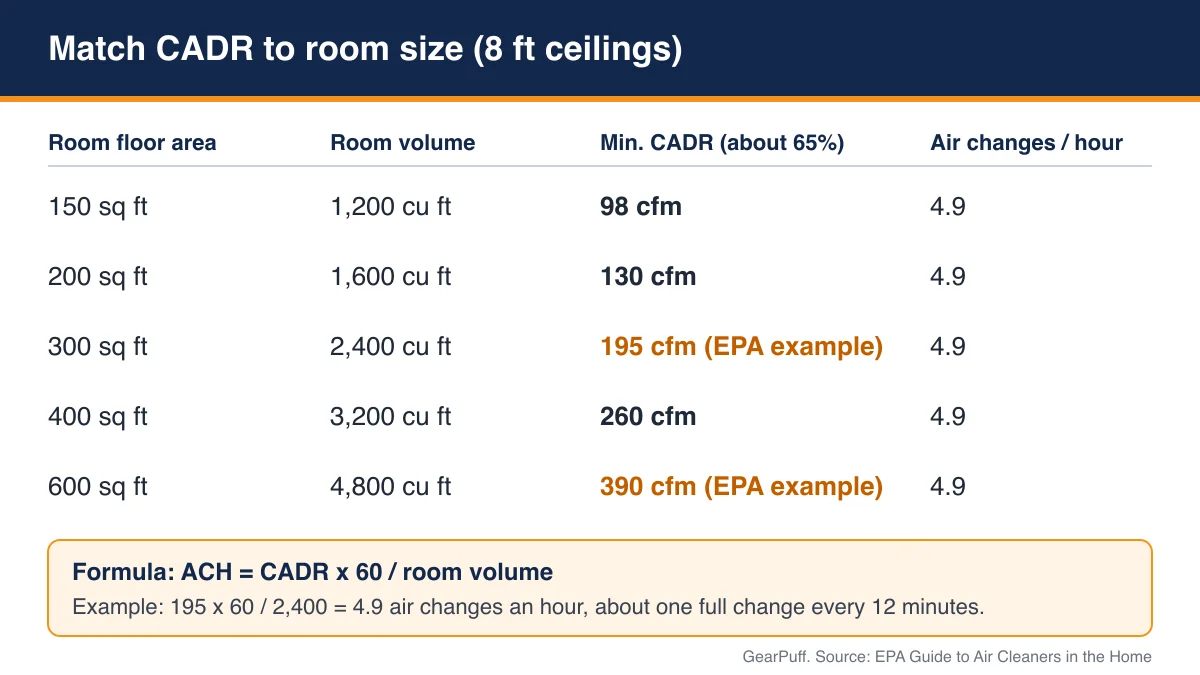
The chart above puts the two thirds rule next to common room sizes. Use it as a shortcut, then check the numbers for your own ceiling height.
Three Worked Examples
Numbers make the schedule real. Here are three rooms, calculated the same way, using 8 foot ceilings.
Example 1. A small bedroom, 10 by 12 feet. Floor area is 120 square feet, so the volume is 960 cubic feet. The two thirds guide suggests a CADR of about 78. A purifier rated 100 CADR gives 100 times 60 divided by 960, which is about 6.3 air changes an hour. That is more than enough on a low setting, so run it quietly all night.
Example 2. A living room, 15 by 20 feet. Floor area is 300 square feet, volume 2,400 cubic feet. EPA’s example gives a minimum CADR of 195. A purifier rated 250 delivers about 6.3 changes an hour on high and roughly half that on medium. Run it on medium or auto in the evening when you are in the room.
Example 3. An open plan space, 25 by 24 feet. Floor area is 600 square feet, volume 4,800 cubic feet. EPA’s example minimum is 390. A purifier rated 200 delivers only about 2.5 changes an hour, which is well under the target no matter how long it runs. This is the classic undersized purchase. Either buy a larger unit or place a smaller one in the spot where you sit and treat it as local cleaning.
The lesson is consistent. If the CADR matches the room, runtime is a comfort and cost choice. If it does not, runtime cannot rescue it.
A Schedule for Every Room and Situation
Bedrooms
Bedrooms are the most common place for a purifier and the easiest case. The room is small, the door is often closed, and you spend eight hours in it.
- Switch the purifier on one to two hours before bed so the air is already clean.
- Run it on the quietest setting that keeps up, or on auto.
- Keep the door closed, and if you can, keep windows shut on high-pollen nights.
Check the noise rating. EPA points out that around 50 decibels is roughly the operating noise of a modern refrigerator, which is a useful comparison. If the low setting is well under that, you will probably sleep fine.
Living rooms and open plan spaces
Larger rooms need larger CADR. If your purifier is undersized for an open plan space, put it in the zone where you spend the most time and run it a notch higher. Do not expect one small unit to clean an entire floor.
Homes with pets
Pets shed dander and hair around the clock, so continuous low running works well. Add a high-speed burst after grooming or when the pet has been rolling on the furniture. If odor is the complaint, look for a unit with an activated carbon filter. EPA notes that activated carbon works when a large amount of material is used in the filter.
Cooking and cleaning
Cooking and cleaning throw a lot of particles into the air at once. Turn the purifier to high while you cook or vacuum, and leave it there for 20 to 30 minutes afterward. Use the range hood too. Ventilation removes pollutants at the source, which no purifier can beat.
Smoke and heavy pollen days
Close the windows, close the doors to the room, and run the purifier continuously on a high or medium setting. This is where a properly sized HEPA unit earns its cost. A plug-in ionizer is not the right tool for smoke.
When you are away
You can switch it off to save power, or leave it on low. If the home is dusty, leave it on. If you are away for days, off is fine.
How Auto Mode and Air Quality Sensors Work
Many purifiers have an auto mode that adjusts fan speed to a built-in particle sensor. It is convenient, and it is worth knowing its limits.
- What it does well. Ramps up when you cook or vacuum, and drops back to a quiet speed when readings fall. That is exactly the “high in bursts, low the rest of the time” schedule this guide recommends.
- What it misses. Cheap sensors respond mainly to larger particles and can miss fine particles, gases and odors. An indicator light reading “good” does not mean the air is perfect.
- How to use it. Leave it on auto for daily running. In the evening or during heavy pollen or smoke, override it to a fixed medium or high setting.
A useful sanity check is to compare the purifier’s display with a separate PM2.5 monitor. If the two disagree a lot, trust the independent one more.
Seasonal Adjustments
Your best schedule changes through the year.
- Spring and summer, pollen season. Keep windows closed on high-pollen days and run the purifier continuously. Change into clean clothes and wash your hair before bed if pollen is a trigger, so the bedroom stays cleaner.
- Wildfire or smoky periods. Run on high until outdoor air improves, keep windows and doors closed, and consider a second purifier if the room is large. Do not use ionizers or ozone-emitting units, as EPA advises avoiding air cleaners that intentionally produce ozone.
- Winter. Homes are sealed up and heated, and dust and pet dander build up. Continuous low running in main rooms works well. Check filters before the season starts.
- After renovation or painting. Run on high with a fresh filter, and ventilate the space. A HEPA filter will help with dust, and carbon helps with some fumes, but ventilation is the main fix for chemical smells.
Where to Put It
Placement changes how well the same runtime works.
- Leave space around the intake. Follow the manufacturer’s clearance, often a foot or more from walls and furniture.
- Put it near the sleeper or the seat, not in a far corner, so the cleanest air reaches you.
- Keep it off the floor if you have pets or small children, unless the unit is designed for it, and keep the cord out of reach.
- Do not block the airflow path with curtains or a sofa.
- Close the door. A purifier only cleans the room it is in, and an open door lets it fight the whole house.
Filter-Based Purifiers vs Ionizers: Runtime Is Different
Everything above assumes a purifier with a fan and a filter. Runtime works differently for units that use ions.
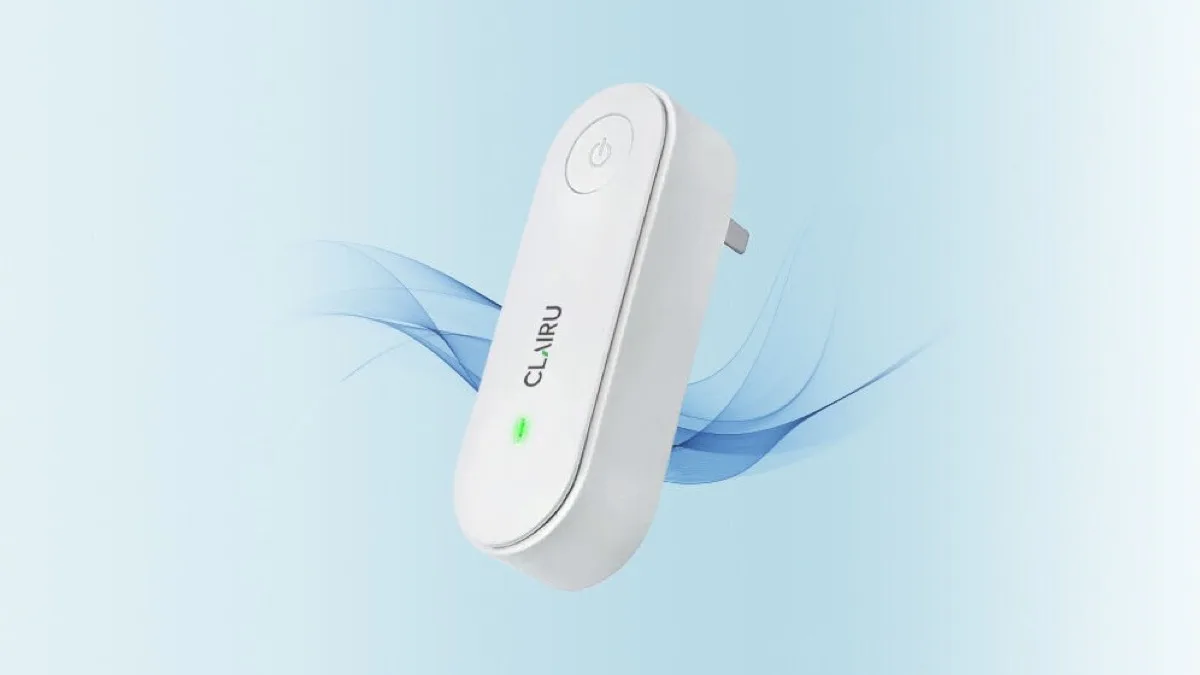
A plug-in ionizer, like the Clairu, has no fan and no filter, and most publish no CADR. That means you cannot use the two thirds rule or the ACH formula. It also matters for safety. EPA’s guidance says to avoid portable air cleaners that intentionally produce ozone, and it lists ionizers among the types that may have the potential to emit ozone. EPA recommends looking for air cleaners tested and shown to emit little or no ozone, and points to certification from the California Air Resources Board.
So if you use an ionizer, treat runtime with more care.
- Do not run an uncertified unit continuously in a small closed bedroom.
- Try it for a few hours at a time at first, in a well-ventilated room.
- If you notice a sharp or metallic smell, headaches or throat irritation, unplug it.
- Ask the seller for CARB certification or measured ozone output.
We cover the safety question in more detail in our explainer on whether plug-in ionic air purifiers work.
What Running It All Day Costs
Electricity is the cost people worry about most. The formula is simple.
Daily cost equals watts multiplied by hours, divided by 1,000, then multiplied by your price per kilowatt hour.
Here is an example with clearly assumed numbers, so you can swap in your own.
| Setting | Watts (assumed) | Hours | Energy per day | Cost at 17 cents per kWh (assumed) |
|---|---|---|---|---|
| Low | 10 | 24 | 0.24 kWh | about 4 cents |
| Medium | 30 | 24 | 0.72 kWh | about 12 cents |
| High | 60 | 24 | 1.44 kWh | about 24 cents |
The watts figures are illustrative. Real purifiers vary, and the wattage is usually printed on the label or in the manual. Your electricity rate will also differ, in the US and the UK alike.
The takeaway is that a purifier on low costs very little to run all day, and high is where the bill grows. That is the real argument for auto mode and a schedule: run high only when you need it.
Energy labels can mislead. EPA notes that an ENERGY STAR label means the unit meets strict energy efficiency guidelines, but it does not refer to the air cleaning effectiveness in any way. Choose on CADR first and energy second.
Filter Life and Maintenance
Running more hours uses filters faster. Manufacturers typically recommend replacing HEPA filters every 6 to 12 months and carbon filters more often, though the right timing depends on how dusty or smoky your home is.
EPA’s guidance is blunt on this point: all filters need regular replacement, and a dirty, overloaded filter will not work well. A few habits help.
- Write the install date on the filter or set a calendar reminder.
- Pre-filters, where fitted, can be vacuumed monthly to protect the main filter.
- Replace sooner after a smoky event or a very dusty renovation.
- Keep spare filters, and confirm the price before you buy the purifier.
Filter cost is the reason some people are drawn to filter-free units. It is a real saving, but you give up the measurable performance a HEPA filter provides, so weigh the trade carefully.
How to Tell Whether Your Schedule Is Working
You do not need lab equipment to check. A small PM2.5 monitor is inexpensive, and it gives you a way to see the effect.
- Record a baseline. With the purifier off, note the reading at the same time each day for a few days.
- Run your schedule. Keep the door closed and leave the purifier on auto or low.
- Watch the trend. Readings should fall within the first hour and stay lower, with short spikes when you cook.
- Adjust. If levels stay high, the unit is probably undersized or the filter is worn, and more hours will not help.
If you do not want another gadget, use symptoms and dust as a rough guide. Fewer dust films on surfaces, easier breathing on waking and less sneezing are all worth noting for two weeks.
Working With Your HVAC and Fans
Your central heating and cooling system can help or hinder a portable purifier.
- HVAC fan setting. Running the system fan continuously moves air through the furnace filter, which helps a little with whole-house particle removal. A better furnace filter raises resistance, so check what your system can handle before upgrading.
- Ceiling and box fans. A fan can carry clean air from a purifier to the far corners of a large room, but it also stirs settled dust. Use a gentle setting.
- Exhaust fans. Bathroom and kitchen fans remove pollutants at the source, so use them while cooking and showering.
- Fresh air. EPA lists ventilating with clean outdoor air as one of the most effective ways to improve indoor air. Open windows briefly when outdoor air is good, then close them and let the purifier catch up.
A purifier is one layer of a system. It works best beside source control and ventilation, not instead of them.
Mistakes That Waste Runtime
- Buying too small. A low CADR runs forever and never gets ahead.
- Blocking the intake. Placing a purifier tight against a wall or behind a sofa cuts airflow.
- Leaving windows open. You are filtering the whole neighborhood.
- Running on high all day. It is louder, costs more and wears filters faster for little extra benefit.
- Forgetting filters. A clogged filter turns your schedule into wasted electricity.
- Expecting a purifier to fix a source. Damp, mold, smoking indoors and dusty bedding need dealing with directly.
A Simple Weekly Routine
If you want a plan you can follow without thinking, use this one.
- Weekdays. Leave the purifier on auto, or on low, in the room you use most. Move it to the bedroom at night if you only own one.
- Cooking or cleaning. High for 20 to 30 minutes after, then back to auto.
- Weekly. Vacuum the pre-filter if there is one, and wipe dust from the intake.
- Monthly. Check the filter by eye, and check the indicator.
- Every 6 to 12 months. Replace the main filter, or sooner in dusty homes.
Quick Reference: Schedules at a Glance
| Situation | Setting | Duration |
|---|---|---|
| Normal day, right-sized purifier | Low or auto | Most of the day |
| Bedroom | Low, quiet mode | Two hours before bed through the night |
| After cooking or cleaning | High | 20 to 30 minutes |
| Smoke or heavy pollen outside | Medium to high, windows closed | Continuous |
| Away for the day | Off or low | Your choice |
| Ionizer or uncertified unit | Short sessions, ventilated room | Watch for smell or irritation |
Bottom Line
For a properly sized filter purifier, the honest answer to how many hours a day to run an air purifier is most of them, on a low setting, with short bursts on high when the air gets worse. Size it to the room using CADR and the two thirds rule, keep filters fresh, and let auto mode do the work.
For ionizers and other units that may emit ozone, run them with more caution, and only after you have checked certification. If you are weighing a cheap plug-in against a filter unit, our guide to what to avoid when buying an air purifier covers the traps.
Frequently Asked Questions
Is it OK to run an air purifier 24 hours a day?
How many hours a day should I run an air purifier in my bedroom?
Should I turn my air purifier off when I leave the house?
Does running an air purifier all day use a lot of electricity?
How long does it take an air purifier to clean a room?
Should I run my air purifier on high or low?
Do I need to close the windows when running an air purifier?
How often should I replace the air purifier filter if I run it all the time?
Do plug-in ionizers need to run all day?
More Smart Home Guides
Related Product Reviews

Maya Chen
Smart home enthusiast and IoT specialist. Has automated over 50 homes across different ecosystems. Former smart home consultant for Google Nest and Amazon Alexa. Passionate about making technology accessible.
Affiliate disclosure:This article contains affiliate links. If you buy through them, GearPuff may earn a commission at no extra cost to you. It keeps our testing independent and our reviews free.