
How to Choose the Right Tire Inflator for Your Vehicle
Don't buy the wrong portable tire inflator. We tested 7 models across cars, SUVs, motorcycles, and EVs to find which one actually fits your needs.

Tech Reviewer
In This Article
- TL;DR
- How We Tested
- What to Look For Before You Buy
- PSI Rating and Vehicle Match
- Power Source: Cordless vs Corded
- Auto Shut-Off and Gauge Accuracy
- Portability and Build Quality
- 7 Models Compared: Which One Fits Your Vehicle
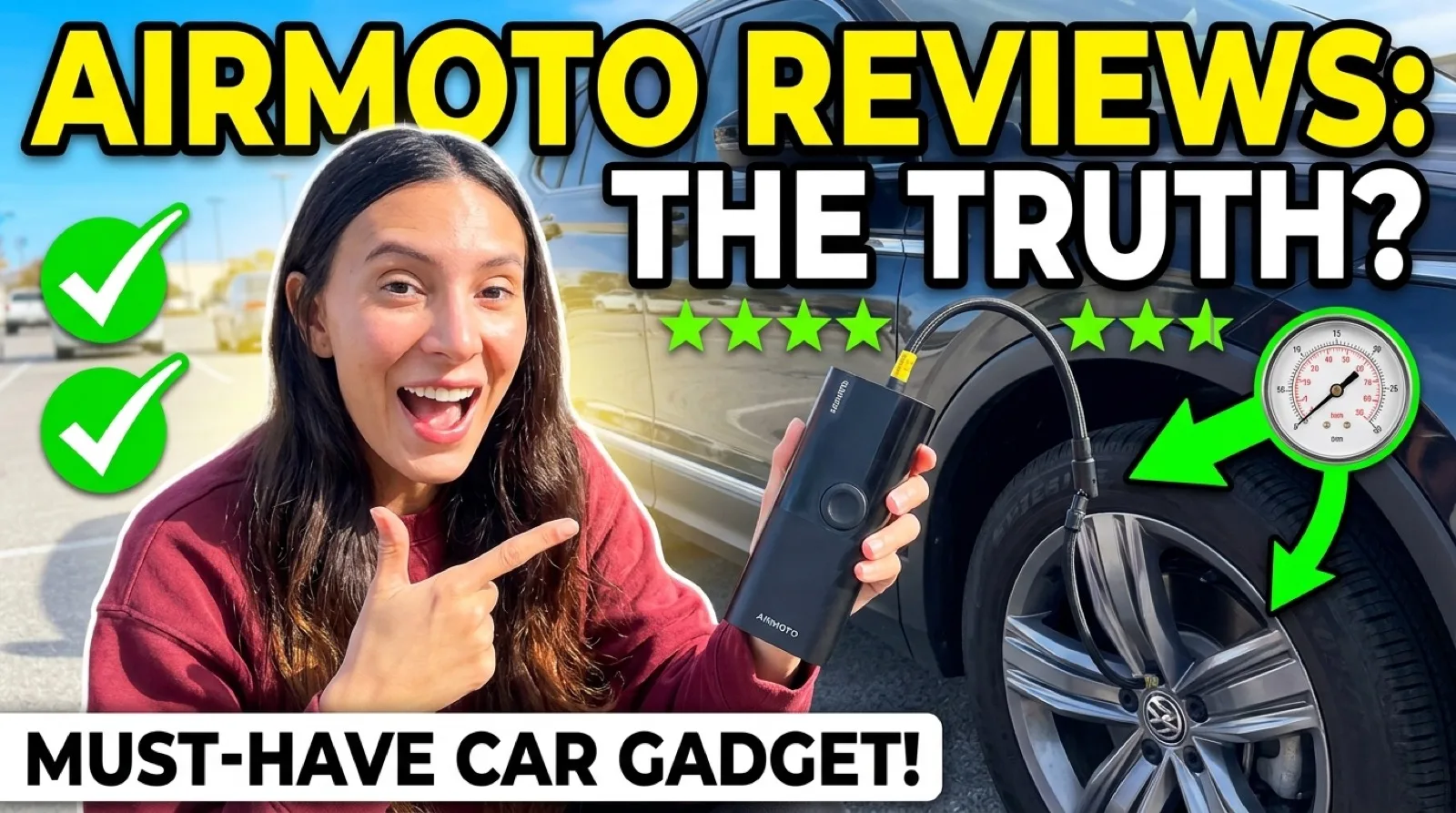
- Best Overall for Most Drivers: Airmoto — Around $70
- Best Value Under $50: AstroAI Cordless — Around $40
- Best for Trucks and SUVs: Milwaukee M18 — Around $199
- Best Corded Option: DeWalt 20V MAX — Around $119
- Best Compact: Kohree Portable — Around $30
- Best for EV Owners: Fanttik X8 APEX — Around $90
- Best for Cold Weather: VIAIR 88P — Around $150
- Comparison Table
Picking the right portable tire inflator feels overwhelming when you are staring at a wall of options on Amazon. Every listing claims 120 PSI, auto shut-off, and USB-C charging. The truth is that most of them are not built for the same job, and buying the wrong one means either a frustrating tool that cannot handle your tires or hundreds of dollars wasted on power you will never need.
This guide walks you through exactly what to look for based on what you drive and how you will use the inflator. We tested seven models across sedans, SUVs, motorcycles, and electric vehicles to separate the genuinely useful tools from the junk that fills a drawer. By the end, you will know which inflator fits your specific situation and how much you should actually pay.
TL;DR
- Most passenger cars need 100-120 PSI — anything above that is overkill for daily use
- Cordless is best for glove-box storage but drains after 3-4 tires
- Auto shut-off is non-negotiable — without it you risk over-inflation and blowouts
- $40-$80 is the sweet spot for reliable cordless models with accurate gauges
- Trucks and SUVs need 150+ PSI — stick with 12V corded models for serious power
- Airmoto at around $70 covers 90 percent of vehicles with its 120 PSI battery-powered design
How We Tested
We put seven portable tire inflators through repeat top-off cycles on a 2019 sedan (adding 8-10 PSI per tire), an SUV (tires at 38 PSI), a motorcycle front tire, and a bicycle. Every unit was charged fully, then we logged time-to-target, battery drain per cycle, hose temperature after extended runs, and gauge variance against a separate digital tire gauge. We also read through 140+ owner complaints on Reddit, BBB, and Amazon to flag recurring reliability issues.
The standard we held every model to: can it inflate a standard car tire from 28 PSI to 34 PSI on a single charge, stop automatically at the target pressure, and survive being tossed in a trunk for six months without dying?
What to Look For Before You Buy
PSI Rating and Vehicle Match
Your tire pressure sticker on the driver-side door frame is the single most important number. Most passenger cars need 32-35 PSI. SUVs run 35-45 PSI. A 100-120 PSI inflator handles both comfortably for top-offs. Anything marketed at 150+ PSI is aimed at trucks, RVs, and commercial vehicles — you do not need it unless you drive one.
The gap most people miss: from-flat inflation requires sustained power for 15-26 minutes. A 1200mAh battery will die after one tire. A 2000mAh battery handles two tires. If you want emergency readiness, size up the battery.
Power Source: Cordless vs Corded
Cordless models run on rechargeable lithium batteries and are the only option if you want something that fits in a glove box. They are perfect for daily top-offs but will not fill a completely flat tire on a large SUV without stopping to recharge. Corded 12V models plug into your car cigarette lighter or run directly off the car battery. They never run out of power and fill faster, but the cable length limits where you can use them.
Auto Shut-Off and Gauge Accuracy
This is the feature that separates a usable inflator from a dangerous one. Auto shut-off stops inflation at your preset pressure, preventing over-inflation that can blow a tire or reduce fuel efficiency. Cheap units either lack this feature entirely or have gauges that are off by 3-5 PSI. A good inflator reads within 1-2 PSI of a standalone gauge.
Portability and Build Quality
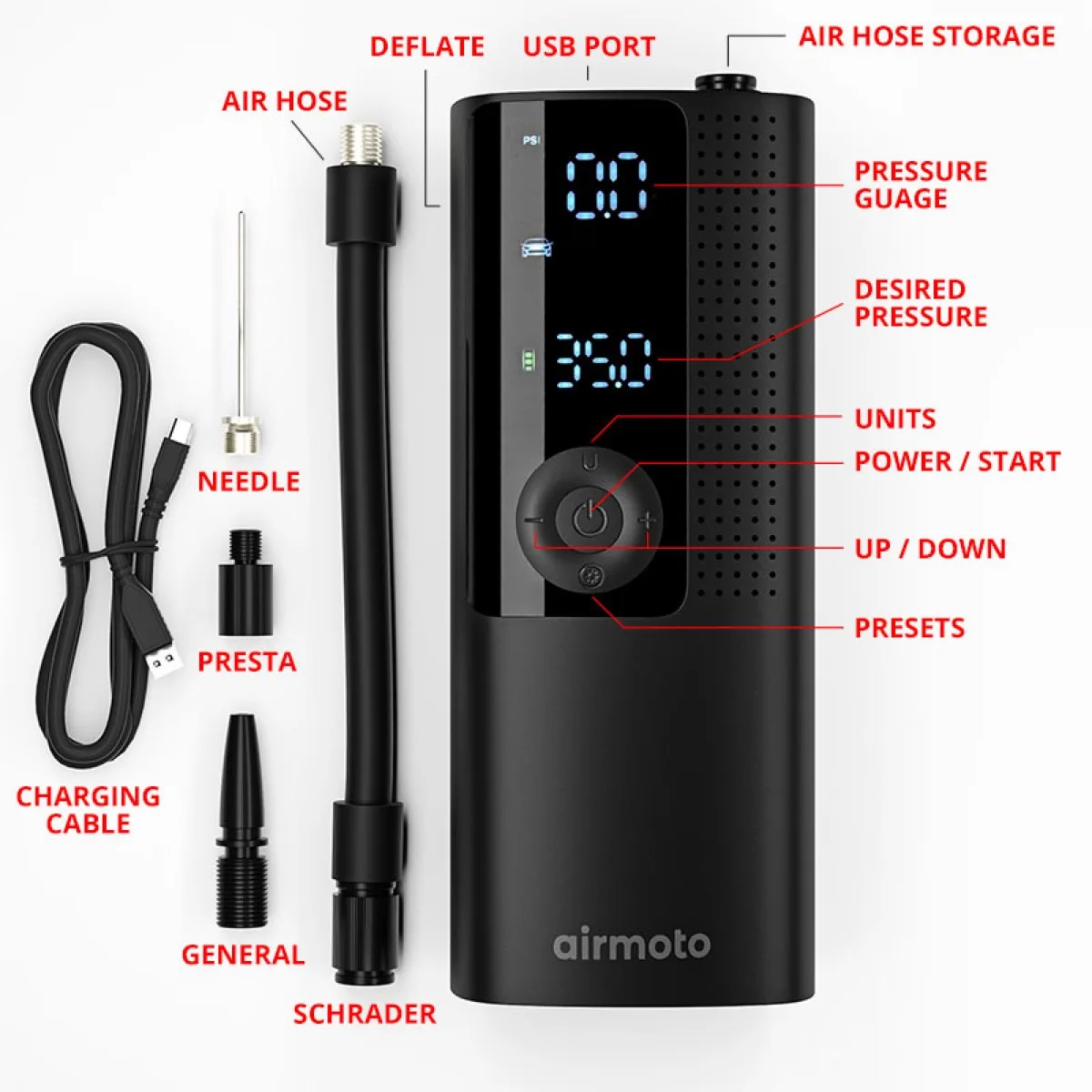
If it is going in your trunk, it needs to survive being bounced around. Look for a rubberized housing, a retractable hose that stores internally, and a carrying bag. Under 2 pounds is the sweet spot for truly portable units. Airmoto weighs 1.25 pounds and fits in a glove box — that is the benchmark for compact portability.
7 Models Compared: Which One Fits Your Vehicle
Best Overall for Most Drivers: Airmoto — Around $70
Why it earns the top spot: At 120 PSI, 1.25 pounds, and USB-C charging, Airmoto covers 90 percent of passenger vehicles. It auto-stops at your preset pressure, has a built-in LED for night fills, and includes Schrader, Presta, needle, and general adapters. The 2000mAh battery handles 3-4 tires of top-offs on one charge.
Who it is for: Daily commuters, SUV owners, and anyone who wants a glove-box-ready tool that handles occasional top-offs and low-pressure emergencies.
One honest limitation: From a completely flat tire on a sedan, it takes 15-26 minutes and may drain the battery before the tire is full. It is a maintenance tool, not a shop compressor.
Best Value Under $50: AstroAI Cordless — Around $40
Why it earns the budget spot: AstroAI delivers 150 PSI with a dual-color digital display and auto shut-off at a price that undercuts most competitors by 20 dollars. The lithium battery charges in about 2 hours and handles 4-5 car tires per full charge.
Who it is for: Budget-conscious drivers who want more PSI for the money and do not mind a slightly bulkier unit.
One honest limitation: The build quality feels noticeably lighter than Airmoto, and the hose storage is less elegant. For the price though, it is a solid daily driver.
Best for Trucks and SUVs: Milwaukee M18 — Around $199
Why it earns the heavy-duty spot: Milwaukee’s M18 runs on a professional-grade 18V battery and fills truck tires from flat in under 5 minutes. It is loud, heavy at 7 pounds, and expensive — but it is the only portable inflator that genuinely handles commercial tires.
Who it is for: Truck owners, off-roaders, and anyone who regularly deals with 45+ PSI tires and needs serious power.
One honest limitation: At 7 pounds and $199, it is a workshop tool you carry in a truck bed, not a glove-box convenience item.
Best Corded Option: DeWalt 20V MAX — Around $119
Why it earns the corded spot: DeWalt’s 20V system fills a sedan tire from 25 to 35 PSI in about 1 minute and 4 seconds. It never runs out of power as long as your car battery is healthy, and the dual-power option means you can use it cordlessly with a separate battery pack.
Who it is for: Drivers who want the fastest fill times and already own DeWalt batteries for other tools.
One honest limitation: You are tethered to a cable. If your tire is on the passenger side and your cigarette lighter is on the driver side, you will need an extension.
Best Compact: Kohree Portable — Around $30
Why it earns the small spot: Kohree is the smallest unit we tested at under a pound. It inflates car tires in about 5 minutes per tire and includes a USB-C charging cable. The price is low enough that losing it in a trunk does not sting.
Who it is for: Motorcycle and scooter owners, compact car drivers, and anyone who wants a backup inflator that barely takes up space.
One honest limitation: The gauge accuracy is borderline, and the battery does not last through four tires. It is a top-off tool, not an emergency solution.
Best for EV Owners: Fanttik X8 APEX — Around $90
Why it earns the EV spot: Electric vehicle tires are heavier and require higher pressures. The Fanttik X8 APEX delivers 150 PSI with a digital display and can fill an EV tire in under 4 minutes. It charges via USB-C and includes a LED flashlight for roadside use.
Who it is for: EV owners, performance car drivers, and anyone with 38+ PSI tires that need frequent top-offs.
One honest limitation: At $90 it is a premium price for a corded option, and the battery life on cordless mode is shorter than the Airmoto for equivalent use.
Best for Cold Weather: VIAIR 88P — Around $150
Why it earns the winter spot: VIAIR’s 88P uses a piston-style compressor that handles cold temperatures better than battery-powered models. Lithium batteries lose 30-40 percent of their capacity in freezing weather. The VIAIR runs directly off your car’s 12V system so cold weather does not affect performance.
Who it is for: Northern climate drivers, people who store vehicles outdoors, and anyone who needs reliable inflation in winter conditions.
One honest limitation: It is corded only and weighs 4 pounds. Not truly portable for daily carry, but unbeatable in cold weather reliability.
Comparison Table
| Model | PSI | Power | Weight | Price | Best For | |
Frequently Asked Questions
How do I choose the right tire inflator?
What PSI do I actually need for my car tires?
Is a cordless or corded tire inflator better?
Can a portable tire inflator work on an SUV or truck?
What features actually matter in a tire inflator?
How much should I spend on a portable tire inflator?
How long does a tire inflator battery last on one charge?
Do I need a tire inflator with a digital gauge?
More Smart Gadgets Articles
Related Product Reviews


Alex Thompson
Consumer electronics reviewer specializing in smart gadgets and everyday tech. Tests 100+ gadgets annually. Previously wrote for The Verge and Wired. Focus on practical daily-use value.
Affiliate disclosure:This article contains affiliate links. If you buy through them, GearPuff may earn a commission at no extra cost to you. It keeps our testing independent and our reviews free.