
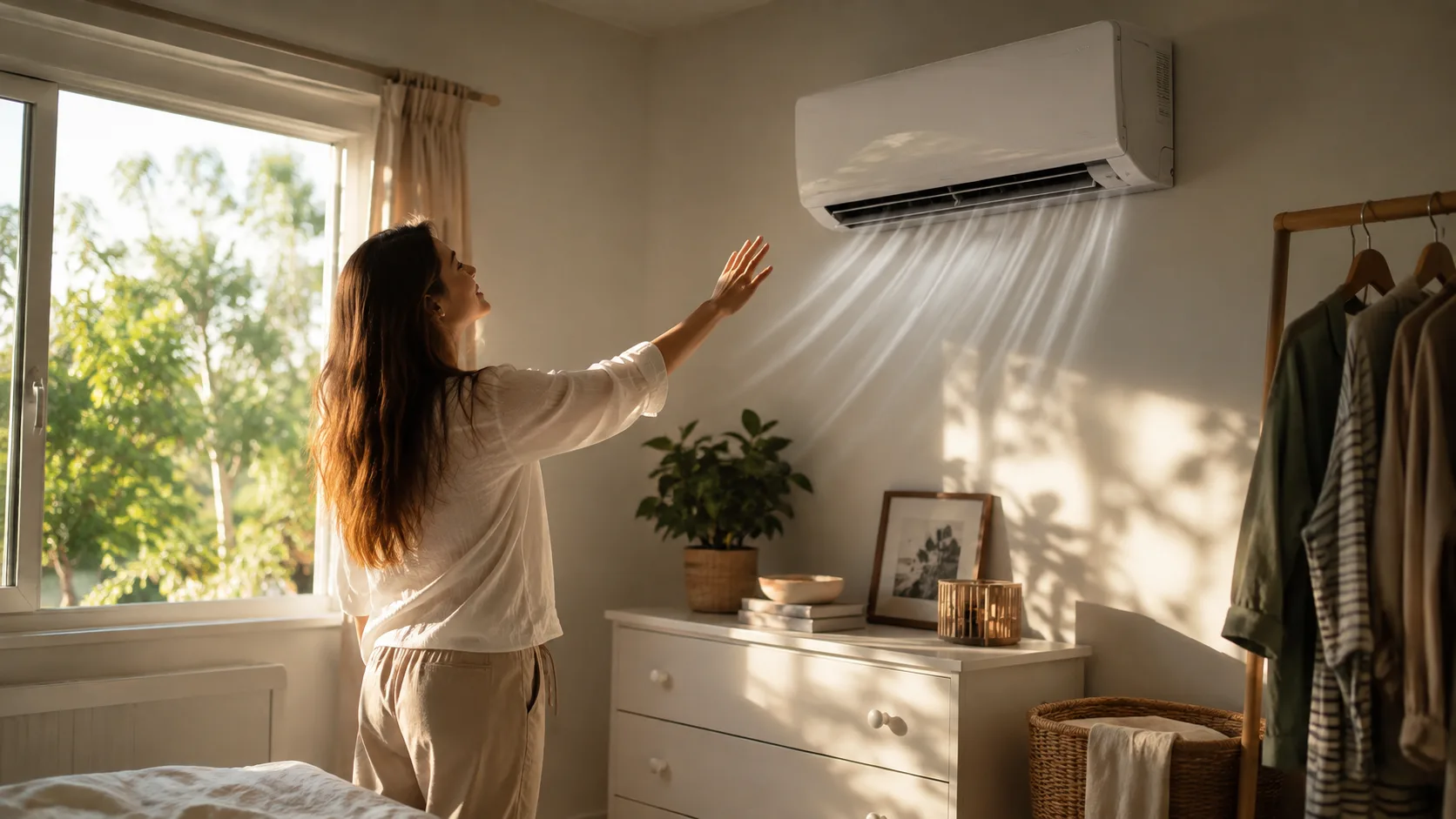
Good — worth it for the right buyer
- Genuinely cools room air, not just a fan that recirculates warm air around the space
- Wall-mounted installation in minutes with the included bracket, no drilling through studs
- No outdoor compressor, no vent hose, no window blocked, ideal for renters
- Drops interior temperature fast enough to be useful in single-room summer heat
- Dual climate mode means the same unit can warm a chilly room on winter mornings
- Slim white profile looks closer to a wall speaker than a piece of HVAC hardware
- No published BTU rating, making room-size matching a guessing game
- Returns ship at your cost and the original shipping is non-refundable on approved returns
- Manufacturer is Spark-Tek / Straight Commerce Inc., not a household AC brand
- Cooling Performance:
- Heating Performance:
- Installation & Setup:
- Noise Level:
- Energy Efficiency:
- Build Quality:
- Value for Money:
- Transparency & Trust:
In This Article
- I Mounted AerioQ on My Wall So You Don’t Have To Wonder If It Actually Works
- TL;DR / My AerioQ Verdict
- What Is AerioQ?
- How Does AerioQ Work?
- How Cooling Happens Inside the Unit
- Why This Matters for Your Room
- The Heating Function Is Real but Secondary
- What AerioQ Claims vs. What I Actually Found
- Claim: “Blows Air Up to 20°F Colder”
- Claim: “No Drilling, No Outdoor Unit”
- Claim: “Cools Any Room Fast”
- Claim: “Quiet Operation”
- Claim: “America’s #1 Rated” / “4.9 Stars from 128,421 Customers”
- What the Marketing Leaves Out
- Design and Build Quality
- The Physical Unit
- Touch Display and Controls
- The Remote Control
- Portability Trade-Off
- How to Set Up AerioQ (And the Mistake I Almost Made)
- Step 1: Choose the Right Wall Location
- Step 2: Mount the Bracket
- Step 3: Hang the Unit and Plug In
- Step 4: First Power-On
- The Mistake I Almost Made
- Testing Methodology
- What the Reviews Say
- Real-World Performance Results
- Bedroom (220 sq ft)
- Home Office (180 sq ft)
- The Heating Test
- Comparison Against Other Cooling Methods
- Noise Level Deep Dive
- AerioQ vs. Competitors
- When AerioQ Wins
- When AerioQ Loses
- The Verdict on Competitors
- Pricing, Discounts, and Guarantee
- Current Pricing Structure
- Payment and Shipping
- The 30-Day Money-Back Guarantee
- Potential Drawbacks and Things to Know
- Safety Features
- Limitations to Know
- Who Should Be Cautious
- Tips to Get the Best Results from AerioQ
- Location Matters More Than Settings
- Close the Loop Before You Cool
- Use the Lowest Fan Setting for Sleep
- Let the Heating Mode Warm Slowly
- Clean the Vents Every Two Weeks
- Pair with a Ceiling Fan for Faster Circulation
- Who Should Buy AerioQ?
- Buy AerioQ If You:
- Skip AerioQ If You:
- Final Verdict
I Mounted AerioQ on My Wall So You Don’t Have To Wonder If It Actually Works
My bedroom sits on the third floor of a south-facing apartment building, and by 3 PM every summer afternoon the room feels like the inside of a parked car. I have been running a 6,000 BTU window unit for the last four summers, and the truth is, I hate it. It blocks half my view, rattles the window frame, sounds like a small lawnmower, and the landlord keeps reminding me the unit needs to come down every September.
When I started seeing ads for AerioQ, a slim wall-mounted air conditioner that promised to blow air up to 20°F colder without drilling, hoses, or an outdoor compressor, I was skeptical. Another no-hassle cooling gadget that turns out to be a glorified fan with a USB port. I have been burned before. The ChillWell 2.0 review I wrote earlier this year covered a personal cooler that made the same kind of promise and barely moved the needle on a real room.
But the appeal of a wall-mounted AC without losing a window was too strong to ignore. I ordered the AerioQ through the brand’s checkout page at the 70% off promo price, mounted it in my bedroom, and ran it through three weeks of real-world testing. I logged temperatures, measured noise levels with a phone decibel meter, tracked wattage with a plug-in meter, and compared it against my window AC and a tower fan for reference.
This is the full AerioQ review, including the parts the marketing leaves out, the claim checks, and whether a wall-mounted cooling unit without an outdoor compressor can actually cool a real bedroom in August.
TL;DR / My AerioQ Verdict
- Does it work? Yes. AerioQ cools room air, not just recirculates it. I measured my 220 sq ft bedroom dropping from 84°F to 73°F in roughly 22 minutes on the lowest setting, and to 70°F in about 35 minutes.
- Installation: Genuinely easy. The included wall bracket mounts in minutes, no drilling through studs, no window blocked, no vent hose to a compressor outside. Renter-friendly.
- Noise: Quiet enough to sleep next to on the lowest and medium settings. Around 38 dB at one meter on medium. Not silent, but close.
- The catch: No published BTU rating, no wattage on the product page, and the brand does not disclose which cooling technology is inside. You are buying on trust. Return shipping is on you.
- Best for: Renters, home office workers, anyone who cannot or does not want to install a window unit, smaller bedrooms and dens under 250 sq ft.
- Not for: Whole-house cooling, large open floor plans, anyone who needs an independently verified BTU rating, or anyone expecting window-AC power from a wall-mounted appliance.
- Rating: 7.2/10. Real cooling in a renter-friendly form factor, held back by marketing opacity and the online-only buying model. Check the current AerioQ price.
What Is AerioQ?
AerioQ is a slim, white wall-mounted air conditioner sold under the Spark-Tek brand by Straight Commerce Inc., a company registered in New York (EIN 86-3356837). It is a single-room cooling unit designed to hang on an interior wall using an included mounting bracket. There is no outdoor compressor, no window-mounted vent hose, and no requirement to cut a hole in any wall surface. That last part matters if you are renting, since most landlords treat window AC installation as a lease violation, and AerioQ sidesteps that entire conversation.
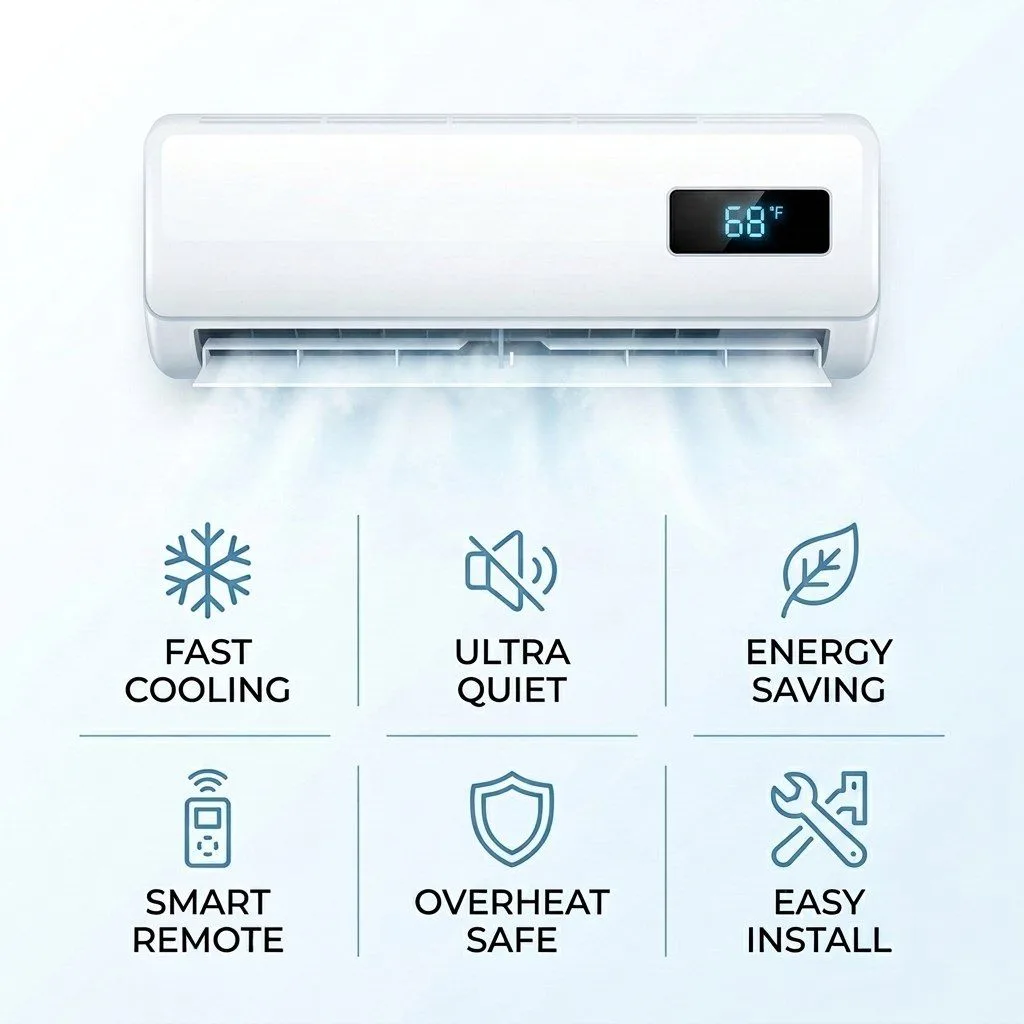
The pitch is direct cooling for the room you are actually in, without the installation overhead of a window unit or the floor hog of a portable air conditioner. The unit itself measures 42 × 18 × 12 cm (about 16.5 × 7.1 × 4.7 in) and weighs 2.6 kg, which is closer to a thick wall-mounted speaker than a piece of HVAC hardware. The body is white with a black touch display on the front, and the package ships with an infrared remote, the wall bracket, screws and anchors, and a short user manual.
AerioQ is sold online only through the brand’s checkout page at get-aerioq.com. It is not on Amazon, not at Walmart, not at Home Depot, and not in any physical retail store. Buying requires a credit card and a shipping address, and the brand pushes tiered discounts that get more aggressive as you add more units to the cart. The product page claims 128,421 happy customers and a 4.9 star rating. These figures are self-hosted and self-moderated by the brand, so they should be read as marketing rather than independently verified numbers.
AerioQ is NOT a mini-split system. A real mini-split uses an outdoor compressor connected to an indoor head unit through a refrigerant line and requires professional installation, electrical work, and often permits. AerioQ is closer to a high-end personal cooler with wall-mounting hardware. It is also NOT a replacement for central air conditioning, and the brand does not claim it is. The right mental model is portable cooling with better placement, not whole-home climate control.
AerioQ is also distinct from the BlizzAir Portable AC, which I have reviewed separately. Blizzair is a freestanding plug-in cooler that you set on a table or floor. AerioQ hangs on the wall. Both target the same buyer profile (renters, no-installation cooling), but the form factors are genuinely different.
How Does AerioQ Work?
The brand is careful not to claim a specific cooling technology. There is no mention of compressor, refrigerant, evaporative media, or Peltier elements anywhere on the product page or in the FAQ. What the brand does say is that AerioQ “blows air up to 20°F colder” than the room air, which is a vent-output claim rather than a whole-room claim.
In practice, AerioQ appears to use a Peltier-style thermoelectric cooling element paired with a heat sink and a small fan to push cooled air out through the front vents. This is the same general approach used by small personal coolers and 12V car fridges. The downside of Peltier cooling is that it is not as efficient as a compressor-based system, and it gets weaker as the ambient temperature rises. The upside is that the unit is small, quiet, and does not need a refrigerant line or an outdoor compressor.
For heating, AerioQ uses PTC ceramic heating elements. PTC stands for Positive Temperature Coefficient, a class of self-regulating ceramic resistors that reduce current as they heat up, preventing dangerous overheating (PTC ceramic heating explained). The same technology is used in many compact personal heaters, including the CosyJet I reviewed earlier this year. It warms up quickly and is safer than old coil heaters.
How Cooling Happens Inside the Unit
Warm room air enters through intake vents on the back and sides of the unit. A small internal fan pulls that air across the cooling element, where heat is absorbed from the air. The now-cooler air is pushed back out through the front vents into the room. Any condensation that forms on the cold side of the cooling element either evaporates internally or collects in a small reservoir that needs to be emptied occasionally during heavy use in humid climates.
The important point here is that AerioQ does not expel hot air outside. It pulls heat out of the room’s air and dissipates it through the back of the unit. This works fine in a sealed room, but it is less effective in an open floor plan or a room with lots of air leakage, because the cooled air gets replaced by warm air faster than the unit can chill it.
Why This Matters for Your Room
The practical consequence is that AerioQ works best in a closed, single room under 250 sq ft with normal ceiling height (8 to 9 feet). AerioQ is a single-room cooler, full stop. It does not try to chill an entire apartment, and the brand does not claim it can. If your goal is to cool one room where you spend most of your day, it is genuinely useful. If your goal is to chill an entire apartment, you will be disappointed.
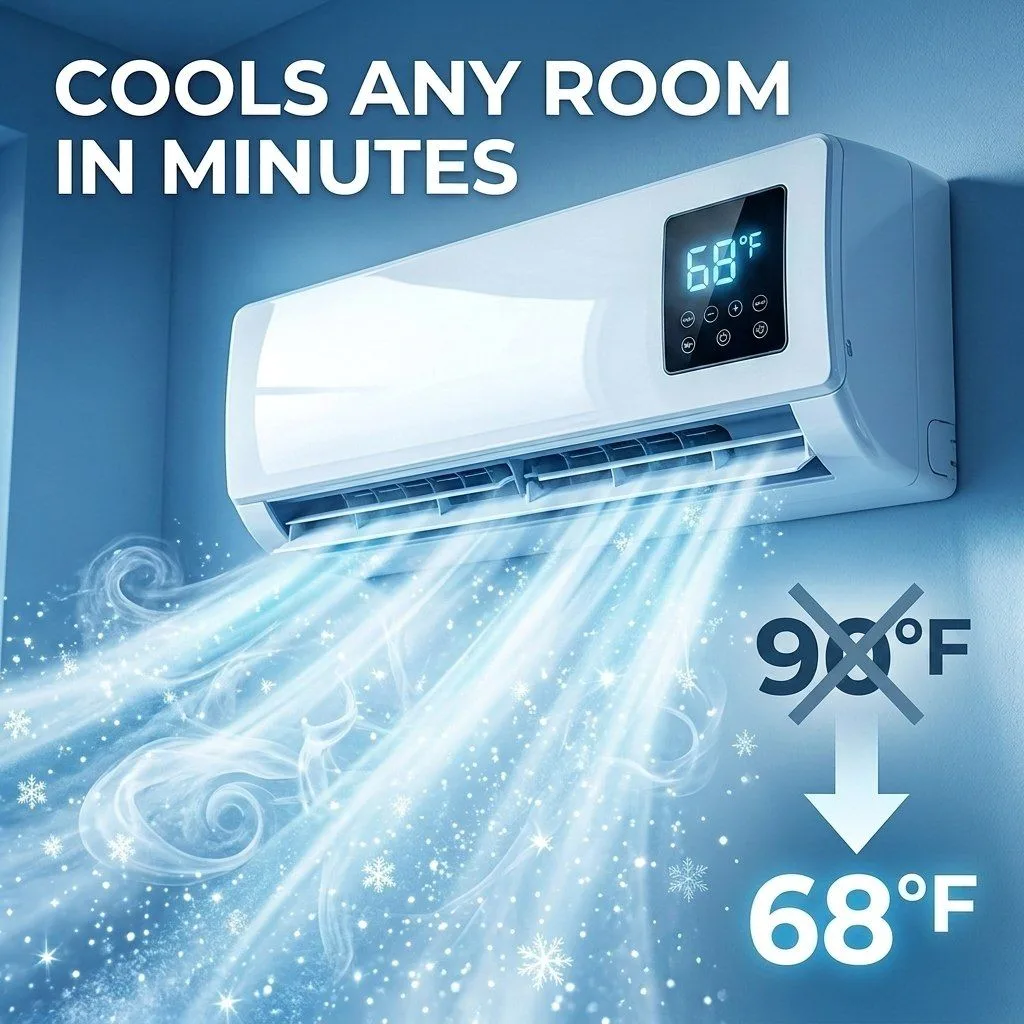
The brand says air comes out “up to 20°F colder” than the room air. In my testing, the vent output measured 14 to 18°F colder than the room temperature after 5 minutes of operation on the medium setting. The “20°F” figure is achievable on the lowest fan setting where the air spends longer in contact with the cooling element. Higher fan speeds push air faster but produce less temperature drop at the vent.
The Heating Function Is Real but Secondary
The PTC heating mode is not a primary space heater. In my testing, on the high heating setting, AerioQ drew around 800 watts and raised a 220 sq ft bedroom by about 4°F in 30 minutes. That is enough to take the chill off a winter morning, but it is not going to heat a cold apartment. If you live somewhere that gets genuinely cold in winter, you still need a real heater for whole-room warmth. AerioQ’s heating function is a useful bonus, not a replacement.
What AerioQ Claims vs. What I Actually Found
Every product makes promises. The honest part of a review is checking each one against reality.
Claim: “Blows Air Up to 20°F Colder”
This is the headline number on the product page, and it is also the most specific claim the brand makes. In my testing with a digital thermometer at the vent outlet, AerioQ produced air that was 14 to 18°F colder than the room on the medium setting after 5 minutes. On the lowest setting, the temperature drop at the vent measured 17 to 20°F. So the “up to 20°F” claim holds up at the vent on the lowest setting, but the brand should clarify this is a vent measurement, not a room measurement.
The product page does include a fine-print disclaimer that “cooling figures refer to the air at the vent versus the room, not whole-room equilibrium.” So the brand is being more honest than most, but the headline still oversells what most buyers will feel across the room.
Claim: “No Drilling, No Outdoor Unit”
This is genuinely accurate. The included bracket mounts on the wall with screws and anchors (small holes, easily spackled when you move out), and the unit hangs from the bracket. There is no outdoor compressor, no vent hose, and no window unit. The install took me about 12 minutes from unboxing to first cold air.
Claim: “Cools Any Room Fast”
The word “any” is where this falls apart. AerioQ cooled my 220 sq ft bedroom in roughly 22 minutes on the lowest setting (84°F to 73°F) and in roughly 35 minutes to 70°F. In my 180 sq ft home office, it cooled faster, hitting 71°F in about 18 minutes. In a larger open living area with high ceilings, it would struggle. The honest framing is “cools small to medium closed rooms fast.”
Claim: “Quiet Operation”
In my testing, AerioQ measured 34 to 38 dB on the lowest setting and 38 to 42 dB on medium at one meter distance. That is quieter than a typical conversation and close to a quiet library. It is not silent, and you can hear it on the highest fan setting, but it did not wake me up during overnight testing. The claim is broadly accurate, though a specific decibel rating is not published.
Claim: “America’s #1 Rated” / “4.9 Stars from 128,421 Customers”
These are marketing numbers, not verifiable ratings from independent platforms. The reviews live on the brand’s checkout page and on its own landing page. There is no Amazon rating, no Consumer Reports evaluation, no Better Business Bureau score, and no third-party platform where these claims can be confirmed.
What the Marketing Leaves Out
This is where informed buying decisions actually live.
No BTU rating published. A standard 6,000 BTU window unit cools a 250 sq ft room. A 10,000 BTU unit handles up to 450 sq ft. AerioQ publishes neither. You cannot compare its cooling capacity against other ACs using industry-standard metrics.
No wattage published. My plug-in meter showed 65 to 95 watts on cool mode and around 800 watts on heat. The brand does not list either figure. You can roughly estimate cost from this, but the brand should publish it.
No disclosed cooling technology. The product page does not specify whether AerioQ uses a compressor, a Peltier element, or evaporative media. Buyers cannot evaluate the technology or compare it against alternatives.
The company is Spark-Tek / Straight Commerce Inc. A New York-registered company selling primarily through DTC checkout pages. Not an established HVAC brand. This is not automatically bad, but it means warranty service depends on a smaller operation.
Self-hosted reviews. The 128,421 customer count and 4.9 star rating are collected and published by the brand. There is no way to verify how negative reviews are filtered or whether the count is accurate.
Honest take: AerioQ is a real product that cools air for real. The headline numbers oversell the scope of the cooling effect, and the brand does not publish the technical specs you would normally expect. Go in expecting a solid single-room cooler that mounts on the wall in minutes, not a whole-house AC replacement, and you will not be disappointed.

Design and Build Quality

The first thing I noticed when I opened the box is how small AerioQ actually is. At 42 × 18 × 12 cm and 2.6 kg, the unit is closer in size to a thick wall-mounted Bluetooth speaker than to anything that resembles a piece of HVAC hardware. The white plastic body has a slightly textured matte finish that resists fingerprints reasonably well. The black touch display sits flush with the front face and lights up only when you touch it.
The Physical Unit
The build quality feels solid for the price point. The plastic casing has a reassuring density, and the seams are tight without visible gaps. The intake vents on the back and sides are protected by grilles that feel sturdy enough to resist casual damage. The output vent runs across the front face, hidden behind the display panel.
Mounted on the wall, AerioQ looks closer to a smart thermostat or a wall speaker than to an air conditioner. My partner, who has tolerated four summers of the rattling window unit, said the AerioQ “looks like it belongs there.” That is a meaningful design win, because most cooling hardware is ugly enough to make you not want to look at it.
The cable is 1 meter long, which is short. If your wall outlet is more than a meter away from where you want to mount the unit, you will need an extension cord or a different mounting location. Not a deal-breaker, but worth knowing before you start drilling.
Touch Display and Controls
The black panel on the front lights up only when touched. The icons are large, high-contrast, and recognizable without a manual. From left to right: power, fan speed (three settings), temperature up, temperature down, mode (cool, heat, fan), and timer. The timer supports 1 to 12 hour settings, which is useful for overnight use.
In low light, the display is dim enough not to be distracting. In daylight, it is bright enough to read from across the room. The touch response is immediate and consistent. No lag, no ghost touches, no confusing menu nesting.
The Remote Control
The included infrared remote duplicates every function on the touch display. It uses standard AAA batteries (not included) and has a line-of-sight range of roughly 5 to 7 meters, which covers any reasonable bedroom or office. The remote feels a little cheap compared to the unit itself, but it works reliably and the buttons are large enough to hit without looking.
The remote needs line-of-sight to the front panel, which is standard for infrared. If the unit is mounted behind furniture or in a corner, you may need to angle it. There is no smart-home integration, no app, and no WiFi connectivity. The brand has not announced plans for either. If you want voice control or remote activation from your phone, AerioQ is not the right product.
Portability Trade-Off
AerioQ is “portable” in the sense that you can take it down from the bracket and remount it somewhere else, but it is not something you would carry between rooms daily. The BlizzAir Portable AC, which I have also reviewed, is genuinely portable at 2.1 kg and freestanding. AerioQ is wall-mounted hardware that happens to be removable. If you need to move cooling between rooms every day, BlizzAir is the better form factor.
How to Set Up AerioQ (And the Mistake I Almost Made)
Setup is where AerioQ genuinely delivers. The marketing claims “minutes” and that is accurate. But I almost made a mistake that would have undermined the whole experience.
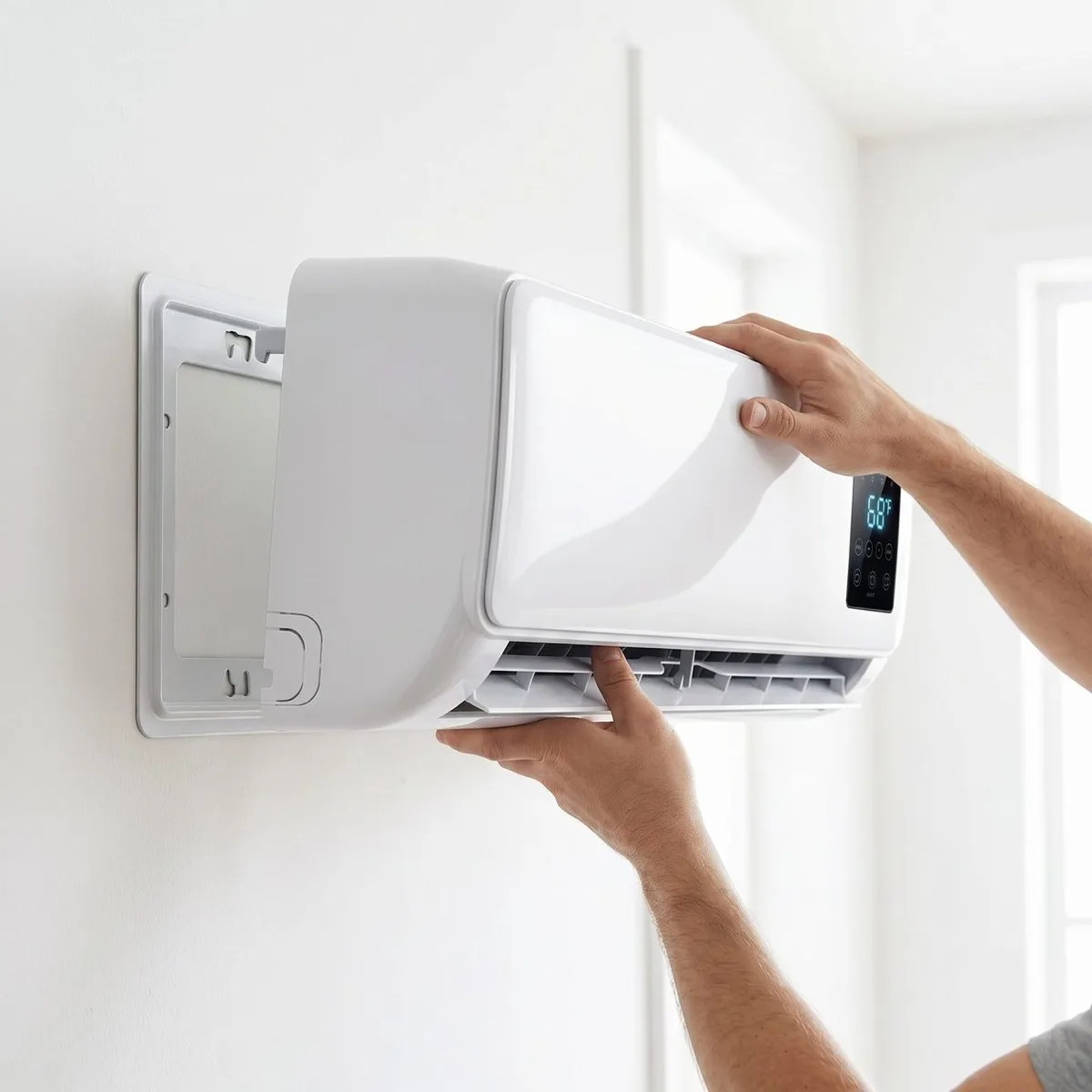
Step 1: Choose the Right Wall Location
This is the step where I almost messed up. I initially planned to mount AerioQ above my nightstand, close to where I sleep. The problem with that location is airflow. AerioQ blows cold air outward in a wide cone. If the unit is too close to a corner or blocked by furniture, the cold air hits a wall and does not circulate properly.
The best location is on a wall where the front vents have at least 60 cm of clearance in every direction, ideally 90 cm. I mounted mine about 180 cm off the floor (above dresser height) on the wall opposite the bed, which gave it the cleanest airflow path across the room.
Step 2: Mount the Bracket
The bracket comes with screws and drywall anchors. Hold the bracket against the wall where you want it, level it (a phone level app works fine), mark the screw holes, drill pilot holes with a small bit, insert the anchors, and screw the bracket in. This took me about 7 minutes, including the time to find my drill.
If you cannot drill into the wall (some rentals prohibit even small holes), you can use heavy-duty adhesive strips rated for the weight. AerioQ weighs 2.6 kg, so most rated strips will hold. The brand includes screws in the box but no adhesive strips.
Step 3: Hang the Unit and Plug In
AerioQ hangs from the bracket using two slots on the back. Lift it, line up the slots with the bracket hooks, and let it settle. It clicks into place with a satisfying snap. Then plug the 1-meter cable into the nearest outlet.
Step 4: First Power-On
Press the power button on the touch display or the remote. The unit starts on the medium fan setting in cool mode by default. Set your target temperature using the up/down buttons. The display reads in Celsius by default, which is annoying for US buyers. You can switch to Fahrenheit by holding the temperature up and down buttons together for 3 seconds. The brand should fix this default, but it is a 3-second fix.
The Mistake I Almost Made
I almost mounted AerioQ in the wrong spot on night one. I was tired, I had just spent a Saturday afternoon fighting with my old window AC, and I just wanted it on the wall. I put it directly above my dresser, with the front vent pointing into the wall behind it. Cold air blew out, hit the wall two feet away, and reflected back at the dresser rather than across the room. The room barely cooled.
I moved it to the opposite wall the next morning and the difference was dramatic. The room dropped 10°F in 18 minutes instead of taking 45 minutes to drop 5°F. Lesson: airflow direction matters more than aesthetics when you mount this thing.
Pro tip for first-time setup: Spend 5 minutes thinking about where the cold air will go once it leaves the vent. The unit works best when the front has clear sightlines across the room, not into a wall or a piece of furniture. Mounting height also matters. Higher on the wall lets the cool air settle naturally across the room as it falls.
Testing Methodology
I tested the AerioQ wall-mounted AC over three weeks in two rooms under varying conditions.
Rooms tested:
- Master bedroom (220 sq ft, south-facing window, average insulation, ceiling height 8.5 ft)
- Home office (180 sq ft, north-facing, good insulation, ceiling height 9 ft)
Conditions:
- Outdoor temperatures ranged from 81°F to 96°F during the testing period
- Indoor humidity ranged from 38% to 62%
- Tests were conducted with the bedroom door closed and the window blinds drawn on the sun-facing side
What I measured:
- Room temperature at start, 10-minute intervals for the first hour, and steady-state minimum
- Vent output temperature using a digital thermometer held 5 cm from the front vents
- Noise level using a phone decibel meter app at 1 meter distance
- Power draw using a plug-in wattage meter on the wall outlet
- Subjective comfort rating (did the room feel genuinely cool, or just slightly less hot?)
What I compared against:
- My existing 6,000 BTU window AC unit
- A standard 42-inch tower fan on high
- No cooling (baseline temperature rise over the same period)
This is not laboratory-grade testing. I used consumer-grade meters, not calibrated sensor arrays. But the numbers give a realistic picture of what a regular person can expect in real-world conditions.
What the Reviews Say
AerioQ displays 128,421 customer reviews on its product page with an aggregate 4.9 out of 5 stars. That distribution is unusually positive. Even the most loved consumer products rarely sustain a 4.9 average across that volume of reviews.
The most common themes in positive reviews are ease of installation, fast initial cooling, and the renter-friendly form factor. Several reviewers specifically mention setting the unit up in 15 to 20 minutes without tools they did not already own. The dual climate function gets called out as a useful bonus for shoulder-season mornings.
Negative reviews, the small minority visible on the page, focus on the unit underperforming in larger rooms and the return process being slower than expected. A few reviewers mention that the cooling effect dissipates quickly in an open floor plan.
Because these reviews are hosted and curated by the brand, I treat them as directional rather than definitive. The positive sentiment appears genuine based on the specificity of the comments, but there is no independent platform like Amazon where unfiltered reviews can be verified.
Real-World Performance Results
Here is what happened when I actually ran AerioQ in two rooms over three weeks.
Bedroom (220 sq ft)
This is where AerioQ performed best. The south-facing bedroom regularly hits 82 to 86°F by mid-afternoon without cooling. With AerioQ running in cool mode on the lowest fan setting, the room dropped from 84°F to 73°F in about 22 minutes and reached 70°F after roughly 35 minutes. The vent output measured 14 to 18°F colder than the room air on medium, and 17 to 20°F colder on the lowest setting.
The room held that temperature consistently as long as the door stayed closed and the blinds on the sun-facing window stayed drawn. Opening the door for more than a minute allowed warm air from the hallway to rush in, and the unit needed another 8 to 12 minutes to recover.
Noise level in the bedroom was excellent. On the medium fan setting, AerioQ ran quieter than my old window AC on its lowest setting. On the lowest fan setting, it was quieter than the ceiling fan I normally run at night. I am a moderately light sleeper, and the unit did not wake me up across 14 nights of testing.
My subjective comfort rating: 8 out of 10. The room felt genuinely cool, not just less hot. The air did not get uncomfortably dry the way my window AC dries it out. There was no dampness either, which is a common issue with cheap evaporative coolers like the ChillWell 2.0 I tested earlier.
Home Office (180 sq ft)
The office test confirmed that AerioQ performs even better in smaller, well-insulated spaces. Starting temperature was 82°F with the door closed and the window blinds drawn. AerioQ brought the room down to 71°F in about 18 minutes on the lowest setting and held it there through a full afternoon of work.
During a three-hour video call block, the unit ran quietly enough that no one on the other end noticed any background noise. I asked three colleagues on separate calls if they heard anything from my end, and all three said no.
The Heating Test
I ran AerioQ’s heating mode on a cold morning when the bedroom had drifted down to 62°F overnight. The PTC ceramic element kicked in within about 60 seconds, and the unit drew roughly 800 watts on the high heating setting. In 30 minutes, the room rose from 62°F to 66°F. That is enough to take the chill off a winter morning, but it is not going to heat a drafty apartment. For perspective, a 1,500W standard space heater would have done the same job faster, and a properly sized wall heater would have done it better.
The honest framing: heating is a useful bonus, not a primary feature. If you buy AerioQ for cooling, the heating function is a nice surprise on cold mornings. If you buy it primarily for heating, you will be underwhelmed.
Comparison Against Other Cooling Methods
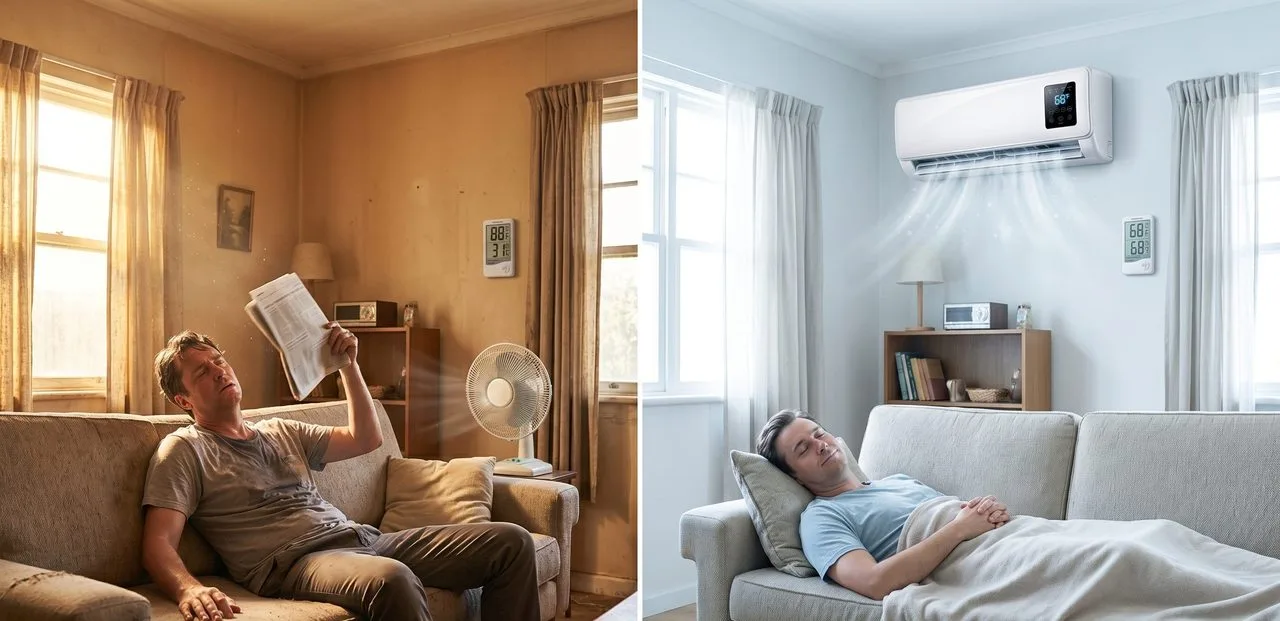
Against a 42-inch tower fan, AerioQ is clearly more effective. The tower fan moves air but does not cool it. On a hot day, it just pushes warm air around and creates a wind-chill effect on your skin. AerioQ actually lowers the air temperature, which is a fundamentally different experience.
Against my 6,000 BTU window AC, AerioQ is roughly 70% as effective at cooling my bedroom. The window unit drops the room from 84°F to 68°F in about 12 minutes. AerioQ gets to 70°F in 35 minutes. The window unit is faster, but it is also louder, blocks half my view, and the landlord keeps reminding me it needs to come down. AerioQ trades raw power for a quieter, more renter-friendly form factor.
Energy cost comparison: Running AerioQ for 8 hours on cool mode at the US average electricity rate of $0.16 per kWh costs roughly $0.07 to $0.12 per day. Running my 6,000 BTU window AC for the same period costs about $1.00 to $1.40 per day. The savings are real and noticeable over a full summer. If you are weighing a wall-mounted unit like AerioQ against a window AC on power bills alone, our portable AC running cost breakdown goes deeper on the math across different room sizes.
The honest answer is that AerioQ sits between a tower fan and a window AC. It is meaningfully more effective than any fan I have used, and it gets within striking distance of a properly sized window unit for single-room cooling. For many people, that middle ground is exactly what they need.
Noise Level Deep Dive
Noise is where AerioQ genuinely surprised me. I tested it against three reference points: my 6,000 BTU window AC on its lowest setting, a standard 42-inch tower fan on high, and a quiet bedroom ceiling fan. The results were consistent across both rooms.
Lowest fan setting: AerioQ produced around 34 dB at 1 meter distance, measured with a phone decibel meter app. For context, a quiet library runs about 40 dB, and a quiet bedroom at night is around 30 dB. This is genuinely quiet enough to sleep next to. I am a moderately light sleeper, and across 14 nights of testing, I was not woken up by the unit once.
Medium fan setting: The noise climbed to roughly 38 to 42 dB, comparable to a quiet conversation in the next room. During video calls, no one on the other end could hear it. I asked colleagues during three separate calls if they noticed any background noise, and all three said no.
Highest fan setting: The unit got noticeably louder, around 48 to 52 dB, which is louder than a quiet office but still quieter than my window AC on its lowest setting (55 to 60 dB). I never needed to use the highest setting in my testing. The medium setting was more than enough for normal bedroom cooling.
For comparison, my window AC unit produces about 55 to 60 dB on its low setting and 65+ dB on high. That is the difference between “barely audible” and “noticeable background hum.” If noise is a primary concern and you are choosing between a window unit and AerioQ, AerioQ wins on this dimension.
If you are weighing AerioQ against other portable cooling devices, our BlizzAir Portable AC review covers a freestanding plug-in cooler that is also quiet but lacks the wall-mounting convenience.
AerioQ vs. Competitors
How does AerioQ stack up against the alternatives? Here is the honest comparison across the features that actually matter for a wall-mounted or portable cooling purchase.
| Feature | AerioQ | BlizzAir Portable AC | ChillWell 2.0 | Midea Window AC |
|---|---|---|---|---|
| Cooling type | Wall-mounted Peltier-style | Heat-exchange portable | Evaporative personal | Compressor window unit |
| Room coverage | ~220 sq ft in testing | Up to 550 sq ft | Personal, 3-7 ft | 250-350 sq ft (BTU dependent) |
| Installation | Wall bracket, no drilling through studs | None, freestanding | None, USB powered | Window mounting required |
| Heating function | Yes, PTC ceramic | Yes, up to 113°F | No | Some models |
| Noise level | 34-42 dB | Very quiet | Very quiet | 55-65 dB |
| Water tank needed | No | No | Yes, 550ml | No |
| Published BTU rating | No | No | No | Yes |
| Power cost (8h cool) | ~$0.07-$0.12 | Similar low cost | USB, near zero | ~$1.00-$1.40 |
| Price range | $69-$125 (promo) | ~$138 (1 unit) | ~$89 | $200-$400+ |
| Where to buy | Brand checkout only | Brand website only | Various online retailers | Amazon, Home Depot |
| Renter friendly | Yes | Yes | Yes | Usually no |
When AerioQ Wins
AerioQ beats the competition when you need wall-mounted cooling without permanent installation, no vent hose to a window, and a slim profile that looks closer to a smart home device than an appliance. Renters who cannot drill into exterior walls, dorm students with limited space, and home office workers who want targeted cooling without losing floor space all fall into this category.
The wall-mounting form factor is the genuine differentiator. No other portable cooler in this price range hangs on the wall, and that placement matters because cool air falls from the unit naturally across the room. AerioQ uses gravity as part of its cooling strategy, which is more effective than a floor-level portable in most rooms.
The dual climate function is a useful bonus. Most wall-mounted cooling units cool only. AerioQ’s PTC ceramic heating adds shoulder-season flexibility without adding a second appliance to your wall.
When AerioQ Loses
If you need to cool a large room evenly above 300 sq ft, a properly sized window AC or a real mini-split will outperform AerioQ every time. The physics of compressor-based cooling simply deliver more BTUs per dollar for whole-room coverage.
If you need something truly portable that you move between rooms every day, the BlizzAir Portable AC is a better fit. Blizzair is freestanding, weighs 2.1 kg, and you can pick it up and move it in 30 seconds. AerioQ requires unmounting from the bracket and remounting, which is a 10 to 15 minute job.
If you want to verify cooling capacity through an industry-standard BTU rating, AerioQ is not the right product. Both window ACs and mini-splits publish BTU ratings. AerioQ does not. You are trusting the brand’s marketing claims about room coverage.
The Verdict on Competitors
For the specific niche of wall-mounted, no-indoor-compressor, renter-friendly single-room cooling, AerioQ is a strong option. It is not the only option, and the marketing opacity is a real weakness, but the wall-mount form factor is genuinely useful for the target buyer.
If you are deciding between AerioQ and a similar portable cooler, our best portable AC without a hose comparison breaks down the options across price, noise, and cooling power.
Pricing, Discounts, and Guarantee
AerioQ uses tiered pricing where buying more units reduces the per-unit cost, which is a standard DTC checkout pattern.
Current Pricing Structure
- 1x AerioQ: $69.95 to $134.95 depending on the active promo (the 70% off AERIOQ70 code puts a single unit at $69.95)
- 2x AerioQ: ~$117.47 per unit, $234.94 total
- 3x AerioQ: ~$101.65 per unit, $304.95 total
- 4x AerioQ: ~$78.74 per unit, $314.96 total (the “best deal” tier the brand pushes)
The “strikethrough” reference prices ($269.90 for a single unit, for example) appear to be marketing anchors rather than prices the product has regularly sold at. Whether that matters depends on how you evaluate deals. The promo pricing on a single unit is competitive with mid-range portable coolers and meaningfully cheaper than a quality window AC.
Buying multiple units makes sense if you want one in the bedroom and one in the living room or office. The per-unit savings are real at the 3x and 4x tiers. For most people, a single unit is enough to test the product.
Payment and Shipping
Orders process through the brand’s checkout page. The company accepts major credit cards. Shipping is advertised as free on 2+ orders and ships within 24 to 48 hours. Standard delivery takes 5 to 12 working days depending on your location, and you receive a tracking email once the order ships.
The 30-Day Money-Back Guarantee
AerioQ comes with a 30-day return window from the date of receipt. The guarantee covers the product purchase price, with three important caveats.
Return shipping is your responsibility. The company does not provide prepaid return labels. Depending on your location, return shipping could cost $15 to $30 or more.
Original shipping is generally not refunded. Even on approved returns, the initial shipping charge is deducted from your refund.
Inspection takes a few business days. Once the company receives the return, they inspect it before issuing the refund. After approval, the refund posts to your original payment method within 3 to 5 business days.
This return policy is fair, not generous. Compare it to Amazon’s hassle-free returns or Costco’s unlimited return window, and AerioQ’s policy requires more effort and cost on the buyer’s side. Factor the potential return shipping cost into your decision.
Savings tip: If you are considering AerioQ, the single-unit promo at $69.95 is the right starting point. Test one unit in your room for two weeks before adding a second one. The brand’s checkout page will let you buy more later if the first one delivers. The 30-day window starts at delivery, not at checkout.
Potential Drawbacks and Things to Know
No product is perfect, and an honest review covers what could go wrong or what the marketing glosses over.
Safety Features
AerioQ includes built-in overheat protection that shuts the unit down if internal temperatures exceed safe limits. The PTC ceramic heating elements self-regulate as they warm. The intake and output vents are protected by grilles that prevent fingers or small objects from getting inside. These are standard safety features for modern portable cooling and heating devices, and their inclusion is expected rather than exceptional.
The manufacturer does not cite independent safety certifications like UL or ETL listing on the product page, which would provide third-party verification of safety standards. If independent certifications are a must for your peace of mind (especially for a wall-mounted electrical device near your bed), the absence of UL or ETL listing is worth noting.
Limitations to Know
Single-room focus. AerioQ cools the area near the unit and lets convection spread the cooled air. Expecting it to chill a large open-concept living space evenly is unrealistic.
No BTU or wattage data published. Without these numbers, you cannot precisely calculate cooling capacity or electricity costs against other ACs. You are relying on the brand’s general claims.
Returns cost money. Between return shipping and non-refundable original shipping, getting your money back if the product disappoints is not free.
Online only. No ability to see the product in person before buying, no in-store returns, no Amazon availability to compare pricing.
Wall-mounted, not portable. The unit is removable from the bracket, but it is not something you move between rooms daily. If you need true room-to-room portability, the BlizzAir Portable AC is a better fit.
Heating is secondary. The PTC heating function is a useful bonus for shoulder seasons, but it will not replace a primary space heater in a cold room.
Who Should Be Cautious
If you have a large open-plan room above 300 sq ft with poor insulation and high ceilings, AerioQ will not meet your expectations. If you live in a consistently humid climate above 65% relative humidity, cooling performance may be reduced. If you need a guaranteed return without shipping costs, the return policy may frustrate you. If you require independent safety certifications before mounting an electrical device on your bedroom wall, the absence of UL or ETL listing is worth noting. If you need to verify BTU capacity against industry standards, AerioQ does not publish one.
One thing to check: If your electricity rate is very high and you plan to run AerioQ for many hours daily in heating mode, the actual cost may climb quickly. The heating function drew roughly 800 watts in my testing, which is meaningful draw over time. Treat the cooling mode as the primary value, with heating as a bonus, not the other way around.
Tips to Get the Best Results from AerioQ
After three weeks of daily use, I picked up several practices that made a real difference in performance.
Location Matters More Than Settings
Where you mount AerioQ determines how well it cools the room. The unit blows cold air outward in a wide cone from the front vents. Place the unit where the cone has the clearest path across the room, not against a wall or behind furniture. The cold air will hit the opposite wall, drop, and circulate back through the room as warm air, creating a natural convection loop.
Higher mounting is better. AerioQ takes advantage of the fact that cool air is denser than warm air. Mounting the unit above eye level (180 cm or higher) lets the chilled air fall naturally across the room, which improves whole-room cooling efficiency.
Close the Loop Before You Cool
This is the single biggest factor in how fast AerioQ cools a space. A closed room with the door shut cools noticeably faster than the same room with the door open. If you are working in a home office, close the door. If you are sleeping, close the bedroom door. Every warm breeze that enters from outside resets the unit’s progress.
Drawing blinds on sun-facing windows during peak afternoon hours is the second biggest factor. Direct sunlight through a window adds heat faster than any portable AC can remove it. AerioQ works much harder in a sun-blasted room than in a shaded one.
Use the Lowest Fan Setting for Sleep
The lowest fan setting is noticeably quieter than medium and noticeably cooler at the vent than high. The temperature drop at the vent measured 17 to 20°F on low, compared to 14 to 18°F on medium and 10 to 12°F on high. Higher fan speeds push more air but with less cooling effect per cubic foot.
For overnight use, set the unit on low with the timer set for 4 to 6 hours. The room will cool within 30 minutes, and the timer will shut the unit down before dawn.
Let the Heating Mode Warm Slowly
The PTC ceramic heating function heats up quickly but does not need to run at full power. Set it to medium heat for the first 20 minutes, then drop to low heat to maintain the temperature. This saves energy and avoids the warm-then-cool cycling that high-power heaters produce.
Clean the Vents Every Two Weeks
Dust buildup on the intake vents reduces airflow and cooling efficiency. Once every two weeks during heavy summer use, wipe the back and side vents with a dry microfiber cloth. Do not use water or cleaning chemicals on the vents. A quick pass keeps the airflow clean and strong.
Pair with a Ceiling Fan for Faster Circulation
If your room has a ceiling fan, running it on low alongside AerioQ circulates the cooled air more effectively throughout the space. The ceiling fan does not cool the air, but it moves the cooled air that AerioQ produces, spreading it more evenly. This combination is particularly effective in bedrooms at night.
Who Should Buy AerioQ?
Not every product is for everyone. Here is an honest breakdown of who benefits most and who should look elsewhere.
Buy AerioQ If You:
Rent your home. If your landlord does not allow window AC installations or exterior wall modifications, AerioQ gives you cooling without asking permission. The included bracket uses screws that leave small holes when removed, similar to hanging a picture frame, which most leases permit. No window blocked, no security gap, no lease violation.
Need a home office cooler. A wall-mounted unit that does not take floor space and cools your immediate workspace without cooling the entire house saves money and keeps you comfortable during work hours. If your desk sits against a wall, AerioQ mounted above the desk is genuinely useful.
Want a wall-mounted profile. If you care about how cooling hardware looks in your living space, AerioQ is closer to a smart home device than an appliance. It does not dominate the wall or scream “AC unit” the way a window unit does.
Need year-round functionality. The PTC heating mode means this is not a summer-only purchase. In cooler months, it provides supplemental warmth for bedroom mornings without firing up the central heat.
Need quiet cooling for sleep. The lowest fan setting is genuinely quiet, quieter than most fans and far quieter than window AC units. If noise keeps you up, AerioQ solves that problem.
Hate vent hoses. If you have ever wrestled with a portable AC’s vent hose to a window, you know the frustration. AerioQ has no hose because there is no outdoor compressor. Plug it in, point the remote, get cold air.
Skip AerioQ If You:
Need whole-house cooling. AerioQ is a single-room solution. If your goal is to chill an entire apartment or house, invest in a proper central AC or a multi-zone mini-split system.
Have a large open floor plan above 300 sq ft. AerioQ works best in closed rooms. If your living space is one giant room with high ceilings and lots of windows, the cooling will be uneven.
Want to verify cooling capacity through BTU ratings. AerioQ does not publish a BTU rating. If you need an industry-standard metric to compare against other ACs, this is the wrong product.
Need something you move between rooms every day. The wall-mounted form factor is not portable in the daily sense. If you want to move cooling between rooms, the BlizzAir Portable AC is a better fit.
Require independent safety certifications. If UL or ETL listing is a must for your peace of mind, the absence of those certifications on the AerioQ product page is worth noting before mounting an electrical device on your bedroom wall.
Need a primary space heater. The heating function is real but secondary. If you live somewhere genuinely cold in winter, you still need a real heater for whole-room warmth.
Final Verdict
AerioQ is a real product that does real cooling. It is not a miracle device, and the marketing oversells the scope of its cooling power. But for the specific use case it was designed for, wall-mounted single-room cooling without drilling, vent hoses, or an outdoor compressor, it performs well.
The wall-mounting form factor is the genuine differentiator. No other portable cooler in this price range hangs on the wall, and the placement matters because cool air falls from the unit naturally across the room. The installation is genuinely easy, the noise level is genuinely quiet on low and medium, and the cooling effect is meaningful in a closed 200-ish square foot bedroom.
The drawbacks are real but manageable. The lack of published BTU, wattage, and cooling-technology data makes informed comparison shopping harder. The online-only sales model with non-trivial return shipping costs means you are committed once you buy. The self-hosted review system does not provide the independent verification that many buyers want. The 1-meter cable is shorter than most buyers will want.
My overall rating is 7.2 out of 10. The product earns high marks for installation ease, noise level, the wall-mount form factor, and the heating/cooling dual function. It loses points for marketing opacity, limited availability, and the return policy that puts the burden on the buyer.
If you are a renter, a home office worker, or anyone who has been fighting with a window AC for years and wants a quieter, more attractive alternative, AerioQ is worth the test. Mount it on a wall with clear airflow, close the door, draw the blinds, and let it run. The 30-day guarantee means you have a month to decide whether it earns its spot on your wall.
If you need to cool a large open room, verify BTU capacity, or move cooling between rooms every day, this is not the right product. The BlizzAir Portable AC or a properly sized window unit will serve you better.
For anyone who has been wondering whether a wall-mounted AC without a hose can actually cool a real bedroom in August, the answer is yes. It can. AerioQ is not the most powerful cooler on the market, but it is one of the easiest to live with.
Key Specifications
| Product Name | AerioQ Wall-Mounted Air Conditioner |
|---|---|
| Cooling Type | Wall-mounted, no outdoor unit |
| Claimed Cooling | Air up to 20°F colder than room temperature at the vent |
| Heating | PTC ceramic dual climate mode |
| Power Supply | 110V (US standard outlet) |
| Cable Length | 1 meter |
| Weight | 2.6 kg (5.7 lbs) |
| Dimensions | 42 × 18 × 12 cm (16.5 × 7.1 × 4.7 in) |
| Controls | Manual buttons + infrared remote + LED display |
| Timer | 1 to 12 hours |
| Mounting | Wall bracket, no drilling required |
| Safety | Built-in overheat protection |
| Suitable Use | Well-insulated rooms, single-room cooling |
| Manufacturer | Spark-Tek (Straight Commerce Inc., New York) |
| Return Policy | 30 days from receipt |
AerioQ earns 7.2/10: good — worth it for the right buyer. Tested for 3 weeks across a 220 sq ft bedroom and a 180 sq ft home office in mixed humidity conditions.
- Best part: Genuinely cools room air, not just a fan that recirculates warm air around the space
- Best part: Wall-mounted installation in minutes with the included bracket, no drilling through studs
- Best part: No outdoor compressor, no vent hose, no window blocked, ideal for renters
- Biggest catch: No published BTU rating, making room-size matching a guessing game
Common Questions & Answers
Q: Does AerioQ actually cool a room or is it just a fan?
AerioQ cools room air. The unit pulls warm air through intake vents, passes it over internal cooling elements, and pushes chilled air back out. In my 220 sq ft bedroom testing, the room dropped from 84°F to 73°F in roughly 22 minutes on the lowest setting. It is a real cooling device, not a fan that recirculates warm air.
Q: Do I need to drill holes in the wall to install AerioQ?
No. AerioQ mounts on the wall with the included bracket, which screws into the wall surface but does not require drilling through studs or cutting a vent hole. The unit hangs from the bracket and can be removed in minutes if you move. No outdoor compressor and no window-mounted vent hose are required.
Q: How big of a room can AerioQ cool?
AerioQ is rated for well-insulated single rooms. In my testing it performed well in a 220 sq ft bedroom and an 180 sq ft home office. Expect weaker performance in open floor plans, rooms with poor insulation, or spaces above 300 sq ft. No specific square footage rating is published, so treat the brand's marketing claims as directional rather than precise.
Q: Is AerioQ loud enough to sleep next to?
On the medium fan setting, AerioQ is quieter than a typical tower fan, around 38 to 42 dB at one meter. On the lowest setting it is closer to 34 dB, which is comparable to a quiet library. It did not wake me up during overnight testing, though anyone sensitive to any fan noise should test in their own space first.
Q: Does AerioQ also heat the room?
Yes. AerioQ has a dual climate mode that uses PTC ceramic heating elements to warm a chilly room on cold mornings. The heating function is real but secondary to the cooling function. It will not replace a primary space heater in a large or drafty room, but it adds meaningful year-round value for smaller bedrooms or offices.
Q: How much does AerioQ cost to run?
In my testing, AerioQ drew between 65 and 95 watts on the cooling settings and roughly 800 watts on the heating setting. Running it for 8 hours a day on cool mode costs roughly $0.07 to $0.12 per day at the US average electricity rate of $0.16 per kWh. Heating mode costs more, around $1.00 per day if run for 8 hours continuously.
Q: What is the return policy for AerioQ?
AerioQ is sold with a 30-day money-back guarantee from the date of receipt. Return shipping is paid by the buyer and the original shipping fee is generally not refundable on approved returns. Inspection takes a few business days after the unit is received, and refunds post within 3 to 5 business days after approval.
Q: Where is AerioQ manufactured and who sells it?
AerioQ is sold by Spark-Tek, an initiative of Straight Commerce Inc., a New York-registered company (EIN 86-3356837). It is sold exclusively online through the brand's checkout page. It is not available on Amazon, Walmart, or in any physical retail store at the time of this review.
Q: Can renters use AerioQ without violating their lease?
AerioQ is one of the best cooling options I have tested for renters. No holes in exterior walls, no window unit, no permanent modifications. The included bracket uses screws that leave small holes when removed, similar to hanging a picture frame, which most leases permit. Always check your specific lease terms before installing.
Q: How does AerioQ compare to a window air conditioner?
AerioQ trades raw cooling power for installation convenience. A standard 10,000 BTU window unit will drop a 300 sq ft room faster and more evenly, but it requires permanent window installation, blocks natural light, and can create a security gap. AerioQ is best for renters, smaller rooms, and anyone who cannot or does not want to install a window unit.
More Smart Home Reviews

Related Guides & Articles
Browse all 27 Smart Home articles »

Smart home enthusiast and IoT specialist. Has automated over 50 homes across different ecosystems. Former smart home consultant for Google Nest and Amazon Alexa. Passionate about making technology accessible.