
Evap Leak Repair Cost in 2026: What You'll Actually Pay
EVAP leak repair costs $20 for a gas cap to $1,500 for a charcoal canister. Learn common EVAP codes, DIY smoke testing, and how to diagnose before paying a shop.

Tech Reviewer
In This Article
- What Is the EVAP System?
- Why the EVAP System Exists
- Common EVAP Trouble Codes
- What Each Code Tells You
- Common Causes of EVAP Leaks
- 1. Loose or Bad Gas Cap ($0-$25)
- 2. Cracked or Disconnected Hose ($20-$100)
- 3. Failed Purge Valve ($50-$200)
- 4. Failed Vent Valve ($50-$200)
- 5. Charcoal Canister Damage ($200-$1,500)
- 6. Fuel Tank Pressure Sensor ($100-$400)
- Vehicle-Specific EVAP Repair Costs
- DIY Smoke Test: Find the Leak for $20-$30
- How to Perform a Smoke Test
- How to DIY the Cheap Fixes
- Gas Cap Fix
- Hose Replacement
- Purge Valve Replacement
- Vent Valve Replacement
- When to Take It to a Shop
- DIY vs Shop Cost Comparison
- What Happens If You Don’t Fix It
- How FIXD Helps
- Mistakes to Avoid
- How to Choose: Decision Guide
- The Bottom Line
A check engine light with a P0440 or P0456 code is one of the most confusing diagnoses you can get. The car drives fine. It starts fine. Nothing feels wrong. But something in the EVAP system is leaking fuel vapors into the atmosphere, and the EPA cares about that.
EVAP codes sometimes appear alongside other check engine light codes. If you’re also seeing P0130-P0141 codes, you might have an oxygen sensor issue on top of the EVAP leak. And if the EVAP leak has been running rich for a while, it could be damaging your catalytic converter. Our check engine light repair cost guide covers how to prioritize multiple codes.
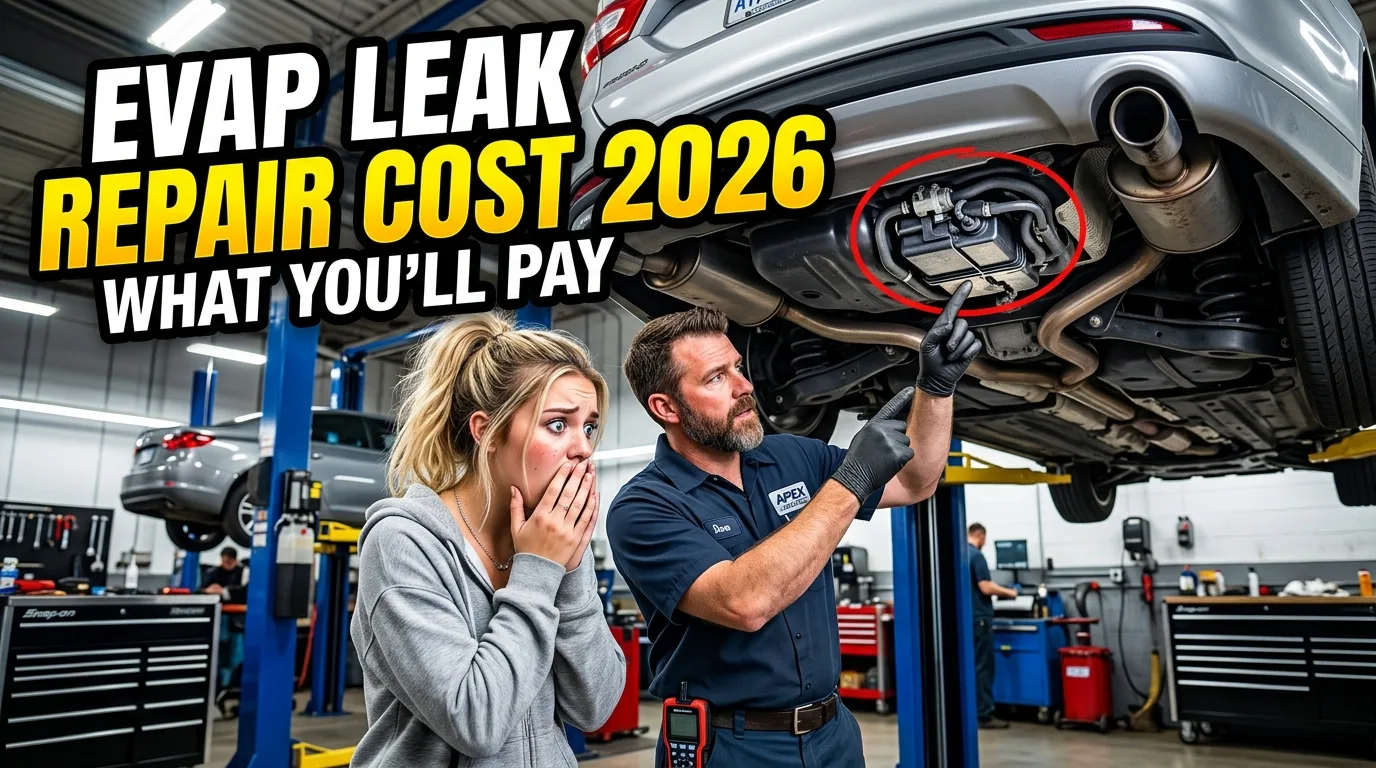
The good news: EVAP leaks range from a $20 gas cap to a $1,500 charcoal canister replacement. Most fall on the cheap end. The trick is figuring out which component actually failed before you start throwing parts at it.
What Is the EVAP System?
Your car’s evaporative emission control (EVAP) system captures fuel vapors from the gas tank and routes them to the engine to be burned instead of released into the air. It’s an emissions system, and every car built since the mid-1980s has one.
The main components:
- Gas cap: Seals the fuel tank. The most common failure point.
- Charcoal canister: Stores fuel vapors until the engine can burn them. Usually mounted near the fuel tank.
- Purge valve (solenoid): Controls when vapors flow from the canister to the engine.
- Vent valve: Controls when fresh air enters the canister to purge stored vapors.
- Hoses and lines: Connect everything. Rubber hoses crack with age.
- Fuel tank pressure sensor: Monitors pressure changes in the fuel tank to detect leaks.
When any of these develop a leak, fuel vapors escape. The system detects the pressure change and throws a code.
Why the EVAP System Exists
Before the 1980s, cars vented fuel vapors directly into the atmosphere. That contributed significantly to smog and air pollution. The EVAP system was mandated by the Clean Air Act to capture those vapors and route them back to the engine for combustion. It’s an environmental system, not a performance system. That’s why a failing EVAP component doesn’t usually affect how the car drives.
Common EVAP Trouble Codes
Your OBD2 scanner will show one of these:
- P0440: Evaporative Emission Control System Malfunction (general, no specific leak identified)
- P0441: EVAP System Incorrect Purge Flow
- P0442: EVAP System Small Leak Detected
- P0443: EVAP Purge Control Valve Circuit Malfunction
- P0446: EVAP Vent Control Circuit Malfunction
- P0452: EVAP System Pressure Sensor Low Input
- P0453: EVAP System Pressure Sensor High Input
- P0455: EVAP System Large Leak Detected
- P0456: EVAP System Very Small Leak Detected
- P0457: EVAP System Leak Detected (Fuel Cap Loose/Off)
The FIXD OBD2 scanner reads these codes and tells you which one is most likely causing the issue. P0442 and P0456 are almost always a loose gas cap or cracked hose. P0455 is a big leak, often a disconnected hose or completely failed component. P0443 and P0446 point to the purge or vent valve.
What Each Code Tells You
| Code | Leak Size | Most Likely Cause | Typical Fix Cost |
|---|---|---|---|
| P0440 | Unknown | General malfunction | $0-$200 |
| P0441 | Flow issue | Bad purge valve | $50-$200 |
| P0442 | Small (0.040”) | Cracked hose or loose cap | $0-$100 |
| P0443 | Circuit | Failed purge valve | $50-$200 |
| P0446 | Circuit | Failed vent valve | $50-$200 |
| P0452 | Sensor low | Bad pressure sensor | $100-$300 |
| P0453 | Sensor high | Bad pressure sensor | $100-$300 |
| P0455 | Large (0.080”+) | Disconnected hose, bad seal | $20-$300 |
| P0456 | Very small (0.020”) | Loose cap, tiny hose crack | $0-$50 |
| P0457 | Cap off/loose | Gas cap | $0-$25 |
Common Causes of EVAP Leaks
Here’s what typically goes wrong, ranked from cheapest to most expensive:
1. Loose or Bad Gas Cap ($0-$25)
The most common cause by far. Either you didn’t tighten it enough (twist until it clicks 3 times) or the rubber seal cracked. A new OEM gas cap costs $10-$25 at any auto parts store.
Gas caps degrade over time. The rubber seal dries out, cracks, and loses its ability to hold pressure. If your cap is more than 5 years old, replace it proactively. It’s the cheapest insurance against EVAP codes.
2. Cracked or Disconnected Hose ($20-$100)
Rubber hoses in the EVAP system get brittle with age and heat. A cracked hose between the gas tank and charcoal canister is a common failure. The hose itself costs $5-$20, but finding it can take time. This is where a smoke test earns its keep.
Common hose failure spots:
- Between the gas tank and charcoal canister (under the car, exposed to road salt and debris)
- At the charcoal canister connections (vibration cracks the rubber)
- Near the purge valve on the engine (heat cycles make the rubber brittle)
- At the fuel filler neck (where the filler pipe meets the tank)
3. Failed Purge Valve ($50-$200)
The purge solenoid controls when fuel vapors get routed to the engine. When it sticks open or closed, you get codes P0441, P0443, or P0446. The part costs $30-$100. Replacement is a 30-minute job on most vehicles.
A purge valve stuck open causes a rich condition at idle (fuel vapors entering when they shouldn’t). A purge valve stuck closed causes the charcoal canister to saturate, which leads to the more expensive canister replacement.
4. Failed Vent Valve ($50-$200)
Similar to the purge valve but on the canister side. Causes P0446. Same general cost and labor. The vent valve allows fresh air into the canister during purge. When it fails, the system can’t complete the purge cycle.
5. Charcoal Canister Damage ($200-$1,500)
The canister itself rarely fails unless it gets saturated from overfilling the gas tank (topping off past the first click) or from a failed purge valve. A new canister costs $150-$500 for the part, and labor adds $100-$300. Total: $200-$1,500 depending on the vehicle.
On some newer vehicles, the charcoal canister is built into the fuel tank assembly. Replacing it means dropping the tank, which pushes labor to $300-$500.
6. Fuel Tank Pressure Sensor ($100-$400)
The pressure sensor monitors pressure changes in the fuel tank. When it fails, you get P0452 or P0453. The sensor itself costs $30-$100, but it’s often mounted on or inside the fuel tank, which makes labor expensive.
Vehicle-Specific EVAP Repair Costs
| Vehicle Type | Gas Cap | Hose Repair | Purge Valve | Vent Valve | Charcoal Canister |
|---|---|---|---|---|---|
| Economy (Civic, Corolla) | $10-$20 | $20-$80 | $50-$150 | $50-$150 | $200-$800 |
| Midsize (Camry, Accord) | $10-$25 | $25-$100 | $60-$180 | $60-$180 | $250-$900 |
| Truck/SUV (F-150, RAV4) | $12-$25 | $30-$120 | $70-$200 | $70-$200 | $300-$1,000 |
| Luxury (BMW, Lexus) | $15-$40 | $50-$150 | $100-$300 | $100-$300 | $500-$1,500 |
The wide range comes down to part availability and labor access. Luxury vehicles often use brand-specific parts and have tighter engine bays that increase labor time.
DIY Smoke Test: Find the Leak for $20-$30
Before you replace anything, find the leak. A smoke test is the most reliable method:
Option 1: Auto parts store rental. AutoZone, O’Reilly, and Advance Auto Parts loan out smoke machines for $20-$30 (refundable deposit). You hook it to the EVAP service port, pump smoke in, and watch where it escapes.
Option 2: DIY smoke machine. Buy a $15 tobacco smoke machine from Amazon or make one with a 9V battery, a heating element, and mineral oil. It’s janky but works.
Option 3: The soap and water method. If you can see the hoses, spray them with soapy water and look for bubbles. This only works for accessible hoses, not buried lines.
How to Perform a Smoke Test
-
Locate the EVAP service port. It’s usually a small valve stem near the charcoal canister or on the fuel filler pipe. Your repair manual or online forum for your specific vehicle can point you to it.
-
Connect the smoke machine. Attach the smoke machine’s output to the EVAP service port. If you don’t have a service port, connect to the charcoal canister’s vent line.
-
Seal the system. Close the gas cap. The purge valve should be closed (engine off). The vent valve should be closed (most vehicles close it automatically when the engine is off).
-
Pump smoke in. Run the smoke machine for 2-3 minutes. You should see smoke coming from the leak within a few minutes.
-
Look for the leak. Check all hoses, connections, and the gas cap seal. Smoke will be visible escaping from the leak point.
-
Repair the leak. Replace the cracked hose, tighten the connection, or swap the faulty valve.
The smoke test takes 15 minutes and saves you from guessing.
How to DIY the Cheap Fixes
Gas Cap Fix
- Tighten the existing cap until it clicks 3 times.
- Clear the code with your OBD2 scanner.
- Drive 50-100 miles. If the light stays off, problem solved.
- If it comes back, buy a new OEM cap ($10-$25). Same process.
Hose Replacement
- Do the smoke test to find the cracked hose.
- Buy the correct diameter hose from any auto parts store ($5-$20 for 3 feet).
- Cut to length, push onto the fittings, and secure with hose clamps.
- Clear the code and drive.
Purge Valve Replacement
- Locate the purge valve (usually on the engine, near the intake manifold).
- Disconnect the electrical connector and the two vacuum hoses.
- Remove the mounting bolt (10mm usually).
- Install the new valve, reconnect everything.
- Clear the code.
Vent Valve Replacement
- Locate the vent valve (usually on or near the charcoal canister under the car).
- Disconnect the electrical connector and the vent hose.
- Remove the mounting bolt.
- Install the new valve, reconnect everything.
- Clear the code.
When to Take It to a Shop
Take it to a professional if:
- The smoke test shows a leak you can’t access (buried under the car, near the fuel tank).
- You’re getting P0443 or P0446 and the purge/vent valve replacement didn’t fix it.
- The charcoal canister needs replacement (this is often buried in the fuel tank on newer cars).
- You’re not comfortable working around fuel system components.
- You’re getting P0452 or P0453 (pressure sensor codes) that require dropping the fuel tank.
A shop diagnostic for EVAP issues typically costs $80-$150, but that includes the smoke test and a definitive diagnosis. Some shops waive the diagnostic fee if you do the repair there.
DIY vs Shop Cost Comparison
| Fix | DIY Cost | Shop Cost | Savings |
|---|---|---|---|
| Gas cap replacement | $10-$25 | $50-$100 | $40-$75 |
| Hose repair | $5-$30 | $100-$200 | $70-$170 |
| Purge valve | $30-$100 | $150-$300 | $50-$200 |
| Vent valve | $30-$100 | $150-$300 | $50-$200 |
| Charcoal canister | $150-$500 | $400-$1,500 | $100-$500 |
| Pressure sensor | $30-$100 | $200-$500 | $100-$300 |
The smaller fixes (gas cap, hose) are easy DIY jobs. The larger ones (canister, pressure sensor) might require a shop unless you’re comfortable dropping the fuel tank.
What Happens If You Don’t Fix It
An EVAP leak won’t strand you on the side of the road. But it creates problems over time:
- Emissions test failure. In most states, an active EVAP code is an automatic fail. You can’t renew your registration without passing.
- Reduced fuel economy. Fuel vapors that should be burned are escaping. You lose 1-3% fuel economy on small leaks, up to 5% on large ones.
- Gas smell. You’ll notice a fuel odor near the car, especially after filling the tank.
- Environmental impact. Fuel vapors are a significant contributor to ground-level ozone and smog.
- Failed inspection. Many states require a passing emissions test for registration renewal.
The fix is usually cheap. Don’t let a $20 gas cap turn into a failed emissions test and a rushed, overpriced repair at the last minute.
How FIXD Helps
The FIXD OBD2 scanner reads your EVAP code and translates it into plain language. Instead of staring at “P0442” and googling for 20 minutes, FIXD tells you “small EVAP leak detected” and gives you a repair estimate. That puts you in the driver’s seat when a shop gives you a quote.
FIXD also clears codes after you fix the problem and monitors whether the repair held. If the EVAP code comes back within a few days, something else is going on, and you know to dig deeper.
Mistakes to Avoid
-
Replacing parts without diagnosing first. EVAP leaks are hard to find by visual inspection alone. A smoke test costs $20-$30 and tells you exactly what’s broken. Replacing parts blind wastes money.
-
Ignoring the gas cap. Over 40% of EVAP codes are caused by a loose or worn gas cap. Check it first. It’s free to tighten and $10-$25 to replace.
-
Using aftermarket gas caps that don’t seal properly. Not all aftermarket caps are created equal. A cap that doesn’t seal triggers the same code you’re trying to fix. Buy OEM or a known brand.
-
Not clearing the code after the repair. The check engine light won’t turn off by itself after most EVAP repairs. You need to clear the code with a scanner.
-
Forgetting to check the charcoal canister. If you’ve topped off your gas tank many times, the canister might be saturated. Replacing hoses and valves won’t fix a saturated canister.
How to Choose: Decision Guide
If you’re getting P0456 or P0457 (very small leak / cap loose): Start with the gas cap. Tighten it. If the code returns, replace the cap ($10-$25). If that doesn’t work, do a smoke test to find a tiny hose leak.
If you’re getting P0442 (small leak): Do a smoke test. P0442 is usually a cracked hose or a loose connection. The smoke will show you exactly where.
If you’re getting P0455 (large leak): Check for disconnected hoses first. A large leak is usually visible. If everything looks connected, do a smoke test. Large leaks are often at the charcoal canister or filler neck.
If you’re getting P0441 (incorrect purge flow): The purge valve is the most likely culprit. Test it by applying vacuum to the valve with the engine off. If vacuum holds, the valve is stuck closed. If vacuum leaks through, the valve is stuck open. Replace it.
If you’re getting P0443 or P0446 (circuit malfunction): These codes point to electrical problems with the purge or vent valve. Check the wiring and connector first. If the wiring is intact, replace the valve.
If you’re getting P0452 or P0453 (pressure sensor): The pressure sensor might need replacement. On some vehicles, this requires dropping the fuel tank. Get a shop quote before attempting this DIY.
The Bottom Line
EVAP leaks are one of the cheapest check engine light fixes. Start with the gas cap ($0-$25). Do a smoke test ($20-$30) before replacing parts blind. Most EVAP repairs cost under $200. Only the charcoal canister pushes into serious money.
Frequently Asked Questions
What is an EVAP leak and how serious is it?
Can I pass emissions with an EVAP code?
Is an EVAP leak dangerous?
How do I find an EVAP leak myself?
Why does my gas cap light keep coming on?
What is the difference between P0440, P0442, P0455, and P0456?
How much does a smoke test cost?
Can I replace the EVAP purge valve myself?
Alex Thompson
Consumer electronics reviewer specializing in smart gadgets and innovative tech. Tests 100+ gadgets annually. Previously wrote for The Verge and Wired. Focus on practical daily-use value.
Affiliate disclosure:This article contains affiliate links. If you buy through them, GearPuff may earn a commission at no extra cost to you. It keeps our testing independent and our reviews free.