
Ignition Coil Replacement Cost in 2026: What to Expect
Ignition coil replacement costs $150-$700 depending on your vehicle. Learn coil-on-plug vs coil pack, misfire codes P0350-P0365, and when to replace spark plugs too.

Tech Reviewer
In This Article
- What Ignition Coils Do
- Why Coils Fail
- How Long Do Ignition Coils Last?
- Common Ignition Coil Trouble Codes
- Coil Code vs Misfire Code: What Each Tells You
- Symptoms of a Bad Ignition Coil
- What Happens If You Don’t Fix It
- Ignition Coil Replacement Cost by Vehicle
- 4-Cylinder Engine
- 6-Cylinder Engine
- 8-Cylinder Engine (V8)
- Why the Wide Range?
- Vehicle-Specific Cost Examples
- OEM vs Aftermarket Ignition Coils
- Coil-on-Plug vs Coil Pack: Cost Comparison
- Spark Plug Wire Replacement (Coil Pack Systems Only)
- DIY Ignition Coil Replacement
- Common DIY Mistakes
- When to Replace All Coils vs Just One
- Full Set Cost by Engine
- How to Choose: Decision Guide
- How FIXD Helps
- Mistakes to Avoid
- The Bottom Line
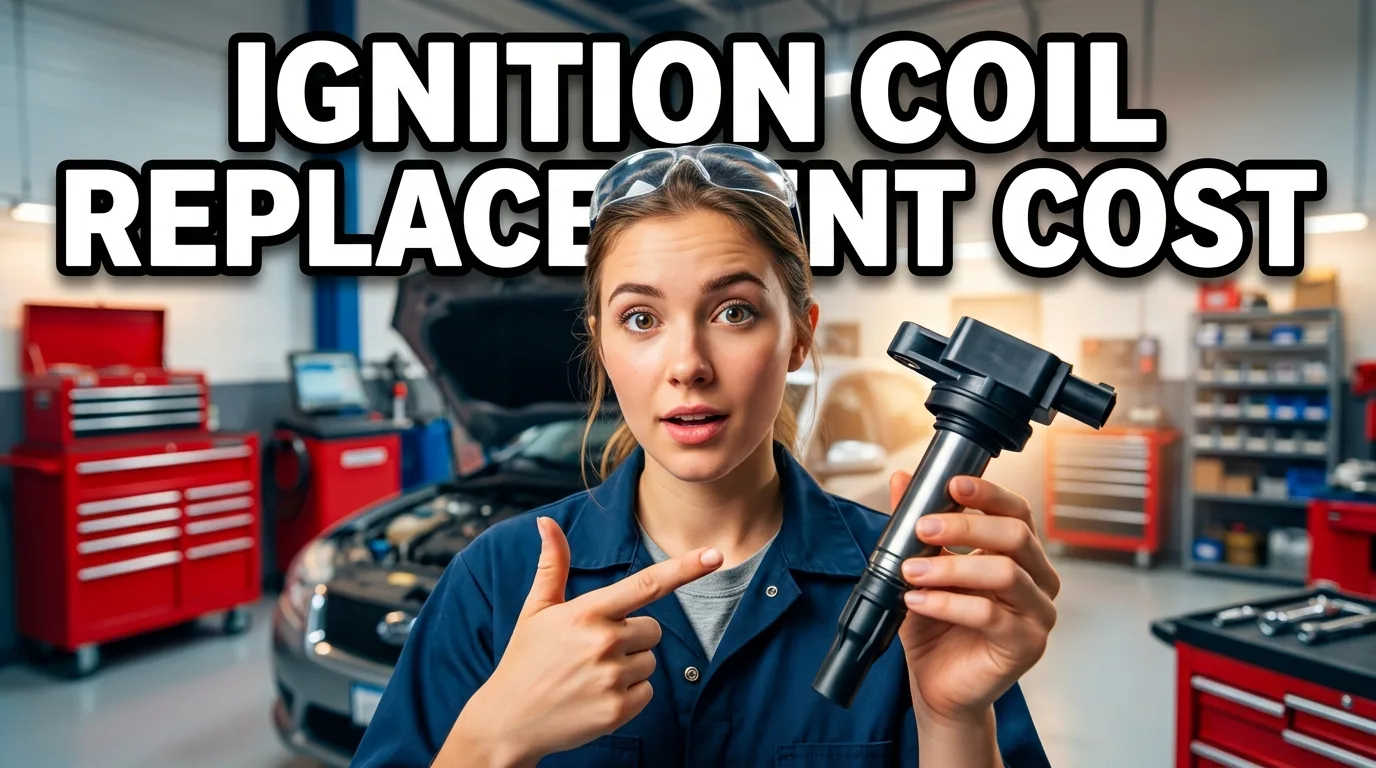
An ignition coil takes 12 volts from your battery and transforms it into the 40,000+ volts needed to fire a spark plug. When a coil fails, that cylinder stops firing. The engine runs rough, wastes gas, and the check engine light comes on with a P0350-series code.
A misfiring cylinder sends unburned fuel into the exhaust, which can damage your catalytic converter over time. And if the coil failed because the spark plug was worn, you need to fix the plug too. Our check engine light repair cost guide covers how to diagnose P0350 codes alongside other engine codes.
Ignition coil replacement is one of the easier engine repairs, but the cost depends on how many coils your engine has and whether you’re doing it yourself. Here’s the full picture.
What Ignition Coils Do
Each ignition coil is a small transformer. It converts the battery’s 12V into a high-voltage pulse that jumps the spark plug gap and ignites the fuel-air mixture. Without enough voltage, the spark is weak or nonexistent, and the cylinder misfires.
Modern engines use one of three coil setups:
Coil-on-Plug (COP): Each cylinder has its own coil sitting directly on the spark plug. No spark plug wires. This is the most common setup in vehicles built after 2005.
Coil Pack (Waste Spark): One coil serves two cylinders. Spark plug wires connect the coil pack to the plugs. Common in 1990s-2000s vehicles.
Distributor with Ignition Coil: The oldest setup. One coil feeds the distributor, which routes spark to each cylinder in sequence. Rare in anything built after 2000.
Why Coils Fail
Ignition coils degrade from:
- Heat cycles: The engine bay gets hot. Repeated heating and cooling breaks down the insulation around the coil windings.
- Vibration: Coils mounted on the engine vibrate constantly. Over time, internal connections crack.
- Moisture: Water intrusion into the spark plug well corrodes the coil boot and can cause arcing.
- Worn spark plugs: A worn plug requires more voltage to fire. The coil works harder and overheats.
- Age: Most coils last 100,000-150,000 miles. After that, the insulation breaks down.
How Long Do Ignition Coils Last?
Most ignition coils last 100,000-150,000 miles. But several factors shorten that lifespan:
- Heat: Coils mounted directly on the engine (COP systems) face constant heat cycles. The insulation breaks down faster.
- Worn spark plugs: A worn plug requires more voltage to fire. The coil works harder and overheats.
- Moisture: Water in the spark plug well causes arcing and corrosion. Common after car washes or heavy rain.
- Vibration: Engine vibration cracks internal coil connections over time.
- Electrical stress: A bad ground or failing crankshaft position sensor can send voltage spikes through the coils.
If your car has 80,000+ miles on the original coils, consider replacing them preventively. The cost of a full set ($150-$500) is less than the cost of a stranded-on-the-road tow plus emergency repair.
Common Ignition Coil Trouble Codes
The P0350 series tells you which coil failed:
- P0350: Ignition Coil Primary/Secondary Circuit Malfunction (general)
- P0351: Ignition Coil A Primary/Secondary Circuit Malfunction (Cylinder 1)
- P0352: Ignition Coil B (Cylinder 2)
- P0353: Ignition Coil C (Cylinder 3)
- P0354: Ignition Coil D (Cylinder 4)
- P0355: Ignition Coil E (Cylinder 5)
- P0356: Ignition Coil F (Cylinder 6)
- P0357: Ignition Coil G (Cylinder 7)
- P0358: Ignition Coil H (Cylinder 8)
You’ll also see P0300-P0312 (misfire codes) alongside P0350 codes. The misfire code tells you which cylinder is affected. The P0350 code confirms it’s the coil.
The FIXD OBD2 scanner reads both codes and gives you a clear diagnosis. P0351 plus P0301 = cylinder 1 ignition coil is the problem.
Coil Code vs Misfire Code: What Each Tells You
| Code Type | Example | Meaning |
|---|---|---|
| P0350-series | P0351 | Coil A (cylinder 1) circuit is bad |
| P0300-series | P0301 | Cylinder 1 is misfiring |
| P0351 + P0301 | Both | Coil on cylinder 1 failed, causing the misfire |
| P0301 only | No P0351 | Misfire on cylinder 1, but coil circuit is OK (check plug, injector, compression) |
| P0351 only | No P0301 | Coil circuit issue, but misfire hasn’t triggered yet (still needs repair) |
Symptoms of a Bad Ignition Coil
- Check engine light: Usually with a P0350-series code and/or P0300-series misfire code.
- Rough idle: The engine shakes because one cylinder isn’t contributing power.
- Poor fuel economy: Unburned fuel gets wasted. Expect 10-25% worse mileage.
- Hesitation or stumbling: Especially during acceleration when the engine needs maximum spark energy.
- Engine won’t start: If multiple coils fail, the engine may not start at all.
- Flashing check engine light: This means a severe misfire is dumping raw fuel into the exhaust. Stop driving immediately to avoid destroying your catalytic converter.
- Engine surge at idle: A failing coil can cause intermittent misfires that make the engine RPM fluctuate.
What Happens If You Don’t Fix It
A bad ignition coil creates a domino effect:
- Week 1-2: One cylinder misfires. Engine runs rough, fuel economy drops. You can drive, but it’s not great.
- Month 1-2: Unburned fuel enters the catalytic converter. The converter starts to overheat. P0420 might appear.
- Month 2-3: The catalytic converter degrades from the raw fuel. Replacement costs $800-$4,000.
- Month 3+: The worn coil stresses the remaining coils. Another one fails. Now you’re replacing multiple coils.
Fix the coil early. A $30-$100 part prevents a $800-$4,000 converter repair.
Ignition Coil Replacement Cost by Vehicle
4-Cylinder Engine
- Parts (1 coil): $30-$100
- Parts (full set of 4): $120-$400
- Labor: $50-$150
- Total: $150-$400
4-cylinder engines are the cheapest because there are fewer coils and they’re usually easy to access.
6-Cylinder Engine
- Parts (1 coil): $30-$100
- Parts (full set of 6): $180-$600
- Labor: $75-$200
- Total: $200-$500
8-Cylinder Engine (V8)
- Parts (1 coil): $30-$100
- Parts (full set of 8): $240-$800
- Labor: $100-$250
- Total: $300-$700
Why the Wide Range?
Vehicle-specific factors that affect cost:
- Engine accessibility: Some coils are buried under the intake manifold (Ford 5.4L Triton is notorious for this). Easy access = lower labor.
- Brand: OEM coils from the dealer cost $50-$150 each. Aftermarket coils cost $20-$60 each. Quality varies.
- Region: Labor rates range from $75/hr to $150+/hr depending on your area.
Vehicle-Specific Cost Examples
| Vehicle | Single Coil (OEM) | Single Coil (Aftermarket) | Full Set (Aftermarket) | Total at Shop |
|---|---|---|---|---|
| Honda Civic (4-cyl) | $50-$90 | $25-$50 | $100-$200 | $150-$300 |
| Toyota Camry (4-cyl) | $50-$100 | $30-$60 | $120-$240 | $170-$350 |
| Ford F-150 (V8) | $60-$120 | $30-$70 | $240-$560 | $300-$650 |
| BMW 3 Series (6-cyl) | $80-$150 | $40-$80 | $240-$480 | $250-$500 |
| Chevrolet Silverado (V8) | $50-$100 | $25-$60 | $200-$480 | $280-$600 |
OEM vs Aftermarket Ignition Coils
| Feature | OEM (Denso, Bosch, Delphi) | Aftermarket (Standard, Wells) | Budget Aftermarket |
|---|---|---|---|
| Price | $50-$150 per coil | $25-$70 per coil | $15-$40 per coil |
| Lifespan | 100,000-150,000 miles | 60,000-100,000 miles | 30,000-60,000 miles |
| Fitment | Guaranteed | Usually direct-fit | May need modification |
| Warranty | 12 months | 12-24 months | 90 days |
| Quality | Highest | Good | Variable |
For most vehicles, an aftermarket Bosch or Denso coil is the sweet spot. They’re the OEM suppliers for most car brands, so their aftermarket parts are the same quality as dealer parts at a lower price. Budget coils from unknown brands sometimes fail within a year or trigger false codes.
Coil-on-Plug vs Coil Pack: Cost Comparison
| Factor | Coil-on-Plug (COP) | Coil Pack (Waste Spark) |
|---|---|---|
| Coils per engine | 1 per cylinder (4-8 total) | 1 per 2 cylinders (2-4 total) |
| Cost per coil (aftermarket) | $25-$70 | $20-$50 |
| Cost per coil (OEM) | $50-$150 | $40-$100 |
| Full set cost (aftermarket) | $100-$480 | $40-$200 |
| Full set cost (OEM) | $200-$800 | $80-$400 |
| Labor per coil | $25-$50 | $25-$50 |
| Total labor (full set) | $50-$250 | $50-$150 |
| Common vehicles | Most post-2005 | 1990s-2005 |
COP systems cost more to replace because you need one coil per cylinder. But they provide a stronger, more consistent spark because each coil has time to recharge between firing cycles. Coil pack systems share one coil between two cylinders, so the coil fires twice as often and has less time to build voltage.
Spark Plug Wire Replacement (Coil Pack Systems Only)
If you have a coil pack system with spark plug wires, replace the wires at the same time as the coil. Wires degrade from heat and vibration, and old wires with high resistance weaken the spark.
- Spark plug wire set: $20-$80 (aftermarket) / $50-$150 (OEM)
- Labor: Usually included in the coil replacement
Wire resistance increases with age. A new set of wires restores full voltage to the plugs and improves fuel economy.
DIY Ignition Coil Replacement
Replacing a single ignition coil is one of the easier engine repairs:
Tools needed:
- OBD2 scanner (to identify the failed coil)
- Socket set (7mm or 10mm for coil bolts)
- Dielectric grease
- New coil
Steps:
-
Read the code. Use your OBD2 scanner to identify the failed cylinder. P0351 = cylinder 1. P0352 = cylinder 2.
-
Locate the coil. On COP engines, each coil sits on top of the spark plug, held by 1-2 bolts. On coil pack systems, the coil pack is usually mounted on the firewall or engine block.
-
Disconnect the electrical connector. Push the tab and pull.
-
Remove the mounting bolts. Usually 7mm or 10mm.
-
Pull the coil straight up. It might be stuck. Twist gently while pulling. Don’t yank it or you’ll damage the boot.
-
Inspect the old coil. Look for cracks in the housing, corrosion on the terminals, or oil on the boot. Oil in the spark plug well indicates a valve cover gasket leak that needs fixing.
-
Apply dielectric grease inside the new coil boot. This prevents the boot from sticking to the spark plug and keeps moisture out.
-
Install the new coil. Push it down until it seats on the spark plug.
-
Reconnect and clear the code.
Tips:
- Replace the spark plug at the same time. If the coil failed, the plug is probably worn too. Our spark plug replacement cost guide covers that.
- Apply dielectric grease inside the coil boot to prevent future sticking and moisture intrusion.
- If the new coil doesn’t fix the misfire, the problem might be the spark plug, fuel injector, or compression on that cylinder.
Common DIY Mistakes
- Not replacing the spark plug. A worn plug stresses the new coil. Replace both at the same time.
- Forgetting dielectric grease. The boot sticks to the spark plug and tears the next time you remove it.
- Cross-threading the coil bolt. The mounting bolts go into aluminum on most engines. Hand-thread them first.
- Not clearing the code. The check engine light stays on until you clear it with a scanner.
- Buying the cheapest coil. A $15 no-name coil might last 6 months. A $30 Bosch or Denso lasts 60,000+ miles.
When to Replace All Coils vs Just One
Replace just one if:
- The vehicle is under 60,000 miles
- The failed coil was hit by a specific issue (oil leak into the spark plug well, water intrusion)
- You’re on a tight budget
Replace all coils if:
- The vehicle has over 80,000 miles
- You’ve already replaced one coil in the past year (another one failing is a pattern)
- You’re doing a major tune-up (plugs, coils, filters)
- You’re getting multiple P0350 codes across different cylinders
Replacing all coils at once costs more upfront but saves on labor since you’re already in there. It also prevents the “one down, another one next month” cycle.
Full Set Cost by Engine
| Engine | Single Coil | Full Set (Aftermarket) | Full Set (OEM) |
|---|---|---|---|
| 4-cylinder | $25-$60 | $100-$240 | $200-$400 |
| 6-cylinder | $25-$60 | $150-$360 | $300-$600 |
| 8-cylinder | $25-$60 | $200-$480 | $400-$800 |
How to Choose: Decision Guide
If you’re getting a single P0350 code (under 60k miles): Replace just that coil. Buy an aftermarket Bosch or Denso coil ($25-$60) and DIY the swap. Total cost: $25-$60. Also replace the spark plug on that cylinder.
If you’re getting a single P0350 code (over 80k miles): Replace all coils and all spark plugs. The remaining coils are aging, and you’re saving on labor. Budget $200-$500 for the full set.
If you’re getting multiple P0350 codes: Something is stressing all the coils. Check for a bad ground, low battery voltage, or a failing crankshaft position sensor. Don’t just replace all coils without diagnosing the root cause.
If you’re on a tight budget: Replace the single failed coil with an aftermarket part ($25-$60). Replace the spark plug on that cylinder too. Clear the code. Budget for the remaining coils later.
If you want the best result: Replace all coils with OEM Denso or Bosch ($200-$600 for a full set) and all spark plugs. This is the “do it once, do it right” approach.
How FIXD Helps
The FIXD OBD2 scanner identifies exactly which coil failed and estimates the repair cost. You walk into the parts store knowing you need coil C for cylinder 3, not a guess based on symptoms.
FIXD also tracks whether the misfire is consistent or intermittent. An intermittent misfire might be a loose connector or worn spark plug, not necessarily a dead coil.
Mistakes to Avoid
-
Replacing coils without reading the code first. You might replace the wrong coil. Always read the P0350 code to know which one failed.
-
Ignoring the spark plug. A worn spark plug causes the coil to work harder. Replace the plug when you replace the coil.
-
Buying the cheapest coil available. A $15 no-name coil might fail within a year. A $30 Bosch or Denso lasts 60,000+ miles.
-
Not checking for oil in the spark plug well. Oil on the coil boot indicates a valve cover gasket leak. Fix the leak before installing the new coil, or the oil will damage the new one.
-
Forgetting dielectric grease. The boot sticks to the spark plug and tears the next time you need to remove it.
-
Replacing all coils when only one failed (under 60k miles). The other coils are probably fine. Save your money.
The Bottom Line
A single ignition coil replacement runs $150-$400 at a shop or $30-$100 DIY. For V8 engines, budget $300-$700. Always replace the spark plug on the affected cylinder at the same time.
Frequently Asked Questions
How much does it cost to replace an ignition coil?
Can I drive with a bad ignition coil?
How do I know which ignition coil is bad?
Should I replace all ignition coils at the same time?
What's the difference between coil-on-plug and coil pack?
Can a bad spark plug cause an ignition coil to fail?
What does P0350 mean?
How long do ignition coils last?
Alex Thompson
Consumer electronics reviewer specializing in smart gadgets and innovative tech. Tests 100+ gadgets annually. Previously wrote for The Verge and Wired. Focus on practical daily-use value.
Affiliate disclosure:This article contains affiliate links. If you buy through them, GearPuff may earn a commission at no extra cost to you. It keeps our testing independent and our reviews free.