
In This Article
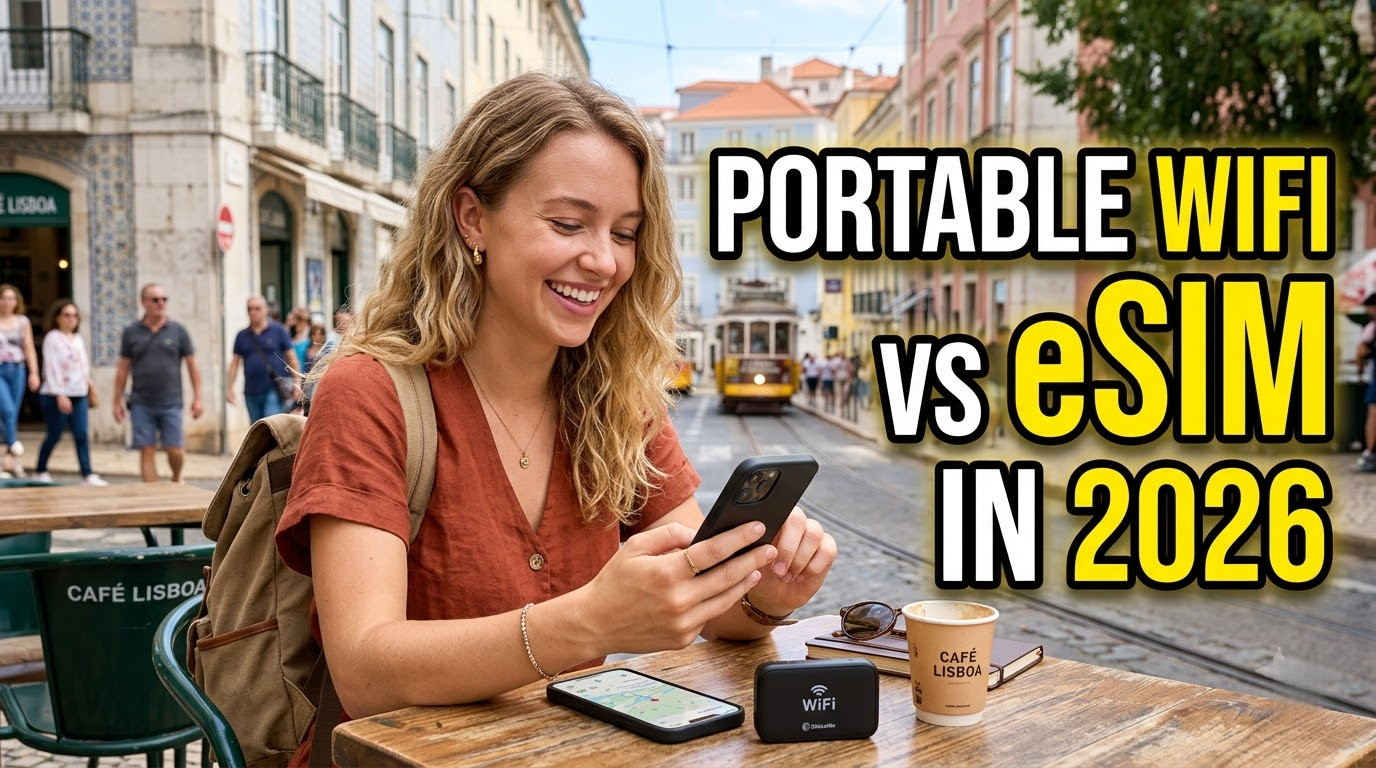
Portable WiFi hotspot or eSIM? The answer depends on how many people are traveling, how much data you need, and whether you want to carry an extra device.
I have tested both across 15+ countries: the Ryoko portable WiFi for 3 weeks in Europe and multiple eSIM providers (Saily, Airalo, Holafly) across Asia, Australia, and North America. Here is the honest comparison based on real travel use. For the portable WiFi deep dive, read our Ryoko portable WiFi review. For the eSIM comparison, see our best eSIMs for travel guide.
Quick Comparison
| Factor | Portable WiFi | eSIM |
|---|---|---|
| Cost (solo) | $5-10/day rental | $3-10 total |
| Cost (group of 4) | $5-10/day split 4 ways | $12-40 total |
| Convenience | Extra device to carry | No extra device |
| Coverage | 100-200 countries | 150-200 countries |
| Battery | 6-13 hours separate | Uses phone battery |
| Hotspot | Yes, 5-10 devices | Yes, via phone |
| Setup | Power on, scan QR | Download app, scan QR |
Cost: eSIM Wins for Solo, Portable WiFi for Groups
The cost math is simple for solo travelers: an eSIM is 3-5x cheaper than a portable WiFi rental. A 5GB Europe eSIM costs $15-$25 for the entire trip. A portable WiFi rental for the same period costs $50-$100 plus a deposit.
For groups, the math changes. A portable WiFi hotspot connects 5-10 devices, so 4 travelers splitting a $7/day rental pay $1.75/day each. Four individual eSIMs at $5/day each cost $20/day total. The portable WiFi is cheaper per person for groups of 3+.
Convenience: eSIM Wins
An eSIM lives on your phone. No extra device, no battery to charge, no risk of losing a rental. You download an app, buy a plan, and you are connected. The setup takes 2-5 minutes.
A portable WiFi is an extra device to carry, charge, and keep track of. It sits in your bag or pocket, drains its own battery, and needs daily charging. The convenience gap is significant for solo travelers. For groups, the shared connectivity justifies the extra device.
Battery Life: Depends
An eSIM uses your phone’s battery, which you are already managing. There is no separate battery to charge or carry.
A portable WiFi has its own battery (6-13 hours) that needs daily charging. If you are out all day, you may need to carry a power bank. The upside: your phone battery is not draining from hotspot duty.
For all-day connectivity without battery anxiety, a portable WiFi with a power bank is more reliable. For convenience, the eSIM wins because it eliminates a separate battery.
Coverage: Comparable
Both eSIMs and portable WiFi hotspots depend on local carrier partnerships for coverage. In popular destinations (US, Europe, Japan, Australia), both provide excellent coverage. In remote areas, both may have gaps.
The difference: some portable WiFi devices support external antennas, which can improve signal in weak-coverage areas. eSIMs are limited by your phone’s antenna. If you travel to remote locations regularly, a portable WiFi may perform better in weak signal areas.
Safety and Privacy: Portable WiFi Wins
A portable WiFi creates a private, encrypted network that only your devices join. Public WiFi at cafes, hotels, and airports is shared with strangers and is vulnerable to snooping and man-in-the-middle attacks.
An eSIM connects directly to the cellular network, which is encrypted by the carrier. It is safer than public WiFi but does not provide the private network isolation of a portable hotspot.
For travelers who prioritize privacy, a portable WiFi adds an extra security layer.
When to Choose eSIM
- Solo travel
- Short to medium trips (1-14 days)
- Budget-conscious travelers
- Travelers who want zero extra devices
- Trips with reliable cellular coverage
When to Choose Portable WiFi
- Group travel (3+ people)
- Extended trips (2+ weeks) in one area
- Remote travel with weak cellular coverage
- Travelers who prioritize battery independence
- Business travelers who need reliable, private connectivity
The Bottom Line
For most solo travelers, an eSIM is the better choice. It is cheaper, more convenient, and eliminates the hassle of carrying an extra device. For groups, a portable WiFi hotspot provides shared connectivity at a lower per-person cost.
The best approach for many travelers: use an eSIM as your primary connection and carry a portable WiFi as backup for remote areas or group sharing. This gives you the convenience of an eSIM with the reliability of a portable hotspot when you need it.
For our top eSIM picks, see our best eSIMs for travel guide.
Common Questions & Answers
Q: Is eSIM or portable WiFi better for travel?
For solo travelers, eSIMs are generally better: cheaper, more convenient, and no extra device to carry. For group travel (3+ people), a portable WiFi hotspot is more cost-effective because one device connects multiple people. For trips to remote areas with poor cellular coverage, a portable WiFi with external antenna support may perform better.
Q: How much does portable WiFi cost vs eSIM for a 2-week Europe trip?
A 2-week Europe eSIM with 5GB costs $15-$25. A portable WiFi rental for 2 weeks costs $50-$100 plus a $50-$100 deposit. For solo travel, the eSIM is 3-5x cheaper. For a group of 4 sharing one hotspot, the per-person cost is comparable.
Q: Can I use an eSIM and portable WiFi together?
Yes. Some travelers use an eSIM as their primary connection and carry a portable WiFi as backup for areas with poor coverage. The eSIM handles most connectivity, and the hotspot fills gaps. This provides redundancy without doubling costs.
Q: Does portable WiFi work everywhere?
Portable WiFi works wherever there is cellular coverage, which is similar to eSIM coverage. Both depend on local carrier partnerships. In remote areas with no cell towers, neither will work. For most popular travel destinations, both provide reliable coverage.
Q: Is portable WiFi safer than public WiFi?
Yes. A portable WiFi hotspot creates a private, encrypted network that only your devices join. Public WiFi at cafes and hotels is shared with strangers and is vulnerable to snooping. Both are safer than public WiFi, but portable WiFi adds an extra layer of privacy.
Q: How long does a portable WiFi battery last?
Most portable WiFi hotspots last 6-12 hours on a single charge with moderate use. Premium devices like the Netgear Nighthawk M6 last up to 13 hours. Carrying a power bank extends runtime. eSIMs use your phone's battery, so they do not have a separate battery to manage.
Q: What makes a smart gadget worth buying in 2026?
Look for proven real-world performance, not just spec-sheet numbers. A smart gadget is worth buying when it solves a daily problem reliably, integrates with your existing ecosystem, and has a track record of software updates and good customer support from the manufacturer.
Q: How long do smart gadgets typically last before needing replacement?
Most smart gadgets have a functional lifespan of 2-4 years depending on usage intensity and battery care. Devices with replaceable batteries and active software support tend to last longer. Check the manufacturer's update commitment timeline before purchasing.
More Smart Gadgets Articles
Related Product Reviews



Consumer electronics reviewer specializing in smart gadgets and everyday tech. Tests 100+ gadgets annually. Previously wrote for The Verge and Wired. Focus on practical daily-use value.