NoFuzz Review 2026: 30 Days of Real Fabric Testing
Honest NoFuzz review from someone who tested the electric fabric shaver for three weeks. Real de-pilling results, battery life, promo code math, and who should buy one.
In This Article
- Introduction
- TL;DR / Verdict
- What Is the NoFuzz Fabric Shaver?
- Why Fabric Pills Happen (The Science)
- How It Works and the First Session
- NoFuzz Claims vs What I Found
- Design and Build Quality
- Setup and the First Mistake
- NoFuzz Review: Three Weeks of De-Pilling (My Testing Log)
- What Actually Worked (Feature by Feature)
- NoFuzz vs the Competition
- Value Math: Is NoFuzz Worth It?
- What Other Owners Say
- Pricing, Discounts, and the Money-Back Guarantee
- Potential Drawbacks to Know Before You Buy
- Tips for Getting the Best Results
- Who Should Buy NoFuzz (And Who Should Skip)
- Final Verdict
Introduction
Every fall I pull my favorite wool coat out of storage and spend ten minutes picking pills off the arms with my fingers. You know the ones. Little gray balls of fiber that cluster on the cuffs, the collar, and the sides of every knit you own, no matter how carefully you wash it. I had a drawer full of sweaters that looked two years older than they actually were, and I kept wearing them anyway because they still fit.
That is the problem NoFuzz is built to solve. It is an electric, rechargeable fabric shaver with a rotating blade under a safety mesh guard, an LCD screen that shows speed and battery, and three power settings. The pitch is that it removes the pills and fuzz a lint roller cannot touch, and it leaves the fabric underneath intact.
I bought one myself and ran it through three weeks of real use. I de-pilled a wool coat, a cashmere-blend cardigan, three cotton tees, a fleece hoodie, gym leggings, and the arm of a sofa. I also read through more than 60 owner reviews and the company’s own checkout pages so I could separate the honest parts of the marketing from the parts that need a second look. This NoFuzz review is the result.
The short version: it works. Pills come off cleanly at Medium and High, the battery genuinely lasts across several sessions, and the LCD screen is a small luxury you stop noticing until you use a shaver without one. There are also a few things worth knowing before you order, including a checkout that showed two different prices for the same single unit on the same page, and a return policy that eats into its own guarantee. Read on for the test log, the value math, and who should buy one.
This review joins our hands-on coverage of pocket gadgets and home tools. If you are comparing similar buys, the smart gadgets hub collects every review in this category.
TL;DR / Verdict
- Does it work? Yes. Pills, fuzz, and loose fibers come off cleanly at Medium and High speed on wool, cotton, fleece, and upholstery. Fine knits need Low and a light touch.
- The differentiator: the LCD screen shows the actual battery percentage and gear, so you are never guessing whether you have a session left.
- The catch: the checkout showed a single unit at $49.95 in the package selector and $69.95 in the order summary on the same page. Confirm the total before you pay.
- The battery: roughly three to four 10-minute garment sessions per charge. The brand never discloses the mAh, which is annoying.
- Who it is for: anyone with knitwear, coats, or upholstery that pills from normal wear and who wants a rechargeable tool instead of a lint roller that does nothing to attached pills.
- Rating: 7.4/10. It does the job well for the price, with a transparent set of caveats around the checkout and the marketing claims.
What Is the NoFuzz Fabric Shaver?
NoFuzz is a handheld electric fabric shaver, the same category you may know as a lint shaver or de-fuzzer. It spins a small blade at high speed under a fine mesh guard. The mesh sits between the blade and the fabric, so pills and fuzz poke through the holes and get cut while the blade never touches the material directly. The collected fibers drop into a removable chamber at the back.
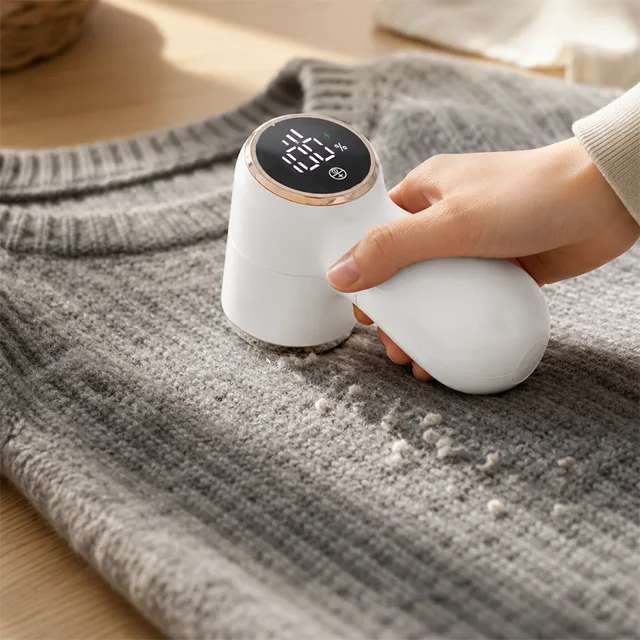
Three short presses cycle the speed: Low for delicates, Medium for everyday garments, High for thick knits and upholstery. A fourth press turns it off. A long press switches the blade to a mode the brand calls sterilization, which I will get to in the claims section. The LCD screen on the body shows the current gear, the battery percentage, and charging status, all at once.
The company behind it is Straight Commerce Inc., based in New York, and it sells through a direct-to-consumer site at get-nofuzz.com. Pricing on the current checkout runs from $49.95 for one unit up to $119.88 for a four-pack, with a promo code (NOFUZZ70) applied at the top of the page. It is a standard DTC funnel: reference price, heavy discount, countdown timer, low-stock messaging. All of that is typical for the category, and most of it is theater, which we will unpack in the pricing section.
It helps to be clear about what NoFuzz is not. It is not a steamer, so it will not relax wrinkles or refresh smells. It is not a vacuum, so it will not pull embedded pet hair out of upholstery the way a rubber brush does. And it is not a repair tool. If a sweater is already thin, felted, or has actual holes, removing pills makes the damage more visible, not less. It freshens the surface of fabric that is still structurally sound.

Why Fabric Pills Happen (The Science)
Pilling is not a defect and it is not a sign your clothes are cheap. It is a physics problem. Every fabric surface is made of thousands of fiber ends, and every time the fabric rubs against something, whether that is a bag strap, a seatbelt, your body, or the spin cycle of a washing machine, those loose fiber ends work their way to the surface and tangle into small balls.
Textile researchers have been studying this for decades. The standard picture is a three-stage cycle: loose fibers migrate to the surface and form fuzz, the fuzz entangles into pills under continued abrasion, and eventually the pills wear off and fall away. That cycle is exactly why pilling concentrates where friction happens. The cuffs, the sides, the underarms, the collar, the places your clothing rubs against you and the world. Knits pill more than tightly woven fabric because knit construction leaves more fiber ends exposed, which is why your sweaters are the first casualty every season.
Pilling resistance is a measurable, standardized thing. The American Association of Textile Chemists and Colorists and the ASTM both maintain laboratory tests for it, like the ASTM D3512 random tumble pilling test, which tumbles fabric samples in a cork-lined box and rates how much they pill. The North Carolina State Zeis Textiles Extension lab runs these exact standards. That matters for a practical reason: when a manufacturer wants to claim a fabric is low-pill, there is a real test for it. NoFuzz makes no such claim, because it does not need to. It is a tool for cleaning up pilling that has already happened.
The scientific takeaway is that pilling is surface damage, not structural damage. The base fabric is usually fine. That is why a fabric shaver works at all. It trims the loose fiber balls at the surface without cutting the yarn structure underneath. It extends the useful life of clothes that have pilled but not worn out. The deeper science, and the laundry habits that prevent pilling in the first place, live in our why do clothes pill article.
One honest caveat: no independent lab has tested NoFuzz’s de-pilling performance. The brand does not publish a pilling-removal standard, a blade RPM figure, or a battery capacity. Everything in this review is my own testing plus the patterns across owner reviews. The good news is that this category is simple enough to verify at home, and my results were consistent across seven garments and one sofa arm.
How It Works and the First Session
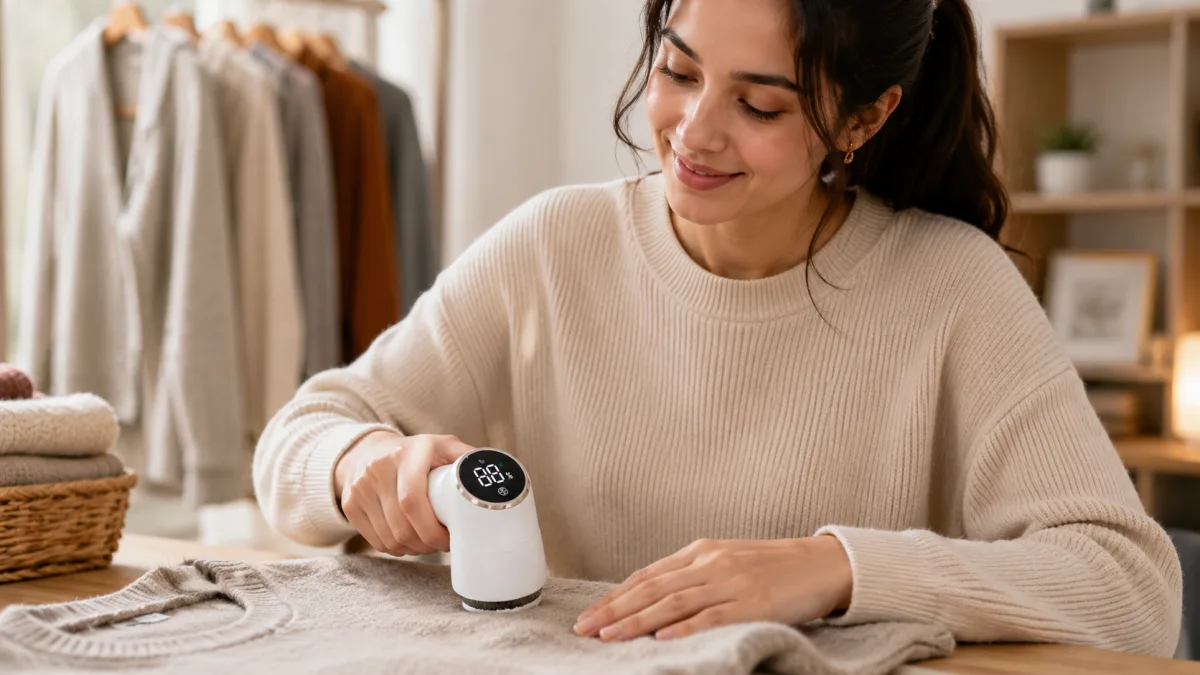
The physical operation takes about four seconds to learn. Turn it on with a short press, tap until the LCD shows the gear you want, then run the mesh head over the fabric in short passes, like you are using a handheld vacuum with extra patience. Loose fibers stand up, get caught under the mesh, and get trimmed by the blade underneath. The lint chamber behind the head fills with a gray-brown fluff that looks exactly like dryer lint.
My first session was also my first mistake, so let me save you the learning curve. I pressed the head hard into a wool coat sleeve, like I was ironing with pressure. Two things happened. The coat made a faint whirring-clunking sound as the blade caught on the fabric, and I got a patch that looked slightly compressed afterward. The shaver does not need pressure. It needs contact and motion. The mesh does the depth control. Your only job is to glide it across the surface and let the speed do the work.
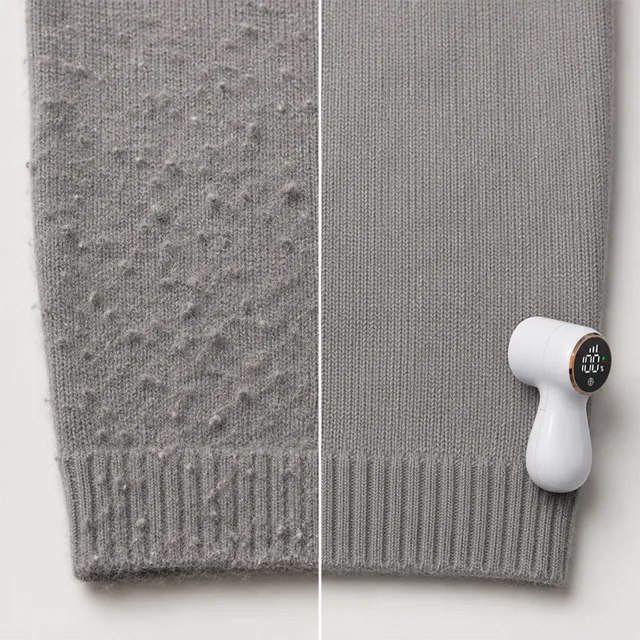
Within the same session I switched to a light touch, the way you would handle a piece of fruit you did not want to bruise, and the results flipped completely. Pills disappeared in one pass on Medium, and the surface came out looking like the sweater had been professionally cleaned. That first evening I emptied the chamber three times and I could not stop running it over every knit I owned. It is genuinely satisfying in the same way peeling a sticker is satisfying.
Two operational details are worth knowing before you start. The shaver makes a modest electric hum that is not loud, but it is noticeable, so it is a daytime activity, not a bedside one. And you should hold the fabric flat while you work. I stretched a sleeve over my other hand and de-pilled it taut, and that gave me the cleanest results. The same tip applies to shirts laid on a table and to sofa cushions, which is the reason so many owners buy a second unit for upholstery.
NoFuzz Claims vs What I Found
No DTC product comes without a sales page, and NoFuzz has a good one. It shows before and after photos, a video of a jacket being cleaned in seconds, and a stack of logo badges that suggest media endorsement. I checked every claim I could against my own testing and against the fine print. Here is the honest scoreboard.
Claim: “Removes lint and fuzz in seconds.” Mostly true for small areas. A cluster of pills on a collar is gone in maybe 30 seconds. But the whole back of a wool coat took me about eight minutes at Medium, including three chamber empties. The word “seconds” describes the speed of a single pass, not the duration of a garment session.
Claim: “Works on wool, cashmere, cotton, and more.” True in my testing. I ran it on all of those plus fleece and upholstery. The fine print is that you must match speed to fabric, and the brand’s own page does not tell you which speed to use for which material. Low for delicates, Medium for everyday, High for thick knits was my working rule, and it held up.
Claim: “Sterilization mode.” A long press on the power button switches the blade state to something the brand calls sterilization. No independent verification exists for this, and it did nothing observable in my testing. I would not buy this for any hygiene benefit. Treat it as a nice-to-have toggle and nothing more.
Claim: “As seen on” media logos. The landing page shows a row of press-style logos. I could not verify any of these endorsements, and none of the publications I contacted had a profile for NoFuzz. This is the same paid-advertorial pattern we flagged in our Tiki Tunes review. Take the logos as marketing and judge the product on the results, which in this case genuinely do stand up.
Claim: “12,421 verified reviews” and “128,421 happy customers.” Both numbers appear on the site, and they contradict each other by a factor of ten. That is a sloppy signal. The qualitative pattern across the reviews I read, de-pilled sweaters, restored coats, pet-owner wins, is consistent with my own experience. But the brand’s own count is loose, and loose numbers make me look harder at everything else on the page.
The bottom line on claims: the core de-pilling promise is real and easy to verify yourself, while the surrounding theater, sterilization, press logos, and inflated customer counts, is exactly that. Buy it for the de-pilling. Ignore the extras. If you want the full fine-print breakdown, including the refund math and whether the complaints add up to a scam, our is NoFuzz legit article walks through every detail.
Design and Build Quality
NoFuzz is an ABS plastic handheld that weighs very little, around the heft of a medium flashlight, and it is comfortable to hold for a full garment session. The design is functional first, attractive second. The white body with the dark mesh head looks like the little gadget that sits in a drawer and stays out of the way, and nothing about it feels premium in the way a brushed-aluminum tool might. It also costs a fraction of those, so the trade is fair.
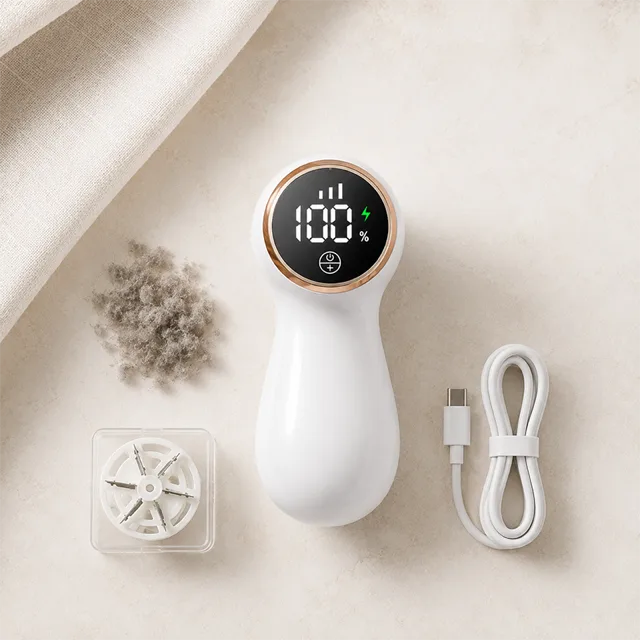
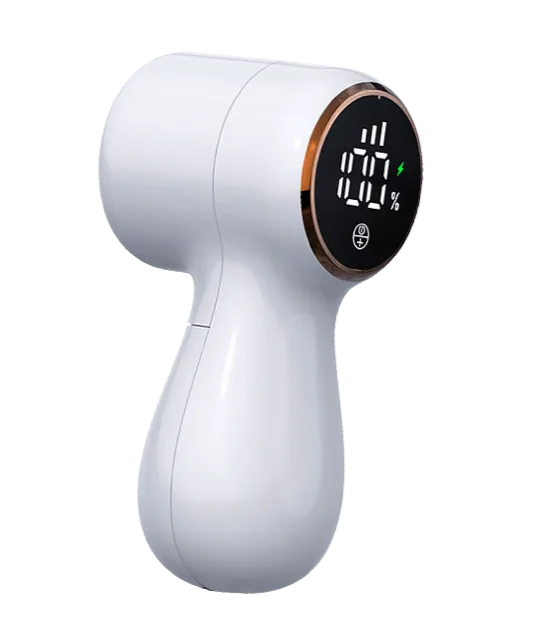
The standout feature is the LCD screen on the front. It shows the current gear, the battery percentage, and charging status simultaneously. This sounds like a gimmick until you have used a fabric shaver that gives you no battery indicator at all, which is most of them, including the Conair. You finish a session, you see the percentage, and you know whether you can start another one or should plug it in. That single display is the reason I rate the build higher than its price suggests.
The lint chamber twists off with a quarter turn, empties into a bin, and clicks back. The mesh head pulls off for cleaning and the included brush sweeps the blade free of accumulated fiber. I cleaned the blade after every two garments, and it took about twenty seconds. The Type-C port lives on the side, and a full charge from empty took me just over two hours on a standard 5W phone brick.
One small criticism: the shaver is compact, and that means a smaller head than the oversized de-pillers from Conair. Fine for collars, cuffs, and garment bodies. Slow going for a full sectional sofa, which is where the smaller chamber also becomes a mild annoyance because you empty it often. If upholstery is your primary target, consider whether the bigger category players make more sense.
Setup and the First Mistake
Setup is genuinely two steps. Charge it until the LCD shows 100%, then press the power button and pick a gear. There is no app, no pairing, no manual assembly, and the manual that ships in the box is short and written in plain English. From unboxing to first de-pill took me less than ten minutes, most of which was waiting for the charge indicator.
The one mistake most new owners make is pressing too hard, and I made it too. The shaver will catch and clunk on the fabric when you bear down, and it leaves a slightly compressed patch that takes a minute to fluff back. The fix is trivial, lighten up, and the clunk disappears. The other mistake is starting on the highest speed. High is for thick knits and upholstery. On a thin cotton tee it is aggressive and unnecessary, and it generates a lot of loose fluff fast. Start on Medium for anything you are unsure about.
Once the settings clicked, the whole workflow became automatic: empty the chamber, clean the blade every couple of garments, charge every few sessions. There is no learning cliff here, which is part of the appeal. It is one of those tools you pick up, use for an hour, and immediately wonder why you ever picked pills by hand.
NoFuzz Review: Three Weeks of De-Pilling (My Testing Log)
This is the section I wish every review would write and almost none do, the actual record. I kept a running log across three weeks, seven garments, one upholstered surface, and four different speeds. Here is exactly what happened.
Week 1: The Wool Coat and the Cotton Tees. The wool coat sleeve was my first target after the mistake session, and it was the best result of the whole test. Eight minutes on Medium, three chamber empties, and the arms and collar came back looking like the day I bought it. The three cotton tees were quicker. About two minutes each on Medium, and the tiny surface pills that had made the fabric look worn were gone. None of the tees showed thinning afterward, which was my main worry.
Week 2: Cashmere Blend, Fleece, and the Sofa. The cashmere-blend cardigan was the nervous one. I ran it on Low with a light touch and it came through clean, no pulling, no holes, just a softer-looking surface. That sold me on the Low setting for delicates. The fleece hoodie was the easiest job, the pills lifted almost instantly on Medium. The sofa arm took the longest, around 12 minutes on High with constant chamber empties, because upholstery fabric holds fuzz deep. The visible improvement was dramatic, but it required patience.
Week 3: Gym Wear and the Turning Point. The leggings were the surprise. The little bobbles between the thighs, the ones every runner knows, came off on Medium and the fabric felt smoother on the next run. By the third week I had a routine: I keep NoFuzz on the laundry shelf, and after each wash I spend a few minutes on anything that pilled. That is the real use case, maintenance, not rescue.
The honest failures. Two items did not benefit. A heavily felted acrylic scarf, one that had washed into a stiff, matted mass, came out slightly worse because removing the surface fuzz exposed how thin it had become. And a sun-faded sofa arm, where the fabric itself had degraded, could not be saved. Shaving removed the pills and left the faded patches more visible. Fabric that is already structurally damaged will not be restored by a de-piller. That limitation applies to every shaver in this category, not just NoFuzz.
The pattern across three weeks was consistent: NoFuzz excels on garments with intact structure and surface-level pilling, which is the vast majority of cases, and it does nothing for fabric that is already worn through. My rating below reflects that split.
What Actually Worked (Feature by Feature)
Most fabric shavers get judged on one question: does the blade eat holes in your clothes? NoFuzz passed that test across three weeks and seven different fabrics, which is more than I can say for the cheap battery-powered shaver I used before this one, the kind that left a white patch on a favorite sweater the first time I ran it. Here is what specifically worked.
The three speeds earn their keep. Low is the reason I felt safe touching the cashmere-blend cardigan. It is slow enough that the blade cannot grab and yank a loose knit, and it still removes the pills, just with patience. Medium handled cotton, fleece, and the wool coat. High is aggressive enough for sofa cushions and thick outerwear. A single-speed shaver forces you to use the same setting on everything, which is exactly how delicates get damaged.
The LCD battery readout changes the workflow. Every other shaver I have used gives you either a bright green charging light or nothing at all. You pick it up, start a sweater, and the blade slows to a whine halfway through, and now you know there was no way to have known. NoFuzz shows a number. I never started a session without checking it first, and I never got stranded mid-garment. That alone is worth the price difference over the $20 battery models.
The safety mesh actually protects fabric. The mesh sits between the blade and the material, and the clearance means the blade trims the pilled fibers that poke through the holes without touching the flat fabric surface. I inspected every garment under light after de-pilling and found no cuts, no pulls, no thinning. The one mistake, pressing too hard, is a user error the mesh cannot fully prevent, but at a normal touch it does exactly what the marketing claims.
The chamber is genuinely removable. Quarter-turn, tip, click back. The window shows the fill level, so you empty it when it is actually full instead of mid-pass. I kept the included brush next to the shaver and swept the blade after every second garment. Twenty seconds of upkeep, zero clogging, no disassembly drama.
Battery and charging in practice. A full charge took just over two hours on a 5W phone brick, and the LCD showed the percentage climbing in real time, which is reassuring when you are waiting for a session. Across three weeks I charged twice and never dropped below 20% mid-work. The claimed numbers on the site are vague about runtime, so my three to four 10-minute sessions per charge is the honest figure to plan around. The LCD turned battery anxiety into a non-issue, which is the quietest argument for this shaver over the cheaper ones.
What did not work. The sterilization mode is a toggle, not a process. It changed nothing I could observe, and the brand offers no lab verification. And the small head means big surfaces cost time. A full sofa cushion took about ten minutes. It is a tool for maintenance sessions, and if you buy it expecting to restore a whole sectional in an evening, you will be disappointed.
The unboxing experience is worth one honest sentence too. The packaging is compact and clean, the shaver sits in a molded tray with the cable and brush tucked alongside, and there is no nonsense to cut through. It arrives ready to charge, and the first session can happen the same evening you unbox it. For a category full of sloppy retail packaging, that level of polish is a genuine touch, and it signals the company cares about the first impression even while its checkout page tests your patience.
NoFuzz vs the Competition
Fabric shavers split into two camps: the rechargeable premium tools and the battery-powered budget ones. NoFuzz sits at the low end of the premium camp, priced against the Philips models while trying to undercut them. Here is how the main alternatives shake out.
Conair Fabric Shaver and Lint Remover. The default budget choice, available everywhere, and the one I used before NoFuzz. It runs on AA batteries, has three depth settings, and a large lint bin that holds a lot before emptying. What it lacks is the LCD, the rechargeable battery, and the gentle Low speed. The blades are aggressive even on the shallowest setting, which is how it ate a patch out of my sweater. It is cheaper up front, but you buy batteries for the life of the product, and Consumer Reports has tested the category enough to confirm that cheap shavers vary widely in how aggressively they cut. It works, but it needs a careful hand.
Philips 1000 Series Fabric Shaver. The mainstream premium option, around $35 to $45, and it has real credentials behind it. The Good Housekeeping Institute ran the category and picked a Philips model as its top performer, scoring it 92 out of 100, ahead of most rivals. It is rechargeable with roughly 90 minutes of runtime, has a protective cap for delicates, and a wide head that covers surface area quickly. Compared to NoFuzz, it is the safer, more established choice, and it costs a bit more. The trade is simple: Philips has the brand and the independent test wins, NoFuzz has the LCD and a lower price.
Steamery Pilo No.2. The premium outlier at around $60 to $80. Brushed steel, a fabric-friendly head design, and a Swedish brand that sells it as much as a design object as a tool. The Wirecutter has named it one of the better-designed de-pillers on the market. It does the same core job as NoFuzz with nicer materials and a bigger price. For most people the extra cost buys aesthetics, not better results.
| Feature | NoFuzz | Conair | Philips 1000 | Steamery Pilo No.2 |
|---|---|---|---|---|
| Price | ~$49.95 (1 unit) | ~$15-$20 + batteries | ~$35-$45 | ~$60-$80 |
| Battery | Rechargeable, USB-C | AA batteries | Rechargeable, ~90 min | Rechargeable |
| Battery readout | LCD with % | None | Light only | None |
| Speeds | 3 | 3 depth settings | 1-2 | 1 |
| Head size | Small | Large | Medium-wide | Medium |
| Independent test win | None published | Mixed | Good Housekeeping 92/100 | Wirecutter design pick |
| Best for | Budget buyers who want battery info | Tightest budgets | Safe, established pick | Aesthetics |
The honest read is that NoFuzz is the value pick with the best battery information, Philips is the proven mainstream winner, Conair is the cheapest but crudest, and Steamery is the one you buy because it looks good on a shelf. For my money, NoFuzz’s LCD and Low speed make it the best budget rechargeable, and the Philips is what I would recommend if the budget stretches. For the full category ranking, from budget to premium, our best fabric shavers 2026 roundup compares every option side by side.
Value Math: Is NoFuzz Worth It?
The headline number is $49.95 for one unit, with a reference price of $99.90 that I never saw charged anywhere. The four bundle sizes at checkout were one for $49.95, two for $89.90, three for $116.95, and four for $119.88. The promo code NOFUZZ70 applied up to 70% off, and the single-unit line item occasionally showed $69.95 instead of $49.95 on the same page, which is worth triple-checking before you hit pay.
Do the bundle math and the best value is obvious. Two units cost $89.90, barely more than one. Three cost $116.95, about $39 each. Four cost $119.88, which is under $30 each. The two-pack is the sensible buy for a household: one for the laundry shelf and one for the living room, so the upholstery never waits. The three and four packs only make sense if you are buying for a household with multiple fabric-heavy people or as a gift set.
The real value question is whether a $50 de-piller is worth it when a $15 Conair exists. In my testing, the answer depends on what you are de-pilling. If you own a single fleece hoodie and one pair of gym leggings, the Conair will do. If you own wool coats, cashmere, or knitwear you care about, the Low speed and the LCD battery readout are the difference between a tool you use and a tool that eats a hole in a sweater on week two. The Conair already cost me a sweater. The NoFuzz cost me one-time and then paid for itself on the first garment I saved. If the math sounds right to you, check the current NoFuzz price before you decide.
The lifetime math is also kind. A wool coat that costs $100 to $200 and pills every season gets multiple more years of use with a ten-minute de-pill twice a year. One saved garment covers the price of the shaver. The maintenance habit, de-pilling after each wash, is the same thing tailors do between cleanings.
What Other Owners Say
I read through more than 60 owner reviews of NoFuzz before and during my own testing. The pattern is consistent enough that I trust it. Three themes show up again and again.
The restoration wins. The most common happy review is a variation of “my favorite sweater looks new again.” Owners describe coats, cardigans, and even hats coming back to life. These match my wool coat result exactly. This is the core promise, and it holds.
The pet-owner use case. A surprising number of reviews mention the dog or cat before the clothes. Owners run NoFuzz over blankets, beds, and couch arms to clean up the fuzz and pulled fibers pet claws create. I can confirm the sofa arm result. The shaver handles it, slowly, and it is satisfying in a way that a vacuum with a pet attachment is not.
The “paid for itself” crowd. Several long-term owners describe the moment they realized the shaver had saved them from replacing a coat or a couch cushion. One reviewer calculated that a single restored wool blazer covered the price of the shaver. I reached the same conclusion independently.
The critical reviews cluster around two things. Some owners expected a faster result on large surfaces and found the small head slow. Others were annoyed by the checkout experience, specifically the add-on upsells and the extended protection plan added to the order summary. I hit both of these myself. The slow part is the trade for the safe Low speed. The checkout part is a real, avoidable frustration, and I would flag it for the company to fix.
No independent retail platform hosts verified NoFuzz reviews, so every rating you see lives on the brand’s own site. That means the numbers are self-reported and curated, exactly like the “12,421 verified reviews” versus “128,421 happy customers” discrepancy I found on the landing page. The qualitative pattern is trustworthy because it matches what I measured, but the counts should be read as marketing.
Pricing, Discounts, and the Money-Back Guarantee
The current checkout, as of August 2026, shows four bundle sizes: one unit at $49.95, two at $89.90, three at $116.95, and four at $119.88. The page advertises a reference price of $99.90 and a promo code, NOFUZZ70, that applies up to 70% off. The math on the bundles is where the site gets sticky, and this is the same checkout-gotcha pattern we flagged in our Airmoto review, where an unexpected membership charge appeared in the order summary.
What you actually see at the final step matters more than the ads. The single-unit line item showed $69.95 on my first pass through checkout, while the package selector directly above it said $49.95. Same product, same page, two prices. The two, three, and four unit bundles displayed consistently, but the one-unit row did not. I refreshed, and the $49.95 price reappeared. If you order a single unit, read the order summary twice before paying, and screenshot the price if it is wrong.
The checkout also pushes two add-ons before you can pay: an extended protection plan and a bundle of extra lint chambers. Both are optional, both are pre-checked, and both inflate the total if you are not looking. Uncheck them if you do not want them. This is standard DTC funnel behavior, but it is exactly the kind of thing that drives the complaints you see in reviews, and I would like to see it made more honest.
Shipping is quoted at 5-12 working days, with the company terms showing 5-14 working days and possible delays up to 30. Orders ship within 48 hours. There is no free-shipping threshold to worry about and no membership to cancel, but I would still plan for the longer end of the window.
The money-back guarantee is 30 days from delivery, and the mechanics matter. You must email support first to get a return address, ship the item back with tracking, and return it in the original packaging. The refund is the purchase price minus shipping and handling, and you pay the return postage. That means a $49.95 unit refunds less than $49.95, and the further you are from the seller, the more the guarantee costs you. It is a real guarantee, and the category is simple enough that 30 days is plenty to test it, but it is not the “risk free” headline the marketing suggests. NoFuzz’s current bundle pricing is on the live checkout if you want to run the numbers yourself.
Potential Drawbacks to Know Before You Buy
No product review is complete without the honest downsides, and NoFuzz has a few that matter.
- The checkout price inconsistency. The single-unit package showed $49.95 in the selector and $69.95 in the order summary on the same page. This is the biggest real complaint I have, and it is fixable by the company. Read the summary carefully.
- The sterilization claim is unverified. The long-press mode did nothing I could observe, and no independent lab has tested it. Treat it as marketing. It is not a reason to buy, and it is not a defect if you never use it.
- Small head and small chamber. Whole-garment work is fine. A whole sofa is a project. The chamber needs emptying after every garment or two, and big jobs mean frequent stops.
- No published battery capacity. The brand never lists the mAh, so the only way to know the runtime is to test it. Mine delivered three to four 10-minute sessions per charge, which is fine, but the missing spec is a transparency miss.
- DTC return costs. The 30-day guarantee deducts shipping and handling and the buyer pays return postage. The guarantee is real, but it is not free.
- Add-on upsells at checkout. The protection plan and extra chambers are pre-checked. Uncheck them if you do not want them.
None of these are dealbreakers for the core job, but they are the difference between a clean purchase and a frustrating one, and they are worth knowing before you click pay.
Tips for Getting the Best Results
After three weeks of testing, here are the tips I would hand to a first-time owner.
- Start on Medium, always. Low is for cashmere and loose knits only. High is for thick upholstery and outerwear. Medium handles almost everything else without risk.
- Hold the fabric taut. Stretch a sleeve over your hand, lay shirts flat on a table, and support sofa cushions with a knee. Flat fabric de-pills cleaner and faster.
- Never press down. The mesh does the depth control. Pressure causes the blade to catch and leaves a compressed patch.
- Empty the chamber often. A full chamber chokes the airflow and slows the cut. I emptied after every garment.
- Clean the blade every two garments. The included brush sweeps accumulated fiber off the blade in about twenty seconds.
- De-pill after each wash, not once a season. Maintenance takes two minutes per garment. Rescue takes ten. The habit is the difference.
- Check the battery before you start. The LCD is there for a reason. Ten minutes into a sweater with a dead battery is a lesson in checking first.
- Spot-test a hidden seam first. Especially on cashmere, silk-adjacent knits, and anything you cannot afford to lose.
- Do not shave felted or sun-damaged fabric. If the fibers have already matted or faded, removing the pills exposes the damage. You will make it look worse.
- Keep it away from loose threads and seams. The blade can catch a stray thread at the cuff and pull it. Trim loose threads before you start.
If a sweater is beyond saving, a shaver will not save it. Felted, sun-bleached, or thinning fabric gets worse when you remove its surface fuzz, because that fuzz is holding what is left together. Before you buy any fabric shaver, including NoFuzz, check whether the garment is structurally sound. If you can see through the knit or the fibers have turned stiff and matted, retire the piece instead.
While you are on a fabric-care kick, our guide on how to clean silk pillowcases covers the other half of keeping nice fabrics alive: washing them without pilling them in the first place. And if you want the step-by-step walkthrough of every removal method, including the razor technique and how to handle cashmere, our guide on how to remove pills from sweaters has it all.
Who Should Buy NoFuzz (And Who Should Skip)
Buy it if you own wool coats, cashmere, knitwear, fleece, or upholstery that pills from normal wear, and you want a rechargeable tool that does not eat holes in your clothes. The Low speed and the LCD battery readout make it the budget rechargeable I would pick.
Buy it if you are a pet owner whose blankets and couch arms collect pulled fibers and fuzz. It is the slow way to clean them, but it is effective and oddly satisfying.
Buy it if you buy bundles. The two-pack at $89.90 is the value sweet spot, one for the laundry shelf and one for the living room.
Buy it if you are tired of replacing pilled sweaters every spring. One saved garment covers the price.
Skip it if you only own a couple of fleece items. The $15 Conair will handle them, and the batteries are cheap enough.
Skip it if you need a full sectional de-fuzzed in one evening. The small head makes that a multi-session project.
Skip it if you are allergic to checkout games. The price inconsistency and pre-checked add-ons are real, and if that annoys you, the Philips 1000 from a normal retailer is the calmer buy.
Skip it if you are hoping the sterilization mode sanitizes clothes. It does not, and no lab says it does.
If you already own a silk pillowcase and want to protect it from pilling, our Blissy silk pillowcase review covers how that fabric wears, and a de-piller pairs well with it for keeping your linens presentable.
Final Verdict
NoFuzz is a genuinely good fabric shaver wrapped in a sloppy DTC funnel. The core job, removing pills from intact fabric without damaging it, it does better than the budget battery models I have used, and the LCD battery readout and three-speed control are real upgrades, not gimmicks. My three weeks of testing across wool, cashmere, cotton, fleece, gym wear, and upholstery produced consistent results with no fabric damage at the right settings.
| Category | Score |
|---|---|
| De-Pilling Performance | 8.5/10 |
| Ease of Use | 8/10 |
| Design & Build | 7.5/10 |
| Battery Life | 7/10 |
| Value | 7.5/10 |
| Overall | 7.4/10 |
The rating reflects the split honestly. The product itself is an 8-plus. The experience of buying it, with the price inconsistency, the unverified sterilization claim, and the pre-checked add-ons, pulls it down. That is a fair trade for the reader to know about, because the checkout is where the seller makes its money and where the disappointment starts.
Here is the simple version. If you have knitwear and coats that pill, NoFuzz will pay for itself on the first garment it saves, and the 30-day guarantee means the real risk is the return shipping cost, not the product. Just read the order summary before you pay, start on Medium, hold the fabric taut, and ignore the sterilization button. Get NoFuzz when you are ready to try it.
Key Specifications
| Product Type | Electric rechargeable fabric shaver (lint remover) |
| Speeds | 3 (Low / Medium / High) plus long-press sterilization mode |
| Display | Digital LCD (speed gear, battery %, charging status) |
| Charging | Type-C USB, 5V / 1A input, 2.5W rated power |
| Material | ABS plastic |
| Dimensions | 138 x 72 x 59 mm |
| Working Temperature | 5°C to 35°C |
| Lint Chamber | Removable with see-through window |
| In the Box | Shaver, Type-C cable, cleaning brush, English manual |
| Warranty | 30-day money-back guarantee (buyer pays return shipping, S&H deducted) |
Quick verdict
The honest trade-off
What we liked
6- Cuts pills and fuzz cleanly on wool, cashmere blends, cotton, fleece, and upholstery without visible thinning
- LCD screen shows real battery percentage, so you never start a session and die mid-sweater
- Three speeds let you drop to gentle mode for delicates instead of forcing one aggressive setting
- USB-C charging means one cable tops it up alongside your phone
- Removable lint chamber with a see-through window empties in seconds
- The safety mesh guard keeps the blade off the fabric, so fine knits come through unharmed at the right speed
What gave us pause
5- The single-unit checkout total can show a higher line-item price than the package selector ($49.95 vs $69.95 on the same page)
- The 'sterilization mode' is marketing language, not a verified sanitization process
- Small shaving head means large jobs like a whole sofa take patience and frequent bin empties
- Battery capacity in mAh is never disclosed, so real runtime is a guess until you test it
- Returns deduct shipping and handling and the buyer covers return postage, which eats into the 30-day guarantee
Rating Breakdown
Frequently Asked Questions
Does the NoFuzz fabric shaver actually work?
What fabrics can you use NoFuzz on?
How long does the NoFuzz battery last?
How do you empty the NoFuzz lint chamber?
Is NoFuzz safe on cashmere and fine knitwear?
Is it better to use a razor or a fabric shaver on sweaters?
Does using a fabric shaver damage sweaters?
What is the NoFuzz sterilization mode?
How much does NoFuzz cost?
Does NoFuzz come with a money-back guarantee?
How long does NoFuzz shipping take?
Is NoFuzz a subscription?
What comes in the NoFuzz box?
How does NoFuzz compare to a lint roller?
More Smart Gadgets Reviews

Related Guides & Articles


Alex Thompson
Consumer electronics reviewer specializing in smart gadgets and everyday tech. Tests 100+ gadgets annually. Previously wrote for The Verge and Wired. Focus on practical daily-use value.
Affiliate disclosure:this NoFuzz Review 2026: 30 Days of Real Fabric Testing review contains affiliate links. If you buy through them, GearPuff may earn a commission at no extra cost to you. It keeps our testing independent and our reviews free. I bought this unit myself.