
In This Article
An evaporative cooler sounds like a free lunch: a box that turns plain water into cool air for pennies an hour. How do evaporative coolers work well enough to pull that off? The physics is old and simple. The catch is that it only works in dry air, and most marketing conveniently leaves that part out.
This guide breaks down the mechanism, the three parts that do the work, why humidity decides everything, and where the cooling ceiling actually sits. You will leave knowing whether an evaporative cooler fits your room, your climate, and your expectations. If you are comparing portable cooling gear across the whole category, our smart home hub collects every cooler and AC we have tested this season.
TL;DR
- An evaporative cooler, often called a swamp cooler, chills air by pulling it across water-soaked pads. Evaporation absorbs heat from the passing air.
- The effect is local. Most portable models reach only about 3 to 7 feet. They cool you, not the room.
- Dry air makes it sing. In low humidity, supply air can drop 15 to 40 degrees; in humid air, almost nothing happens.
- It adds moisture. That feels great in a dry room and suffocating in a sticky one.
- It costs pennies to run, but it can never match a compressor AC for whole-room cooling.
- Buy one for a dry climate and a small space. Skip it if your summer humidity runs above 50%.
What an Evaporative Cooler Actually Is
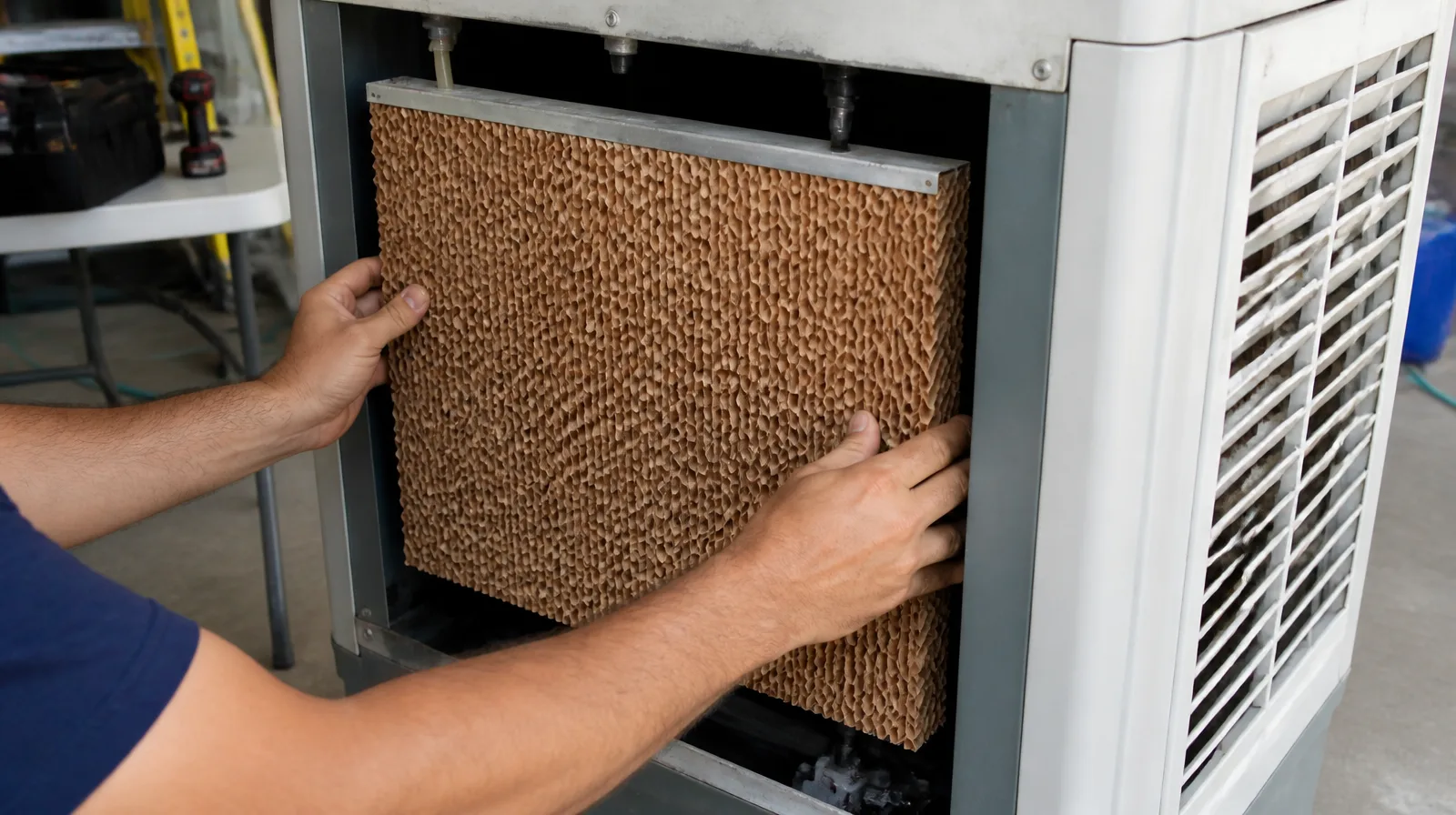
A swamp cooler is a box with three moving pieces: a fan, a water tank, and a pad soaked in that water. The fan pulls warm room air through the pad, water evaporates off it, and the unit blows the result at you. The air leaving the vent is cooler and more humid than the air that went in. That single trait, adding humidity, is what separates it from every compressor air conditioner you have owned.
An AC removes heat with refrigerant and a compressor, dumps it outside through a vent hose, and dehumidifies as a side effect. An evaporative cooler does none of that. It chills the air that passes through it and hands you the water back as a trade. The Air-Conditioning, Heating, and Refrigeration Institute, the industry body that certifies ACs, sums up the whole mechanism in one line: warm, dry air pulled through a water-soaked pad, with evaporation doing the cooling (AHRI on swamp coolers).
Ask how a swamp cooler works in one line and you get: it trades water for cold air, and the amount of cold air it can buy depends entirely on how dry the surrounding air is. The name comes from the aspen shavings used in early pads, which gave the output a faintly swampy smell. Modern units use a treated cellulose honeycomb instead, and they smell like nothing.
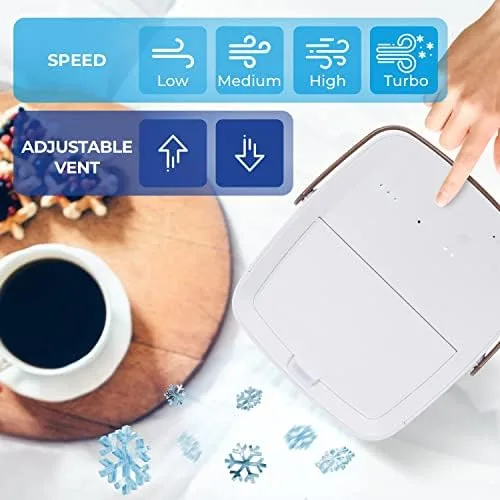
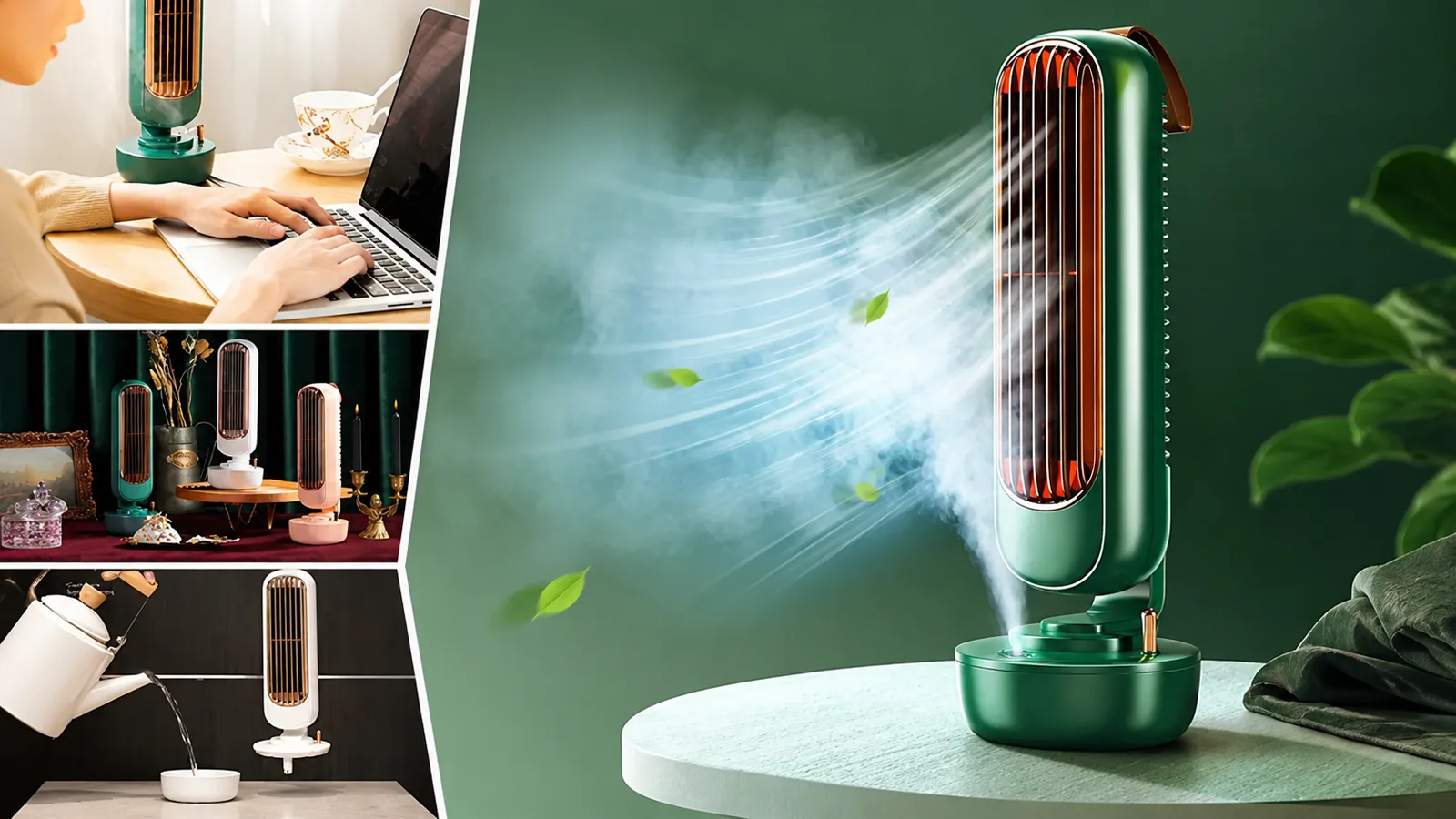
The little unit in the photo above is the ChillWell 2.0, a $89.99 USB-powered version of exactly this mechanism. The BlizzAir we tested runs the same evaporative logic but pairs it with humidity sensors that keep the added moisture in check. Same family, different finish.
The Wet-Bulb Physics: Why Evaporation Cools
The science here is genuinely simple. Water carries a lot of heat with it when it turns to vapor. Evaporating a single pound of water absorbs roughly 970 BTUs of heat from whatever it touches. That is why you feel cold stepping out of a shower or standing in front of a fan after a swim. Your skin is the wet pad, and the breeze is the fan.
A swamp cooler makes that exchange deliberate. Air moves across a wet surface, water evaporates, and the air pays for the vapor with its own heat. The temperature the air can reach has a hard floor called the wet-bulb temperature. Wrap a thermometer in a wet cloth and move air past it: that reading is the wet-bulb temp, and evaporation can never cool air below it. The gap between your normal dry-bulb reading and the wet-bulb reading is your cooling budget.
The Department of Energy’s Building America researchers at Pacific Northwest National Laboratory put it plainly: the amount of cooling depends on how far the dry-bulb and wet-bulb temperatures sit apart, and real units approach but never beat the wet-bulb number (PNNL evaporative cooling guide). Run the math and you see why climate decides everything.
Take two cities on the same July afternoon. In Phoenix the air might read 100°F dry-bulb and 65°F wet-bulb. That 35-degree gap is a huge cooling budget, and a well-built swamp cooler turns much of it into relief you can feel. In Miami the same afternoon might show 90°F dry and 78°F wet, a 12-degree budget that evaporates fast. Push the wet-bulb toward 88°F and there is no budget at all: the air already holds as much water as it wants, so evaporation barely happens and the cooler just recirculates warm, damp air.
There is one clever escape hatch worth knowing. A two-stage, or indirect/direct, unit pre-cools the air with a heat exchanger before it hits the wet pad, so it adds far less humidity and can even beat the outdoor wet-bulb number. They cost more and are mostly a whole-house option, but they are the reason the blanket statement “evaporative only works in deserts” is a little too blunt.
The Three Parts That Do the Work
Every evaporative cooler, from a $30 desk toy to a roof-mounted whole-house unit, is the same machine with the same three parts.
The pad is the business end. It is aspen fiber or a honeycomb of treated cellulose built to hold water and let air pass through. More pad surface means more evaporation and cooler output, which is why whole-house units are stuffed with thick media while a desk cooler gets a thin cartridge you swap out.
The pump recirculates water from the reservoir to the top of the pad, keeping it soaked top to bottom. It is a small electric pump, and it is the part that fails most often. The fan does the work you feel. It pulls air through the wet pad and pushes the cooled air out the front. Fan output is measured in cubic feet per minute, and it is the number that decides what a unit can cover. Whole-house swamp coolers move 3,000 to 25,000 CFM. A personal unit moves a fraction of that, which is why the cool air dies a few feet from the vent.
Keep those three parts honest and the unit keeps cooling. Neglect them and it stops, so predictably that we wrote a maintenance and repair guide around the failures. Pads are measured in months of life, mineral scale builds up in the reservoir, and hard water gums up the pump. Whole-house units add a small bleed-off drain that flushes mineral-laden water out continuously, which is why they need a plumbing connection and portable units do not.
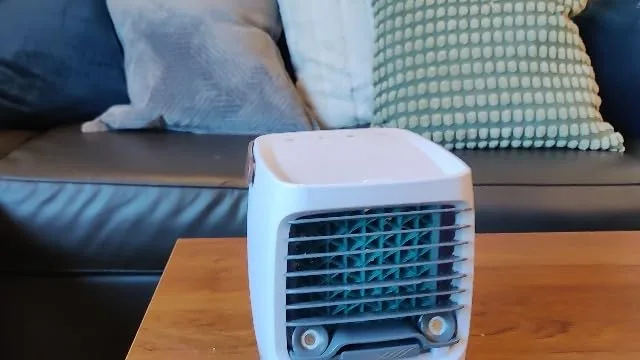
First thing to check when it stops cooling: the water. A dry pad blows warm air. In every evaporative cooler I have run, the most common failure was an empty tank, not a broken fan. Refill, remoisten the pad, and test again before you open the tools drawer.
Why Humidity Is the Whole Game
You could ignore everything else in this guide and still make the right call if you remembered one number: your average summer relative humidity. Below about 40 to 50%, an evaporative cooler works. Above 60%, it essentially stops working, and the added moisture makes the room feel worse than the heat did.
The reason is the wet-bulb gap from earlier. Evaporation needs somewhere to put the water vapor, and humid air is already full. No room in the air, no evaporation, no cooling. On top of that, the unit keeps blowing humidified air at you, and on a muggy evening that feels like standing inside a warm, damp towel.
This is why the same $90 unit is beloved in Las Vegas and returned in New Orleans. I ran the ChillWell 2.0 for a month across a bedroom, a home office, and a patio, and the pattern never moved. On a dry evening two feet away, the misted breeze was genuinely cooler than a plain fan. On a humid afternoon, the air came out neutral, sometimes clammy. The device did not change. The humidity did.
For our US and UK audience, the map splits cleanly. The dry American West is evaporative territory. British summer afternoons, by contrast, often run 60 to 70% relative humidity, which puts most of the UK closer to Miami than to Phoenix on this chart.
Before you buy, check your local averages. If your summer afternoons sit above 50% relative humidity on a regular basis, an evaporative cooler will disappoint you no matter how well it is built. The unit cannot negotiate with physics.
What It Can and Cannot Do
Here is the honest ceiling. An evaporative cooler chills the air that moves through it. It does not lower the temperature of the whole room, because it cannot remove heat from the space the way a compressor AC does. In a sealed room it even works against you, stacking humidity while the small pocket of cooled air mixes and warms within seconds.
My test numbers make the point. Running the ChillWell with one thermometer at the vent and another in the center of a bedroom, the vent air dropped into the mid 60s Fahrenheit while the room stayed in the upper 70s. That gap is the whole product: a personal pocket of cool that is delightful if you are in it and meaningless three feet away.
The BlizzAir, which pairs the same evaporation logic with humidity sensors, did better because it manages moisture instead of adding it blindly. In a 200-square-foot office it pulled the room from 82°F to 72°F in about 18 minutes and bottomed out near 68°F with the door shut. That is real room cooling, but it has a ceiling. The unit plateaued, could not chase a 95°F outdoor spike, and only held its temperature in an enclosed space.
What evaporative coolers never do is dump a bucket of condensate on your floor. There is no drain hose, no window vent, no exhaust to route, which puts them on the other side of the portable AC drainage conversation from the compressor units that leak.
So you trade a wet floor for a full water tank, and you trade deep, dry cooling for cheap, humid relief. Which trade wins comes down to your climate and how you use the room.
Portable vs Whole-House Swamp Coolers
There are two real scales of evaporative cooler, and they are different products wearing the same name. The table shows how they line up, with a compressor AC thrown in as the reference point.
| Portable evaporative cooler | Whole-house swamp cooler | Compressor AC (reference) | |
|---|---|---|---|
| What it cools | You, within 3 to 7 feet | The rooms it feeds, 3,000 to 25,000 CFM | A sealed room, reliably |
| Air temperature drop | A few degrees at the vent | 15 to 40 degrees on supply air | 15 to 25 degrees, and it holds |
| Humidity effect | Adds moisture | Adds moisture | Removes moisture |
| Installation | None, plug it in | Roof or wall mount, ducting, water line | Window kit or ducting |
| Needs a window open? | No | Yes, to exhaust the air | No |
| Water | Tank you refill | Supply line plus bleed-off drain | None |
| Maintenance | Cartridge every 1 to 3 months | Pads twice a season, monthly cleaning | Filter and coil cleaning |
| Energy | Pennies per hour | About a quarter of central AC | The most of the three |
| Typical price | $30 to $140 | $300 to $1,500 installed | $150 to $400 for a window unit |
The portable tier is where most buyers land, and the ChillWell 2.0 is its purest example: small, USB rechargeable, and strictly point-blank in reach, which the full ChillWell 2.0 review documents room by room. It suits a desk, a nightstand, or a camper in dry country.
The whole-house tier is a different animal. It moves enough air that, in a dry climate, it genuinely cools a home at roughly half the installation cost of central AC and a quarter of the energy. The trade is real plumbing and a rule that trips up first-timers: you must open windows or vents so the cooled air has somewhere to go. Pacific Northwest National Laboratory’s guidance calls for 1 to 2 square feet of opening for every 1,000 CFM of cooler output. Skip that and the unit stalls, pressurizing the house instead of cooling it (PNNL evaporative cooling guide).

For most readers of a portable cooling guide, the whole-house tier is context, not a purchase. If you rent, if you want zero installation, or if you only need to cool one room, the portable tier is the one that fits. It is also the tier where marketing overpromises the hardest, so treat every “cools your whole room” claim on a small unit as fiction until you see a test.
Verdict: Is Evaporative Right for You?
Run your climate through the one filter and the answer is almost automatic. Dry summers and a small space where you can sit near the unit: an evaporative cooler is a smart, cheap buy. Humid summers, or a sealed room you expect to walk into cool: it is a waste of money, and a compressor AC or a heat-exchange portable like the BlizzAir is the better tool.
When it fits, the fundamentals worth prioritizing:
- Your summer relative humidity is the whole decision. Above 50%, look elsewhere.
- Match scale to space. Personal units cool a few feet; whole-house units need windows open and real CFM.
- Budget for water and pads. A neglected cooler smells and blows warm air.
- Set expectations up front. You are buying a cooler for your spot in the room, with the dry-climate exception where it genuinely cools the whole space.
Buy for your climate, not the ad. The physics is the same in a $30 unit and a $1,500 one, and it is the humidity in your city that decides whether either one earns its place.
Common Questions & Answers
Q: How do evaporative coolers work?
A fan pulls warm room air through a pad soaked with water. The water evaporates off the pad, absorbing heat from the passing air, and the unit blows the cooled, humidified air out the front. The whole mechanism runs on evaporation, so the drier the surrounding air, the stronger the effect.
Q: How does a swamp cooler work vs an air conditioner?
A swamp cooler chills air by evaporation and adds moisture to what it blows at you. An air conditioner uses refrigerant and a compressor to remove heat from the room and expels it outside, drying the air as a side effect. The swamp cooler cools you; the AC cools the space.
Q: Do evaporative coolers actually cool a room?
Portable units cool the air in front of them, usually within 3 to 7 feet, and do not lower the room's overall temperature. Whole-house swamp coolers move 3,000 to 25,000 CFM, enough to cool a home in a dry climate, but only with windows or vents open to exhaust the air.
Q: Why do evaporative coolers not work in humid climates?
Evaporation needs dry air to accept the water vapor. In humid air the vapor has nowhere to go, so evaporation slows to a trickle and the cooling collapses. The unit still blows humidified air, which can make a muggy room feel worse. Above roughly 50 to 60% relative humidity, expect a big drop-off.
Q: What is the wet-bulb temperature?
It is the temperature a thermometer reads when wrapped in a wet cloth with air moving past it. Evaporation cools the cloth below the normal air temperature, and that cooler reading is the lowest temperature evaporative cooling can reach. The bigger the gap between dry-bulb and wet-bulb, the more cooling headroom you have.
Q: How much does an evaporative cooler cost to run?
Very little. A portable unit draws a few watts for the fan and pump, so it costs pennies per hour. Whole-house units use roughly a quarter of the energy of central AC, per DOE Building America research. The ongoing costs are water and pads, which you replace each season.
Q: Do evaporative coolers need a drain hose or a window vent?
No drain hose. Portable units just need a refillable water tank. Whole-house units need a water supply line, a bleed-off drain to flush minerals, and open windows so the air they push through can escape. Compressor portable ACs are the ones that collect condensation and need draining.
Q: What humidity is too high for an evaporative cooler?
Anything above 50 to 60% relative humidity for regular use. Below 40 to 50% the effect is strong. The simplest check is your city's average summer humidity before you buy, since no cooler overrides that number.
Q: How often do you replace evaporative cooler pads?
Whole-house units: at least twice a season, and monthly during continuous operation. Portable units: every 1 to 3 months depending on use and water hardness. A clogged or scaled pad blows warm air and smells, so treat replacement as routine, not repair.
Q: Can you use an evaporative cooler in the UK?
British summer humidity usually sits at 60 to 70% or higher, which is past the point where evaporation does much work. A personal unit can still add a pleasant mist during a dry spell, but expect a compressor AC or heat-exchange portable to give more reliable relief.
More Smart Home Guides

Related Product Reviews

Smart home enthusiast and IoT specialist. Has automated over 50 homes across different ecosystems. Former smart home consultant for Google Nest and Amazon Alexa. Passionate about making technology accessible.