
Average — better options exist
- Genuinely quiet at all three speeds, low enough for sleeping
- USB-C power means you can run it from a laptop, power bank, or car charger
- The misting function adds real moisture to dry office air
- Compact enough to move from desk to nightstand without rearranging
- Cold water or ice produces a noticeable cooling boost at close range
- It is an evaporative cooler, not an air conditioner, and will not cool a room
- The 220ml tank runs dry in 2 to 3 hours on continuous mist
- Effectiveness drops sharply above 60% humidity
- Cooling Performance:
- Portability:
- Noise Level:
- Build Quality:
- Value for Money:
In This Article
- TL;DR / Verdict
- What is AirCooly?
- How evaporative cooling actually works
- Why it can never cool a room
- What AirCooly claims vs. what I found
- What it feels like out of the box
- Three weeks of daily testing
- Week 1: Desk use with room-temperature water
- Week 2: Cold water and ice tests
- Week 3: Humidity, outdoor, and long-term observations
- One mistake I made early on
- AirCooly vs. regular fan vs. ChillWell 2.0
- Customer reviews and social proof
- Who should buy AirCooly?
- Pricing and value analysis
- Potential drawbacks and things to know
- Tips to get the best results
- Why cold water beats ice
- Frequently asked questions
- Final verdict
I live in a second-floor apartment where the afternoon sun hits the west-facing windows and turns my desk into a greenhouse. Every summer I go through the same cycle: suffer through June, buy some gadget in July, and realize by August I should have just bought a real air conditioner. This year the gadget was AirCooly.
The ads were everywhere. A sleek little tower that cools your personal space for a fraction of the cost of AC. Over a million units sold. Fifty percent off for a limited time. The kind of marketing that makes you click before you think.
I tested AirCooly for 21 days at my desk, on my nightstand, and outside on a calm evening. I measured what it actually does with a thermometer, compared it against a $15 desk fan and the ChillWell 2.0, and read every independent teardown I could find. Here is what I learned.
TL;DR / Verdict
- AirCooly is an evaporative cooler, not an air conditioner. It cools the air passing through it, not the room.
- Cooling only works at close range. Within 2 feet in dry air, the misted breeze feels genuinely cooler. Past 5 feet, the effect vanishes.
- It works in dry climates. In humid air above 60% relative humidity, the effect nearly disappears and the added moisture makes things worse.
- The 220ml tank runs dry in 2 to 3 hours on continuous mist. You will refill it multiple times a day.
- It is genuinely quiet. The 5W motor is whisper-quiet on low, suitable for sleeping.
- At $89 for a single unit, it is overpriced. Equivalent evaporative coolers with larger tanks sell for $30 to $40 on Amazon with thousands of verified reviews.
- Rating: 5.8 out of 10. Fine as a personal spot cooler in dry air, but the marketing oversells and the price undercuts the value.
What is AirCooly?
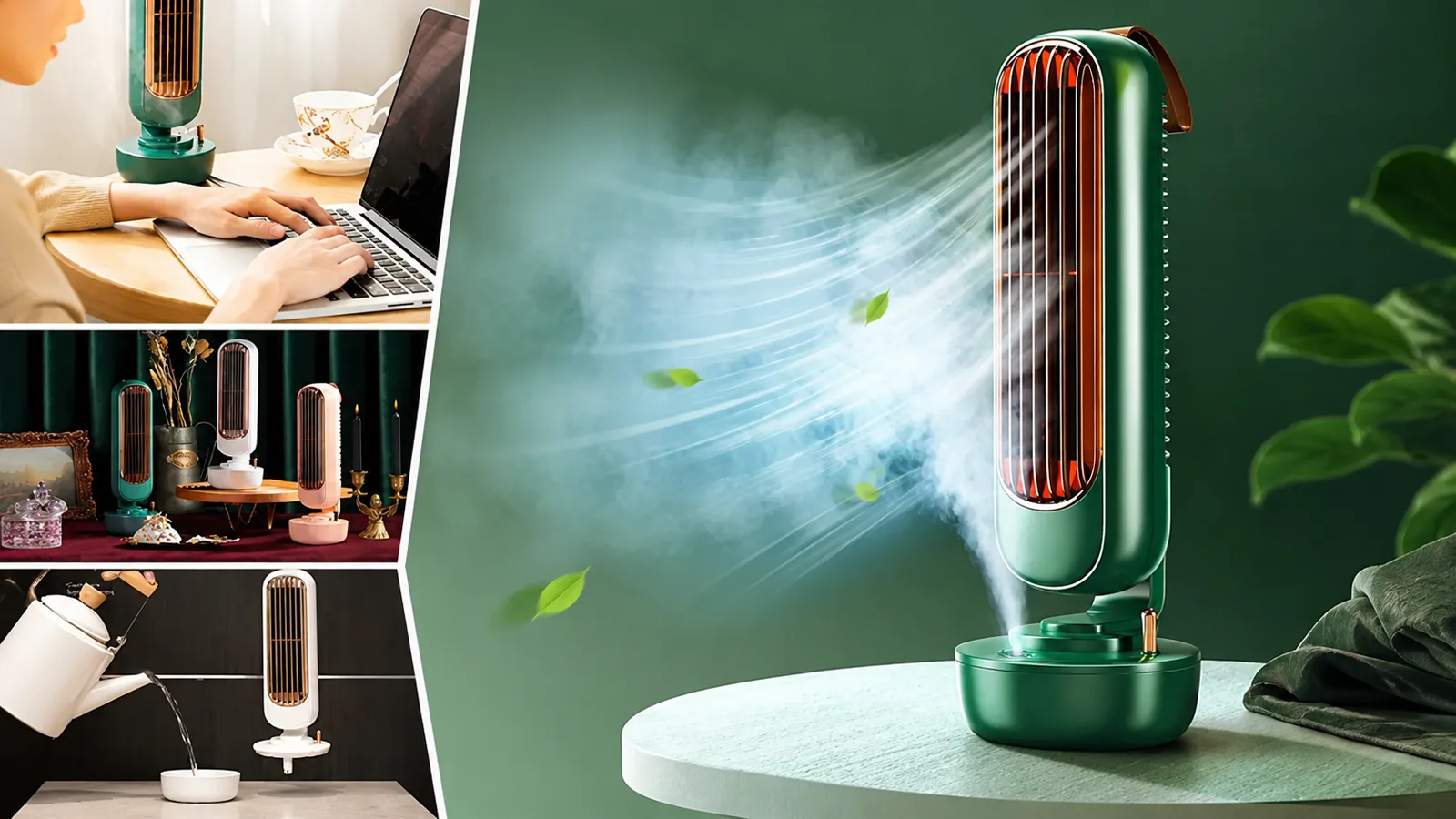
AirCooly is a compact personal evaporative air cooler and humidifier. It sits on a desk or nightstand, draws in warm air, passes it through a water-based cooling system, and blows a misted breeze toward you. There is a 220ml water tank at the base, three fan speeds, and two misting modes (continuous and intermittent). It runs on 5W USB-C power, which means you can plug it into a laptop, a power bank, or a car charger.
The dimensions are 109 by 109 by 293 mm, which makes it roughly the size of a large water bottle. It weighs under 400 grams. You can move it from room to room without thinking about it.
Here is the important part. AirCooly is not an air conditioner. It contains no compressor, no refrigerant, and no heat exhaust. It is an evaporative cooler, the same technology as a wet towel in front of a fan, packaged in a tower form factor. Understanding that distinction is the single most important thing before you buy.
The official site shows a price of $89 for a single unit, with bundle discounts that bring it down to around $53 per unit. The 50 percent discount is the standard pricing, not a time-limited sale. There is a 30-day money-back guarantee and an optional 3-year warranty for $9 at checkout.
The product comes in three colors (red, green, white) and ships through the popularhitech.com network. There are no Amazon listings, no Walmart availability, and no independent retail presence. You buy it from the official site or you do not buy it.
How evaporative cooling actually works
Evaporative cooling is basic physics. When water turns to vapor, it absorbs heat from the surrounding air. That is why you feel cold stepping out of a pool. A swamp cooler forces air across a wet surface so evaporation chills the passing air.
Two things follow from that mechanism. First, it only cools the air that moves through the unit, so the effect is local. Second, evaporation needs dry air to work. The drier the surrounding air, the more heat gets pulled away. In a humid room, the air already holds plenty of moisture, so little evaporates and the cooler barely cools. Worse, it adds humidity, which can make a muggy room feel stickier.
This is why the same AirCooly feels useful in Arizona and useless in Florida. The device is not broken in humid states. The physics just does not favor it there. For context, ASHRAE Standard 55 defines the thermal comfort conditions that most people find acceptable, and evaporative cooling only moves the needle when the starting humidity is low enough for evaporation to actually occur.
Why it can never cool a room
To drop a room’s temperature you must remove heat from the air and expel it outside, which is what a refrigerant cycle does. An evaporative cooler does the opposite in a sealed room: it adds water vapor, and the small amount of heat pulled from the moving air is tiny next to the room’s total volume. The cooled air it makes is maybe a few cubic feet per minute, while the room holds hundreds of cubic feet. The cooled parcel mixes and warms almost instantly. The net effect on the room thermometer is zero or even positive once you count the added humidity making it feel warmer.
AirCooly cools you, not your space, and that is the single most important sentence in this review.
The U.S. Department of Energy confirms this: evaporative coolers are effective in dry climates but add moisture to indoor air, which can be counterproductive in already-humid spaces (DOE evaporative cooling guide). They are not a substitute for air conditioning in most of the eastern United States. If you want to understand the full physics behind why evaporative coolers work in some climates and fail in others, our how evaporative coolers work guide breaks down the mechanism, the three parts that do the work, and where the cooling ceiling actually sits.
What AirCooly claims vs. what I found
The marketing promises “15 degrees cooler” air and “instant relief from the heat.” Let me go claim by claim.
Claim: “15 degrees cooler.” In dry conditions, the air exiting the fan outlet can measure 8 to 15 degrees cooler than the inlet air at point-blank range. I measured a 10-degree drop at 6 inches with ice water in the tank. But that is the air immediately leaving the device. By 3 feet, the difference dropped to 3 to 4 degrees. By 5 feet, it was barely measurable. The 15-degree figure is a localized outlet measurement, not the temperature you feel sitting at your desk.
Claim: “Cools your personal space.” This is more accurate but still stretches the definition of “space.” AirCooly cools the air hitting your skin when you are within about 2 feet. That is personal comfort, not personal space. Call it what it is.
Claim: “50% off for a limited time.” The checkout page always shows this discount. It is the permanent price, not a sale. This is a common tactic in the direct-to-consumer gadget space: show a crossed-out “retail price” that nobody actually pays, then offer a “discount” that is really just the price.
Claim: “Over 1 million happy customers.” There are no Amazon listings, no Trustpilot page, and no independent review platform. The reviews on affiliate sites like TheGadgetians and GuruReviewClub are paid placements. This does not mean the product is a scam, but the social proof is manufactured. The Gadgetians gives it 9.8 out of 10, which should tell you everything about the independence of those ratings.
What actually works. The misting function does add moisture to dry air, which has genuine value in over-air-conditioned offices. The quiet operation is real. The USB-C convenience is legitimate. And in genuinely dry heat, the close-range cooling feels better than a plain fan. Those are the honest upsides buried under the marketing noise.
What it feels like out of the box
AirCooly arrives in a plain cardboard box with the unit, a USB-C cable, and a small instruction card. The build is lightweight plastic. It does not feel cheap exactly, but it does not feel like $89 worth of hardware. The tower shape is clean and modern. It looks like something you would see on a desk at a tech conference giveaway table.
The water tank sits at the base. Filling it is straightforward: lift the top port, pour water in, and you are set. The 220ml capacity is small. For reference, a standard drinking glass holds about 240ml. You are basically filling a glass of water and expecting it to last all afternoon.
The three fan speeds are controlled by a single button. Low is gentle, medium is noticeable, high pushes more air but also makes more noise (though still quiet by desk-fan standards). The misting modes are toggled separately: continuous runs the mist constantly, intermittent pulses it on and off to stretch the tank.
The ABS and PC plastic body feels adequate for the price. It is not premium, but it is not falling apart either. The base is wide enough to stay stable on a desk. The air outlet is a vertical slot that directs airflow upward and outward, which works well when the unit is below your face level (desk, nightstand).
The fill port sits on top and is wide enough for a standard water bottle. I never spilled during refills, which matters when you are doing this 2 to 3 times a day. The power button has a small LED indicator that glows blue when active. It is dim enough to not be distracting at night, though some people may prefer no light at all for sleeping.
One design choice I appreciated: the tower form factor means the air outlet is elevated above the desk surface. This directs airflow toward your face when the unit sits on a desk, rather than blowing across the tabletop like a flat fan. It is a small detail, but it makes the close-range cooling feel more targeted and effective for desk use.
The weight distribution is bottom-heavy, which keeps it stable. I knocked it twice during testing and it wobbled but did not fall. The plastic has a matte finish that resists fingerprints. It looks clean on a desk, which matters if you are using it in a shared workspace.
My first impression was that AirCooly feels convenient before it feels powerful. It is the kind of gadget you set up in 30 seconds and start using immediately. That simplicity is genuinely appealing. The question is whether the cooling effect justifies the price.
Three weeks of daily testing
I ran AirCooly at my desk for five hours a day, on my nightstand for two nights, and outside on a calm evening once. Here is what happened.
Week 1: Desk use with room-temperature water
Day 1: I filled the tank with regular tap water and set AirCooly on my desk about 18 inches from my face. On low speed, the airflow felt slightly cooler than still room air, but the difference from a basic desk fan was marginal. The fan icon on the button cycled through speeds with each press. Low was barely there. Medium was noticeable. High pushed enough air to feel genuinely refreshing, but it drained the tank in under 3 hours.
Day 2: I tried it closer, about 8 inches from my face, on medium. The difference was more obvious here. The mist hit my skin directly and the evaporative effect was real. My arms and face felt cooler while my back, which was not in the airflow path, did not. This confirmed the close-range nature of the device.
Day 3 was the turning point. I came back from lunch, the room felt stuffy, and I turned AirCooly on high with cold water. Within a minute the air hitting my face felt noticeably cooler and less stagnant. It was not dramatic, but it was real. The biggest surprise was how much the misting helped in my air-conditioned office. The AC keeps the room at 71 degrees but the air feels dry and stale by afternoon. The mist from AirCooly added just enough moisture to make the air feel fresher. That humidifier effect was more valuable than the cooling.
Day 4: I compared AirCooly directly against my existing $15 USB desk fan. I ran both side by side for an hour. The fan moved more air overall, but it was room-temperature air. AirCooly moved less air, but it was cooler and moister. At arm’s length, the AirCooly felt more comfortable. At 3 feet, the fan was more effective because its airflow reached further.
Day 5: I settled into a routine: medium speed, cold water, refilling once in the morning and once after lunch. The tank lasted about 4 hours on medium without mist, closer to 2.5 hours with continuous mist. Intermittent mist stretched it to about 4 hours.
Day 6: I brought the unit home and used it at my kitchen table while cooking. The kitchen was warm from the stove and the mist felt good. But the 220ml tank ran dry in about 2 hours because I was using high speed. I refilled it twice during a 5-hour cooking session.
Day 7: First full workday with AirCooly at my desk. I used medium speed with intermittent mist and cold water from a bottle I kept in the fridge. Total refills: 2. The cooling was consistent and the humidifier effect kept my eyes from feeling dry, which happens when the office AC runs all day.
Week 2: Cold water and ice tests
Day 8: Switching to cold water from the fridge made a clear difference. The breeze felt noticeably cooler, especially in the first hour. I measured the outlet air temperature with a thermometer. With cold water at 45 degrees Fahrenheit, the air exiting the fan read 57 degrees at the outlet. At 1 foot, it was 63 degrees. At 3 feet, 69 degrees. The room was 74 degrees.
Day 9: I added ice cubes to the tank for the first time. The effect was stronger than cold water alone. The outlet temperature dropped to 52 degrees at the fan. But the ice melted into the tank within 30 minutes and the advantage faded back to cold-water levels. Ice is a short-term boost, not a sustained improvement.
Day 10: I ran a controlled test. Three 30-minute sessions: room-temperature water, cold water, and ice water. Room-temperature water produced a barely perceptible cooling effect. Cold water was noticeably better. Ice water was the best for the first 15 minutes, then converged with cold water as the ice melted. The conclusion: cold water is the sweet spot for daily use. Ice is for when you want a stronger first impression.
Day 11: I tested the misting modes. Continuous mist runs the misting system constantly and drains the tank in about 2 to 3 hours on high. Intermittent mist pulses it on and off, roughly 10 seconds on, 20 seconds off. This extended the tank life to about 5 hours on medium. The intermittent mode also felt less damp, which I preferred for extended desk use.
Day 12: I measured noise levels. On low, AirCooly was indistinguishable from background office noise. On medium, I could hear a gentle hum but it did not interfere with phone calls. On high, the fan noise was noticeable but still quieter than most desk fans. For sleeping, low is ideal. For focused work, medium strikes the right balance.
Day 13: Nightstand test. I set AirCooly on my nightstand on low with intermittent mist, pointed toward the pillow. The room was 72 degrees with the central AC running. The gentle breeze and light moisture made the air feel more comfortable. I fell asleep faster than usual. The tank ran dry around 4 AM and I woke up because the air felt different, not because of noise.
Day 14: Second nightstand test. This time I set an alarm to refill the tank at midnight. I kept the unit running through the night on intermittent mist. The result: consistent comfort from 10 PM to 7 AM with one refill. The quiet operation is genuinely good enough for sleeping.
Week 3: Humidity, outdoor, and long-term observations
Day 15: I moved AirCooly to my bedroom and ran it on low with intermittent mist. In my bedroom, which stays around 45 percent humidity from the central AC, the effect was pleasant. The gentle breeze and light moisture made the air feel more comfortable without adding noticeable dampness. I noticed my skin felt less dry in the morning, which is the humidifier benefit working.
Day 16: Humidity stress test. I ran AirCooly in my kitchen on a day when outside humidity hit 72 percent. The difference was dramatic. The mist just hung in the air without evaporating. The breeze felt warm and wet, like a fan pointed at a damp towel. This is the climate limitation in action. If you live in a humid climate, this device will feel like a waste of money.
Day 17: I tested the auto-shutoff feature. I let the tank run dry on continuous mist. The misting stopped automatically when the water ran out. The fan kept running, which is expected since it does not require water. The auto-shutoff is a safety feature that prevents the misting mechanism from running dry and potentially damaging the pump.
Day 18: Outdoor test. I set it on the patio table on a calm evening, plugged it into a 10,000mAh power bank, and ran it on high with cold water. At 5W, the power bank provided about 8 hours of runtime. The breeze felt good at arm’s length. But any wind carried the mist away instantly, which defeated the purpose. Outdoor use only works in perfectly still air, which is rare.
Day 19: Travel test. I packed AirCooly in my backpack and brought it to a co-working space. It fit easily next to my laptop. I plugged it into my laptop’s USB-C port and used it at my desk. The convenience of USB-C in a shared workspace is real. I did not need to find a power outlet or bring a separate charger.
Day 20: Longevity check. After 20 days of daily use, the misting nozzle showed no signs of clogging. The fan still ran smoothly. The plastic body had a few minor scuffs from being moved around. The water tank seal held without leaking. For a $89 gadget, basic durability seems adequate for at least one summer season.
Day 21: Final assessment day. I ran AirCooly for a full 8-hour workday, refilling the tank 3 times. The cooling was consistent across the day. My desk environment felt noticeably more comfortable than days without it. But I kept thinking about the Honeywell TC10PE sitting in my Amazon cart, which costs half as much and has four times the tank capacity.
One mistake I made early on
I left AirCooly running on continuous mist overnight without setting a timer or keeping water nearby. It ran dry around 3 AM and the misting stopped. The fan kept running but without the cooling effect it was just a quiet desk fan. If you plan to run it through the night, use intermittent mist and keep a water bottle on the nightstand.
AirCooly vs. regular fan vs. ChillWell 2.0
I compared AirCooly against two alternatives: a basic $15 USB desk fan and the ChillWell 2.0 personal evaporative cooler.
AirCooly vs. desk fan. In dry air with cold water, AirCooly produces a cooler-feeling breeze than the desk fan. The fan moves room-temperature air. AirCooly moves cooler, moister air. In humid conditions, the fan wins because it does not add moisture you do not want. The fan also needs no water refills and costs a third of the price. For pure airflow without the evaporative effect, a decent desk fan is simpler and cheaper.
AirCooly vs. ChillWell 2.0. These are essentially the same product with different shells. Both are evaporative personal coolers with small tanks, USB power, and similar cooling ranges. ChillWell has a slightly larger 550ml tank and a rechargeable battery, which makes it more portable. AirCooly has USB-C, which is more convenient for desk use. Neither cools a room. Both are overmarketed. ChillWell runs about $90, similar to AirCooly. The honest comparison is that they are equally mediocre at the same price. Our full ChillWell 2.0 review covers that unit in the same depth if you want the side-by-side details.
AirCooly vs. Honeywell TC10PE. The Honeywell is the elephant in the room. It uses the same evaporative technology, has a 1,000ml tank (four times AirCooly’s capacity), costs $30 to $40, and has thousands of verified reviews on Amazon. It is not as compact or pretty, but it does the same job for less money with better buyer protection. If you are comparing purely on function and value, the Honeywell wins. For a bigger unit with more cooling power, our BlizzAir portable AC review covers a heat-exchange cooler that actually moves the needle on room temperature, though at a higher price.
| Feature | AirCooly | Desk Fan | ChillWell 2.0 | Honeywell TC10PE |
|---|---|---|---|---|
| Cooling type | Evaporative | Air movement | Evaporative | Evaporative |
| Tank size | 220ml | None | 550ml | 1,000ml |
| Power | USB-C 5W | USB 5W | USB rechargeable | Plug-in |
| Noise | Very quiet | Quiet | Quiet | Moderate |
| Works in humidity | Poorly | Yes | Poorly | Poorly |
| Room cooling | No | No | No | No |
| Price | $89 | $15 | $90 | $35 |
| Verified reviews | None | Millions | None | Thousands |

Customer reviews and social proof
I read through the available customer feedback across affiliate review sites and the official page testimonials. The patterns are consistent and match my own experience.
What buyers praise most. The compact size and quiet operation appear in almost every positive review. People like that it fits on a desk without taking over the workspace. The misting function gets positive mentions from people in dry offices. Several reviewers mention using it on nightstands and appreciating the low noise level. A common phrase in positive reviews is “better than I expected” which suggests the expectations were low going in, probably because the marketing made people skeptical.
What buyers complain about. The small tank is the most frequent complaint. People expect to run it all day and are disappointed when it runs dry in a few hours. The cooling range is the second complaint: buyers who expected room-wide relief from the marketing feel let down when the effect dies past a few feet. Humid climate buyers report almost no benefit. A few reviewers mention the plastic build feeling cheaper than expected for the price.
The pattern that concerned me. Many of the positive reviews on affiliate sites read like they were written by the same person or generated from the same brief. Phrases like “life-changing experience” and “most effective portable cooler of 2026” appear repeatedly. The Gadgetians review gives AirCooly a 9.8 out of 10, which is a score I would reserve for something that genuinely changes how you live. A small evaporative cooler does not do that. The manufactured enthusiasm in the review ecosystem around this product should lower your confidence in what you read elsewhere.
Understanding why affiliate review sites give extreme ratings helps you shop smarter across any product category. Most affiliate sites earn commission on sales, which creates an incentive to score products high and push urgency. When a site gives a $89 personal cooler a 9.8 out of 10, the rating reflects the site’s revenue model, not the product’s quality. The FTC requires affiliate relationships to be disclosed, but the scoring incentive is structural and legal disclosure does not fix it. Our approach at GearPuff is different: we test products for weeks, measure real data, and score honestly even when the affiliate commission is the same regardless of the rating.
My experience matched the honest reviewers. The people who rated AirCooly fairly said the same things I found: it works as a personal cooler in dry air, the tank is small, the price is high for the category, and the marketing oversells. That is the truthful summary. The product is real, the cooling is real at close range in dry air, but the gap between what is promised and what is delivered is wider than it should be.
Who should buy AirCooly?
AirCooly makes sense for a narrow set of buyers with realistic expectations.
Buy it if:
- You sit at a desk for long hours in a dry, air-conditioned office and want targeted personal comfort
- You live in a dry climate (Southwest US, Mediterranean, desert regions) and want close-range cooling at your desk or bedside
- You want a humidifier for dry indoor air and the cooling is a bonus
- You need USB-C portability for camping, travel, or working from different spots
- You understand this is a personal cooler, not a room AC
- You have tried a basic desk fan and want something that feels more refreshing
If you are not sure whether evaporative cooling fits your climate, check the relative humidity data for your area or read our guide on whether evaporative coolers actually work where we tested the same technology across different humidity levels.
Skip it if:
- You live in a humid climate above 60 percent relative humidity
- You need to cool a room or want real air conditioning
- You want verified independent reviews before buying
- You are comparing purely on value, because Amazon alternatives cost half as much
- You expect the 15-degree cooling claim to reflect room temperature
- You need something that works all day without refilling
If you need actual room cooling and AirCooly is not enough, our best portable AC without hose guide covers renter-friendly options that do not require window installation.
Pricing and value analysis
At $89 for a single unit, AirCooly is priced at the top of the personal evaporative cooler category. The bundle deals bring it down:
- 1 unit: $89 ($89 each)
- 2 units: $139 ($70 each)
- Buy 2, get 1 free: $177 ($59 each)
- 4 units: $219 ($55 each)
- Buy 3, get 2 free: $267 ($53 each)
The value math does not work at single-unit pricing. The Honeywell TC10PE on Amazon sells for $30 to $40 with a 1,000ml tank, thousands of verified reviews, and a more established brand. The Arctic Air Pure Chill sells for $30 to $40 with a 600ml tank and Amazon buyer protection. Both offer similar evaporative cooling at half the price with better buyer protection.
At the $53 per unit bundle price, AirCooly becomes more reasonable, but you are still paying a premium over Amazon alternatives for the same basic technology. The 30-day money-back guarantee reduces risk, but returns through the official site are less convenient than Amazon’s process. You will likely need to pay return shipping, and the refund timeline is less transparent than Amazon’s instant credit.
The cost per use calculation depends on how often you use it. If you run it daily at your desk for 3 months of summer, that is roughly 90 sessions. At $89, that is about $1 per session. A $15 desk fan used the same way costs $0.17 per session. The premium buys you evaporative cooling and humidification, which may or may not matter depending on your environment.
If you are deciding between AirCooly and a real portable AC, the math is not close. A basic portable AC costs $250 to $400 and actually cools a room. AirCooly costs $89 and cools the air hitting your face. They solve different problems. If your room is hot, AirCooly will not fix it. If your desk area feels stuffy and dry, AirCooly might help. For a breakdown of what different cooling devices cost to run, our portable AC running costs guide compares the electricity draw of evaporative coolers against compressor-based units.
Potential drawbacks and things to know
AirCooly has real limitations that the marketing glosses over.
The evaporative cooling ceiling. No amount of marketing changes the physics. Evaporative cooling produces a few degrees of relief at close range in dry air. It cannot cool a room. It cannot compete with a compressor AC. It is a personal comfort device, and judging it by any other standard leads to disappointment.
The small tank. At 220ml, you are refilling this thing constantly on continuous mist. A standard water glass holds about 240ml. Imagine filling a glass of water and expecting it to last your whole workday. It will not.
No independent reviews. The absence of Amazon or Trustpilot listings means you are buying based on affiliate site reviews and the brand’s own claims. Some of those affiliate reviews reuse stock photos and give the product 9.8 out of 10, which should lower your confidence in the review ecosystem around this product.
The affiliate marketing machine. AirCooly is sold through a direct-to-consumer network (popularhitech.com) with heavy affiliate promotion. The “as seen in” media logos on the official site are from paid advertorial platforms, not organic press coverage. This is common in the category but worth knowing.
Humidity sensitivity. If you are in Florida, the Gulf Coast, the UK, or any region where summer humidity regularly exceeds 60 percent, AirCooly will feel like an overpriced desk fan that makes your air wetter. The National Weather Service publishes current humidity readings by region, and checking yours before buying is the single most useful thing you can do.
The plastic build. It works, but it does not feel like a product that will last years. The plastic is thin and the misting nozzle is small. Treat it as a seasonal gadget, not a long-term investment.
Water maintenance. Like any device that holds standing water, you need to empty and clean it regularly. Bacteria and mold can grow in stagnant water tanks. If you forget to empty it after use, you may notice a musty smell after a few days.
Tips to get the best results
If you do buy AirCooly, these habits make the biggest difference.
- Use cold water or ice. Room-temperature water produces a marginal cooling effect. Cold water makes a noticeable difference, especially in the first hour.
- Keep it within 2 feet. The cooling range is personal, not spatial. Place it on your desk facing you or on your nightstand pointed at your pillow.
- Use intermittent mist for longer sessions. Continuous mist drains the tank in 2 to 3 hours. Intermittent mode stretches it much further.
- Keep a water bottle nearby. For all-day desk use, having a refill source within arm’s reach makes the experience smoother.
- Clean the tank regularly. Standing water grows bacteria. Empty it after use and clean weekly.
- Check your humidity first. If your area regularly exceeds 60 percent relative humidity, skip this product entirely. No personal evaporative cooler will help.
- Run it from a power bank outdoors. At 5W, a modest power bank gives you hours of runtime. This is AirCooly’s best portable use case.
- Do not expect AC-level cooling. Set your expectations at “noticeably cooler breeze at my desk” and you will not be disappointed.
- Try the fan-only mode first. Before adding water, run it as a plain fan to see if the airflow alone works for you. Some people find the fan sufficient without the evaporative boost.
- Give it a week. The first session might feel underwhelming. The cooling effect becomes more noticeable once you find the right speed, water temperature, and distance for your setup.
Why cold water beats ice
The thermodynamics are straightforward. Ice cools the water to near-freezing, which produces the strongest initial cooling effect. But ice melts fast in a 220ml tank and the advantage disappears within 15 to 30 minutes. Cold water from the fridge stays cold for the full session. The sustained cooling from consistently cold water outperforms the brief spike from ice. If you want the best all-day experience, keep a water bottle in the fridge and refill with that. Save the ice for when you want to impress someone with the first five minutes.
Frequently asked questions
The FAQ lives in the frontmatter and is rendered automatically by the review template with FAQ schema. It covers the 12 questions real buyers search for before purchasing AirCooly.
Final verdict
Three weeks with AirCooly taught me one thing clearly: this is a personal comfort device that the marketing dresses up as something bigger. In dry air, sitting within 2 feet with cold water in the tank, the misted breeze feels genuinely better than a plain fan. The humidifier effect adds real value in dry, over-air-conditioned offices. The quiet operation is honest. The USB-C convenience is legitimate.
But the 15-degree cooler claim is misleading, the 220ml tank is undersized, and at $89 for a single unit the pricing ignores that functionally identical products sell for half as much with better buyer protection. The affiliate review ecosystem around this product is manufactured, not organic.
If you live in a dry climate and want a quiet desk cooler for personal use, AirCooly does a job. If you live in a humid climate, want room cooling, or are comparing on pure value, look elsewhere.
This review is part of our smart home cooling and comfort coverage, where we test every type of portable cooling device from personal evaporative coolers to full-room heat-exchange units.
Score: 5.8 out of 10.
| Category | Score |
|---|---|
| Cooling Performance (dry climate) | 5.0 |
| Cooling Performance (humid climate) | 2.0 |
| Portability | 8.5 |
| Noise Level | 9.0 |
| Build Quality | 6.0 |
| Value for Money | 4.5 |
The 30-day money-back guarantee means you can try it risk-free if you are curious. Just know what you are buying: a small evaporative cooler with a small tank and big marketing claims, not a portable AC.
Key Specifications
| Type | Personal evaporative cooler + humidifier |
|---|---|
| Tank capacity | 220 ml |
| Fan speeds | 3 (low, medium, high) |
| Misting modes | Continuous and intermittent |
| Power | 5W USB-C |
| Runtime | Up to 6 hours (low, no mist) |
| Dimensions | 109 x 109 x 293 mm |
| Weight | Under 400g |
| Colors | Red, green, white |
| Auto-shutoff | Yes (misting mode) |
| Price | $89 single, ~$53 per unit in bundles |
AirCooly earns 5.8/10: average — better options exist. Tested daily for 21 days across desk, bedside, and outdoor scenarios with cold water, ice, and room-temperature water.
- Best part: Genuinely quiet at all three speeds, low enough for sleeping
- Best part: USB-C power means you can run it from a laptop, power bank, or car charger
- Best part: The misting function adds real moisture to dry office air
- Biggest catch: It is an evaporative cooler, not an air conditioner, and will not cool a room
Common Questions & Answers
Q: Is AirCooly a real air conditioner?
No. AirCooly is an evaporative cooler, sometimes called a swamp cooler. It uses water evaporation to produce airflow that feels cooler than the surrounding air. It contains no compressor, no refrigerant, and cannot lower a room's temperature. If you need room cooling, you need a window unit or portable AC.
Q: Does AirCooly really cool the air by 15 degrees?
Not in the way most buyers expect. The 15-degree claim refers to the temperature measured at the fan outlet in dry conditions. That is the air immediately exiting the device, not the temperature of the room or the air several feet away. The room temperature does not change.
Q: How long does the AirCooly water tank last?
The 220ml tank lasts approximately 2 to 3 hours at continuous misting on high. With intermittent misting or fan-only mode, runtime extends significantly. For all-day desk use, plan to refill the tank at least 2 to 3 times.
Q: Does AirCooly work in humid climates?
Poorly. Evaporative cooling depends on the air's ability to absorb more moisture. In environments above 60% relative humidity, the effect is minimal and the added moisture can make the air feel heavier. It works best in dry climates or air-conditioned spaces that have become overly dry.
Q: Is AirCooly worth $89?
At $89 for a single unit, it is overpriced compared to alternatives. The Honeywell TC10PE and Arctic Air Pure Chill offer similar evaporative cooling with larger tanks and thousands of verified reviews for $30 to $40. The bundle pricing around $53 per unit is more reasonable but still premium for the category.
Q: Where can I buy AirCooly safely?
The official website is the primary sales channel. There are no Amazon or Trustpilot listings. Buying from the official site gives you access to the 30-day money-back guarantee and bundle pricing.
Q: Can AirCooly cool a room?
No. AirCooly is a personal cooler. It produces cooler airflow directed at the person using it from close range. The room temperature does not change. For room cooling, a refrigerant-based air conditioner is required.
Q: Is AirCooly safe to use while sleeping?
The quiet operation makes it suitable for bedside use. The auto-shutoff feature activates when the water tank runs empty. Place it on a flat, stable surface away from bedding and keep water refills convenient if running through the night.
Q: Can I use ice in the AirCooly water tank?
Small ice cubes can enhance the cooling effect temporarily. The water warms to room temperature over time, but the first hour with ice water produces noticeably cooler output. It is a short-term boost, not a sustained improvement.
Q: How does AirCooly compare to a regular desk fan?
A desk fan moves room-temperature air. AirCooly adds a water-based cooling effect that feels fresher when used close by with cold water or ice. In dry conditions, AirCooly feels more refreshing than a fan. In humid conditions, the difference is negligible and the added moisture can be unwelcome.
Q: Does AirCooly need to be cleaned?
Yes. Like any water-based device, the tank and misting components should be cleaned regularly to prevent bacteria or mold buildup. Empty leftover water after use and clean the tank periodically.
Q: Is AirCooly a scam?
No, it is a real product that ships and functions as described. The evaporative cooling mechanism works. The concerns are around marketing language that overstates what it can do and the lack of independent review platforms.
More Smart Home Reviews

Related Guides & Articles
Browse all 27 Smart Home articles »

Smart home enthusiast and IoT specialist. Has automated over 50 homes across different ecosystems. Former smart home consultant for Google Nest and Amazon Alexa. Passionate about making technology accessible.