
In This Article
Most swamp cooler repairs are boring, and that is the good news. A unit that suddenly blows warm air almost always fails one of three parts: the pads, the pump, or the fan. Each one is a fix you can do in under an hour with a screwdriver, a hose, and maybe $30 in parts. The whole evaporative cooler maintenance routine, weekly, seasonal, and annual, fits on one page. This guide is that page, written for whole-house swamp coolers first and portable units second, because the portables share the same failure points with less to take apart. If you are weighing a fix against a new cooler, our smart home hub collects every unit we have tested this season.
I spent a month running the ChillWell 2.0 daily and three weeks on the BlizzAir, so the portable maintenance facts here come from real use, not a spec sheet. The whole-house side follows the standard repair playbook that has not changed in decades. Before you touch a wrench, it helps to know what you are working on. The guide to how evaporative coolers work lays out the wet pad, the recirculating pump, and the fan that every fix in this guide comes back to. In short, a fan pulls air through a water-soaked pad, evaporation cools the air, and the pump keeps the pad wet. When one of those stops, you feel it immediately.
TL;DR
- Nine out of ten swamp cooler problems are pads, pump, or airflow, and all three are cheap DIY fixes.
- Pads get replaced twice a season, the reservoir gets cleaned monthly, and the belt gets checked weekly.
- A pump that hums but moves no water is usually a clogged intake screen, not a dead motor.
- “Not cooling” usually means a dry pad, a loose belt, or closed windows, in that order.
- Replace the unit when one repair costs more than about 40 percent of a new one and the unit is past 8 years old.
- Portable units trade the whole-house drill for a cartridge swap every 1 to 3 months, or nothing at all on tankless units.
The Maintenance Schedule
Every evaporative cooler is three parts plus a belt. The pad holds the water, the pump keeps it wet, and the fan moves air across it. Whole-house units add a blower belt and a small bleed-off valve that flushes mineral-laden water. The Air-Conditioning, Heating, and Refrigeration Institute, the industry body that certifies air conditioners, describes the whole mechanism the same way: warm, dry air pulled through a water-soaked pad, with evaporation doing the cooling (AHRI on swamp coolers). Keep those parts clean and wet, and the unit keeps cooling.
| Frequency | Task | Why it matters |
|---|---|---|
| Daily (portable, heavy use) | Check the water level, top up the tank | A dry pad blows warm air |
| Weekly | Confirm the pump wets the pads top to bottom | A starved pump leaves dry streaks and hot air |
| Weekly | Check belt tension, spin the blower by hand | A loose belt halves the airflow |
| Monthly | Flush the reservoir, wipe mineral scale | Scale shortens the life of pads and pump |
| Monthly (portable) | Rinse the cartridge, empty the tank to air-dry | Prevents mildew and the musty smell |
| Twice a season | Replace the pads | Clogged pads block airflow and smell |
| Annually | Deep clean, inspect motor and bearings, flush the supply line | Catches the big failures before July |
Standing water is the enemy of every unit in this category. A wet pad left to rot grows mold, and the musty smell that follows is the most common complaint in owner forums. On the compressor side of the portable AC world, standing condensation causes the same problems, which is why our portable AC drainage and leaks guide spends its whole length on the water problem. For evaporative units the fix is simpler: never seal a wet unit away. Before seasonal storage, run the fan for 20 minutes with the water off to dry the pads, then drain and cover.
None of this is expensive. A season of pads, a replacement pump, and a few hoses runs well under $100 if you do the work yourself. The schedule is the actual price of ownership, and most people skip it and pay later with a dead unit in July.
How to Change Evaporative Cooler Pads
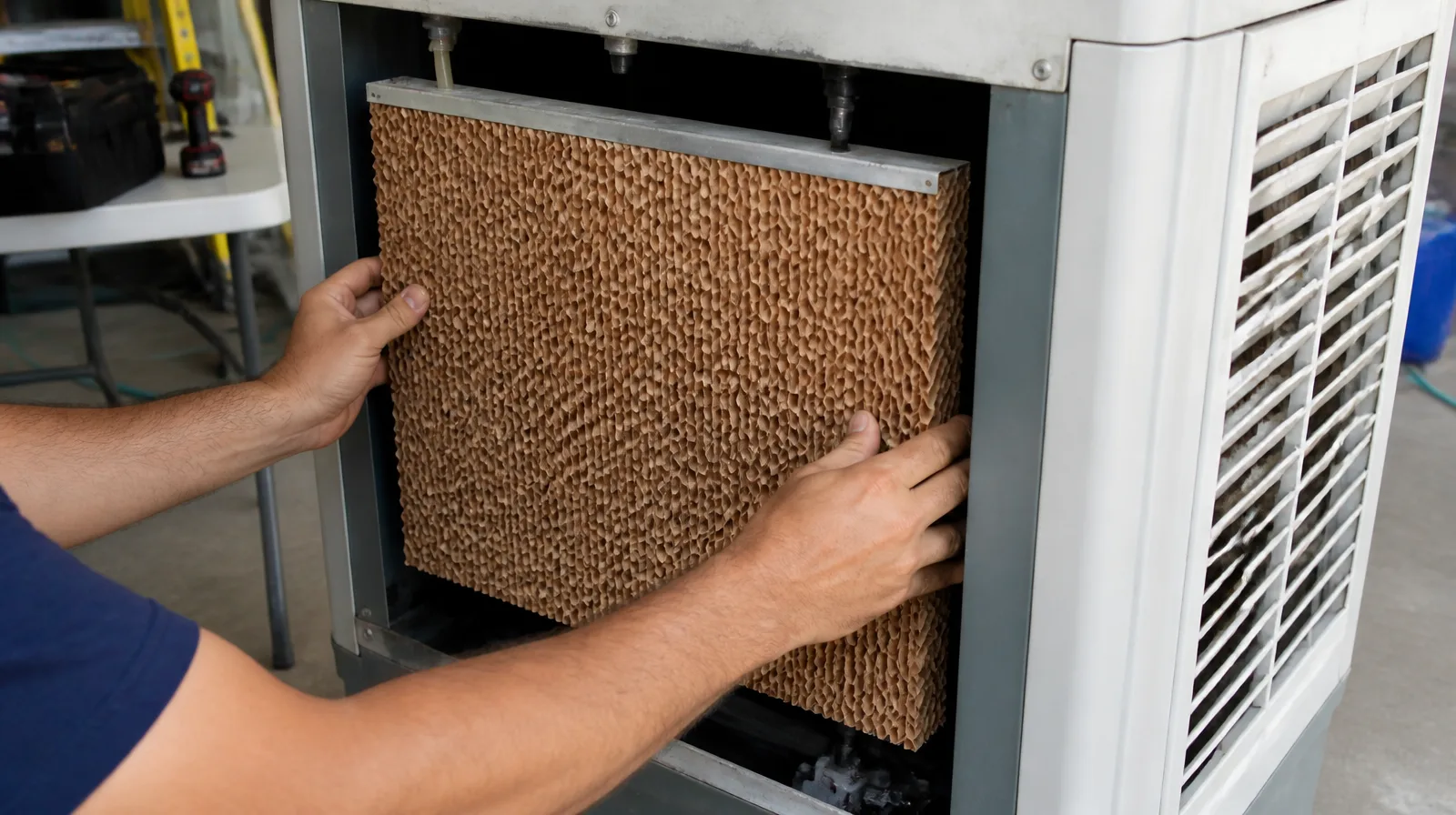
Pads are the only part that wears out on a fixed schedule. Aspen pads are cheap and need replacing often; cellulose honeycomb pads last longer and hold their shape better. On a whole-house unit, plan on two pad changes per season, more if you run the cooler daily in a dusty area. On a portable unit, the cartridge is the same thing at a smaller scale and runs 1 to 3 months depending on use and water hardness.
Here is the full pad swap on a whole-house unit:
- Cut power at the breaker. Water and electricity share this machine, so no shortcuts.
- Drain the reservoir and disconnect the water supply.
- Remove the side panels and pull the old pads from their frames.
- Rinse the scale off the frames and the distributor bar before installing anything.
- Soak the new cellulose pads in a bucket until saturated, then slide them in.
- Refill, reconnect, and run the pump to confirm water reaches the top distributor evenly.
Portable units are easier. The cartridge slides out of the front, you rinse it under cool water, or you replace it outright. The ChillWell 2.0 uses a thin cartridge that I swapped every 4 to 6 weeks during the month I ran it daily, and a fresh one costs a few dollars.
Cost check: a full pad set for a whole-house unit runs $25 to $60. A portable cartridge runs $5 to $15. On both, the labor is under 30 minutes the second time you do it, and it is the single highest-impact maintenance move on the list.
Soak the new pads before you install them. A dry cellulose pad takes a few minutes to saturate from the pump, and during that window the unit blows warm air. A 10-minute soak in a bucket removes the excuse for a slow start.
Pump Not Working: Diagnose and Fix
An evaporative cooler pump is a small electric pump that lifts water from the reservoir to the distributor bar on top of the pads. When it fails, the top of the pads goes dry and warm air comes out the bottom. The pump-not-working diagnosis is a four-step funnel, run in order:
- Power. Confirm the pump is getting electricity. Check the switch, the float switch, and the breaker before you blame the pump itself.
- Water. Is the reservoir full? Pumps run dry and burn out fast, and an empty tank is the classic cause.
- Screen. The intake screen or sump filter clogs with dust and scale first. A 5-minute rinse fixes most “dead” pumps.
- Impeller. Mineral scale can seize the impeller. Soak the pump in white vinegar overnight, then flush it before you spend money on a new one.
The most common outcome is a clogged screen, not a dead motor. In hard-water areas, scale buildup is chronic, which is why the distilled-water advice for portable units and the bleed-off valve on whole-house units exist. They are both doing the same job: keeping minerals from strangling the pump.
Replacement is a $15 to $45 part on a whole-house unit and a 20-minute job. On portable units the pump is often molded into the base, so a failed pump usually means replacing the whole cooler. If you are in that spot with a cheap unit, the repair-vs-replace math a few sections down answers it faster than any manual.
Not Blowing Cold Air: The Airflow Check
“Swamp cooler not cooling” is the search that brings most people here, and it rarely means the machine is dead. Work through these checks before you spend money:
- Is the pad wet top to bottom? Dry streaks mean the pump or distributor is failing, and no amount of fan will help.
- Is the fan blowing at full speed? Compare the output to a clean unit or an earlier memory of this one.
- Is the belt slipping? A loose belt quietly halves the airflow while the motor spins fine.
- Are the windows open? A swamp cooler needs to push air through the house. Shut the windows and the unit pressurizes the rooms and stalls.
- Is the bleed-off working? A blocked bleed-off lets minerals build up and choke the pads from the inside.
On the window point, the researchers at Pacific Northwest National Laboratory’s Building America program recommend 1 to 2 square feet of opening for every 1,000 CFM of cooler output (PNNL evaporative cooling guide). Close them and the unit fights itself, which reads exactly like a “broken cooler” to anyone standing in the warm room.
One more honest check. If the unit is running perfectly and the air still feels weak, read our honest take on whether evaporative coolers actually work. In humid weather above 50 percent relative humidity, a healthy unit produces almost no cooling because evaporation has nowhere to put the moisture. Sometimes the problem is your climate, not your machine, and no repair fixes that.
Airflow, not temperature, is the first thing to fix. Check that the fan spins freely and fast before you buy any part. In my testing, more than half of the “not cooling” reports trace to airflow, not the pump or the pads.
When the Motor Is Beyond Repair
Some failures are worth walking away from. A blower motor that grinds, smells of burnt wire, or refuses to spin is a bigger job than a pump or a belt. The motor itself runs $80 to $150 on a whole-house unit, and a contractor adds labor on top. The bearings are the usual culprit, and they are the one part most homeowners do not rebuild themselves.
When do you call it? When the motor price meets an old unit, the math gets ugly fast. On a portable unit, a dead fan motor is the end of the line entirely, since nothing inside a $90 cooler is meant to be rebuilt. If you are staring at a $120 motor swap on a 12-year-old unit, the honest answer is that a new cooler, or a plug-in portable, is the smarter spend. The BlizzAir we reviewed costs about what a single motor job runs, needs no ducting and no install, and cools a room on its own (BlizzAir Portable AC review).
Repair vs Replace: The Real Cost Math
Run the numbers before you touch anything, because the decision is rarely emotional once you see the table. Here are the real part costs I have seen this season, matched against the replacement value of the unit they live in.
| Repair | Typical part cost | Worth it? |
|---|---|---|
| New pump | $15 to $45 | Yes, on any unit under 8 years old |
| New pads | $25 to $60 | Yes, that is routine, not repair |
| Blower belt | $10 to $25 | Yes, cheap and fast |
| Float valve / bleed-off | $15 to $30 | Yes, prevents bigger failures |
| Blower motor | $80 to $150 | Only if the unit is otherwise solid |
| New whole-house cooler, installed | $300 to $1,500 | The baseline you compare against |
My rule of thumb is a 40 percent line: if any single repair costs more than 40 percent of what a new unit costs, and the unit is older than 8 years, replace it. If the frame is rusted, the distributor is corroded, or the pads keep failing, replace it. If the unit is under 5 years old and the repair is under $60, fix it every time. On the portable side the math is even starker: a $90 cooler with a clogged pump is a $5 screen and 20 minutes, but the same cooler with a dead fan motor is a $90 brick.
You also pay repair costs in air. A half-fixed swamp cooler runs up your water bill and blows tepid air all season, and the worst financial move is a string of $80 repairs on a unit worth $400. Replace once, enjoy the summer.
Portable Units vs Whole-House Swamp Coolers
The maintenance difference between the two scales is the whole reason most people pick a portable in the first place. A whole-house unit is a small machine: pads twice a season, a belt, a pump, a bleed-off valve, a supply line, and a drain you flush. A portable evaporative cooler is a fan, a cartridge, and a tank. A tankless heat-exchange portable like the BlizzAir is even simpler, with no water at all.
The ChillWell 2.0 shows the portable routine in its purest form. During the month I ran it daily, the 550ml tank needed topping every couple of hours on high speed, I emptied and air-dried the tank every evening to keep mildew out, and I rinsed the cartridge weekly. Use distilled water in hard-water areas or the mister clogs with mineral scale, and a white vinegar soak once a month keeps the tank clear. The cartridge is a $5 to $15 part every 1 to 3 months. That is the entire maintenance list.
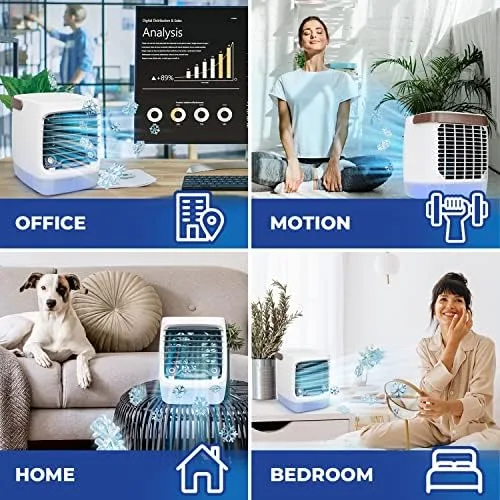
The BlizzAir is the other extreme. It has no tank, no cartridge, and no water to manage. The only maintenance in my three weeks of testing was wiping the intake vents with a dry microfiber cloth every couple of weeks, the same dust routine any fan needs. That is the strongest maintenance argument for a tankless portable: the whole evaporative chore list disappears, and you are left with a plug-in unit that just runs.
If you want to see a full month of the portable maintenance routine documented day by day, my ChillWell 2.0 review logs the tank, cartridge, and battery numbers across every session.
Verdict
A working swamp cooler is a cheap machine, and a neglected one is a money pit. Pads, pump, and airflow solve nine out of ten problems, and all three are weekend jobs for under $100 in parts. The rest is judgment: spend on repairs only when the unit is young and the part is cheap, and replace when the motor, frame, or age says the well is dry.
The fundamentals worth prioritizing:
- Water is the whole system. A dry pad blows warm air, and an empty reservoir burns out the pump.
- Pads are consumables. Budget for two changes a season on whole-house units, one cartridge every 1 to 3 months on portables.
- Airflow first. Check fan speed and open the windows before you buy a single part.
- Run the 40 percent rule. One repair over 40 percent of replacement value on an old unit means buy new.
- Portables shrink the chore list. A cartridge swap, or nothing on a tankless unit, beats the whole-house drill.
Common Questions & Answers
Q: How often should I clean my evaporative cooler?
Flush the reservoir and rinse the intake screen monthly, check the pump flow and belt weekly during heavy use, and do a full deep clean once a year before the season starts. Portable units need the tank emptied and air-dried daily to prevent mildew.
Q: How often do swamp cooler pads need replacing?
Whole-house units need two pad changes per season, and monthly if you run the cooler continuously in a dusty area. Portable units need the cartridge replaced every 1 to 3 months depending on use and water hardness.
Q: Why is my swamp cooler not blowing cold air?
Work through the airflow check in order: a dry pad (pump or distributor failing), a loose belt or slow fan, closed windows, then humidity. If the unit is healthy and running right but the air still feels weak, your climate is probably too humid for evaporative cooling.
Q: Why is my evaporative cooler pump not working?
Most pump failures are one of four things: no power reaching the pump, an empty reservoir, a clogged intake screen, or a seized impeller from mineral scale. Clean the screen and soak the pump in white vinegar before you buy a replacement.
Q: How much does evaporative cooler repair cost?
Pump replacement runs $15 to $45, a full pad set $25 to $60, a blower belt $10 to $25, and a blower motor $80 to $150 for the part. Contractor labor adds more on whole-house units. Most of the work is a DIY job.
Q: Should I repair or replace my swamp cooler?
Fix it if the unit is under 8 years old and the repair is less than 40 percent of a new unit's cost. Replace it if the repair is bigger than that, the frame or distributor is corroded, or the motor is dead on a portable unit, which is never worth rebuilding.
Q: Why does my swamp cooler smell?
Stagnant water, moldy pads, or mineral buildup. Run the fan with the water off to dry the pads, replace them if they are old, and flush the reservoir with a white vinegar rinse. A musty unit left sealed all winter will smell worse in spring.
Q: Do portable evaporative coolers need maintenance?
Yes, but less than a whole-house unit. Refill the tank as it runs, empty and air-dry it daily to stop mildew, rinse the cartridge weekly, and replace it every 1 to 3 months. Use distilled water in hard-water areas so the mister does not clog. Tankless units like the BlizzAir need only vent wipes.
Q: Can a swamp cooler pump be repaired?
Often yes. Clear the intake screen, free the impeller, and soak the pump in white vinegar overnight to dissolve scale. If it still will not move water after a clean, a replacement runs $15 to $45 and takes about 20 minutes on a whole-house unit.
Q: How do I store a swamp cooler for winter?
Drain the reservoir completely, run the fan with the water off for 20 minutes to dry the pads, flush the tank with vinegar, and cover the unit. Never seal a wet unit away, or you will open a moldy one in spring.
More Smart Home Guides
Related Product Reviews

Smart home enthusiast and IoT specialist. Has automated over 50 homes across different ecosystems. Former smart home consultant for Google Nest and Amazon Alexa. Passionate about making technology accessible.