
In This Article
- TL;DR
- Why Gas Station Air Pumps Fail You
- Method 1: Cordless Portable Inflator (The Glove Box Solution)
- How It Works
- Step-by-Step: Using a Cordless Inflator
- Real-World Performance
- When to Choose This Method
- Method 2: 12V Compressor (The Cigarette Lighter Solution)
- How It Works
- Step-by-Step: Using a 12V Compressor
- Real-World Performance
- When to Choose This Method
- Method 3: CO2 Cartridge Inflator (The Emergency Pocket Fix)
- How It Works
- Step-by-Step: Using a CO2 Cartridge Inflator
- Real-World Performance
- When to Choose This Method
- Method 4: Foot Pump (The Zero-Power Option)
- How It Works
- Step-by-Step: Using a Foot Pump
- Real-World Performance
- When to Choose This Method
- Which Method Should You Actually Use?
- How to Find Your Target PSI (Before You Inflate)
- Common Mistakes When Inflating Without a Station
- Building a Tire Inflation Kit That Actually Works
- What Actually Matters
TL;DR
- Quickest method: A cordless portable inflator like the Airmoto tops off a tire in 5-7 minutes and lives in your glove box. No cords, no coins, no gas station.
- Fastest from flat: A 12V compressor plugged into your cigarette lighter fills faster and never runs out of battery while the engine runs.
- Best emergency backup: CO2 cartridge inflators are tiny and instant but limited in volume. Good for bikes and temporary car fixes.
- Zero-power option: A foot pump works anywhere but takes real effort on car tires.
- Our pick: For most drivers, a cordless inflator is the best balance of speed, convenience, and readiness. Check today’s deal on the Airmoto.
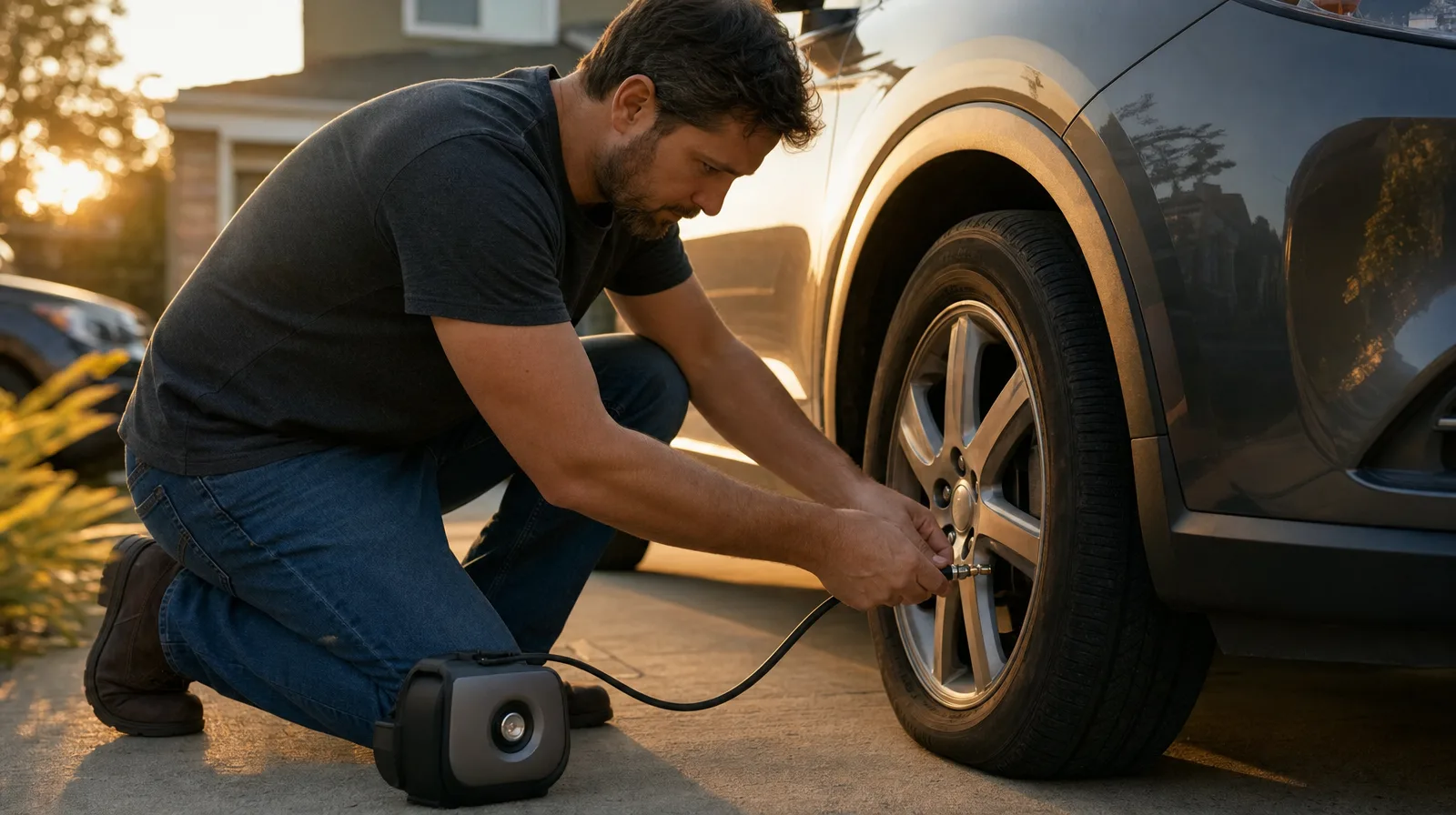
Every driver eventually faces the same moment. The tire pressure light glows on the dashboard, and the nearest gas station with a working air pump is either broken, coin-only, or ten minutes away. You can limp there, feed in quarters, and wrestle with a stiff hose that smells like rubber and regret. Or you can skip the whole thing.
Inflating a tire without a gas station is not complicated. You just need the right tool and five minutes. We tested four methods that work away from station air, ranked them by speed, cost, and convenience, and built this guide to help you pick the one that fits how you actually drive. This is part of our smart gadgets coverage, where we test everyday carry tools under real conditions.
The short version: a cordless portable inflator wins for most people. It’s the smallest, simplest way to handle tire pressure on your own terms. If you want the full breakdown of each method, including step-by-step instructions and honest timing, read on.
Why Gas Station Air Pumps Fail You
Before we get into the methods, it helps to understand why you’re looking for alternatives in the first place.
Gas station air pumps are unreliable. A 2023 survey by the American Automobile Association found that roughly one in four public air pumps is either broken or inaccurate. In many areas, the working ones are coin-operated, charging $1.50 to $2.00 per session, and the hoses are stiff, the nozzles are worn, and the gauges are analog and hard to read in the dark.
The real cost is not the coins. It is the time. You drive to the station, wait for someone to finish, feed in quarters, check the pressure, realize you underfilled, feed in more quarters, and drive home. For a task that takes five minutes with the right tool, the gas station version burns fifteen to twenty minutes of your day.
The U.S. Department of Energy notes that keeping tires at the correct pressure improves fuel economy by up to 3% and extends tire life significantly. The habit matters, and the tool you use determines whether you actually do it monthly or keep putting it off.
A portable inflator removes the friction. You check pressure in your driveway, inflate to the right number, and move on. No station, no coins, no waiting.
Method 1: Cordless Portable Inflator (The Glove Box Solution)
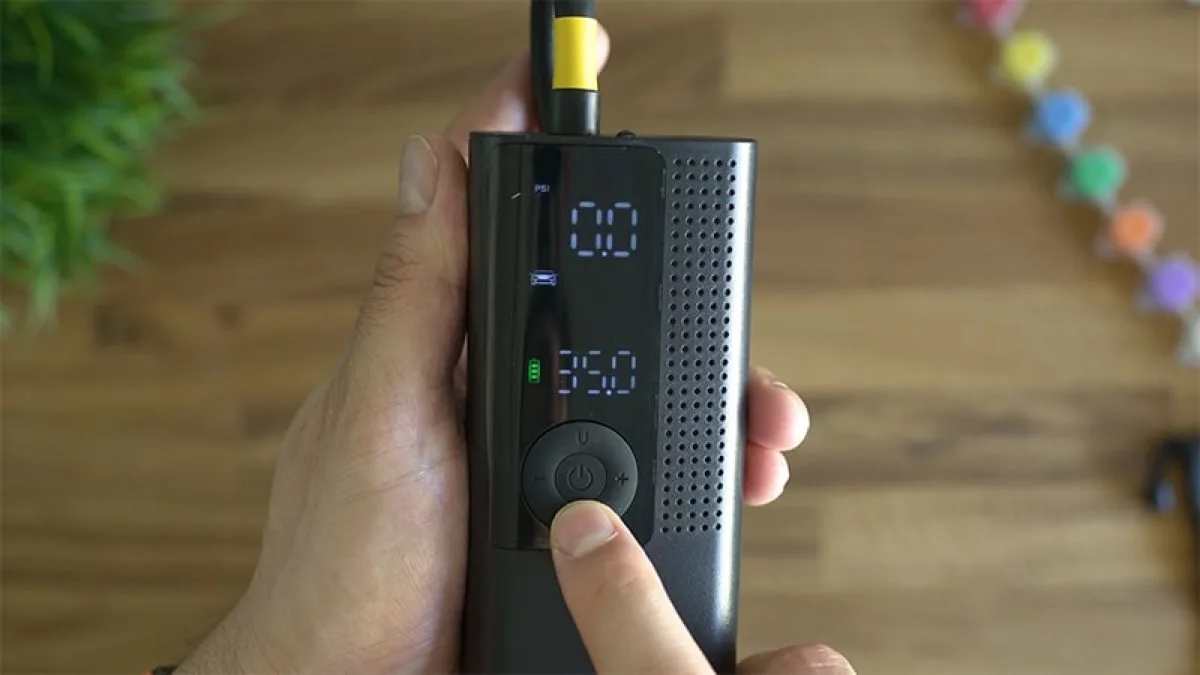
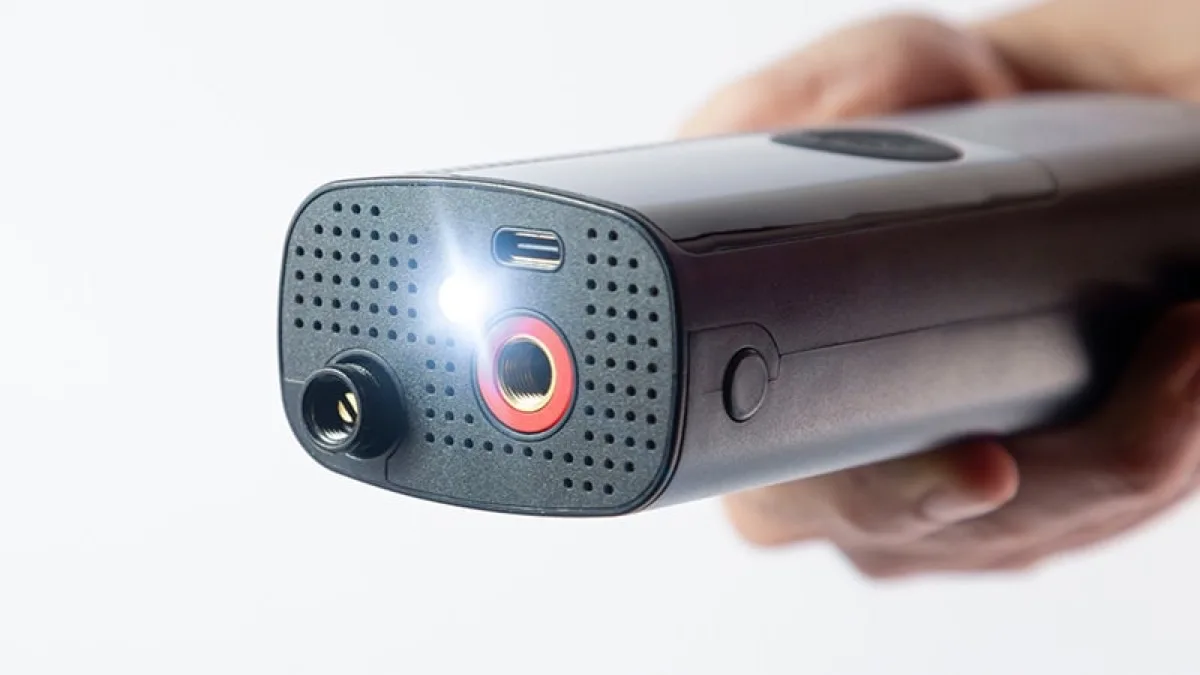
A cordless portable inflator is a battery-powered pump about the size of a large power bank. You charge it over USB-C, connect the hose to your tire valve, set your target PSI on a digital screen, and press start. The pump runs until it hits the number, then shuts off automatically. No cords, no socket, no gas station.
How It Works
Inside the unit, a small motor drives a piston that compresses air into a chamber and forces it through a flexible hose into the tire. An internal pressure sensor reads the tire’s level the moment you connect, shows it on the backlit display, and tracks it live as the pump runs.
The auto shut-off feature is what makes the whole thing feel modern. Set 35 PSI, walk away, and it stops at 35. No staring at a gauge, no risk of over-inflation. This is the single most praised feature across every portable inflator review we have read, and our own hands-on testing confirms it. The Airmoto hit the mark every time, with only minor overshoot on rare cycles.
Step-by-Step: Using a Cordless Inflator
- Charge the unit fully. A full charge from empty takes roughly 2.5 to 3 hours over USB-C. Keep it topped monthly so it is ready when the light comes on.
- Pull the hose from the storage compartment. Most cordless inflators store the hose in a bottom compartment. Pull it out until it stops.
- Thread the connector onto the tire valve. For car tires, use the Schrader connector directly. For road bikes, swap to the Presta adapter.
- Power on and set your target PSI. Hold the power button for three seconds. Use the plus and minus buttons to dial in the number from the door jamb sticker. Add 0.5-1 PSI if your gauge tends to read low.
- Press start and walk away. The pump runs and stops on its own. A routine top-off of 8-10 PSI takes about 5-7 minutes.
- Verify with a separate gauge and replace the valve cap. Cross-check the pressure, then screw the valve cap back on.
Real-World Performance
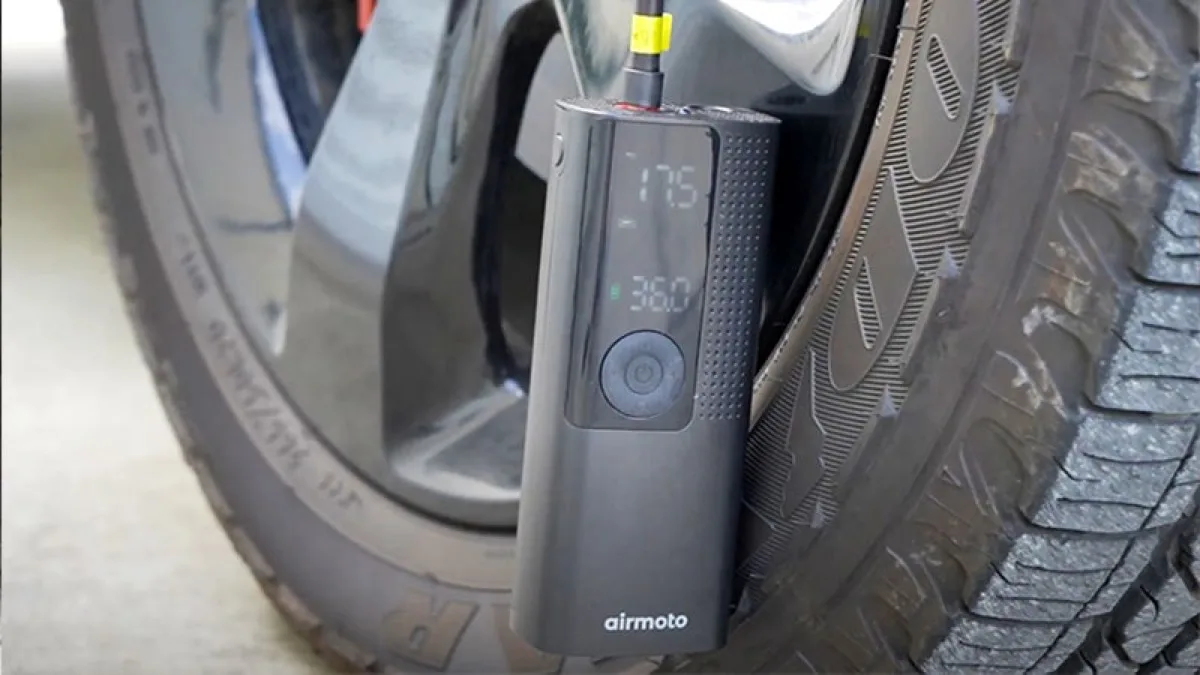
In our four-week test of the Airmoto, we topped off four sedan tires from 28 to 35 PSI, timing each cycle and tracking battery drain. Each tire took 5-7 minutes. The auto shut-off landed within 1 PSI of target every time. Four top-offs dropped the battery from full to roughly half, meaning a full charge comfortably handles a seasonal pressure reset on all four corners.
A completely flat car tire is a different story. Our sedan, started at a soft 18 PSI and brought to 35, took about 12 minutes and used close to a third of the battery. Owner videos and independent testers show fully flat car tires running 15 to 26 minutes, and at least one flat SUV tire drained the battery before reaching pressure.
The lesson: keep the inflator charged, and treat a flat tire as a one-tire job per charge.
When to Choose This Method
A cordless inflator is the best all-around choice for daily drivers, commuters, cyclists, and anyone who wants tire pressure maintenance without leaving the driveway. It handles top-offs brilliantly, manages from-flat fills adequately, and fits in a glove box. The trade-off is speed on big jobs and a battery that needs recharging.
For a deeper look at how this category performs, our portable tire inflator buying guide breaks down PSI, battery life, and gauge accuracy across brands. And if you want a head-to-head comparison of the top cordless options, our Auto Air review covers another strong contender in this class.
Method 2: 12V Compressor (The Cigarette Lighter Solution)
A 12V compressor plugs into your car’s cigarette lighter or 12V accessory socket and draws power directly from the vehicle’s electrical system. No battery to drain, no recharging, no cordless limits. The trade-off is the cord and the bulk.
How It Works
The mechanism is the same as a cordless inflator, a small motor drives a piston to compress air, but the power comes from the car instead of an internal battery. This means the pump runs as long as the engine is on, never runs out of juice mid-fill, and fills faster because it can draw more current than a small lithium cell provides.
Most 12V compressors are larger than cordless units, about the size of a small toolbox, and live in the trunk rather than the glove box. They typically include a longer hose, which makes reaching valve stems easier, and many have an LED light for nighttime use.
Step-by-Step: Using a 12V Compressor
- Start the car. The compressor draws significant power. Running it with the engine off can drain your car battery.
- Plug the 12V adapter into the cigarette lighter socket. Make sure the connection is snug. A loose plug causes intermittent power loss mid-fill.
- Uncoil the hose and connect it to the tire valve. Most 12V units have a longer hose than cordless inflators, which gives you more flexibility on valve positioning.
- Set the target PSI. If the unit has a digital display and auto shut-off, set it and walk away. If it has an analog gauge, you will need to monitor it manually.
- Run the compressor and watch the gauge. The fill is faster than a cordless unit. A routine top-off takes 3-5 minutes. A flat tire takes 8-15 minutes depending on tire size.
- Disconnect, stow the hose, and remove the adapter from the socket. Do not leave the adapter plugged in with the engine off, as it draws a small parasitic current.
Real-World Performance
A 12V compressor fills noticeably faster than a cordless unit because it draws more power. The AstroAI 12V, a popular budget option at roughly $30-40, handles routine top-offs in 3-5 minutes and from-flat fills in 8-15 minutes. The EPAuto 12V, another common pick at a similar price, performs comparably.
The key advantage is sustained runtime. You can fill all four tires from flat without worrying about battery life, which is something no cordless unit under $100 can match. The key disadvantage is dependency: you need a working 12V socket, the cord reaches only so far, and the unit takes up trunk space that a cordless inflator does not.
When to Choose This Method
A 12V compressor is the right pick if you prioritize speed and unlimited runtime over portability. It is ideal for drivers who always inflate near the vehicle, who need to fill multiple tires in one session, or who want the fastest possible fill without worrying about battery math. It is less ideal for cyclists, commuters who want a glove-box backup, or anyone who needs to inflate away from the car.
The AstroAI 12V is our recommended budget pick in this category. It is fast, reliable, and affordable.
Method 3: CO2 Cartridge Inflator (The Emergency Pocket Fix)
A CO2 cartridge inflator uses compressed carbon dioxide stored in a small threaded cartridge. You screw the cartridge into an inflator head, attach the head to the tire valve, and release the gas. It is fast, tiny, and requires zero power. The limitation is volume.
How It Works
Each CO2 cartridge holds a fixed amount of gas at high pressure, typically 16g or 20g. When you puncture the cartridge by tightening it into the inflator head, the gas rushes through the hose and into the tire. A single 16g cartridge can add roughly 2-4 PSI to a standard passenger car tire, depending on tire size and starting pressure. A 20g cartridge adds slightly more.
The process takes seconds, not minutes. But the gas is limited. For a bicycle tire at 40-60 PSI, a single cartridge gets you close to target. For a car tire, you will need multiple cartridges or accept a partial fill that gets you to the nearest air source.
Step-by-Step: Using a CO2 Cartridge Inflator
- Screw the cartridge into the inflator head. The head has a puncture pin that pierces the cartridge seal when you tighten it. Do this after the head is connected to the tire, or you will lose gas.
- Connect the inflator head to the tire valve. Most CO2 inflators use a universal chuck that fits Schrader valves. For Presta valves, use the included adapter.
- Open the valve or trigger the release. Depending on the design, you either turn a knob or press a trigger. The gas flows fast. A bicycle tire inflates in 5-15 seconds. A car tire takes longer and may not reach full pressure.
- Check the pressure immediately. CO2 cools as it expands, and the cold gas can give a temporarily low reading. Wait 30 seconds, then check with a gauge.
- Replace the valve cap. CO2 can dry out rubber valve seals over time, so do not leave the cartridge connected long-term.
Real-World Performance
CO2 inflators shine for cyclists. A road bike tire at 80 PSI inflates in about 10-15 seconds with a single 16g cartridge. The entire kit, head plus two cartridges, weighs under 4 ounces and fits in a jersey pocket or saddle bag.
For car tires, the math is less favorable. A standard passenger tire at 32 PSI needs roughly 200 liters of air to go from flat to full. A 16g CO2 cartridge holds about 8 liters at atmospheric pressure. That means you need many cartridges to fill a car tire, which makes this method impractical for anything beyond a temporary top-off to reach a proper air source.
The learning curve is real. The cartridge gets extremely cold during discharge, which can cause frostbite on bare hands. Wear gloves or use the insulated sleeve that some kits include. And once you puncture a cartridge, you cannot reuse it. Each one is single-use.
When to Choose This Method
A CO2 cartridge inflator is the best emergency backup for cyclists and the best ultra-light option for anyone who needs to get moving fast with minimal gear. It is not a primary inflation method for car tires. Think of it as a bridge to the nearest air source, not a replacement for a compressor.
Method 4: Foot Pump (The Zero-Power Option)
A foot pump is the simplest inflation method that exists. No battery, no cord, no cartridges, no power source at all. You step on a pedal, it pushes air through a hose, and the tire fills. The trade-off is effort.
How It Works
A foot pump uses a piston driven by a foot pedal. Each downward stroke compresses air and pushes it through the hose into the tire. Most foot pumps have a built-in analog gauge on the body, and some include a lock to hold the pedal down for hands-free operation.
The volume per stroke is small, typically 1-2 liters, which means a car tire takes a lot of steps. A bicycle tire takes fewer strokes because the tire volume is smaller. The physical effort is real but manageable for short inflation sessions.
Step-by-Step: Using a Foot Pump
- Position the pump on flat ground near the tire. Make sure the pump is stable and the hose reaches the valve without straining.
- Connect the hose to the tire valve. Most foot pumps include a universal chuck that fits Schrader valves. Some include a Presta adapter for bikes.
- Unlock the pedal if it has a lock mechanism. Some pumps ship with the pedal locked for storage.
- Step on the pedal rhythmically. Use smooth, full strokes. Each stroke pushes a small amount of air. A car tire at 32 PSI takes 200-400 strokes depending on tire size and starting pressure.
- Watch the gauge and stop at your target PSI. The analog gauge on most foot pumps is less precise than a digital reading, so check with a separate gauge when you finish.
- Disconnect the hose and replace the valve cap.
Real-World Performance
A foot pump is slow by any measure. Inflating a standard car tire from flat to 32 PSI takes roughly 5-10 minutes of continuous pumping, depending on your pace and the pump’s volume per stroke. For a bicycle tire, the effort is more reasonable, 2-3 minutes to reach 60 PSI on a mountain bike.
The upside is reliability. A foot pump works anywhere, needs no power, and never runs out of battery or gas. It is the inflation method that will always work as long as you have two legs and the pump. The downside is that it is exhausting for car tires, and most people do not want to work up a sweat before their morning commute.
Quality varies widely. A $15 foot pump from a hardware store may have a flimsy gauge and a wobbly base. A $30-50 pump from a cycling brand like Lezyne or Topeak has a solid gauge, a stable base, and a hose long enough to reach awkward valve positions.
When to Choose This Method
A foot pump is the right pick for cyclists who want a reliable zero-power option, for campers and overlanders who need to inflate without electricity, and as a backup alongside a primary electric method. It is not practical as a primary inflation method for car tires unless you have no other option.
Which Method Should You Actually Use?
The right method depends on your situation. Here is a quick decision matrix.
| Situation | Best Method | Why |
|---|---|---|
| Daily driver, want convenience | Cordless inflator | Glove box storage, no cords, auto shut-off |
| Need fast fills, always near the car | 12V compressor | Faster, unlimited runtime while engine runs |
| Cyclist, need ultra-light backup | CO2 cartridges | Weighs nothing, inflates in seconds |
| Camping, zero-power emergency | Foot pump | Works anywhere, no batteries or gas |
| Multiple flat tires in one session | 12V compressor | Sustained power without battery limits |
| Senior or new driver, simplicity matters | Cordless inflator | Set target, press start, walk away |
| Budget is the top priority | Foot pump or 12V compressor | $15-40 vs $45-80 for cordless |
The pattern is clear. A cordless inflator covers the most situations for the average driver. A 12V compressor is the power pick. CO2 and foot pumps serve specific niches.
If you are buying your first portable inflator, start with a cordless unit. The Airmoto is our top pick for its balance of size, ease of use, and auto shut-off reliability. It is not the fastest from flat, and the battery has limits, but for everyday tire maintenance it is the tool you will actually keep in the car and actually use.
How to Find Your Target PSI (Before You Inflate)
Every method on this list needs the same starting point: the right number.
Your car’s recommended tire pressure is not on the tire sidewall. That number is the maximum the tire can safely hold, not what your vehicle wants. The correct pressure is printed on a sticker inside the driver’s door jamb, in the glove box, or in the owner’s manual. It is usually given as two numbers, one for front tires and one for rear.
Most passenger cars need 30-35 PSI. Most SUVs and light trucks need 32-38 PSI. Check the sticker, not the tire.
Bike tires are different. The number on the tire sidewall is the actual target, not a maximum. Road bike tires typically run 80-110 PSI, mountain bikes 30-50 PSI. The inflator’s max PSI rating needs to exceed your target, but for most personal vehicles 120 PSI is more than enough.
Check pressure when tires are cold, before you have driven more than a mile. Heat from driving bumps the reading several pounds and throws off your target. A monthly check, or a check before long trips, is the habit that makes any portable inflator worth owning.
Common Mistakes When Inflating Without a Station
Inflating to the sidewall number. This over-inflates the tire, makes the ride harsh, reduces traction, and wears the tire unevenly. Always use the door jamb sticker.
Not checking with a separate gauge. Built-in gauges on portable inflators read within 1-3 PSI of a standalone gauge, but the direction of the error varies by brand. Cross-check with a $5-10 digital gauge for peace of mind.
Ignoring heat buildup. Small compressors get warm during long fills. After a 15-20 minute from-flat run, let the unit cool for 5 minutes before starting the next tire. Forcing a marathon fill shortens the motor’s life.
Leaving the inflator uncharged. Lithium-ion batteries slowly lose charge when sitting. A monthly top-up keeps it ready. The worst time to discover a dead battery is when the tire pressure light comes on.
Skipping the valve cap. The valve cap keeps dirt and moisture out of the valve core. A clogged or corroded valve causes slow leaks that no inflator can fix permanently.
Using CO2 for car tires without knowing the limits. A single cartridge adds only a few PSI to a car tire. It is a temporary fix, not a fill. Know the volume math before you rely on it.
Building a Tire Inflation Kit That Actually Works
The best tire inflation setup is not one tool. It is a small kit you keep in the car and never think about until you need it.
The core: A cordless portable inflator, charged monthly. This handles 90% of tire pressure needs. Our pick is the Airmoto for its size, auto shut-off, and glove-box fit.
The backup: A standalone digital tire gauge, $5-10, to cross-check the inflator’s reading. The inflator’s gauge is close enough for everyday use, but a separate gauge eliminates uncertainty.
The insurance: A 12V compressor or a CO2 cartridge kit if you travel far from help. The 12V compressor handles repeated fills. The CO2 kit is lighter for cyclists and hikers.
The extras: A small flashlight or headlamp for nighttime fills, even if the inflator has an LED. A pair of gloves for CO2 cartridge use. A ziplock bag for adapters so they do not vanish into the glove box void.
Total cost for a solid kit: $50-90 for the cordless inflator, $5-10 for a gauge, and $15-40 for a backup 12V or CO2 kit. Under $150 for complete independence from gas station air.
Our portable tire inflator guide walks through the specs that matter when choosing each piece.
What Actually Matters
You do not need the most expensive inflator or the highest PSI rating. You need a tool you keep charged, that fits where you will actually store it, and that handles the tires you actually drive on.
The fundamentals:
- Auto shut-off is non-negotiable. It prevents over-inflation and lets you walk away. Any inflator without it is a worse tool.
- Charge it monthly. A dead inflator is an expensive paperweight. A monthly top-up takes ten seconds and keeps it ready.
- Know your target PSI. The door jamb sticker, not the tire sidewall. Check it once and write it on a sticky note in the glove box.
- Keep a separate gauge. The built-in gauge is close enough for daily use. A standalone gauge is the tiebreaker.
- Match the method to your life. Daily driver? Cordless. Road warrior? 12V backup. Cyclist? CO2 for the jersey pocket.
Everything else is marketing. The right tool is the one you have with you when the light comes on. For most people, that is a cordless inflator tucked in the glove box, charged and forgotten until the moment it matters.
Start with a cordless inflator. Keep it charged. You will handle the next low tire in your driveway instead of hunting for a working pump at 7 a.m.
Common Questions & Answers
Q: How do you inflate a tire without a gas station?
Use a portable cordless inflator, a 12V compressor that plugs into your cigarette lighter, a CO2 cartridge inflator, or a manual foot pump. Each method works without external power or station air.
Q: Can you inflate a car tire with a portable inflator?
Yes. Cordless inflators like Airmoto handle top-offs in 5-7 minutes and from-flat fills in 15-26 minutes. They work for passenger cars, motorcycles, bikes, and sports balls.
Q: How long does it take to inflate a tire with a portable inflator?
A routine top-off of 5-10 PSI takes about 5-7 minutes. A completely flat car tire takes 15-26 minutes depending on tire size and battery level.
Q: Is a 12V compressor faster than a cordless inflator?
Yes. A 12V compressor pulls power directly from your car's socket, so it fills faster and never runs out of battery. The trade-off is the cord and the need for a working 12V outlet.
Q: Can a CO2 cartridge inflate a car tire?
Small CO2 cartridges work for bicycle tires and emergency top-offs on very low car tires, but most car tires need more volume than a single cartridge provides. They're best as a temporary fix to get you to a proper air source.
Q: What PSI should I inflate my car tires to?
Check the sticker inside the driver's door jamb. Most passenger cars need 30-35 PSI. Never inflate to the number on the tire sidewall, which is the maximum the tire can hold, not the recommended operating pressure.
Q: How often should I check my tire pressure?
Once a month and before long trips. Tire pressure drops about 1 PSI for every 10 degrees Fahrenheit of temperature change, so seasonal shifts affect pressure even without a leak.
Q: Are gas station air pumps free?
Some are free, others charge $0.50 to $2.00 per session. Many are broken, coin-only, or hard to find working. A portable inflator eliminates the dependency entirely.
Q: Can I use a bicycle pump for car tires?
A standard floor pump can technically fill a car tire, but it takes hundreds of strokes and is exhausting. A foot pump is more practical but still slow. A portable electric inflator is far easier for car tires.
Q: What is the cheapest way to inflate tires without a gas station?
A basic foot pump costs $15-25 and needs no power. A CO2 cartridge kit runs $10-20 for emergencies. Cordless inflators cost $45-80 but save time and effort. The cheapest long-term option depends on how often you need air.
More Smart Gadgets Guides


Related Product Reviews


Consumer electronics reviewer specializing in smart gadgets and everyday tech. Tests 100+ gadgets annually. Previously wrote for The Verge and Wired. Focus on practical daily-use value.