
In This Article
- TL;DR
- Why It Runs But Doesn’t Cool
- Cause 1: Dirty Filter
- Cause 2: Clogged Drain
- Cause 3: Kinked or Too-Long Exhaust Hose
- Cause 4: Undersized BTU for the Room
- Causes 5-8: Temp Sensor, Compressor, Thermostat, Airflow Block
- Cause 5: Faulty Temperature Sensor
- Cause 6: Compressor Trouble
- Cause 7: Thermostat or Mode Set Wrong
- Cause 8: Airflow Block
- When to Stop Troubleshooting and Replace
- The 10-Minute Fix Checklist
- Verdict
Your portable AC is running but not blowing cold air. The fan spins, the compressor hums, the display reads 72°F, and the vent pushes out air that feels like it came off a radiator. The unit sounds healthy. That’s the maddening part, because a dead fan you can diagnose in seconds. A machine that runs fine and cools nothing takes a little digging.
I’ve spent the summer testing portable cooling for GearPuff, including three weeks on a heat-exchange portable AC across a bedroom, an office, and a living room, plus 30 days on a smaller personal evaporative cooler. I’ve also read the service manuals and the government sizing guides, which is where most of these fixes come from. This is the order I’d actually run: 8 causes for a portable AC that runs but doesn’t cool, ranked from the 10-minute free fix to the sign it’s time to replace. Everything else I’ve tested in the space lives under our smart-home coverage.
TL;DR
- Fix the cheap stuff first. A kinked exhaust hose, a dirty filter, or a wrong mode causes most “runs but doesn’t cool” cases.
- The exhaust loop trap: if hot exhaust air dumps back into the same room, the unit cools nothing no matter what else you do.
- Undersized BTU is the top reason a unit runs nonstop and still can’t bring the room down. The sizing rule of thumb is about 20 BTU per square foot.
- When the compressor dies or the unit is past 8 years old, replacement beats repair.
- The two no-hose units I tested skip the exhaust hose, drain, and compressor failure modes entirely.
Why It Runs But Doesn’t Cool
A compressor AC doesn’t make cold. It moves heat. Refrigerant grabs heat from the room air at the evaporator coil, carries it to the condenser, and the exhaust hose pushes that hot air outside. Every bit of heat the room gains has to leave through that hose, which is why the exhaust side of a portable AC is the whole game.
So when the unit runs and nothing cools, what you’re really saying is: heat is moving, but something is breaking the loop. The compressor can be pumping away at full speed while a single kink in the hose keeps all that heat in the room. The filter can be so clogged that the coil never sees enough air to shed heat. The drain can back up and trip the compressor off. These all feel different to troubleshoot, but they share one trait: the unit sounds perfectly fine.
The exhaust loop trap. If the hot air leaving the exhaust hose gets back into the room, the unit works against itself. It keeps pulling warm air, keeps dumping the same warm air back, and the room never drops. You’ll hear it running, see it sweating, and wonder what’s wrong while the thermometer sits stubborn.
That trap is real enough that the big troubleshooting guides list it first. The repair documentation over at Sears walks through the same suspects, and a kinked or disconnected exhaust hose tops the list. Work through the causes below in order, because the first three cost nothing and fix the majority of cases.
Cause 1: Dirty Filter
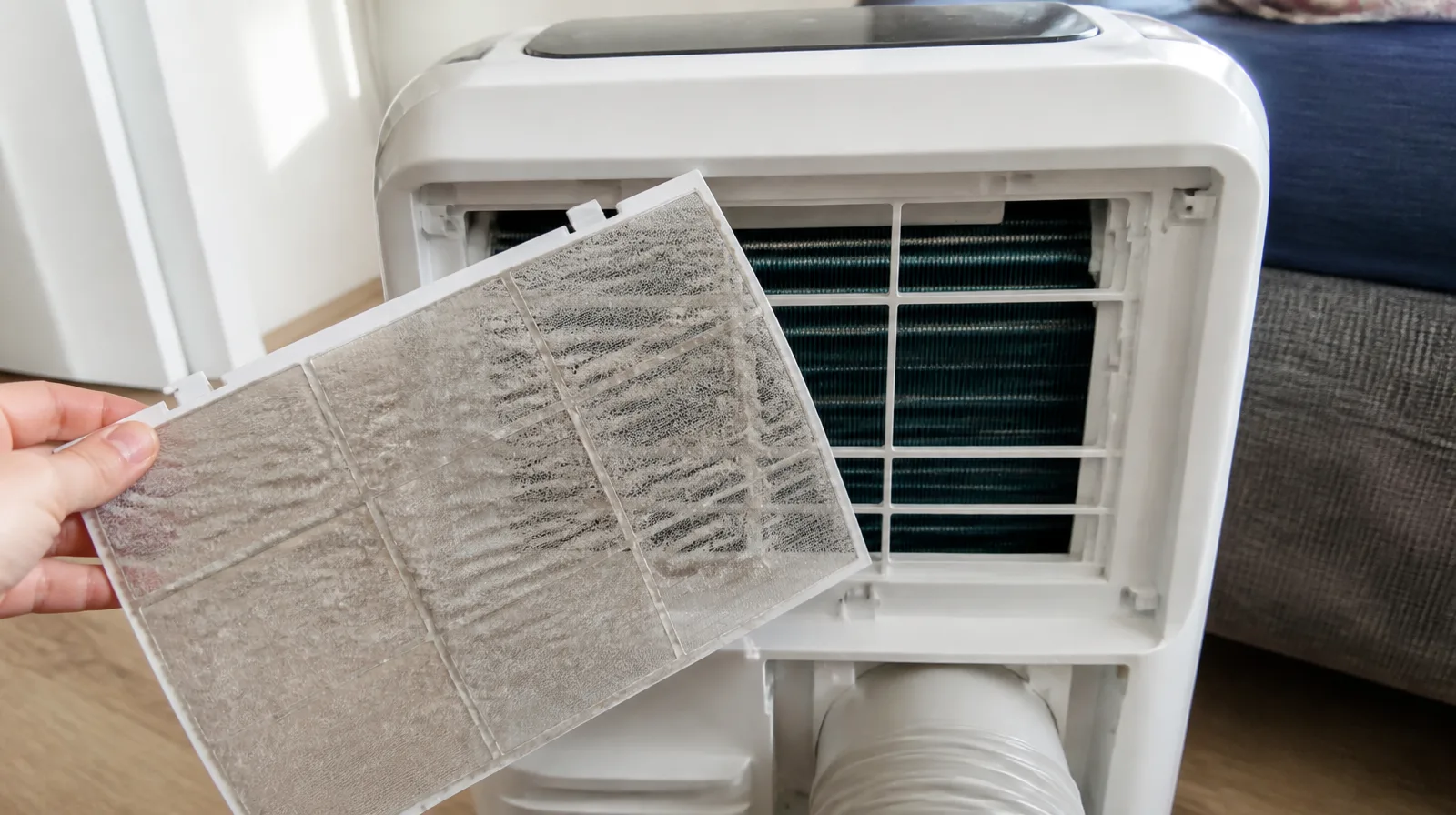
The filter sits in front of the evaporator coil, and its only job is to keep dust off the coil. When it gets clogged, airflow across the coil drops, the coil can’t absorb heat, and the vent blows lukewarm air. This is the most common cause of a portable AC that suddenly “stopped cooling” after a month of daily use.
The fix is a rinse. Turn the unit off, pull the filter (usually behind the front grille or on the top panel), run it under cool water until it runs clear, let it dry completely, and slide it back in. Do not put it back wet, because the moisture carries straight to the coil.
Under heavy use, clean it every two weeks. My BlizzAir testing notes flagged the same habit: a quick pass on the intake vents every fortnight kept airflow strong, and the unit held its temperature. A filter that never gets cleaned turns a fine unit into a warm-air machine in a matter of weeks.
Cause 2: Clogged Drain
A portable AC pulls a surprising amount of moisture out of the air. That condensate collects in a pan or a tray, and if the drain line clogs, the water backs up. Some units shut the compressor off when the pan reads full, which is your warm air. Others let the water sit against the coil and just run worse.
The fix: empty the pan, then clear the drain. A pipe cleaner or a straightened coat hanger usually clears a gunked line in under a minute. Check the pan itself for the mineral scale that builds up in hard-water areas, and wipe it dry before you put it back.
If your unit is leaking or the pan keeps filling, I went deep on the drain mechanics in our portable AC drainage and leaks guide. It covers every leak cause from a clogged line to a kinked hose, and the same fixes apply whether you’re chasing water or chasing warm air.
Cause 3: Kinked or Too-Long Exhaust Hose
The exhaust hose is a long flexible tube, and its whole job is to move hot air out of the room. A kink or a coil in that hose chokes the airflow, the condenser can’t dump heat, and the unit runs hotter and cooler less. An overextended hose does the same thing more quietly: the air has farther to travel, so it slows down before it reaches the window.
The fix is mechanical. Straighten the hose, remove any loops, and shorten it to the minimum length that reaches your window kit. Most units come with an extension hose that you should only use if you actually need it. Two minutes with the hose uncrumpled is the cheapest cooling upgrade you’ll ever make.
Also check where the hose exits. If the window kit is loose or the seal is broken, hot outside air pours back in alongside the exhaust. The gap should be sealed, because that leak bypasses everything the unit just did.
Cause 4: Undersized BTU for the Room
This is the one that feels like a broken unit but isn’t. A portable AC with too few BTU for its room runs continuously, never cycles off, and never catches up. The compressor does its job, the coils shed heat, and the room still sits 5 degrees too warm. Nothing is broken. The machine is just outmatched.
The sizing rule of thumb is about 20 BTU per square foot, and ENERGY STAR hammers the same point: an oversized unit wastes energy, and an undersized one never gets comfortable. A 500 square foot room wants roughly 10,000 BTU. My 8,000 BTU window unit handled a 200 square foot office easily, but I’d never point it at the living room.
Two things worth noting before you throw money at a bigger unit. First, bigger usually means more to run, and I broke down the real electricity math in our portable AC running costs breakdown. Second, not every portable cooler plays the BTU game. A no-hose evaporative unit like the ChillWell 2.0 has no compressor and no BTU rating, and it tops out as a personal cooler within a few feet. If your room truly needs a big BTU count, you need a machine that actually moves that much heat.
Causes 5-8: Temp Sensor, Compressor, Thermostat, Airflow Block
The first four causes cover most cases. The next four are where things get deeper, so I grouped them. Each has a specific fix, and each is worth checking before you declare the unit dead.
Cause 5: Faulty Temperature Sensor
The temperature sensor, a small thermistor near the intake, tells the thermostat when the room has reached the target. When it gets dirty or drifts, it reads warm air as cold. The unit thinks the room is at 68°F, so it throttles the compressor back or cycles it off. Your fix: locate the sensor (usually near the front grille), wipe it clean, and make sure nothing is sitting on top of it. A lamp or a TV within a foot of the intake can heat the sensor and trick the whole unit.
Cause 6: Compressor Trouble
If the compressor is failing, you’ll hear it. The unit clicks on, the compressor hums for a few seconds, then clicks off, over and over. That short cycling is the classic signature of an overheating compressor or a unit low on refrigerant. Neither is a home fix. Compressor work needs a tech, and the sealed refrigerant systems in portable units are rarely worth opening.
One thing you can try before calling anyone: pull the filter and the drain pan, run the unit for 20 minutes, and listen again. A compressor that trips on thermal protection because airflow is choked will settle down once the unit breathes. If it still short cycles after a clean, deep-clean, and a straight exhaust hose, that’s a compressor on its way out, not a cleaning problem. Log the cycle pattern over an hour, because a tech will ask you exactly how often it clicks off.
Cause 7: Thermostat or Mode Set Wrong
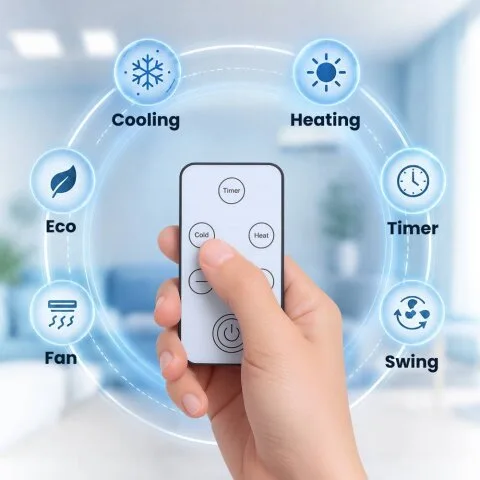
This one is embarrassing when you find it, and I’ve done it. The unit is in Fan mode instead of Cool, or the target temperature is set higher than the room actually is. A portable AC set to 75°F on a day the room is already 74°F has nothing to do. Check the mode, check the setpoint, and give the unit a minute to respond.
Cause 8: Airflow Block
Portable ACs pull air through the back and sides. Push the unit flush against a wall or bury it in a corner, and the intake starves. The fix is clearance: 4 to 6 inches behind and on both sides. Also clear anything stacked on top of the unit, because the exhaust from the vents needs room too. This is the same placement advice I gave in the BlizzAir setup notes, and it applies to every portable cooler I’ve tested.
Here’s the whole map at a glance, so you can match your symptom to the fix in one pass.
| Symptom | Likely cause | The fix |
|---|---|---|
| Runs but blows lukewarm air | Dirty filter | Rinse filter, dry, reinstall |
| Water pooling, compressor cuts out | Clogged drain | Clear drain line, empty pan |
| Runs nonstop, room never cools | Undersized BTU | Recheck sizing, close the room |
| Short cycles on and off | Compressor or sensor | Clean sensor, call a tech for the compressor |
| Blows cold air at vent but room stays warm | Exhaust loop | Straighten hose, seal window kit |
| Runs but never engages cold | Wrong mode or setpoint | Switch to Cool, lower the target |
When to Stop Troubleshooting and Replace
You’ve cleaned the filter, cleared the drain, straightened the hose, and confirmed the size. If the unit still won’t cool, it’s time for the repair-versus-replace math. The line I use: when the fix costs more than about half the price of a new unit, replace it. A compressor swap on a 3-year-old portable AC will exceed that in labor alone. A unit pushing 8 years is generally not worth opening at all.
That’s also the moment to ask whether you even need a compressor-based unit. The no-hose alternatives sidestep the three most common failure modes in this article entirely. There’s no exhaust hose to kink, no drain line to clog, and no compressor to short cycle. I covered the physics of how these units actually perform in our do evaporative coolers work breakdown, and in my testing the good ones hold their own in a small, closed room.
When I ran the BlizzAir in a 200 square foot office on a 93°F day, it took the room from 82°F to 72°F in about 18 minutes with the door closed. It won’t beat a properly sized compressor unit on raw power, but it also never needs the maintenance that sent you here. For a single room under 500 square feet, that trade is often the practical one.
The 10-Minute Fix Checklist
Run these in order, top to bottom. Ten minutes covers the first seven causes, and none of it costs a cent.
- Check the mode is Cool, not Fan, and the setpoint is below room temperature.
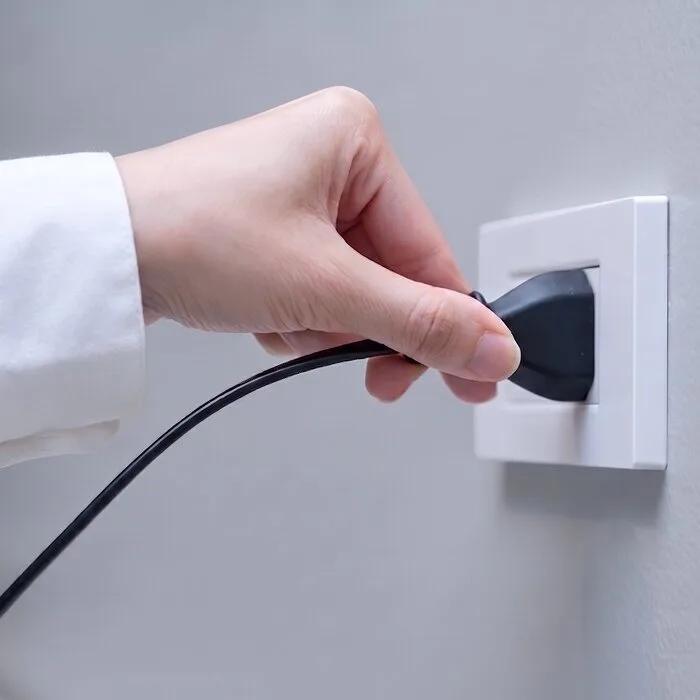
- Turn the unit off and unplug it.
- Pull the filter and rinse it under cool water. Let it dry.
- Empty the drain pan and clear the drain line.
- Straighten the exhaust hose and remove any loops.
- Check the window kit seal for gaps.
- Wipe the temperature sensor clean.
- Move the unit away from walls so it has 4 to 6 inches of clearance.
- Plug it back in, set it low, and let it run for 20 minutes.
- If the vent is still warm after that, you’ve hit the replacement math above.
That last step is the honest one. A clean, correctly sized, well-vented unit either cools or it doesn’t. If it doesn’t after this checklist, stop spending time and spend it once on the right machine instead.
Verdict
Nine out of ten “portable AC not cooling” complaints are airflow problems, and airflow problems are free to fix. Start with the exhaust hose, the filter, and the drain. Those three fixes resolve the majority of cases without spending a dollar.
If the unit still won’t cool, the answer is almost always sizing or age. Undersized units run forever and never win. Old units with compressor trouble cost more to repair than they’re worth. In both cases, replacement is the cheaper path, and the no-hose units I tested remove the failure modes that sent you here in the first place.
Common Questions & Answers
Q: Why is my portable AC running but not blowing cold air?
Most cases trace back to airflow. The exhaust hose is kinked or too long, the filter is clogged, the drain is blocked, or the thermostat is set above room temperature. Check the free fixes first: straighten the exhaust hose, clean the filter, and confirm the unit is in Cool mode with the target below the room's temperature. If those are fine, the unit may be undersized for the room or the compressor may be failing.
Q: Why is my portable AC blowing warm air?
Warm air from a running portable AC usually means the exhaust loop is broken. If the hot exhaust air vents back into the same room instead of outside, the unit recirculates heat and the vent blows warm. A dirty filter or a clogged drain that trips the compressor can also cause lukewarm air.
Q: How do I fix a portable AC that is not cooling?
Work through the cheap fixes in order: straighten the exhaust hose and keep it short, rinse the air filter, clear the drain pan, and verify the mode and target temperature. If none of those help, measure the room against the unit's BTU rating. A unit that is too small for the space will run nonstop and never catch up.
Q: Does the exhaust hose need to go out a window?
Yes, for a compressor-based portable AC. The exhaust hose dumps the heat the unit pulls out of the room, and that heat has to leave the space. Venting it into the same room creates an exhaust loop where the unit cools nothing. The hose should route through the window kit to the outside, with the gap sealed.
Q: How long should a portable AC exhaust hose be?
As short as possible. Extended or coiled hoses restrict airflow and make the unit work harder, which drops cooling output. If the hose is too long for your window setup, reposition the unit or use a shorter hose that still reaches, and never let the hose fold back on itself.
Q: Why does my portable AC cool but the room stays warm?
That is usually a sizing problem. A unit with too few BTU for the square footage runs continuously but never removes enough heat. You also need the door and windows closed so cooled air does not escape. Roughly 20 BTU per square foot is the standard starting point for sizing.
Q: Can a dirty filter cause a portable AC to stop cooling?
Yes. A clogged filter restricts airflow across the evaporator coil, so the coil cannot absorb heat and the vent blows warm. Rinse the filter under cool water, let it dry completely, and reinstall it. Under heavy daily use, clean it every two weeks.
Q: Why does my portable AC turn on and off by itself?
Short cycling usually means the compressor is overheating, the unit is low on refrigerant, or the temperature sensor is reading wrong. A dirty filter that restricts airflow can also trip thermal protection. If it keeps cycling after a full clean and a straight exhaust hose, the compressor may be failing.
Q: Should I recharge the portable AC refrigerant myself?
No. Portable AC refrigerant work requires a licensed technician, and the small sealed systems in portable units are rarely worth servicing. If the unit is blowing warm air, low on refrigerant, and out of warranty, the repair cost usually beats replacement value.
Q: When should I replace my portable AC instead of repairing it?
Replace it when the compressor fails, the unit is eight or more years old, or the repair quote approaches half the price of a new unit. On the flip side, a no-hose evaporative or heat-exchange unit avoids the exhaust hose, drain, and compressor failure modes entirely, which is why we tested both before writing this.
More Smart Home Articles
Related Product Reviews

Smart home enthusiast and IoT specialist. Has automated over 50 homes across different ecosystems. Former smart home consultant for Google Nest and Amazon Alexa. Passionate about making technology accessible.