
In This Article
- TL;DR
- What Actually Matters When Buying a Portable Inflator
- Airmoto vs Auto Air: The Head-to-Head Comparison
- Speed: Top-Offs and From-Flat
- Battery Life: Where Auto Air Pulls Ahead
- Size and Portability
- Gauge Accuracy: Opposite Directions, Same Fix
- Features: LED, Deflate, and the Extras
- Price and Checkout: The Hidden Difference
- Build Quality
- Comparison Table
- Who Should Buy Which
- One Thing Both Inflators Get Right
- Verdict
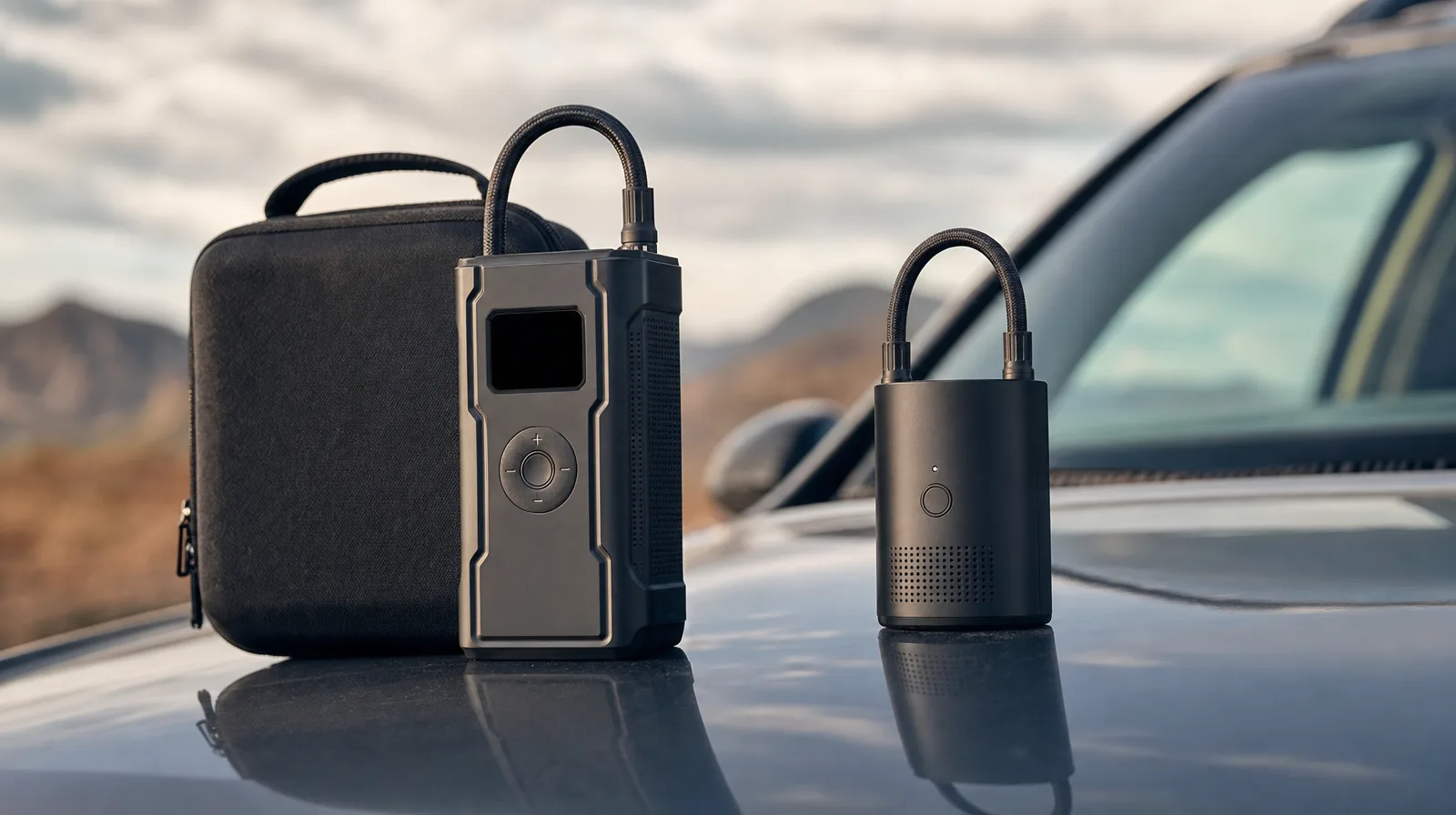
Two portable tire inflators keep showing up in every “best cordless pump” list: Airmoto and Auto Air. They look similar, they cost about the same, and they both promise to kill the gas station air pump for good. But they are not the same product, and the differences matter more than the spec sheets suggest.
I tested the Airmoto for four weeks and the Auto Air for three. I timed every fill, checked every gauge, and tracked battery drain across car tires, bike tires, and basketballs. The results surprised me in a few places, especially around checkout, battery capacity, and gauge direction. Here is the head-to-head breakdown with real numbers so you can pick the right one and move on.
TL;DR
- Auto Air wins on battery and price. The 4000mAh cell lasts roughly twice as long, and the current price sits around $30-40 versus $59 for Airmoto.
- Airmoto wins on accessories and extras. It includes a carrying case, a brighter LED light, and a deflate mode for bleeding air back out.
- Neither wins on from-flat speed. Both take 15-25 minutes to fill a completely flat car tire. Top-offs of 5-10 PSI finish in 3-7 minutes on either unit.
- Checkout is the real difference. Airmoto pushes a recurring VIP membership at checkout. Auto Air does not.
- Gauges read in opposite directions. Airmoto reads 1-2 PSI low. Auto Air reads 1-3 PSI high. Both need a small mental adjustment.
- Best value: Auto Air if you want the simplest, cheapest buy. Airmoto if you want the carrying case and LED light and don’t mind declining the subscription.
What Actually Matters When Buying a Portable Inflator
Before diving into the head-to-head, here are the five factors that decide whether a portable inflator is worth your money:
-
Top-off speed. This is the task you will actually use it for. Adding 5-10 PSI to a low tire at 6 a.m. before work. If it takes more than 7 minutes, the gas station starts looking tempting again.
-
Battery capacity. Measured in mAh, this determines how many tires you can fill before the unit dies. A 2000mAh battery handles about one from-flat car tire. A 4000mAh battery gets you two to three.
-
Gauge accuracy. Every portable gauge drifts a little. What matters is whether the drift is predictable and in a consistent direction. A gauge that always reads 2 PSI high is easy to correct. One that bounces around is not.
-
Price and checkout. The sticker price is not always the real price. Some brands add subscriptions, memberships, or add-ons at checkout that inflate your total. Factor those in.
-
Accessories and extras. Carrying case, LED light, deflate mode, hose storage. These sound minor until you are fumbling in the dark on a shoulder at 11 p.m. with no case to find the adapters in.
Our portable tire inflator buying guide breaks down each of these factors in more depth. For a model-by-model comparison of every option on this list, see our best portable tire inflators of 2026 roundup. For a guide to choosing the right size and type for your vehicle, see our how to choose the right tire inflator guide. For a wider look at every option in this category, our best portable tire inflators of 2026 roundup covers the full field.
Airmoto vs Auto Air: The Head-to-Head Comparison
Speed: Top-Offs and From-Flat
For everyday top-offs, both inflators feel similar. Airmoto adds 8-10 PSI to a sedan tire in about 5-7 minutes. Auto Air does the same job in 3-5 minutes. The difference is small enough that you will not notice it in real life.
From flat, the story changes. Airmoto took 15-26 minutes to bring a completely flat sedan tire to pressure in my testing. Auto Air clocked in at 15-20 minutes for the same task. Both are slow compared to a 12V compressor that plugs into your cigarette lighter. But that is the trade-off for going cordless.
Bike tires are fast on both. Airmoto hits 60 PSI on a road bike in about 2-3 minutes. Auto Air does it in roughly the same window. Basketballs take under a minute on either unit.
Neither inflator will win a race against a shop compressor. But for the driveway top-off that keeps your tires at the right pressure and your fuel economy from tanking, both get the job done.
Battery Life: Where Auto Air Pulls Ahead
This is where the specs matter. Airmoto runs a 2000mAh lithium-ion battery. Auto Air packs 4000mAh, double the capacity.
In practice, that means Airmoto handles about one from-flat car tire per full charge, or roughly four routine top-offs before it needs the USB-C cable. Auto Air manages two to three from-flat fills on a single charge, or about six to eight top-offs.
Both take 2-3 hours to recharge from empty. Both charge over USB-C, which means you can top them up from a car port, a power bank, or a wall adapter.
The battery gap matters most if you are inflating multiple tires in one session. If you routinely check all four tires once a month and each one needs a few PSI, both units handle it easily. If you are recovering from a flat on a Sunday morning and your spouse’s car also has a low tire, Auto Air has the headroom to cover both without making you wait for a recharge.
Cold weather knocks battery performance down on both units. That is a lithium-ion trait, not a brand flaw. Charge fully before winter trips and keep the unit warm in the cabin until you need it.
Size and Portability
Airmoto measures 2.4 by 1.6 by 6.1 inches and weighs 1.25 pounds. Auto Air is slightly smaller at roughly 4.3 inches tall and lighter at 0.77 pounds.
Both fit in a glove box. Both disappear into a trunk organizer. The size difference is real but marginal, and you will not notice it unless you hold them side by side.
Airmoto stores its hose inside a compartment on the bottom, released by a small button. Auto Air’s hose connects externally. The internal storage on Airmoto is a cleaner design, though the hose itself is short and can dangle awkwardly on some valve positions.
If pocket size and light weight are your top priorities, Auto Air edges ahead. If you prefer the hose tucked away neatly, Airmoto’s design wins that point.
Gauge Accuracy: Opposite Directions, Same Fix
Here is something the marketing never tells you. Airmoto’s gauge consistently reads 1-2 PSI low compared to a standalone digital gauge. Auto Air’s reads 1-3 PSI high. Both drift in a predictable direction, which is the good news.
For Airmoto, the fix is simple: set your target 0.5-1 PSI above the number you actually want. For Auto Air, set it 1-2 PSI below your target.
Neither gauge is a precision instrument. For a complete guide to finding the right PSI for your car, see our how much PSI does your car tire need article. If you need exact pressure for track days or performance driving, use either inflator for the bulk fill and finish with a trusted standalone gauge. For everyday maintenance and emergency roadside use, both are close enough to keep you in the safe range.
Heat affects both gauges. After a long from-flat fill where the pump gets warm, readings drift toward the edges of their variance. Let the pump cool for 5 minutes between fills and you will get tighter readings.
Features: LED, Deflate, and the Extras
Airmoto includes a built-in LED light at the top of the unit. It is bright enough to find the valve stem and thread the hose in the dark, and it runs independently of the pump. For roadside work at night, it makes a real difference.
Auto Air also has an LED light, though it is less bright. It handles the basics but does not illuminate the area as well.
Airmoto includes a deflate mode for bleeding air back out of a tire. Handy for fine-tuning bike pressure or deflating pool toys after summer. Auto Air does not have this feature.
Both come with Schrader, Presta, needle, and general adapters. Both handle car tires, bikes, sports balls, and inflatables. The adapter kits are functionally identical.
Airmoto includes a carrying bag at the base price. Auto Air does not. If you care about protecting the unit during trunk storage alongside jumper cables and tools, budget $5-10 for a small padded pouch with Auto Air.
Auto Air can run while plugged in, so a dead battery does not strand you mid-fill. Airmoto cannot operate while charging. You charge it first, then use it cordless.
For more cordless inflator options, our Airmoto vs Fanttik comparison and Airmoto vs AstroAI comparison cover other popular models.
Price and Checkout: The Hidden Difference
Airmoto lists around $59-79 with promo pricing frequently showing $59. The base price includes the unit, hose, four adapters, carrying bag, USB-C cable, and manual.
Auto Air is currently priced around $30-40, which undercuts Airmoto significantly. The package includes the unit, hose, adapters, and USB-C cable. No carrying case.
But the real price story is the checkout experience. Airmoto’s checkout flow pushes a recurring “VIP Customer Benefits” membership that many buyers say they never agreed to. It appears as a pre-checked add-on, and buyers who miss it see monthly charges on their card. Multiple Trustpilot reviewers confirm refunds were issued when they pushed back, but the friction is real.
Auto Air has no subscription, no membership, and no recurring charges. You pay once, you get the pump, done.
For buyers who want the simplest possible purchase with zero checkout vigilance, Auto Air wins this category by a wide margin. For buyers who want the carrying case and accessories Airmoto includes and are willing to uncheck a box to get them, the math still works out, but it requires paying attention.
Build Quality
Both units use ABS plastic housing with a matte finish. Neither feels premium, but neither feels like it will crack if you set it down firmly.
Airmoto held up across four weeks of being tossed in and out of a glove box, trunk, and backpack. The hose connector threaded smoothly and the adapters stayed snug. Multiple owners report units lasting two to three years with normal care.
Auto Air survived three weeks of trunk storage and repeated use without structural issues, though the plastic picked up surface scratches quickly. There is no rubberized armor or IP rating on either unit.
The honest assessment: both are consumer-grade gadgets, not shop tools. They will last for years of casual use if you charge them monthly and store them reasonably. Neither is built for a contractor’s truck.
Comparison Table
| Feature | Airmoto | Auto Air |
|---|---|---|
| Current Price | ~$59 (promo) | ~$30-40 |
| Battery | 2000mAh | 4000mAh |
| Max PSI | 120 | 150 |
| Weight | 1.25 lb | 0.77 lb |
| Height | 6.1 inches | 4.3 inches |
| Top-Off Time (car) | 5-7 min | 3-5 min |
| From-Flat Time (car) | 15-26 min | 15-20 min |
| Gauge Direction | Reads 1-2 PSI low | Reads 1-3 PSI high |
| LED Light | Yes (brighter) | Yes |
| Deflate Mode | Yes | No |
| Carrying Case | Yes (included) | No |
| Run While Charging | No | Yes |
| Subscription at Checkout | Yes (VIP, can decline) | No |
| Warranty | 1-year + 90-day money-back | 90-day money-back |
If you want the full picture on whether either model is worth the money, our is Airmoto worth it analysis breaks down the value math.
Who Should Buy Which
Pick Auto Air if:
- You want the cheapest price with the biggest battery and no subscription hassle.
- You inflate multiple tires regularly and need the extra battery capacity.
- You value a no-surprises checkout with no recurring charges.
- You do not mind buying a $5 padded case for trunk storage.
- You want the option to run the pump while it is plugged in.
Pick Airmoto if:
- You want the carrying case included so adapters do not vanish into the glove box abyss.
- The brighter LED light matters for nighttime roadside fills.
- Deflate mode is useful for your bike tires or inflatables.
- You are comfortable declining the VIP membership at checkout.
- You prefer the larger review community and more owner feedback available online.
Skip both if:
- You need to fill large truck, RV, or trailer tires. A 12V compressor or a larger battery unit like the Milwaukee M18 is the honest pick.
- You need precision PSI readings for performance driving. Both gauges drift enough that you will want a standalone gauge for verification.
- You expect shop-compressor speed. From flat, these are 15-25 minute jobs, not 5-minute miracles.
For a broader look at what matters when choosing, our smart gadgets category covers the latest tested gear in this space.
One Thing Both Inflators Get Right
Under-inflated tires wear faster, grip worse in emergencies, and burn more fuel. The U.S. Department of Energy notes that keeping tires at the right pressure is one of the simplest ways to protect both your mileage and your tire life.
Both Airmoto and Auto Air solve the real problem, which is not filling a flat from zero. It is making the monthly pressure check so easy that you actually do it. A cordless inflator that lives in your car removes every excuse: no gas station trip, no quarters, no wrestling with a stiff hose at a crowded pump. You check the pressure in your driveway, add a few PSI if needed, and move on with your day.
That habit alone is worth more than either product costs.
Verdict
Auto Air is the better value for most buyers. The 4000mAh battery gives you more fills per charge, the price is lower, and the checkout has no subscription trap. For everyday drivers who want a cordless backup for seasonal pressure drops and minor emergencies, Auto Air covers the basics without complications.
Airmoto is the better-equipped option if you want the extras. The carrying case, brighter LED, and deflate mode add real convenience, especially for cyclists and drivers who inflate in the dark. You just have to remember to uncheck the VIP box at checkout, every time.
Either way, you are getting a cordless inflator that handles top-offs in minutes and keeps you off the gas station air pump for good. Keep it charged monthly, carry a standalone gauge for verification, and treat it as the emergency tool it is. That is the real win.
Common Questions & Answers
Q: Which is better, Airmoto or Auto Air?
It depends on your priorities. Auto Air wins on battery capacity (4000mAh vs 2000mAh), max PSI (150 vs 120), and price ($30-40 vs $59). Airmoto wins on included accessories (carrying case, LED light, deflate mode) and has a larger review community. Both handle top-offs in 3-7 minutes and from-flat fills in 15-25 minutes.
Q: Does Auto Air have a subscription like Airmoto?
No. Auto Air does not add a recurring VIP membership at checkout. Airmoto's checkout flow pushes a VIP Customer Benefits subscription that many buyers report never agreeing to. You can decline it, but Auto Air avoids the hassle entirely.
Q: How long does it take each inflator to fill a flat car tire?
Airmoto takes about 15-26 minutes from flat on a sedan. Auto Air takes about 15-20 minutes. Both are slow from flat compared to a 12V compressor. For top-offs of 5-10 PSI, both finish in 3-7 minutes.
Q: Which inflator has better battery life?
Auto Air's 4000mAh battery lasts roughly twice as long as Airmoto's 2000mAh cell. Auto Air can handle 2-3 from-flat fills per charge. Airmoto manages about one from-flat fill or four routine top-offs before needing a recharge.
Q: Is the gauge accurate on both inflators?
Both read within 1-3 PSI of a standalone digital gauge, but in opposite directions. Airmoto reads 1-2 PSI low (set your target slightly higher). Auto Air reads 1-3 PSI high (set your target slightly lower). Neither is a precision instrument, but both are close enough for everyday maintenance.
Q: Can either inflator handle truck or RV tires?
Neither is ideal for large truck, RV, or trailer tires. Airmoto maxes out at 120 PSI and Auto Air at 150 PSI, but the real limitation is air volume and battery life. From-flat fills on large tires will drain the battery and test your patience. A 12V compressor is the better pick for heavy-duty tires.
Q: Which comes with a carrying case?
Airmoto includes a carrying bag at the base price. Auto Air does not include a case. Budget $5-10 for a small padded pouch if you buy Auto Air, especially for trunk storage.
Q: Do both work while charging?
Auto Air can run while plugged into a car USB port or power bank, so a dead battery doesn't strand you mid-fill. Airmoto cannot run while charging. You have to charge it first, then use it cordless.
Q: What adapters do they include?
Both come with Schrader, Presta, needle, and general adapters. They handle car tires, bike tires, sports balls, and basic inflatables. Airmoto also stores its hose internally in a compartment on the bottom.
Q: Which inflator should I buy?
If you want the cheapest price and the biggest battery with no subscription hassle, get Auto Air. If you want a carrying case, built-in LED light, deflate mode, and a larger community of owners to reference, get Airmoto and decline the VIP at checkout.
More Smart Gadgets Articles
Related Product Reviews


Consumer electronics reviewer specializing in smart gadgets and everyday tech. Tests 100+ gadgets annually. Previously wrote for The Verge and Wired. Focus on practical daily-use value.